Table of Contents
BAMS Full Form, Course Details, Fees, Duration & Top Colleges in India 2026
Ayurveda is having its moment. In a world increasingly interested in natural healing, holistic wellness, and traditional medicine systems, BAMS has emerged as one of India’s most respected and career-rich medical degrees. And if you’re a Class 12 student with Biology wondering whether BAMS is the right path — you’re asking exactly the right question.
This complete guide covers everything: BAMS full form, what BAMS actually is, eligibility, course details, fees, duration, top colleges, and career scope — all in one place, without the confusion.
Quick Snapshot: BAMS Course 2026
| Feature | Details |
|---|---|
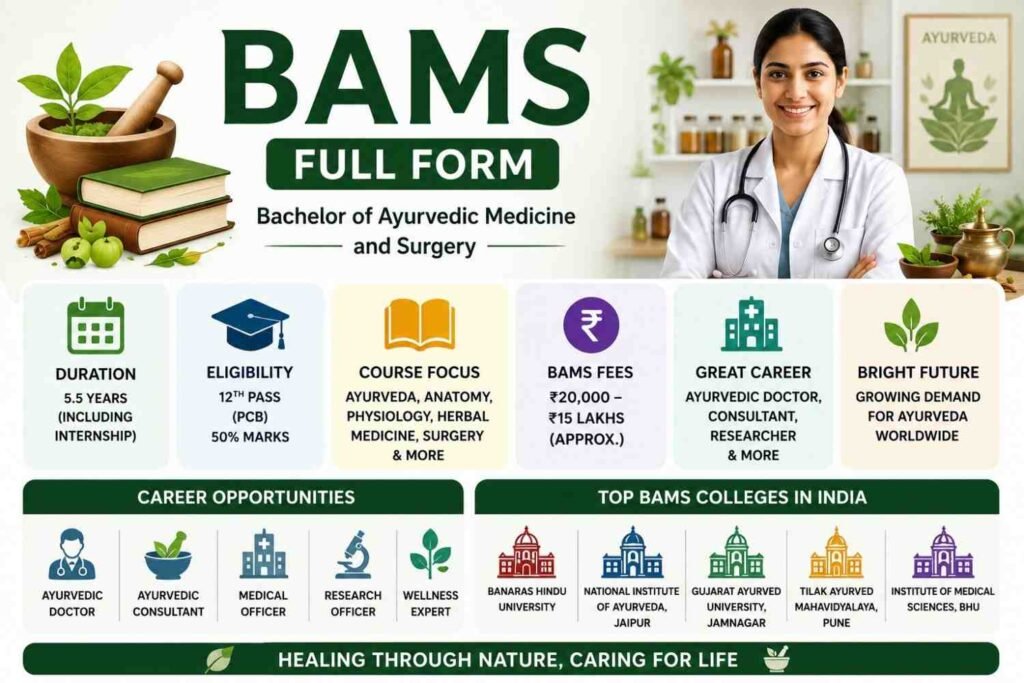
| BAMS Full Form | Bachelor of Ayurvedic Medicine and Surgery |
| Duration | 5.5 Years (4.5 Years + 1 Year Internship) |
| Level | Undergraduate Professional Medical Degree |
| Regulatory Body | CCIM (Central Council of Indian Medicine) + NMC |
| Key Entrance Exam | NEET UG (Mandatory) |
| Eligibility | Class 12 with PCB; minimum 50% |
| Average BAMS Fees | INR 50,000 – 2.50 Lakh/year |
| Average Starting Salary | INR 3 – 8 LPA |
| Senior Doctor Salary | INR 12 – 30+ LPA |
| Total BAMS Colleges in India | 400+ (CCIM approved) |
1. BAMS Full Form: What Does BAMS Stand For?
BAMS Full Form = Bachelor of Ayurvedic Medicine and Surgery
BAMS full form is Bachelor of Ayurvedic Medicine and Surgery. It is a professional undergraduate medical degree in the Indian traditional medicine system of Ayurveda — one of the world’s oldest and most comprehensive systems of natural healing.
Breaking down the BAMS full form:
- B = Bachelor (undergraduate level)
- A = Ayurvedic (Ayurveda-based medicine system)
- M = Medicine (clinical medical knowledge)
- S = Surgery (basic surgical training included)
What Is BAMS?
BAMS is a 5.5-year professional degree — 4.5 years of academic study followed by a mandatory 1-year internship (rotating between clinical departments). It is recognized by the Central Council of Indian Medicine (CCIM) and is equivalent in status to MBBS within the AYUSH (Ayurveda, Yoga, Unani, Siddha, Homeopathy) framework.
A BAMS graduate is a registered Ayurvedic physician — legally entitled to practice medicine, prescribe Ayurvedic treatments, and run a clinic across India and several international countries.
2. What Is BAMS? — Understanding Ayurveda and This Degree
The Science of Ayurveda
Ayurveda (from Sanskrit: Ayur = Life, Veda = Knowledge) is India’s 5,000-year-old system of natural medicine. Unlike modern allopathy, which primarily treats disease after it occurs, Ayurveda focuses on:
- Prevention through lifestyle, diet, and daily routines (Dinacharya)
- Treatment using herbs, minerals, oils, and holistic therapies
- Balance of three doshas (Vata, Pitta, Kapha) that govern body functions
- Panchakarma — detoxification therapies that are now globally sought after
- Rasayana — rejuvenation therapies for longevity and vitality
Why BAMS Is More Relevant Than Ever in 2026
India’s AYUSH industry is worth over INR 1.5 Lakh Crore (USD 18 billion) and growing at 15%+ annually. Global interest in Ayurveda, yoga, and natural wellness has never been higher. BAMS graduates are finding opportunities not just in traditional practice but in:
- Corporate wellness programmes
- International Ayurveda clinics (UAE, Germany, UK, USA)
- Pharmaceutical research and product development
- Government health departments (National AYUSH Mission)
- Teaching and research at AYUSH universities
3. BAMS Eligibility: Who Can Apply?
Eligibility for BAMS 2026
- Class 12 (10+2) passed from a recognized board
- Compulsory subjects: Physics, Chemistry, Biology (PCB)
- Minimum marks: 50% aggregate in PCB (45% for SC/ST/OBC in reserved category seats)
- Age: Minimum 17 years as of December 31 of the admission year
- NEET UG qualification is mandatory — NEET score is the sole criterion for all BAMS admissions (government and private)
Can PCM Students Apply for BAMS?
No. BAMS requires Biology as a compulsory subject in Class 12. PCM students (without Biology) are not eligible for BAMS admission.
NEET Requirement for BAMS
Since 2020, NEET UG is mandatory for all BAMS admissions across India — government and private colleges alike. There is no state-level separate entrance exam for BAMS anymore.
NEET Cutoff for BAMS (Approximate):
| Category | NEET Percentile | Approx. NEET Score |
|---|---|---|
| General | 50th percentile | 140+ marks |
| SC/ST/OBC | 40th percentile | 107+ marks |
Top government BAMS colleges may require NEET scores of 400–500+. Private colleges are accessible at lower scores but vary by state.
4. BAMS Course Details: Structure and Duration
BAMS Duration: 5.5 Years Total
| Phase | Duration |
|---|---|
| Professional Academic Course | 4.5 Years (9 Semesters of 6 months each) |
| Compulsory Rotating Internship | 1 Year |
| Total BAMS Duration | 5.5 Years |
BAMS Professional Examinations
The 4.5 academic years are divided into 4 Professional Examinations (BAMS Parts):
| Professional Exam | Duration | Subjects Covered |
|---|---|---|
| 1st Professional (Part I) | 1.5 Years | Padarth Vigyan, Sanskrit, Rachna Sharira, Kriya Sharira |
| 2nd Professional (Part II) | 1 Year | Dravyaguna, Rasa Shastra, Charaka Samhita (Purvardha) |
| 3rd Professional (Part III) | 1 Year | Agad Tantra, Swasthavritta, Prasuti Tantra, Roga Nidana |
| 4th Professional (Part IV) | 1 Year | Kaya Chikitsa, Shalya Tantra, Shalakya Tantra, Panchkarma |
| Internship | 1 Year | Rotating clinical departments |
5. BAMS Course Details: Subjects Covered
BAMS is a comprehensive programme covering both Ayurvedic classical texts and modern biomedical sciences. Here’s what you’ll study:
Core Ayurvedic Subjects
| Subject | What It Covers |
|---|---|
| Padarth Vigyan | Fundamental Ayurvedic philosophy; Tridosha theory; Panchamahabhuta |
| Rachna Sharira | Ayurvedic anatomy; body structure from the Ayurvedic perspective |
| Kriya Sharira | Ayurvedic physiology; how the body functions |
| Dravyaguna Vigyan | Pharmacology of herbs; 700+ medicinal plants, their properties and uses |
| Rasa Shastra | Ayurvedic pharmacy; preparation of medicines from minerals, metals, plants |
| Charaka Samhita | Study of the ancient Charaka Samhita text (foundational Ayurvedic treatise) |
| Sushruta Samhita | Study of Sushruta’s surgical texts (the world’s first surgical manual) |
| Kaya Chikitsa | Internal medicine; diagnosis and treatment of diseases |
| Shalya Tantra | Surgery; Ayurvedic surgical principles and modern surgical concepts |
| Shalakya Tantra | ENT (Ear, Nose, Throat) and Ophthalmology |
| Prasuti Tantra | Obstetrics and Gynaecology; Ayurvedic approach to maternal health |
| Kaumar Bhritya | Paediatrics; child healthcare |
| Panchkarma | Detoxification and rejuvenation therapies (Vamana, Virechana, Basti, Nasya, Raktamokshana) |
| Agad Tantra | Toxicology; Forensic Medicine |
| Swasthavritta | Preventive and social medicine; Dinacharya, Ritucharya, Yoga |
Modern (Biomedical) Subjects Also Taught in BAMS
| Modern Subject | Why It’s Included |
|---|---|
| Anatomy (modern) | Dissection and modern anatomical knowledge |
| Physiology | Understanding body functions scientifically |
| Biochemistry | Cellular chemistry; drug metabolism |
| Pathology | Disease mechanisms; lab diagnostics |
| Microbiology | Infection, bacteria, viruses |
| Pharmacology | Modern drug actions alongside Ayurvedic pharmacology |
| Community Medicine | Public health, epidemiology |
This integration of classical Ayurvedic texts with modern biomedical sciences makes BAMS graduates uniquely versatile — they understand both traditions.
6. BAMS Fees: Complete Breakdown
Government BAMS Colleges
| College Type | Annual Fee |
|---|---|
| Central Government AYUSH Colleges | INR 10,000 – 50,000 |
| State Government BAMS Colleges | INR 15,000 – 80,000 |
| Government-Aided Autonomous | INR 30,000 – 1.00 Lakh |
Private BAMS Colleges
| College Tier | Annual Fee |
|---|---|
| Top Private Colleges (Tier 1 cities) | INR 1.50 – 2.50 Lakh |
| Mid-Tier Private Colleges | INR 80,000 – 1.80 Lakh |
| Entry-Level Private | INR 50,000 – 1.20 Lakh |
Total 5.5-Year BAMS Cost (Realistic Estimate)
| College Type | Total Cost (Tuition + Hostel + Internship) |
|---|---|
| Government College | INR 3 – 8 Lakh |
| Private College (Mid-Tier) | INR 10 – 18 Lakh |
| Private College (Top) | INR 18 – 28 Lakh |
Additional Costs to Budget For
- Books and study material: INR 10,000 – 25,000/year
- Instruments kit: INR 5,000 – 15,000 (one-time)
- Panchakarma practical consumables: INR 5,000 – 10,000/year
- Internship: Most hospitals provide a monthly stipend of INR 3,000 – 8,000 during the internship year
7. Top BAMS Colleges in India 2026
Tier 1: Premier Government Institutions
1. BHU (Banaras Hindu University) — Faculty of Ayurveda, Varanasi
- India’s most prestigious Ayurvedic faculty; part of one of India’s oldest central universities
- NEET cutoff: Very high (500+ scores for general category)
- Annual fees: INR 15,000 – 30,000
- Why Choose: Heritage, research depth, IMS BHU hospital network, Varanasi — the city of Ayurveda
2. Gujarat Ayurved University (GAU), Jamnagar
- India’s first dedicated Ayurvedic university (est. 1967)
- Jamnagar is considered the “World Capital of Ayurveda” — home to IPGT & RA (Institute for Post Graduate Teaching and Research in Ayurveda)
- Annual fees: INR 20,000 – 50,000
- Why Choose: Pioneer institution; world-class PG research; WHO Collaborating Centre for Ayurveda
3. National Institute of Ayurveda (NIA), Jaipur
- One of India’s premier autonomous government Ayurveda institutes
- Annual fees: INR 25,000 – 50,000
- Strong clinical exposure; central government institution
4. Government Ayurvedic College, Thiruvananthapuram (Kerala)
- Kerala is globally renowned for Ayurveda — this college is its most respected BAMS institution
- Annual fees: INR 10,000 – 30,000
- Kerala Ayurveda tradition (Ashtanga Hridayam focus) — unique curriculum depth
5. State Ayurvedic College and Hospital, Lucknow (UP)
- One of North India’s oldest and most respected government BAMS colleges
- Annual fees: INR 10,000 – 25,000
Tier 2: Top Private BAMS Colleges
6. DY Patil University (Ayurvedic Medical College), Pune / Navi Mumbai
- Highly regarded private Ayurveda institution with strong clinical infrastructure
- Annual fees: INR 1.50 – 2.20 Lakh
- Strong placements in corporate wellness and international Ayurveda
7. KLE University (Shri BMK Ayurvedic Medical College), Belagavi, Karnataka
- Top private Ayurveda college in Karnataka; excellent research programme
- Annual fees: INR 80,000 – 1.50 Lakh
8. BVDU (Bharati Vidyapeeth) Ayurvedic College, Pune
- Well-established private BAMS programme with hospital facility
- Annual fees: INR 1.00 – 1.80 Lakh
9. SDM College of Ayurveda, Udupi (Karnataka)
- One of Karnataka’s most respected private Ayurveda colleges
- Annual fees: INR 80,000 – 1.50 Lakh
10. JSS Ayurvedic Medical College, Mysuru
- Part of JSS University system; NAAC accredited
- Annual fees: INR 1.00 – 1.80 Lakh
State-Wise Top BAMS Colleges at a Glance
| State | Top BAMS College |
|---|---|
| Uttar Pradesh | BHU Varanasi, State Ayurvedic College Lucknow |
| Gujarat | Gujarat Ayurved University (Jamnagar) |
| Kerala | Govt. Ayurvedic College Thiruvananthapuram |
| Rajasthan | NIA Jaipur, RUHS Jaipur |
| Karnataka | SDM Udupi, KLE Belagavi, JSS Mysuru |
| Maharashtra | DY Patil Pune, BVDU Pune |
| Madhya Pradesh | Govt. Ayurvedic College Bhopal |
| Punjab/Haryana | Sri Sai Ayurvedic Medical College, Shri Krishna AYUSH University |
8. BAMS vs MBBS: Key Comparison
Many students debate between BAMS and MBBS. Here’s an honest comparison:
| Factor | BAMS | MBBS |
|---|---|---|
| Full Form | Bachelor of Ayurvedic Medicine & Surgery | Bachelor of Medicine & Bachelor of Surgery |
| Duration | 5.5 Years (4.5 + 1 yr internship) | 5.5 Years (4.5 + 1 yr internship) |
| Entrance Exam | NEET UG | NEET UG |
| NEET Cutoff | Lower (140–500+ depending on college) | Higher (500–700+ for govt. MBBS) |
| Seats Available | ~50,000+ nationwide | ~1.1 Lakh nationwide (but competition is extreme) |
| Practice Rights | Registered Ayurvedic physician | Allopathic physician |
| Starting Salary | INR 3 – 8 LPA | INR 6 – 15 LPA (higher initially) |
| International Practice | Growing acceptance (UAE, Germany, UK) | Globally recognized |
| Postgraduate Options | MD/MS Ayurveda (3 years) | MD/MS Allopathy |
| Fees (Govt.) | INR 10K – 80K/year | INR 10K – 80K/year |
| Fees (Private) | INR 50K – 2.5 Lakh/year | INR 5 – 25 Lakh/year (much higher) |
Bottom line: If MBBS was your first choice but NEET score was not high enough, BAMS is a respected, legally recognized medical career — not a consolation prize. It’s a genuinely different and increasingly valued medical tradition with its own career strengths.
9. Career After BAMS: What Are Your Options?
A BAMS degree opens diverse and growing career paths:
Clinical Practice
- Ayurvedic Doctor / Physician — Own clinic, hospital practice, government hospital
- Panchakarma Therapist — Specialized detox and rejuvenation centre management
- Naturopathy and Wellness Consultant — Integrative health clinics
Government Jobs After BAMS
BAMS graduates are eligible for multiple government positions:
- Medical Officer (AYUSH) — State and central government hospitals and dispensaries
- National Health Mission (NHM) — AYUSH doctors under NHM postings across India
- DRDO / CSIR — Herbal and natural product research
- National AYUSH Mission — Health programmes and policy implementation
- UPSC / State PSC — Medical Officer through state public service commission exams
Non-Clinical Careers
| Career Path | Description | Salary Range |
|---|---|---|
| Pharmaceutical Industry | Ayurvedic drug development, QC, regulatory | INR 5 – 15 LPA |
| Corporate Wellness | Wellness programmes for corporates (Yoga, Ayurveda) | INR 6 – 15 LPA |
| Teaching / Academia | Lecturer at BAMS college (MD Ayurveda required) | INR 6 – 15 LPA |
| International Practice | UAE, Germany, UK, Australia Ayurveda clinics | INR 15 – 40+ LPA |
| Research | CCRAS, NIA, CSIR research positions | INR 5 – 12 LPA |
| Wellness Tourism | Ayurvedic resort management, spa direction | INR 6 – 18 LPA |
Higher Education After BAMS
- MD Ayurveda (3 years) — Specialization in a specific branch (Kaya Chikitsa, Panchkarma, Dravyaguna, etc.)
- MS Ayurveda — Surgical specializations (Shalya, Shalakya)
- PhD in Ayurvedic Sciences
- MBA in Hospital Management / Healthcare Management
10. Frequently Asked Questions About BAMS
Q: What is BAMS full form? A: BAMS full form is Bachelor of Ayurvedic Medicine and Surgery — a 5.5-year professional medical degree in the Ayurvedic system of medicine.
Q: What is the duration of BAMS? A: BAMS duration is 5.5 years — 4.5 years of academic study divided into 4 professional examinations, followed by 1 year of compulsory rotating internship.
Q: Is NEET compulsory for BAMS? A: Yes. Since 2020, NEET UG is mandatory for all BAMS admissions across India — both government and private colleges. There is no separate entrance exam for BAMS.
Q: What is the BAMS fee in government colleges? A: Government BAMS college fees are very affordable — ranging from INR 10,000 to INR 80,000 per year depending on the state and institution type.
Q: Can a BAMS doctor practice allopathy? A: No. BAMS graduates are registered as Ayurvedic physicians and can prescribe Ayurvedic medicines. Some states permit BAMS doctors to prescribe a limited list of allopathic medicines — but this is a contested regulatory area. BAMS practice rights are clearly defined by the CCIM and state medical councils.
Q: Is BAMS a good career? A: Yes — especially for students passionate about Ayurveda and natural medicine. The AYUSH industry is growing rapidly, government jobs are accessible, international opportunities are expanding, and a MD Ayurveda post-BAMS offers excellent specialization depth.
Q: What is the difference between BAMS and MBBS? A: MBBS is the degree for modern allopathic medicine; BAMS is for Ayurvedic medicine. Both are 5.5-year degrees requiring NEET. MBBS has higher NEET cutoffs and significantly higher private fees. Both lead to full medical practice rights within their respective systems.
Final Verdict: Is BAMS the Right Course for You?
BAMS is the right choice if:
- You’re passionate about Ayurveda, natural healing, and holistic medicine
- Your NEET score qualifies you for a good BAMS college but not MBBS
- You want a medical career without the extreme fees of private MBBS (INR 50–80 Lakh)
- You’re interested in international wellness or pharmaceutical research careers
- You believe in the long-term potential of India’s AYUSH sector
Here’s your BAMS action plan:
- Prepare seriously for NEET — higher score = better college, including government options
- Target government BAMS colleges first (BHU, GAU Jamnagar, NIA Jaipur, Kerala)
- Research state counselling — most BAMS admissions happen through state NEET counselling for AYUSH seats
- Plan for MD Ayurveda after BAMS if research or specialization interests you
Ayurveda is ancient wisdom meeting modern demand. A BAMS degree puts you at the heart of one of the world’s fastest-growing wellness industries.
Heal the world — the Ayurvedic way. 🌿