
AQI Full Form: Meaning, Importance, Categories, and Impact on Health
Have you ever checked the weather app and noticed a number labeled AQI? You may have seen news reports discussing AQI levels, especially during winter or in highly populated cities. AQI is an important indicator that helps us understand the quality of the air we breathe every day.
For students, understanding the AQI full form, its significance, and how it affects health is important because it is frequently asked in school exams, competitive exams, and general knowledge quizzes.
In this comprehensive guide, we will explore the meaning of AQI, how it is measured, its categories, health impacts, and ways to improve air quality.
AQI Full Form
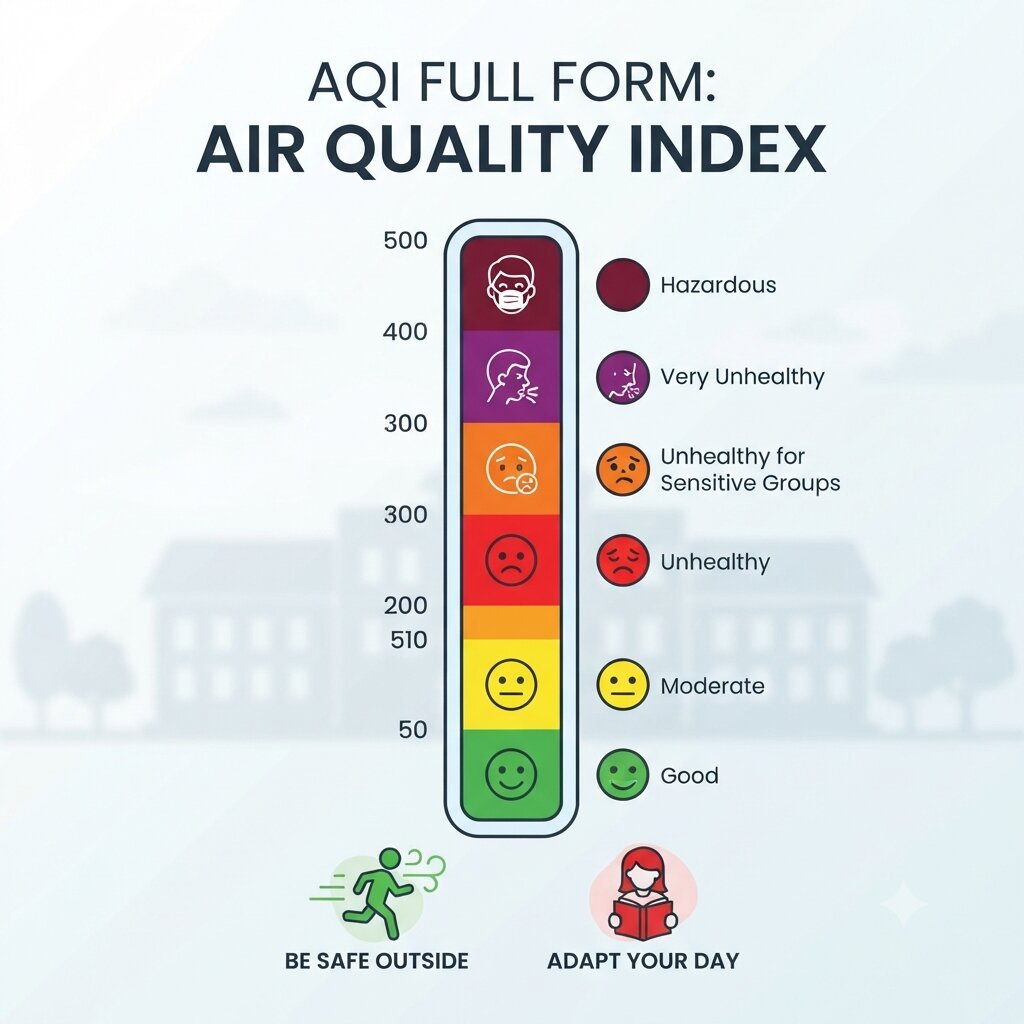
The AQI full form is Air Quality Index.
It is a numerical scale used to measure and report the quality of air in a particular area. AQI helps people understand whether the air around them is clean, moderately polluted, or hazardous to health.
| Abbreviation | Full Form |
|---|---|
| AQI | Air Quality Index |
What Is AQI?
AQI (Air Quality Index) is a system that measures the concentration of various air pollutants and converts them into a single number that represents overall air quality.
The higher the AQI value, the more polluted the air is and the greater the potential health risk.
AQI serves as a simple tool that allows the public to understand air pollution levels without needing detailed scientific knowledge.
Why Is AQI Important?
Air pollution is a major environmental challenge affecting millions of people worldwide.
AQI is important because it:
Provides information about air quality.
Helps people take preventive measures.
Raises awareness about pollution.
Assists governments in monitoring environmental conditions.
Protects vulnerable groups such as children and elderly people.
Encourages pollution control measures.
By checking AQI regularly, individuals can make informed decisions about outdoor activities.
History of AQI
Various countries have developed air quality monitoring systems over the years to address growing pollution concerns.
India introduced the National Air Quality Index (NAQI) in 2014 to provide a standardized method of reporting air quality across the country.
The system allows citizens to easily understand pollution levels and their possible health effects.
How Does AQI Work?
AQI is calculated using the concentration of different air pollutants measured by monitoring stations.
These pollutants include:
PM2.5 (Fine particulate matter)
PM10 (Coarse particulate matter)
Nitrogen dioxide (NO₂)
Sulfur dioxide (SO₂)
Carbon monoxide (CO)
Ozone (O₃)
Ammonia (NH₃)
Lead (Pb)
The pollutant with the highest impact determines the AQI value reported for that location.
Major Pollutants Used in AQI Calculation
1. PM2.5
PM2.5 refers to extremely small particles suspended in the air.
Sources
Vehicle emissions
Industrial activities
Burning of fuels
Construction work
These particles can enter deep into the lungs and bloodstream.
2. PM10
PM10 consists of larger particles such as dust, smoke, and pollen.
Sources
Road dust
Construction sites
Industrial processes
3. Nitrogen Dioxide (NO₂)
NO₂ is produced mainly from vehicle exhaust and industrial emissions.
Health Effects
Breathing problems
Lung irritation
Reduced respiratory function
4. Sulfur Dioxide (SO₂)
SO₂ is released when fossil fuels are burned.
Sources
Power plants
Factories
Industrial facilities
5. Carbon Monoxide (CO)
CO is a colorless and odorless gas.
Sources
Motor vehicles
Fuel combustion
Industrial processes
6. Ozone (O₃)
Ground-level ozone forms when pollutants react in sunlight.
Effects
Breathing difficulties
Eye irritation
Reduced lung function
AQI Categories
AQI values are divided into categories that indicate different levels of air quality.
AQI Scale in India
| AQI Range | Category | Air Quality |
|---|---|---|
| 0–50 | Good | Clean air |
| 51–100 | Satisfactory | Minor impact |
| 101–200 | Moderate | Breathing discomfort for sensitive groups |
| 201–300 | Poor | Health effects possible |
| 301–400 | Very Poor | Respiratory illness risk |
| 401–500 | Severe | Serious health effects |
These categories help people understand the severity of pollution levels.
AQI Color Codes
AQI systems often use colors for easier understanding.
| Color | AQI Category |
|---|---|
| Green | Good |
| Light Green | Satisfactory |
| Yellow | Moderate |
| Orange | Poor |
| Red | Very Poor |
| Dark Red/Maroon | Severe |
These color indicators are commonly displayed on air quality apps and websites.
Health Effects of High AQI
Poor air quality can affect people of all ages, especially children and older adults.
Short-Term Effects
Eye irritation
Coughing
Throat irritation
Headaches
Difficulty breathing
Long-Term Effects
Asthma
Lung diseases
Heart diseases
Reduced lung function
Increased risk of respiratory infections
Children are particularly vulnerable because their lungs are still developing.
Why Is AQI Important for Students?
Students spend significant time outdoors for school, sports, and recreational activities.
Monitoring AQI can help students:
Avoid outdoor activities during high pollution periods.
Protect their respiratory health.
Understand environmental issues.
Participate in pollution awareness campaigns.
Knowledge of AQI also supports science and environmental studies learning.
AQI and Environmental Awareness
AQI encourages people to become more environmentally responsible.
When communities understand pollution levels, they are more likely to:
Reduce vehicle use.
Use public transport.
Plant trees.
Save energy.
Support environmental initiatives.
This awareness contributes to cleaner and healthier cities.
Causes of Poor AQI
Several factors contribute to worsening air quality.
Vehicle Emissions
Cars, buses, and trucks release harmful pollutants into the atmosphere.
Industrial Pollution
Factories emit gases and particulate matter.
Construction Activities
Dust from construction sites increases particulate pollution.
Burning of Waste
Open burning releases toxic pollutants.
Crop Residue Burning
Agricultural burning significantly affects AQI in many regions.
Natural Factors
Dust storms and wildfires can also increase AQI levels.
How to Improve AQI?
Improving air quality requires collective efforts from individuals, communities, industries, and governments.
Use Public Transportation
Reducing vehicle usage lowers emissions.
Plant More Trees
Trees absorb pollutants and improve air quality.
Reduce Energy Consumption
Using energy efficiently reduces pollution from power generation.
Avoid Burning Waste
Proper waste disposal minimizes harmful emissions.
Promote Renewable Energy
Solar and wind energy reduce dependence on fossil fuels.
Follow Environmental Regulations
Industries should comply with pollution control standards.
AQI Monitoring in India
India has established air quality monitoring stations across major cities.
These stations continuously monitor pollutants and provide real-time AQI data.
Citizens can access AQI information through:
Government websites
Mobile applications
Weather apps
News channels
This information helps people make healthier decisions.
AQI and Climate Change
Although AQI mainly measures air pollution, there is a close relationship between pollution and climate change.
Activities that increase pollution often contribute to:
Global warming
Greenhouse gas emissions
Environmental degradation
Reducing pollution helps improve both air quality and climate conditions.
Interesting Facts About AQI
Here are some interesting facts students should know:
AQI stands for Air Quality Index.
It measures overall air pollution levels.
Higher AQI means poorer air quality.
AQI helps people understand health risks.
Children are among the most affected groups.
India launched its National Air Quality Index in 2014.
AQI is updated regularly using monitoring stations.
AQI in Competitive Exams
Questions related to AQI often appear in:
School examinations
UPSC exams
SSC exams
Banking exams
State government exams
Environmental science quizzes
Sample Question
Q. What is the AQI full form?
Answer: Air Quality Index.
Frequently Asked Questions (FAQs)
What is the AQI full form?
AQI stands for Air Quality Index.
What does AQI measure?
AQI measures the level of air pollution in a specific area.
Is a higher AQI better or worse?
A higher AQI indicates poorer air quality and greater health risks.
Which AQI range is considered good?
An AQI between 0 and 50 is considered good.
Why is AQI important?
AQI helps people understand air pollution levels and take necessary precautions.
Which pollutants are included in AQI?
AQI includes PM2.5, PM10, NO₂, SO₂, CO, O₃, NH₃, and Pb.
Conclusion
The AQI full form is Air Quality Index. It is an important tool used to measure and communicate air quality levels. AQI helps people understand pollution conditions, protect their health, and make informed decisions about outdoor activities.
For students, learning about AQI is valuable for academic studies, environmental awareness, and competitive exam preparation. As air pollution continues to be a global concern, understanding AQI empowers individuals to contribute toward cleaner air and a healthier future for everyone.