
CRM Full Form: Meaning, Uses, Benefits, and Importance for Students
If you have ever come across the term CRM and wondered what it means, you are not alone. CRM is one of the most commonly used terms in business, marketing, and customer service. Whether you are a school student, college student, or preparing for competitive exams, understanding the CRM full form and its importance can be very useful.
In this article, we will explain the meaning of CRM, how it works, its types, features, advantages, and why it is important in today’s digital world.
CRM Full Form
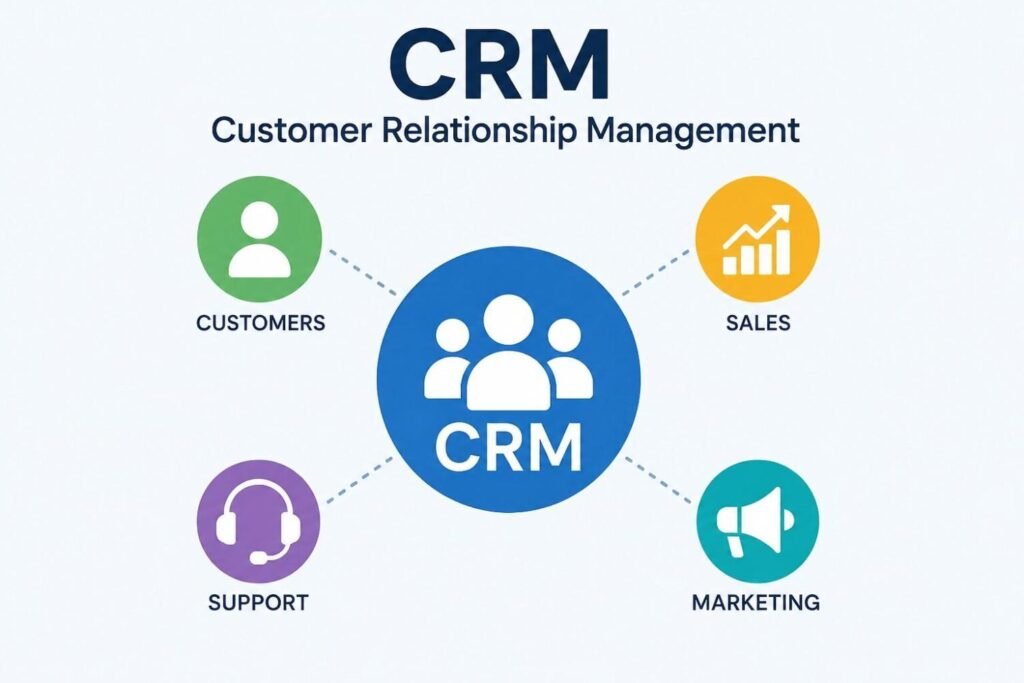
The CRM full form is Customer Relationship Management.
CRM refers to a combination of strategies, technologies, and software used by organizations to manage and improve relationships with customers. It helps businesses track customer interactions, increase sales, and provide better services.
CRM Full Form in English
| Abbreviation | Full Form |
|---|---|
| CRM | Customer Relationship Management |
What is CRM?
CRM (Customer Relationship Management) is a system that helps businesses organize customer information and manage communication effectively. It stores details such as:
Customer names
Contact numbers
Email addresses
Purchase history
Customer preferences
Previous interactions
Using CRM software, companies can understand customer needs and provide personalized services.
Definition of CRM
Customer Relationship Management (CRM) is a process that enables organizations to build strong relationships with customers by collecting, organizing, and analyzing customer data to improve sales, customer satisfaction, and business growth.
Why is CRM Important?
Customer satisfaction is the key to business success. CRM helps companies maintain strong relationships with customers and increase loyalty.
Importance of CRM
Improves customer satisfaction.
Increases sales and revenue.
Helps businesses understand customer needs.
Enhances communication.
Builds long-term relationships.
Saves time through automation.
Improves decision-making.
How Does CRM Work?
CRM software collects customer information from various channels such as:
Website visits
Emails
Phone calls
Social media platforms
Live chats
Online purchases
The software stores this information in a central database. Employees can access customer details and provide better services based on previous interactions.
Example
Suppose you buy a smartphone from an online store. The company records:
Your name
Product purchased
Contact details
Previous orders
Customer complaints
Next time you contact customer support, they can quickly access your information and assist you efficiently. This is how CRM works.
Types of CRM
CRM systems are mainly divided into three categories.
1. Operational CRM
Operational CRM focuses on automating daily business operations.
Functions
Sales automation
Marketing automation
Customer support
Benefits
Saves time
Improves efficiency
Reduces manual work
2. Analytical CRM
Analytical CRM helps companies analyze customer data and behavior.
Functions
Customer segmentation
Sales forecasting
Performance analysis
Benefits
Better business decisions
Improved marketing strategies
Increased customer satisfaction
3. Collaborative CRM
Collaborative CRM allows different departments to share customer information.
Functions
Team collaboration
Information sharing
Customer interaction management
Benefits
Better communication
Faster problem-solving
Improved customer experience
Features of CRM Software
Modern CRM software comes with several powerful features.
Contact Management
Stores customer details in one place.
Lead Management
Tracks potential customers and sales opportunities.
Sales Automation
Automates repetitive sales tasks.
Email Integration
Allows businesses to communicate directly with customers.
Customer Support
Manages complaints and queries efficiently.
Reporting and Analytics
Provides detailed reports and performance insights.
Task Management
Helps teams organize schedules and reminders.
Advantages of CRM
CRM offers numerous benefits to businesses and organizations.
Better Customer Relationships
Businesses can understand customer preferences and provide personalized services.
Increased Sales
CRM helps track leads and convert them into customers.
Improved Productivity
Automation reduces repetitive work and saves time.
Enhanced Customer Retention
Satisfied customers are more likely to return.
Better Communication
Different departments can access the same customer data.
Data Security
Customer information is stored securely.
Improved Marketing Campaigns
Businesses can target the right audience effectively.
Disadvantages of CRM
Although CRM has many advantages, it also has some limitations.
High implementation cost.
Requires employee training.
Data security concerns.
Complex setup for beginners.
Dependence on technology.
Despite these challenges, the benefits usually outweigh the drawbacks.
Popular CRM Software
Many companies around the world use CRM software to manage customer relationships.
| CRM Software | Company |
|---|---|
| Salesforce | Salesforce Inc. |
| HubSpot CRM | HubSpot |
| Zoho CRM | Zoho Corporation |
| Microsoft Dynamics 365 | Microsoft |
| Freshsales | Freshworks |
| Pipedrive | Pipedrive |
| SAP CRM | SAP |
These platforms help businesses improve customer experience and increase profitability.
Applications of CRM
CRM systems are used in various industries.
Banking
Banks use CRM to manage customer accounts and provide personalized services.
Healthcare
Hospitals maintain patient records and appointments through CRM systems.
Education
Educational institutions manage admissions and student relationships.
E-commerce
Online stores track customer orders and preferences.
Real Estate
Property dealers maintain records of buyers and sellers.
Telecommunications
Companies provide better support and manage customer complaints.
Insurance
Insurance firms use CRM to manage policies and customer interactions.
CRM in Digital Marketing
CRM plays an important role in digital marketing.
It helps marketers:
Understand customer behavior.
Segment audiences.
Run targeted campaigns.
Track customer engagement.
Improve conversion rates.
Increase customer loyalty.
With CRM tools, businesses can create personalized marketing strategies and achieve better results.
Skills Required for CRM Professionals
Students interested in CRM-related careers should develop these skills:
Communication skills
Problem-solving abilities
Customer service skills
Data analysis knowledge
Marketing understanding
Teamwork
Technical knowledge
These skills are highly valuable in today’s business environment.
Career Opportunities in CRM
Knowledge of CRM can open doors to various career options.
CRM Executive
Handles customer interactions and support.
Sales Manager
Manages sales teams and customer relationships.
Marketing Manager
Creates marketing campaigns using customer insights.
Customer Success Manager
Ensures customer satisfaction and retention.
Business Analyst
Analyzes customer data and business performance.
CRM Consultant
Helps organizations implement CRM systems effectively.
CRM Full Form in Different Fields
Although CRM commonly stands for Customer Relationship Management, its meaning can vary depending on the context.
| Field | CRM Full Form |
|---|---|
| Business | Customer Relationship Management |
| Medical | Cardiac Rhythm Management |
| Engineering | Composite Risk Management |
| Military | Composite Risk Management |
| Aviation | Crew Resource Management |
However, in business and marketing, CRM mainly refers to Customer Relationship Management.
Difference Between CRM and ERP
Many students confuse CRM with ERP.
| CRM | ERP |
|---|---|
| Focuses on customers | Focuses on business operations |
| Improves customer relationships | Manages company resources |
| Sales-oriented | Process-oriented |
| Used by sales and marketing teams | Used by all departments |
| Enhances customer experience | Enhances productivity |
Frequently Asked Questions (FAQs)
What is the CRM full form?
The CRM full form is Customer Relationship Management.
What is CRM used for?
CRM is used to manage customer relationships, improve sales, and provide better customer service.
Why is CRM important?
CRM helps businesses understand customer needs, increase customer satisfaction, and boost revenue.
Which companies use CRM software?
Companies like Salesforce, HubSpot, Microsoft, Zoho, and Freshworks provide CRM solutions.
Is CRM useful for students?
Yes. Understanding CRM helps students preparing for business, marketing, management, and competitive examinations.
Is CRM software expensive?
Some CRM tools are free, while advanced versions require paid subscriptions.
Conclusion
The CRM full form is Customer Relationship Management. CRM is a powerful technology and strategy that helps organizations manage customer interactions, improve satisfaction, and increase sales. In today’s digital age, CRM has become essential for businesses of all sizes.
For students, learning about CRM provides valuable knowledge about business operations, marketing, and customer service. As industries continue to rely on technology and data-driven decisions, understanding CRM can also open up excellent career opportunities in the future.