Table of Contents
BPT Full Form, Course Details, Fees, Duration & Top Colleges in India 2026
You love the idea of helping people recover — watching someone walk again after an injury, seeing a stroke patient regain movement, helping an athlete get back on the field after surgery. If that kind of work excites you, then BPT might be the healthcare career you’ve been looking for.
But before you commit, you deserve clear, honest answers: What is BPT? What does BPT stand for? What will you study? How much does it cost? And which colleges are actually worth attending?
This complete guide answers everything — from BPT full form to course details, fees, duration, top colleges, and career scope in 2026.
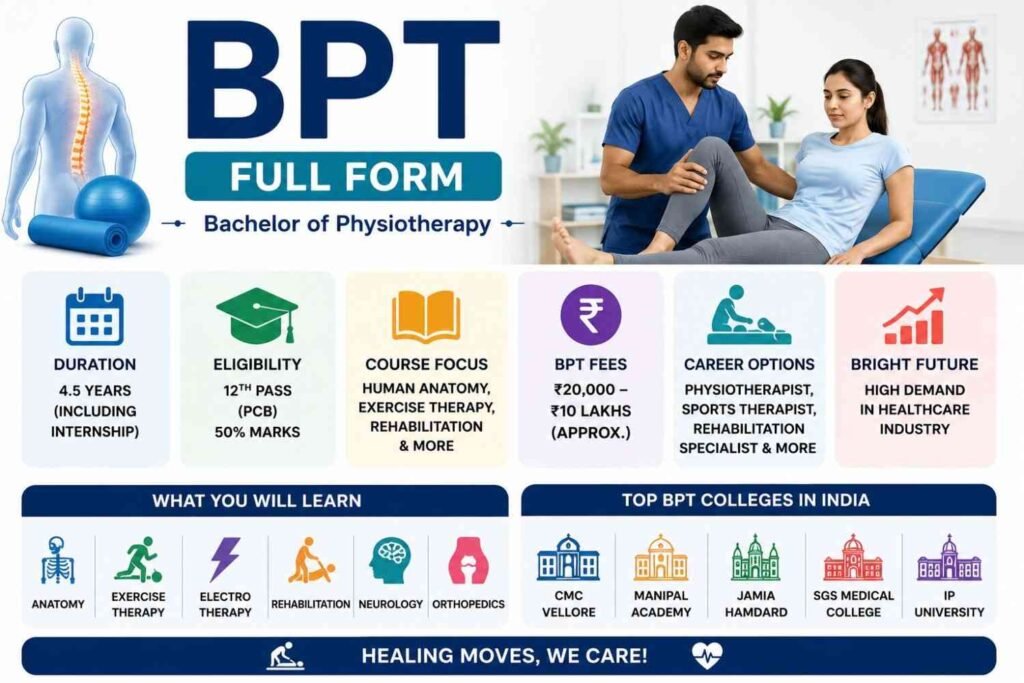
Quick Snapshot: BPT Course 2026
| Feature | Details |
|---|---|
| BPT Full Form | Bachelor of Physiotherapy |
| Duration | 4.5 Years (4 Years + 6 Months Internship) |
| Level | Undergraduate Professional Healthcare Degree |
| Regulatory Body | Indian Association of Physiotherapists (IAP) + State Medical Councils |
| Key Entrance Exams | NEET (some states), State CETs, University Tests |
| Eligibility | Class 12 with PCB; minimum 50% |
| Average BPT Fees | INR 40,000 – 2.00 Lakh/year |
| Average Starting Salary | INR 3 – 7 LPA |
| Senior Physiotherapist Salary | INR 10 – 25+ LPA |
| BPT Colleges in India | 600+ (IAP/State Council recognized) |
1. BPT Full Form: What Does BPT Stand For?
BPT Full Form = Bachelor of Physiotherapy
BPT full form is Bachelor of Physiotherapy. It is a professional undergraduate healthcare degree that trains students in the assessment, diagnosis, and physical treatment of movement disorders, injuries, disabilities, and chronic conditions affecting the human body.
Breaking down the BPT full form:
- B = Bachelor (undergraduate level)
- P = Physiotherapy
- T = Therapy (treatment-focused discipline)
What Is BPT?
BPT is a 4.5-year professional degree (4 years academic + 6 months compulsory internship) that prepares graduates to practice as licensed physiotherapists. Physiotherapy uses physical methods — exercises, manual therapy, electrotherapy, hydrotherapy, and more — to help patients recover from injuries, surgeries, neurological conditions, and chronic musculoskeletal pain.
A BPT graduate is a Physiotherapist — a healthcare professional who helps people restore movement and function when they are affected by injury, illness, or disability.
2. What Is BPT? — The Full Picture
Physiotherapy: What Physiotherapists Actually Do
Physiotherapists are movement specialists. They work with patients across all age groups and conditions:
- Sports injuries — Helping athletes recover from torn ligaments, muscle strains, fractures
- Post-surgical rehabilitation — Recovery after joint replacement, cardiac surgery, spinal surgeries
- Neurological conditions — Stroke rehabilitation, Parkinson’s disease, Multiple Sclerosis, cerebral palsy
- Musculoskeletal pain — Back pain, neck pain, arthritis, sciatica
- Cardiopulmonary rehabilitation — Helping heart and lung patients regain physical function
- Paediatric physiotherapy — Developmental delays, cerebral palsy, congenital disorders in children
- Geriatric physiotherapy — Fall prevention, mobility improvement in elderly patients
- Women’s health — Pelvic floor rehabilitation, postnatal recovery
- Workplace ergonomics — Preventing and treating occupational injuries
Why BPT Is a Smart Career Choice in 2026
- India’s physiotherapy sector is growing at 12–15% annually
- Aging population + rising lifestyle diseases (back pain, diabetes-related complications, obesity) = growing patient demand
- Sports industry boom — IPL, Pro Kabaddi, ISL, and India’s Olympics push create demand for sports physiotherapists
- International demand for Indian physiotherapists is strong — UK, Australia, UAE, Canada, and USA all recognize BPT degrees (with additional licensing requirements)
- Post-COVID awareness of rehabilitation has significantly increased patient and hospital demand for physiotherapy services
3. BPT Eligibility: Who Can Apply?
Basic Eligibility for BPT 2026
- Class 12 (10+2) passed from any recognized board
- Compulsory subjects: Physics, Chemistry, Biology (PCB)
- Minimum marks: 50% aggregate in PCB (45% for reserved category at many institutions)
- Age: Minimum 17 years as of December 31 of the admission year
Is NEET Required for BPT?
This is a commonly asked question — and the answer varies by state:
| State/Category | NEET Requirement |
|---|---|
| Some states (Maharashtra, Karnataka, etc.) | NEET score used for merit ranking |
| Many other states | No NEET requirement; state CETs or university tests used |
| Private universities | Often their own entrance tests or direct merit-based admission |
Unlike MBBS, BAMS, or BDS — where NEET is universally mandatory — BPT admission requirements vary significantly by state. Check the specific admission rules for your state before assuming NEET is required.
Entrance Exams for BPT Admission
| Exam | States/Colleges Accepting |
|---|---|
| NEET UG | Maharashtra, Karnataka, some other states (for merit ranking) |
| State CETs | Various state-level physiotherapy common entrance tests |
| CUET | Central university-affiliated BPT programmes |
| University Entrance Tests | Manipal MET, SRM JEEE, Amity Entrance, LPU NEST |
| Merit-Based (Class 12) | Many private colleges offer direct admission on 12th marks |
4. BPT Course Details: Duration and Structure
BPT Duration: 4.5 Years Total
| Phase | Duration |
|---|---|
| Academic Programme | 4 Years (8 Semesters) |
| Compulsory Internship | 6 Months (rotating clinical departments) |
| Total BPT Duration | 4.5 Years |
Year-Wise BPT Structure
Year 1 — Basic Sciences Foundation
The first year builds your biomedical knowledge base:
- Anatomy (including regional and applied anatomy)
- Physiology
- Biochemistry
- Sociology and Psychology
- English Communication
Year 2 — Applied Sciences + Introduction to Clinical Physiotherapy
- Pathology
- Microbiology
- Pharmacology
- Biomechanics
- Exercise Therapy (foundation)
- Electrotherapy (introduction)
Year 3 — Clinical Physiotherapy Begins
- Exercise Therapy (advanced)
- Electrotherapy (advanced)
- Musculoskeletal and Sports Physiotherapy
- Neurological Physiotherapy
- Cardio-Pulmonary Physiotherapy
- Clinical Practicum begins (supervised patient contact)
Year 4 — Advanced Specialization + Research
- Paediatric Physiotherapy
- Community Rehabilitation
- Geriatric Physiotherapy
- Research Methodology
- Sports Physiotherapy (advanced)
- Orthopaedic Physiotherapy
- Dissertation / Research Project
6-Month Internship (rotating through departments):
- Musculoskeletal and Orthopaedics
- Neurology
- Cardiopulmonary
- Paediatrics
- Community / Outreach physiotherapy
5. BPT Course Details: Subjects Covered
Here’s a comprehensive overview of all subjects in the BPT programme:
Basic Sciences (Years 1–2)
| Subject | What It Covers |
|---|---|
| Anatomy | Complete body structure; muscles, bones, joints, nerves — the foundation of physiotherapy |
| Physiology | How body systems work; muscle contraction, nerve impulses, cardiovascular and respiratory function |
| Biochemistry | Cellular chemistry; energy metabolism; relevance to muscle function and recovery |
| Pathology | Disease mechanisms; how injuries and conditions develop at the tissue level |
| Pharmacology | Drugs used in pain management and rehabilitation; drug-therapy interactions |
| Microbiology | Infection control in clinical settings; wound care |
| Biomechanics | Physics of human movement; force, torque, lever systems in the body — core to physiotherapy reasoning |
| Psychology | Patient motivation, pain psychology, therapeutic relationship |
Core Physiotherapy Subjects (Years 2–4)
| Subject | What It Covers |
|---|---|
| Exercise Therapy | Therapeutic exercises for strength, flexibility, balance, endurance; designing rehabilitation protocols |
| Electrotherapy | Using electrical modalities for pain relief and healing: TENS, Ultrasound, IFT, LASER, SWD |
| Manual Therapy | Hands-on techniques: joint mobilization, manipulation, soft tissue therapy, massage |
| Musculoskeletal Physiotherapy | Assessment and treatment of bones, muscles, joints; sprains, fractures, post-surgical rehab |
| Neurological Physiotherapy | Stroke, Parkinson’s, cerebral palsy, spinal cord injury rehabilitation |
| Cardio-Pulmonary Physiotherapy | Breathing exercises, chest physiotherapy, cardiac rehab |
| Sports Physiotherapy | Injury prevention, performance enhancement, acute sports injury management |
| Paediatric Physiotherapy | Developmental disorders, congenital conditions, pediatric rehabilitation |
| Geriatric Physiotherapy | Elderly care, fall prevention, mobility improvement |
| Community Rehabilitation | CBR (Community-Based Rehabilitation); disability and inclusion |
| Research Methodology | Evidence-based practice; reading and conducting clinical research |
6. BPT Fees: Complete Breakdown
Government Colleges
| College Type | Annual Fee |
|---|---|
| Central Government Institutions | INR 20,000 – 60,000 |
| State Government Colleges | INR 15,000 – 80,000 |
| Government-Aided Autonomous | INR 30,000 – 1.00 Lakh |
Private Colleges
| College Tier | Annual Fee |
|---|---|
| Top Private Universities (MAHE, Amity, SRM) | INR 1.20 – 2.00 Lakh |
| Mid-Tier Private Colleges | INR 60,000 – 1.50 Lakh |
| Entry-Level Private | INR 40,000 – 80,000 |
Total 4.5-Year BPT Cost (Realistic Estimate)
| College Type | Total Cost (Tuition + Hostel + Internship) |
|---|---|
| Government College | INR 2 – 5 Lakh |
| Private Mid-Tier | INR 8 – 15 Lakh |
| Private Top-Tier | INR 12 – 20 Lakh |
Scholarships for BPT Students
- State Government Scholarships: SC/ST/OBC/EWS merit and means-based through NSP portal
- AICTE Pragati Scholarship: INR 50,000/year for girl students at AICTE-approved institutions
- University Merit Scholarships: Most private universities offer 25–50% fee waivers for high board scores (90%+)
- Healthcare Sector Scholarships: Several healthcare foundations offer scholarships specifically for allied health students
7. Top BPT Colleges in India 2026
Tier 1: Premier Government and Autonomous Institutions
1. AIIMS (All India Institute of Medical Sciences) — BPT / MPT Programme
- AIIMS Delhi offers MPT (Master of Physiotherapy) — among India’s most coveted physiotherapy qualifications
- BPT available at AIIMS Bhopal, Raipur, and newer AIIMS campuses
- Annual fees: INR 20,000 – 50,000
- Why Choose: AIIMS brand; world-class clinical exposure; extensive patient volume
2. Christian Medical College (CMC), Vellore
- CMC Vellore is India’s most respected private medical institution; its Allied Health Sciences (including Physiotherapy) programme is exceptional
- Annual fees: INR 60,000 – 1.20 Lakh
- Why Choose: World-class clinical exposure; CMC brand respected globally; exceptional faculty
3. Manipal College of Health Professions (MCHP), MAHE, Manipal
- MAHE is NAAC A++ and one of India’s top healthcare universities
- BPT programme with excellent clinical facilities and international tie-ups
- Annual fees: INR 1.20 – 1.80 Lakh | Admission: MET
- Why Choose: MAHE brand; strong placements in international markets; Manipal Group hospital network
4. SRM Institute of Science and Technology, Chennai
- NAAC A++ | Strong BPT programme with access to SRM hospitals
- Annual fees: INR 1.20 – 1.80 Lakh | Admission: SRMJEEE
- Strong South India placement network
5. Amity University, Noida — Amity Institute of Physiotherapy
- NAAC A+ | QS World Ranked
- BPT programme with strong Delhi-NCR healthcare industry connections
- Annual fees: INR 1.50 – 2.00 Lakh | Admission: CUET / Amity Entrance
- Proximity to Apollo, Fortis, Max, and hundreds of NCR hospitals for clinical exposure
6. Lovely Professional University (LPU), Phagwara
- NAAC A++ | Large BPT programme with multiple hospital tie-ups
- Annual fees: INR 80,000 – 1.50 Lakh | Admission: LPUNEST
- Scholarships available; strong placement support; multiple healthcare company recruiters
7. Chandigarh University
- NAAC A+ | Growing BPT programme in North India
- Annual fees: INR 80,000 – 1.50 Lakh
- Tie-ups with Chandigarh and Tricity healthcare facilities
8. KMC (Kasturba Medical College) / Manipal College — Additional Campuses
- Manipal’s original medical campus has an exceptional physiotherapy tradition
- Annual fees: INR 1.50 – 2.00 Lakh
9. KIIT University, Bhubaneswar
- NAAC A++ | BPT with strong East India placements
- Annual fees: INR 1.00 – 1.80 Lakh
State-Wise Top BPT Colleges
| State | Top BPT College |
|---|---|
| Karnataka | RGUHS affiliated colleges, SDM Udupi, JSS Mysuru |
| Tamil Nadu | CMC Vellore, SRM Chennai, Sri Ramachandra University |
| Maharashtra | DY Patil University, KEM Hospital (govt.), Sancheti Institute |
| Delhi NCR | AIIMS Delhi, Amity Noida, Delhi paramedical colleges |
| Kerala | Government Medical College Kozhikode (Govt. BPT) |
| Punjab/Chandigarh | LPU, Chandigarh University, PGIMER (affiliated PG) |
| Odisha | KIIT University |
| Andhra/Telangana | GITAM, NTR University of Health Sciences affiliated colleges |
8. BPT vs Other Allied Health Degrees
Students often compare BPT with similar healthcare degrees:
| Degree | Full Form | Duration | Focus | NEET Required? |
|---|---|---|---|---|
| BPT | Bachelor of Physiotherapy | 4.5 Years | Movement rehabilitation | Some states |
| BOT | Bachelor of Occupational Therapy | 4.5 Years | Functional independence rehabilitation | Some states |
| B.Sc Nursing | Bachelor of Science in Nursing | 4 Years | Nursing care, patient management | No (for most) |
| BHMS | Bachelor of Homeopathic Medicine | 5.5 Years | Homeopathic medicine | Yes (NEET) |
| BAMS | Bachelor of Ayurvedic Medicine | 5.5 Years | Ayurvedic medicine | Yes (NEET) |
| B.Sc MLT | Medical Laboratory Technology | 3 Years | Lab diagnostics | No |
Choose BPT if: You want to work directly with patients, love rehabilitation and movement science, and want a hands-on clinical career without the extreme NEET cutoffs of MBBS.
9. Career After BPT: What Are Your Options?
A BPT degree opens excellent and diverse healthcare career paths:
Clinical Practice
| Job Role | Setting | Salary Range |
|---|---|---|
| Hospital Physiotherapist | Multispeciality hospitals | INR 3 – 7 LPA (entry) |
| Sports Physiotherapist | Sports teams, academies | INR 5 – 20 LPA |
| Neurological Physiotherapist | Neuro rehab centres | INR 4 – 10 LPA |
| Paediatric Physiotherapist | Children’s hospitals, schools | INR 3 – 8 LPA |
| Community Physiotherapist | NGOs, community health | INR 3 – 6 LPA |
| Private Practice / Clinic Owner | Self-employed | Variable; INR 10–40+ LPA (established) |
Government Jobs After BPT
- Government Hospital Physiotherapist — Central and state government hospitals under NHM, AIIMS, CGHS
- Staff Selection Commission (SSC) — Physiotherapist posts in Central Government
- Railway Board — Railway hospital physiotherapy posts
- Army / Air Force / Navy — Defence physiotherapy services (commissioned officer level)
- ESI Hospitals — Employees’ State Insurance physiotherapy positions
- District Hospitals — State government recruitment
International Career Opportunities
BPT graduates from India are highly sought internationally:
| Country | Pathway | Earning Potential |
|---|---|---|
| UK | HCPC Registration after degree evaluation | GBP 28,000 – 50,000/year |
| Australia | AHPRA Registration | AUD 65,000 – 1,00,000/year |
| UAE / Gulf | DHA / HAAD / MOH licensing | AED 8,000 – 18,000/month |
| Canada | College of Physiotherapists provincial registration | CAD 60,000 – 90,000/year |
| USA | Foreign Physical Therapist Credentialing + State licensure | USD 70,000 – 1,10,000/year |
International practice typically requires additional licensing exams and credential evaluation. Many countries require IELTS/OET English proficiency tests alongside the professional license.
Higher Education After BPT
- MPT (Master of Physiotherapy) — 2-year specialization in any clinical area; opens academic and advanced clinical career paths
- MBA in Healthcare Management — For administrative and management roles
- PhD in Physiotherapy — For research and academia
- Specialty Certifications — Maitland, McKenzie, PNF, NDT/Bobath (international certifications that add significant market value)
10. Frequently Asked Questions About BPT
Q: What is BPT full form? A: BPT full form is Bachelor of Physiotherapy — a 4.5-year professional healthcare degree in physical rehabilitation and movement therapy.
Q: What is the duration of BPT? A: BPT duration is 4.5 years — 4 years of academic study followed by 6 months of compulsory rotating internship.
Q: Is NEET required for BPT admission? A: NEET requirement varies by state. Some states like Maharashtra and Karnataka use NEET scores for BPT merit ranking. Many other states use state-level CETs or direct admission based on Class 12 marks. Private universities typically have their own entrance tests or admit on Class 12 merit.
Q: What is the BPT fee in India? A: Government college BPT fees range from INR 15,000 – 80,000/year. Private college fees range from INR 40,000 – 2.00 Lakh/year. Total 4.5-year cost ranges from INR 2 Lakh (government) to INR 20 Lakh (top private).
Q: What is the salary after BPT in India? A: Entry-level BPT salary in India ranges from INR 3 – 7 LPA. With 5–7 years of experience or specialization, physiotherapists earn INR 10 – 20 LPA. Private practice owners and sports physiotherapists can earn significantly more.
Q: What is the difference between BPT and MPT? A: BPT (Bachelor of Physiotherapy) is the 4.5-year undergraduate degree — the entry qualification to practice. MPT (Master of Physiotherapy) is a 2-year postgraduate specialization degree taken after BPT, enabling deeper expertise in areas like sports, neurology, orthopaedics, or paediatrics.
Q: Can a BPT graduate work abroad? A: Yes — BPT graduates are eligible to pursue physiotherapy careers in the UK, Australia, UAE, Canada, and USA after clearing respective country-specific licensing exams and credential evaluations. Indian BPT graduates are respected internationally.
Final Verdict: Is BPT the Right Course for You?
BPT is the right choice if:
- You have PCB in Class 12 and want a healthcare career that doesn’t require top NEET scores like MBBS
- You love working directly with patients and seeing physical progress
- You’re interested in sports medicine, rehabilitation, or hospital-based clinical practice
- You want a globally mobile career — Indian physiotherapists are in demand worldwide
- You’re willing to invest 4.5 years in a hands-on, patient-facing professional degree
Your BPT action plan:
- Score 90%+ in Class 12 PCB — maximizes scholarship eligibility and college options
- Check state-specific admission requirements — NEET or CET depending on where you apply
- Target good hospital-affiliated colleges — clinical exposure during internship defines your career
- Plan your MPT specialization early — knowing your interest (sports, neuro, ortho) helps you make better internship and project choices
Physiotherapy is one of healthcare’s most human-centered professions. You don’t just treat conditions — you restore lives.
Help people move again. It’s one of the most rewarding things you can do. 💪