Table of Contents
MBA Full Form – What Is MBA, Course Details, Fees, Duration & Top Colleges (2026–27)
Quick Summary: Searching for MBA full form, what the course is all about, how much it costs, and which colleges are the best in India? You’re exactly where you need to be! This complete guide to MBA course details covers everything — from eligibility and MBA fees to entrance exams, specialisations, top IIMs, and salary after graduation. Whether you’re a Class 12 student planning ahead or a graduate ready to apply, let’s get started! 🎓
1. MBA Full Form – What Does MBA Stand For?
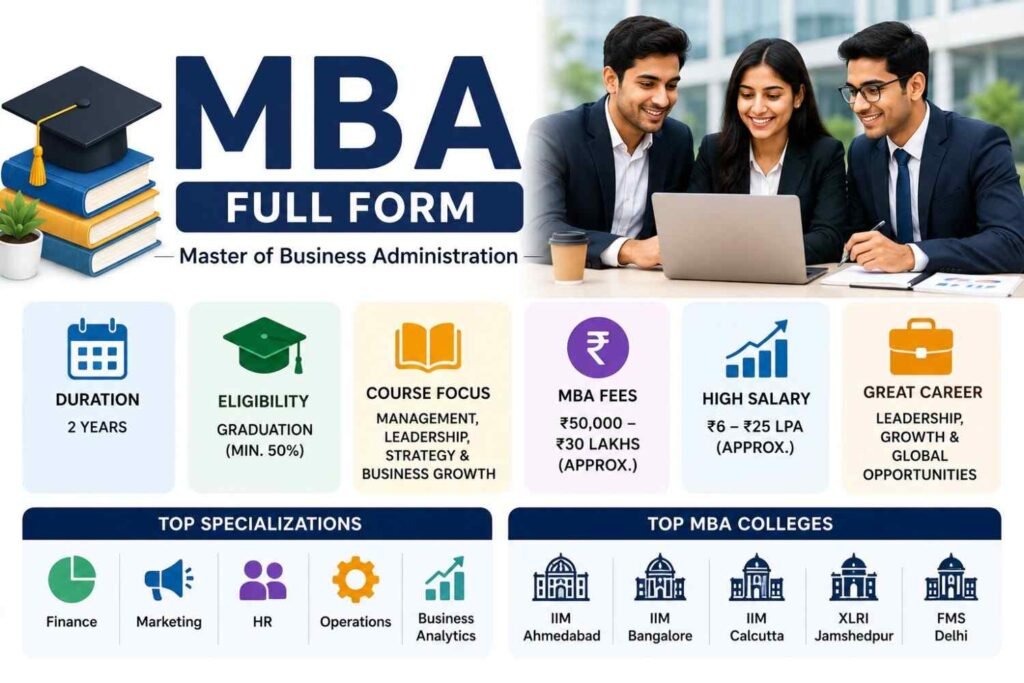
Let’s kick off with the most searched question — MBA full form is Master of Business Administration.
Three words. One degree. Unlimited possibilities.
MBA stands for Master of Business Administration — a postgraduate programme designed to help individuals learn advanced management and business skills. The goal of an MBA is to prepare students for leadership roles in various industries.
From the boardrooms of top MNCs to the funding rounds of fast-growing startups, MBA graduates are everywhere. And in 2025–26, the MBA remains the single most transformative postgraduate degree for anyone who wants to build a career in business, finance, consulting, marketing, or entrepreneurship.
2. What Is MBA? (The Real, Simple Explanation)
So what is MBA, really — beyond the textbook definition?
The Master of Business Administration (MBA) is one of the most popular postgraduate degrees in India. This 2-year professional programme is designed to build strong leadership skills, business acumen, and decision-making capabilities among students.
Think of it this way: an engineer learns to build bridges; a doctor learns to heal patients; an MBA graduate learns to run organisations, lead teams, and drive business growth. That’s the simplest way to understand what MBA means.
But here’s what makes it truly special in 2025–26:
It’s a career transformer. MBA career reports for 2025–2026 are looking really promising! More than 90% of graduates are getting jobs with good packages and many are seeing their salaries jump by over 50 per cent right after their postgraduation in India.
It’s universal. Whether you studied engineering, commerce, arts, or science in your graduation — an MBA welcomes all. The classroom itself becomes a melting pot of diverse backgrounds, which is part of what makes the learning so rich.
It builds your network. Your batch-mates at a top B-school go on to become CEOs, VCs, consultants, and entrepreneurs. Your MBA alumni network is often as valuable as your degree itself.
It future-proofs your career. Due to government initiatives like Make in India, Digital India, and Startup India, the demand for management experts has increased significantly. By 2027, the demand for business project management professionals is expected to grow at a rate of 33%.
3. MBA Course Details – At a Glance
Here’s your complete snapshot of MBA course details:
| Feature | Details |
|---|---|
| MBA Full Form | Master of Business Administration |
| Degree Level | Postgraduate (PG) |
| MBA Course Duration | 2 Years (4 Semesters) |
| Eligibility | Any bachelor’s degree with min. 50% marks |
| MBA Fees (IIMs) | ₹20 – 28 Lakh (total) |
| MBA Fees (ISB) | ₹41 – 43 Lakh (total) |
| MBA Fees (FMS, JBIMS) | ₹2 – 7 Lakh (total) |
| MBA Fees (Private) | ₹5 – 25 Lakh (total) |
| Key Entrance Exams | CAT, XAT, GMAT, MAT, CMAT, SNAP, NMAT |
| Top Specialisations | Finance, Marketing, HR, Business Analytics, Operations |
| Average Salary (IIMs) | ₹28 – 35 LPA |
| Average Salary (Good Colleges) | ₹6 – 15 LPA |
| Average Salary (Freshers) | ₹5 – 8 LPA |
| Top Recruiters | McKinsey, BCG, Goldman Sachs, Deloitte, Amazon, TCS |
| AICTE / UGC Approved | Yes |
4. Who Should Do an MBA? Is It Right for You?
Before diving deeper into MBA course details, ask yourself — is MBA genuinely the right move for you?
You should definitely consider an MBA if:
✅ You want to move into leadership or senior management roles ✅ You’re an engineer, doctor, or science grad who wants a switch to business ✅ You want to start your own company and need business skills ✅ You want to work in consulting, investment banking, or product management ✅ Your current salary has hit a ceiling and you want a significant jump ✅ You want to build a world-class professional network
Think twice before choosing MBA if:
- You’re not sure why you want it — “everyone does it” is not a good reason
- You’re not ready to invest 2 years and significant fees without a clear goal
- You want a purely technical career (data science, coding, research) — there are faster paths
- You haven’t done any research on which B-school fits your goals and profile
The honest truth: an MBA from the right college for the right reasons can be life-changing. An MBA without clarity is just an expensive piece of paper.
💡 Note for Class 12 Students: You can’t join MBA directly after 12th — it needs a bachelor’s degree. But this is the perfect time to plan! Choose your undergraduate course wisely, keep your grades strong, build relevant experience, and set your sights on CAT or GMAT 3–4 years from now.
5. MBA Eligibility Criteria 2025–26
Here’s what you need to qualify for MBA admission in 2025–26:
Academic Qualification
A bachelor’s degree in any discipline from a recognised university with a minimum of 50% aggregate marks (45% for reserved categories) is the standard eligibility for MBA.
- Degree from any discipline — Engineering, Commerce, Arts, Science, Law, Medicine
- Minimum 50% aggregate marks in graduation (45% for SC/ST/OBC at most colleges)
- Final-year graduation students can also apply provisionally
Work Experience
- Not mandatory at most Indian MBA programmes
- However, work experience of 1–5 years significantly strengthens your application at top B-schools
- ISB Hyderabad requires a minimum of 2 years of work experience
- IIMs and top colleges give bonus points for work experience during selection
Age Limit
- No strict age limit for MBA in India (unlike UPSC)
- Most full-time MBA students are between 22–30 years old
- Executive MBA (EMBA) is designed for professionals with 5+ years of experience
6. MBA Course Duration – How Many Years?
The MBA course duration in India is most commonly 2 years — but different formats exist:
Full-Time MBA: 2 Years (Most Common)
The standard full-time MBA is a 2-year, 4-semester residential programme. This is what IIMs, XLRI, FMS, MDI, and most top B-schools offer.
Executive MBA (EMBA): 1–2 Years
Executive MBA is a one-year course designed for individuals with at least 2 years of work experience. ISB Hyderabad’s flagship PGP is a 1-year programme (considered equivalent to a 2-year MBA).
Part-Time / Weekend MBA: 2–3 Years
For working professionals who cannot attend full-time. Classes are held on weekends or evenings, allowing students to continue working.
Distance / Online MBA: 2 Years
The average distance MBA course fee is in the range of INR 20,000 – 60,000 per annum. Offered by IGNOU, Symbiosis, Amity, and many other universities. Good for professionals who need flexibility.
Integrated MBA: 5 Years
Some universities offer integrated programmes (BBA+MBA or B.Sc+MBA) that students can join directly after Class 12 — combining undergraduate and postgraduate education in 5 years.
7. Types of MBA Programmes in India
Not all MBAs are the same! Here’s a breakdown:
| Type | Duration | Best For |
|---|---|---|
| Full-Time MBA | 2 years | Fresh graduates / Early-career professionals |
| Executive MBA (EMBA) | 1–2 years | Mid-career professionals (5+ years experience) |
| Part-Time / Weekend MBA | 2–3 years | Working professionals who can’t leave jobs |
| Distance / Online MBA | 2 years | Working professionals needing flexibility |
| Integrated MBA (BBA+MBA) | 5 years | Class 12 students planning ahead |
| PGDM | 2 years | Autonomous institutes like IIMs (MBA equivalent) |
PGDM vs MBA: MBA and PGDM are equivalent 2-year programs. MBA is university-affiliated, while PGDM is autonomous and offered by institutes like IIMs. IIMs technically award PGP (Post Graduate Programme) / PGDM degrees, not MBA — but these are treated as equivalent to MBA by all employers globally.
8. MBA Fees in India – IIMs, Private & Government Colleges
MBA fees in India span an extraordinary range — from ₹2 Lakh at government colleges to ₹43 Lakh at ISB. Here’s the complete breakdown:
MBA Fees at Top Tier-1 Institutions
| College | Total MBA Fees | Average Placement |
|---|---|---|
| IIM Ahmedabad | ~₹27–28 Lakh | ₹35+ LPA |
| IIM Bangalore | ~₹24–25 Lakh | ₹30+ LPA |
| IIM Calcutta | ~₹27 Lakh | ₹35.22 LPA |
| ISB Hyderabad | ~₹41–43 Lakh | ₹35+ LPA |
| IIM Lucknow | ~₹22 Lakh | ₹25+ LPA |
| XLRI Jamshedpur | ~₹26 Lakh | ₹28+ LPA |
| MDI Gurgaon | ~₹22 Lakh | ₹25+ LPA |
The top three IIMs — IIM Ahmedabad, IIM Calcutta, and IIM Bangalore — have average fee ranges from INR 20.75 Lakh to 27.5 Lakh and average placement packages ranging from INR 28.18 LPA to INR 35.22 LPA.
Government Colleges with Low MBA Fees
The best value-for-money MBA option in India deserves a special callout:
MBA fees in India vary widely — top IIMs charge around ₹20–28 lakh, ISB costs ₹41–43 lakh, while low-fee colleges like FMS Delhi and JBIMS Mumbai charge between ₹2–7 lakh.
| College | Total MBA Fees | Average Placement |
|---|---|---|
| FMS Delhi (Delhi University) | ~₹2 Lakh | ₹25+ LPA |
| JBIMS Mumbai | ~₹5–7 Lakh | ₹20+ LPA |
| IIT (DMS IIT Delhi, SJMSOM IIT Bombay) | ~₹10–14 Lakh | ₹20–25 LPA |
Best ROI in India: FMS Delhi is the undisputed king of ROI — pay ₹2 Lakh total, get ₹25+ LPA placements. But cracking FMS needs a 98–99 CAT percentile. Worth every bit of the effort!
Private College MBA Fees
| College Tier | Annual Fees | Total Fees |
|---|---|---|
| Top Private (SPJIMR, IMT, IMI) | ₹10–15 Lakh/year | ₹20–28 Lakh |
| Mid-Level Private | ₹5–8 Lakh/year | ₹10–16 Lakh |
| Average Private University | ₹1–3 Lakh/year | ₹2–6 Lakh |
| Distance / Online MBA | ₹20,000–60,000/year | ₹40K – 1.2 Lakh |
9. MBA Syllabus & Specialisations
Core MBA Subjects (Year 1 – Foundation)
Year 1 builds your foundation in all areas of business:
- Semester 1: Managerial Economics, Financial Accounting, Organisational Behaviour, Statistics & Quantitative Methods, Business Communication
- Semester 2: Marketing Management, Financial Management, Human Resource Management, Operations Management, Business Ethics & Corporate Governance
Core MBA Subjects (Year 2 – Specialisation)
- Semester 3: Specialisation Electives I, Strategic Management, International Business, Entrepreneurship
- Semester 4: Specialisation Electives II, Research Project / Dissertation, Summer Internship (review), Leadership Development
Most Popular MBA Specialisations (2025–26)
Finance, Business Analytics, Marketing, and Operations remain the most in-demand MBA specialisations in 2026, driven by strong hiring trends.
| Specialisation | Career Roles | Salary Potential |
|---|---|---|
| Finance | Investment Banker, Financial Analyst, CFO | ₹10 – 35+ LPA |
| Marketing | Brand Manager, Digital Marketing Head, CMO | ₹8 – 25 LPA |
| Human Resources (HR) | HR Manager, CHRO, Talent Head | ₹7 – 20 LPA |
| Business Analytics | Data Analyst, BI Manager, Analytics Lead | ₹10 – 30+ LPA |
| Operations / Supply Chain | Operations Manager, Supply Chain Head, COO | ₹8 – 22 LPA |
| Consulting | Strategy Consultant, Management Consultant | ₹15 – 40+ LPA |
| Entrepreneurship | Startup Founder, VC-backed Entrepreneur | Unlimited |
| International Business | Global Trade Manager, Export Head | ₹8 – 20 LPA |
10. MBA Entrance Exams 2025–26 – Everything You Need to Know
Getting into a great MBA programme starts with the right entrance exam. Here’s the complete guide:
| Exam | Full Form | Conducted By | Accepting Colleges |
|---|---|---|---|
| CAT | Common Admission Test | IIMs | All 22 IIMs + 1000+ colleges |
| XAT | Xavier Aptitude Test | XLRI | XLRI + 150+ colleges |
| GMAT | Graduate Management Admission Test | GMAC | ISB, IIMs, global colleges |
| SNAP | Symbiosis National Aptitude Test | Symbiosis | All Symbiosis institutes |
| NMAT | NMIMS Management Aptitude Test | GMAC | NMIMS + 50+ colleges |
| MAT | Management Aptitude Test | AIMA | 600+ colleges |
| CMAT | Common Management Admission Test | NTA | AICTE-approved colleges |
| IIFT | IIFT Entrance Exam | IIFT | IIFT Delhi & Kolkata |
CAT – The King of MBA Entrance Exams
Top MBA colleges accepting CAT 2025 scores include 22 IIMs, IITs, FMS Delhi, SPJIMR, MDI Gurgaon, and IIFT New Delhi.
CAT cutoffs range from 88 to 99 percentile across different IIMs. For FMS Delhi and IIM Ahmedabad, you’re looking at 98–99 percentile.
How the Admission Process Works
- Appear for entrance exam (CAT/XAT/GMAT/SNAP)
- Shortlisting based on exam score + academic profile
- Written Ability Test (WAT) / Group Discussion (GD)
- Personal Interview (PI)
- Final Selection based on composite score (exam + WAT/GD + PI + academics + work experience)
- Counselling and fee payment
11. Top MBA Colleges in India 2025–26
India’s top MBA colleges in 2026, according to NIRF rankings, are led by IIM Ahmedabad, IIM Bangalore, and IIM Kozhikode. These institutes offer average salaries between ₹28–35 LPA, placement rates above 95%, and flagship 2-year programs primarily through CAT.
Tier 1 – Premier Government B-Schools
| College | Location | Total Fees | Avg. Package | Exam |
|---|---|---|---|---|
| IIM Ahmedabad | Ahmedabad | ~₹27 Lakh | ₹35+ LPA | CAT |
| IIM Bangalore | Bangalore | ~₹24 Lakh | ₹30+ LPA | CAT |
| IIM Calcutta | Kolkata | ~₹27 Lakh | ₹35.22 LPA | CAT |
| IIM Lucknow | Lucknow | ~₹22 Lakh | ₹25+ LPA | CAT |
| IIM Kozhikode | Kozhikode | ~₹21 Lakh | ₹25+ LPA | CAT |
| FMS Delhi | New Delhi | ~₹2 Lakh | ₹25+ LPA | CAT |
| JBIMS Mumbai | Mumbai | ~₹5–7 Lakh | ₹20+ LPA | MH-CET |
| DMS IIT Delhi | New Delhi | ~₹10–14 Lakh | ₹20–25 LPA | CAT/GMAT |
Tier 2 – Top Private B-Schools
| College | Location | Total Fees | Avg. Package | Exam |
|---|---|---|---|---|
| ISB Hyderabad | Hyderabad | ~₹41–43 Lakh | ₹35+ LPA | GMAT/GRE |
| XLRI Jamshedpur | Jamshedpur | ~₹26 Lakh | ₹28+ LPA | XAT |
| MDI Gurgaon | Gurgaon | ~₹22 Lakh | ₹25+ LPA | CAT/GMAT |
| SPJIMR Mumbai | Mumbai | ~₹22 Lakh | ₹30+ LPA | CAT/GMAT |
| IIFT Delhi | New Delhi | ~₹16 Lakh | ₹20+ LPA | IIFT/CAT |
| IMT Ghaziabad | Ghaziabad | ~₹18 Lakh | ₹14+ LPA | CAT/XAT |
| Symbiosis (SIBM Pune) | Pune | ~₹20 Lakh | ₹16+ LPA | SNAP |
IIM Calcutta Highlight: IIM Calcutta has recorded the highest salary package of 1.45 CPA (crore per annum) and an average package of ₹35.22 LPA — the highest among all IIMs.
12. Jobs & Career Scope After MBA
An MBA opens doors across virtually every industry. Here’s what your career can look like:
Top Job Roles for MBA Graduates
| Job Role | Industry | Salary Range |
|---|---|---|
| Management Consultant | Consulting | ₹12 – 40+ LPA |
| Investment Banker | Finance | ₹15 – 50+ LPA |
| Marketing Manager | FMCG, E-commerce, Tech | ₹8 – 25 LPA |
| Product Manager | Tech Startups, MNCs | ₹15 – 40 LPA |
| HR Business Partner | All sectors | ₹8 – 20 LPA |
| Business Development Manager | Across industries | ₹8 – 22 LPA |
| Operations Manager | Manufacturing, Logistics | ₹8 – 20 LPA |
| Entrepreneur / Startup Founder | Self | Unlimited |
| Supply Chain Manager | FMCG, Retail, E-commerce | ₹8 – 20 LPA |
| Chief Financial Officer (CFO) | All sectors | ₹30 – 100+ LPA |
Top MBA Recruiters in India
McKinsey, BCG (Boston Consulting Group), Bain & Company, Goldman Sachs, JP Morgan, Deloitte, EY, KPMG, Amazon, Google, Microsoft, P&G, Hindustan Unilever, Mahindra, Tata Group, Infosys, and hundreds of top startups.
Graduates of MBA programs have a wide range of career options in fields like IT, finance, healthcare, education, and more.
13. MBA Salary in India – What to Realistically Expect
Here’s the complete salary picture after an MBA degree:
MBA salaries in India for 2026 are between INR 5 LPA and INR 8 LPA for fresh graduates most of the time. If you have done your MBA from top schools like IIM, FMS, or XLRI, then you can get a salary of INR 12–20+ LPA.
Salary by College Tier
| College Tier | Fresher Salary | Mid-Level (3–5 yrs) | Senior (8–10 yrs) |
|---|---|---|---|
| IIM A/B/C + ISB | ₹28 – 35+ LPA | ₹40 – 70 LPA | ₹1 Crore+ |
| Tier 2 IIMs + XLRI + MDI | ₹14 – 25 LPA | ₹25 – 50 LPA | ₹50 – 80 LPA |
| Good Private B-Schools | ₹8 – 14 LPA | ₹14 – 25 LPA | ₹25 – 50 LPA |
| Average Private B-Schools | ₹5 – 8 LPA | ₹8 – 15 LPA | ₹15 – 30 LPA |
| Distance / Online MBA | ₹3 – 6 LPA | ₹6 – 12 LPA | ₹12 – 20 LPA |
An MBA graduate in India can expect to earn an average income of roughly INR 20 LPA, with the maximum compensation reaching INR 70 LPA, according to a report by the Indian School of Business.
14. MBA vs PGDM – What’s the Difference?
This is one of the most frequently confused topics among MBA aspirants. Here’s the clear answer:
| Feature | MBA | PGDM |
|---|---|---|
| Full Form | Master of Business Administration | Post Graduate Diploma in Management |
| Awarding Body | Universities (affiliated colleges) | Autonomous institutes |
| Examples | MBA from Delhi University, Pune University | PGDM from IIMs, ISB, XLRI, MDI |
| Degree / Diploma | Degree (recognised by UGC) | Diploma (recognised by AICTE) |
| Industry Recognition | Excellent | Excellent (IIM PGDM is treated as equivalent) |
| Curriculum Flexibility | More standardised | More industry-aligned, updated frequently |
| Fees | Generally lower | Generally higher at premium institutes |
MBA and PGDM are equivalent 2-year programs. MBA is university-affiliated, while PGDM is autonomous and offered by institutes like IIMs. Both are highly respected — the institute’s reputation matters far more than whether it’s called MBA or PGDM.
15. Frequently Asked Questions (FAQs)
Q1. What is MBA full form? MBA full form is Master of Business Administration — a postgraduate programme designed to help individuals learn advanced management and business skills. It is one of the most popular and respected degrees in India and globally.
Q2. What is MBA course duration? The standard MBA course duration is 2 years (4 semesters). ISB Hyderabad offers a 1-year executive MBA. Integrated programmes (BBA+MBA) after Class 12 are 5 years long.
Q3. What are MBA fees in India? MBA fees in India vary widely — top IIMs charge around ₹20–28 lakh, ISB costs ₹41–43 lakh, while low-fee colleges like FMS Delhi and JBIMS Mumbai charge between ₹2–7 lakh. Average private college MBA fees range from ₹10 – 20 lakh.
Q4. What is MBA eligibility in India? A bachelor’s degree in any discipline from a recognised university with a minimum of 50% aggregate marks (45% for reserved categories) is required. Work experience is not mandatory but highly valued at top B-schools.
Q5. Can a 12th class student directly join MBA? No. MBA requires a bachelor’s degree first. However, some universities offer 5-year integrated programmes (BBA+MBA) that 12th students can join directly after Class 12.
Q6. Which is the best entrance exam for MBA in India? CAT is the most important and widely accepted MBA entrance exam in India — all 22 IIMs and 1,000+ colleges accept it. XAT is important for XLRI; GMAT is used for ISB and international colleges.
Q7. What is the average MBA salary in India? MBA salaries for fresh graduates range from INR 5–8 LPA at average colleges to INR 28–35 LPA at top IIMs. With 5–8 years of experience, professionals can expect INR 15–25 LPA at good B-schools.
Q8. Which are the top MBA colleges in India? The top three are IIM Ahmedabad, IIM Calcutta, and IIM Bangalore. Among government colleges, FMS Delhi and JBIMS Mumbai offer the best ROI. Top private B-schools include ISB Hyderabad, XLRI, MDI Gurgaon, and SPJIMR.
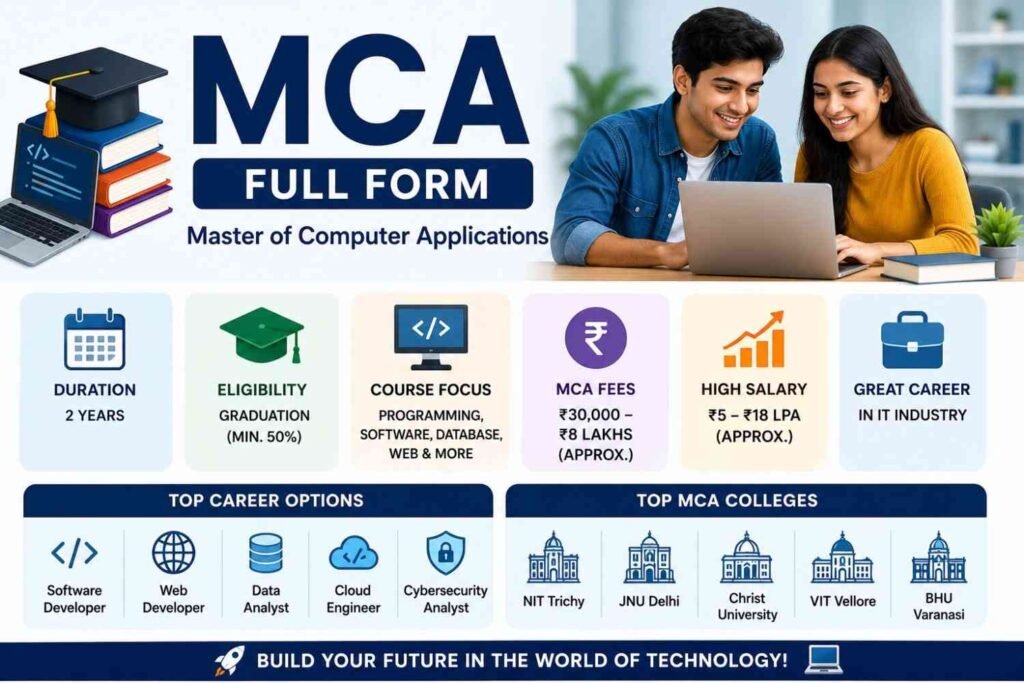
Q9. Is MBA better than MCA? MBA is better if you want a business, finance, marketing, or management career. MCA is better if you want a technology or IT career. Both are 2-year postgraduate programmes but serve very different career goals.
Q10. What is the difference between MBA and PGDM? MBA is a university-affiliated degree while PGDM is an autonomous diploma. IIMs award PGDM, not MBA — but both are equally respected by employers. The institute’s reputation matters far more than the nomenclature.
Q11. How many IIMs are there in India? There are 22 IIMs in India as of 2025, spread across cities including Ahmedabad, Bangalore, Calcutta, Lucknow, Kozhikode, Indore, Shillong, and many more. All 22 IIMs accept only CAT scores for MBA admissions.
Q12. Can I do an MBA without a CAT score? Yes! Many top colleges accept XAT (XLRI), GMAT (ISB, IIMs for international candidates), SNAP (Symbiosis), NMAT (NMIMS), CMAT, or MAT scores. Some private colleges also offer direct admission without an entrance exam.
Final Thoughts
And that’s your ultimate guide to MBA full form, course details, fees, colleges, and career scope for 2025–26! 🎉
Here’s your quick recap of everything important:
- MBA full form = Master of Business Administration — a 2-year postgraduate degree
- Open to any graduate from any discipline with 50% marks
- MBA fees range from ₹2 Lakh (FMS Delhi) to ₹43 Lakh (ISB) — choose wisely based on ROI
- CAT is the most important exam — start preparing at least 6–8 months in advance
- Top colleges: IIM A, B, C, ISB, FMS Delhi, XLRI, MDI, SPJIMR, JBIMS
- Salary: ₹5–8 LPA at average colleges; ₹28–35 LPA at top IIMs
- Best specialisations for 2026: Finance, Business Analytics, Marketing, Consulting
MBA is not just a degree — it’s a career-defining investment. The key is choosing the right B-school for your goals, preparing hard for the entrance exam, and entering the programme with clear intent about what you want to achieve.
For Class 12 students — start planning NOW. Pick the right undergraduate course, keep your academic record strong, develop extra-curricular achievements, and set your MBA goal for 3–4 years from now.
The B-school of your dreams is waiting. Go get it! 💼🚀