
Table of Contents
BAF Full Form – What Is BAF, Course Details, Fees, Duration & Top Colleges (2026–27)
Quick Summary: Searching for BAF full form, what the course covers, how much it costs, and which colleges are the best? You’ve found exactly what you need! This complete guide to BAF course details covers everything a Class 12 Commerce student needs to know — from eligibility and BAF fees to syllabus, top colleges, career options, and salary after graduation. Whether you’re dreaming of the finance world or a career in accounting, let’s get started! 📊
1. BAF Full Form – What Does BAF Stand For?
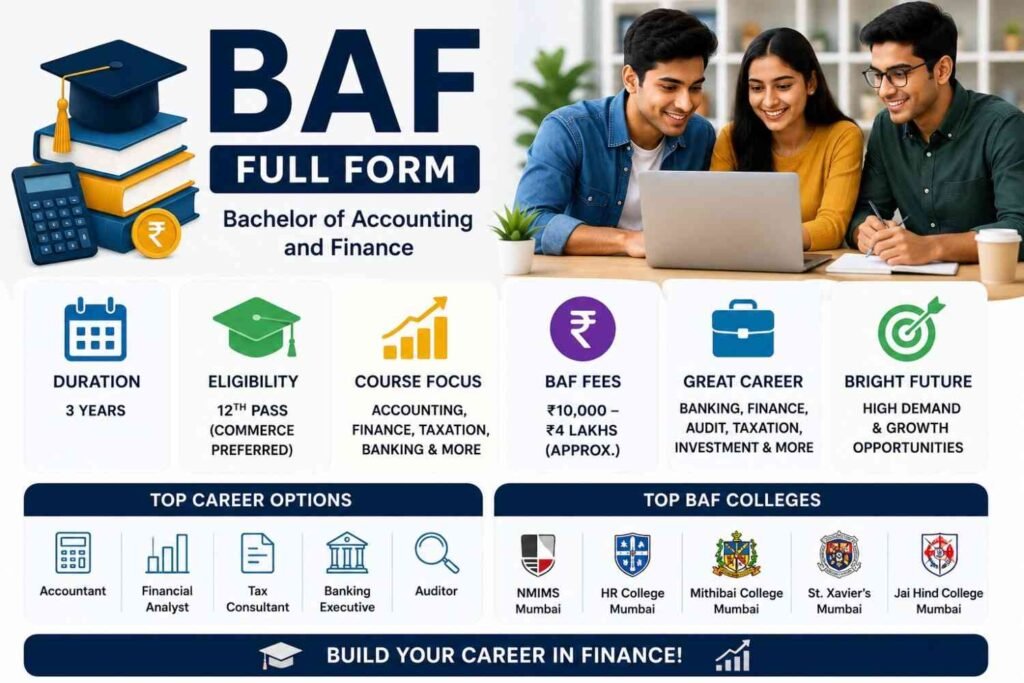
Let’s begin with the most important question — BAF full form is Bachelor of Accounting and Finance.
That’s it! BAF stands for Bachelor of Accounting and Finance — a 3-year professional undergraduate degree that gives students deep, specialised knowledge in two of the most critical pillars of business: accounting and finance.
BAF full form is Bachelor of Accounting and Finance. BAF is actually a B.Com in Accounting and Finance course which spans 3 years and it is a recognised undergraduate professional degree programme in India. BAF teaches some of the most important subjects like financial accounting, cost accounting, taxation, wealth management, auditing, and business laws — which strengthens your core knowledge in the field of accounting, auditing, and finance, making you an invaluable asset for any big organisation.
2. What Is BAF? (Simple, Clear Explanation)
So what is BAF exactly, and why is it gaining so much popularity among Commerce students?
BAF full form stands for Bachelor of Accountancy and Finance. It is a three-year undergraduate program which covers specialised knowledge of accounting, auditing, and finance — some of the most crucial subjects in the business world. BAF subjects include financial accounting, cost accounting, taxation, wealth management, auditing, and business laws.
Think of it this way: while a regular B.Com gives you a broad understanding of commerce, BAF drills deep into the world of money — how companies manage their finances, how auditors ensure accountability, how tax strategies work, and how investment decisions are made. If you want to be the person in a company who knows exactly where the money comes from, where it goes, and how to make it grow — BAF is built for you.
Why BAF is booming in 2026–27:
India’s fintech market is projected to reach $150 billion by 2025, making it one of the nations with the fastest growth rate. According to Business Today, the banking and financial sector generated 67,000 new jobs in FY22 alone. This explosive growth in financial services means that skilled BAF graduates are more in demand than ever.
The BAF course is also offered in collaboration with ICAI (Institute of Chartered Accountants of India), which means the syllabus is directly aligned with CA Foundation concepts — giving BAF students a massive head start if they plan to pursue CA alongside or after their degree.
3. BAF Course Details – At a Glance
Here’s your complete snapshot of BAF course details:
| Feature | Details |
|---|---|
| BAF Full Form | Bachelor of Accounting and Finance |
| Also Known As | Bachelor of Accountancy and Finance |
| Degree Level | Undergraduate (UG) |
| BAF Course Duration | 3 Years (6 Semesters) |
| Eligibility | Class 12 (Commerce preferred) with min. 45–50% marks |
| BAF Fees (Government) | ₹16,000 – ₹50,000/year |
| BAF Fees (Private) | ₹50,000 – ₹1,50,000/year |
| Admission Mode | Merit-Based / Entrance Exam |
| Key Entrance Exams | CUET UG, MHT-CET, SET, NPAT, DUAT |
| Core Subjects | Financial Accounting, Taxation, Auditing, Business Law, Cost Accounting |
| Top Specialisations | Taxation, Investment Analysis, Wealth Management, Auditing |
| BAF Salary (Fresher) | ₹2 – 6 LPA |
| Highest Package | ₹8 – 12 LPA (with CA / CFA / experience) |
| Top Recruiters | EY, KPMG, Deloitte, PwC, SBI, Accenture, ICICI Bank, Morgan Stanley |
| Further Study Options | CA, CFA, MBA Finance, MCom, CPA, CS |
| ICAI Collaboration | Yes |
4. Who Should Choose BAF After 12th?
Before we dive into the nitty-gritty of BAF course details, the most important question is — is BAF the right course for YOU?
Choose BAF if:
✅ You studied Commerce in Class 12 and love Accountancy or Economics ✅ You’re interested in becoming a CA, CFA, or financial analyst ✅ You want to work in auditing, taxation, banking, or investment banking ✅ You want a specialised finance degree rather than a general B.Com ✅ You’re planning to pursue CA and want a degree that aligns with the CA syllabus ✅ You want to work at top firms like EY, KPMG, Deloitte, PwC, or Goldman Sachs ✅ You’re fascinated by how companies manage money, prepare financial statements, and plan budgets
Think twice if:
- Numbers and accounts don’t interest you at all — BAF is very maths and finance-heavy
- You want a broader management degree — BBA or BMS would suit you better
- You’re from Science or Arts stream and have no commerce background (though you can still apply!)
- You want a tech career — BCA or BSc CS are better routes
5. BAF Eligibility Criteria 2026–27
Here are the standard BAF eligibility criteria for 2026–27 admissions:
Academic Qualification
Students must have completed a 10+2 degree in Commerce or a related stream with a minimum of 50% marks for the general category and 45% marks for reserved category students. Students are also required to clear entrance exams like MHT-CET, CUET, etc. The minimum age limit to enrol in the course is 17 years.
- Class 12 pass from a recognised board (CBSE, ICSE, State Boards)
- Commerce stream is preferred — but candidates from Science and Arts streams can also apply at many colleges
- Minimum marks: 45–50% aggregate (General); 40–45% for SC/ST/OBC
- Age: Minimum 17 years; maximum 25 years at most colleges
Subject-Specific Requirements
Some institutes may require specific subjects such as Mathematics, Economics, or Accounts in Class 12. Colleges under Mumbai University typically prefer students with Commerce background who have studied Accountancy and Mathematics or Economics.
💡 Commerce Advantage: While BAF is technically open to students from all streams, Commerce students with a background in Accountancy and Business Studies have a natural head start. If you studied these subjects in Class 11–12, you’ll find BAF significantly easier to navigate from day one.
6. BAF Course Duration – How Many Years?
Bachelor of Accounting and Finance (BAF) is an Undergraduate course with a duration of 3 years and six semesters.
Each year contains two semesters. BAF classes include a rich mix of:
- Theory lectures (financial concepts, accounting standards, tax laws)
- Practical training (journal entries, financial statement preparation, tax calculations)
- Seminar and workshops (industry-oriented guest lectures and case studies)
- Projects and conferences (real-world assignments)
- Functional training (simulated business environments)
The system demands a deep understanding of financial subjects and accounting from various sources like practical training, classroom teachings, seminars, projects, conferences, expert talks, and functional training.
7. Types of BAF Programmes in India
BAF is not a one-size-fits-all programme. Here are the main formats available:
| Type | Duration | Description |
|---|---|---|
| Full-Time BAF | 3 Years | Regular on-campus degree; most common format |
| Part-Time BAF | 3–4 Years | For working students; weekend or evening classes |
| Distance BAF (IGNOU) | 3–6 Years | Flexible distance learning; ideal for those who can’t attend full-time |
| Online BAF | 3 Years | Growing format; offered by select private universities |
BAF course is also available at IGNOU through distance mode and spans 3 to 6 years in duration. In Indian colleges, INR 40,000 to INR 1,50,000 is the average full-time BAF course fee range.
💡 IGNOU BAF: If you need flexibility or lower fees, IGNOU’s distance BAF is a popular, nationally recognised option. It allows you to complete the degree at your own pace within a 3–6 year window.
8. BAF Fees in India – Government vs Private Colleges
BAF fees are one of the most searched topics — and here’s the complete, honest picture:
BAF Fees Overview
The BAF fees per year is in the range of INR 16,000–1,00,000. The average fees of BAF across India cost between INR 20,000 to 3,00,000. The fees differ from public colleges to private institutions. The typical tuition cost for entry into the Bachelor of Accounting and Finance degree is between Rs 20,000 and Rs 1.5 lakh.
| College Type | Annual Fees | Total 3-Year Fees |
|---|---|---|
| Government / Autonomous Colleges | ₹16,000 – ₹50,000/year | ₹48,000 – ₹1.5 Lakh |
| Mid-Range Private Colleges | ₹50,000 – ₹80,000/year | ₹1.5 – ₹2.4 Lakh |
| Premium Private Colleges | ₹80,000 – ₹1,50,000/year | ₹2.4 – ₹4.5 Lakh |
| IGNOU (Distance Mode) | ₹5,000 – ₹10,000/year | ₹15,000 – ₹30,000 |
Notable Fee Examples
- Jai Hind College, Mumbai: Total academic fee is ₹1.4 Lakhs for the full BAF programme — one of Mumbai’s most prestigious BAF colleges at a very reasonable cost
- Government colleges (Shankar Narayan, etc.): As low as ₹16,000–30,000 per year — exceptional value for excellent BAF education
- Private colleges pan-India: The fee structure is approximately ₹30,000 – ₹1.5 Lakh, varying by college location, ranking, and features
Scholarships Available
Various scholarships are offered to BAF students by government and private institutes based on annual income, merit score, and quota:
- National Scholarship Portal (NSP) — central government merit + means-based scholarships
- Post-Matric Scholarship for SC/ST students
- State Government Scholarships — especially in Maharashtra for Mumbai University students
- College-Specific Merit Scholarships — many top colleges waive fees for high scorers
🏆 Best Value Pick: Government-aided colleges under Mumbai University (Shankar Narayan College, Wilson College, etc.) offer excellent BAF education at ₹16,000–30,000 per year. The combination of low fees, Mumbai’s financial ecosystem for internships, and strong alumni networks makes this the best ROI for BAF students.
9. BAF Syllabus – Semester-Wise Breakdown
The three-year BAF degree covers a variety of subjects, including auditing, taxation, business law, financial management, investment analysis, market systems, financial accounting, cost accounting, and more. The syllabus of the Bachelor of Accounting and Finance is very elaborate and is divided into 6 semesters.
Semester 1 & 2 – Foundation Year
Core Subjects:
- Financial Accounting I & II
- Business Mathematics & Statistics
- Business Communication
- Economics (Micro & Macro)
- Foundation of IT Applications
- Business Law I (Contract Act, Sale of Goods Act)
Semester 3 & 4 – Core Specialisation
Core Subjects:
- Cost Accounting I & II
- Taxation I (Income Tax basics — salaries, house property, business income)
- Auditing & Assurance
- Financial Management I
- Business Law II (Company Law, Negotiable Instruments Act)
- Commerce & Marketing
- Management Accounting
Semester 5 & 6 – Advanced & Industry Application
Core Subjects:
- Direct Tax (Advanced Income Tax, Tax Planning)
- Indirect Taxes (GST — principles, registration, computation)
- Investment Analysis & Portfolio Management
- Financial Accounting III (Amalgamation, Partnership, Company Accounts)
- International Finance
- Wealth Management
- Strategic Management
- Research Methodology & Project Work
BAF course comprises core subjects such as taxation, auditing, accounting, financial accounting, business communication, business law, and managerial economics, which helps students gain knowledge and learn every aspect of this course.
💡 CA Connection: Notice how BAF subjects — Auditing, Taxation (Direct + Indirect), Financial Accounting, Cost Accounting, and Business Law — closely mirror the CA Intermediate and CA Foundation syllabus. This is by design! BAF is structured in collaboration with ICAI, making it one of the best degrees to pursue alongside CA.
10. BAF Admission Process & Entrance Exams
Admission Routes
BAF admission is based on merit in colleges like KES, MSG SGKM College of Arts, Science and Commerce. Colleges like Jai Hind may conduct entrance exams for the course based on the requirement. Most private colleges across India offer direct admission based on Class 12 merit. Premier colleges under Mumbai University and other state universities use centralised merit-based processes.
Key BAF Entrance Exams
| Entrance Exam | Conducted By | Accepting Colleges |
|---|---|---|
| CUET UG | NTA | Central universities and select state colleges |
| MHT-CET | Maharashtra | Maharashtra state colleges including Mumbai University |
| SET (Symbiosis Entrance Test) | Symbiosis University | Symbiosis-affiliated colleges, Pune |
| NPAT | NMIMS | Narsee Monjee University, Mumbai |
| DUAT | Dibrugarh University | Northeast India colleges |
| Direct Merit-Based | Individual colleges | Most private colleges across India |
Step-by-Step Admission Process
- Check eligibility — Class 12 Commerce (or Science/Arts) with 45–50% marks
- Register for relevant entrance exam (CUET/MHT-CET/SET)
- Appear for entrance exam — typically tests English, Maths, Logical Reasoning, General Awareness
- Check merit lists on college/university websites
- Submit application to shortlisted colleges with documents
- Document verification — marksheets, certificates, ID proof
- Pay fees and confirm admission
11. Top BAF Colleges in India 2026–27
There are more than 100 colleges in India offering BAF courses, out of which most are private colleges while others are deemed as well as government colleges. Mumbai is considered a home to various top colleges offering the BAF course.
Top BAF Colleges in Mumbai (Hotspot for BAF)
| College | Location | Total BAF Fees | Known For |
|---|---|---|---|
| Jai Hind College (JHC) | Churchgate, Mumbai | ~₹1.4 Lakh (total) | Located near Churchgate; close to finance firms; top recruiters EY, KPMG, Deloitte, PwC |
| St. Xavier’s College | Fort, Mumbai | ₹50,000 – ₹80,000 | Heritage institution; excellent faculty; strong alumni network |
| Mithibai College | Vile Parle, Mumbai | ₹40,000 – ₹70,000 | Modern infrastructure; vibrant campus; SVKM group |
| Narsee Monjee College (NM) | Vile Parle, Mumbai | ₹60,000 – ₹1 Lakh | Top placements; SVKM; 300+ recruiting companies |
| Shankar Narayan College | Bhandup, Mumbai | ₹16,000 – ₹30,000 | Affordable government-aided; strong BAF programme |
| KES Shroff College | Kandivali, Mumbai | ₹30,000 – ₹50,000 | Merit-based admission; good placement record |
| H.R. College of Commerce | Churchgate, Mumbai | ₹40,000 – ₹70,000 | Prestigious; Mumbai University top college |
Top BAF Colleges Outside Mumbai
| College | Location | Annual Fees | Known For |
|---|---|---|---|
| Christ University | Bangalore | ₹80,000 – ₹1.5 Lakh | Modern curriculum; strong industry connections |
| Symbiosis College of Arts & Commerce | Pune | ₹50,000 – ₹80,000 | Symbiosis group; excellent placement record |
| Jain University | Bangalore | ₹60,000 – ₹1 Lakh | Industry-focused; entrepreneurship culture |
| Amity University | Multiple campuses | ₹1 – 1.5 Lakh | 300+ recruiters; modern facilities |
| LPU (Lovely Professional University) | Punjab | ₹80,000 – ₹1.2 Lakh | ACBSP-accredited; strong placement network |
🏆 Best Pick for BAF: For those who can get into Mumbai’s colleges, Jai Hind College (Churchgate location gives direct access to internships at finance firms on Nariman Point) and St. Xavier’s College (exceptional academics and alumni) are the gold standards. For value, Shankar Narayan College at ₹16,000/year is hard to beat.
12. Jobs & Career Scope After BAF
Students have the opportunity to work at several companies like EY, KPMG, Deloitte, PwC, Accenture, Oracle, Gartner, SBI, etc. The BAF degree opens doors across accounting, finance, banking, audit, and taxation sectors. BAF offers a vast scope for graduates in the field of business both in India and foreign countries.
Top Job Roles for BAF Graduates
Account executive, Finance Manager, Tax Specialist, and Auditor are some of the popular accounting and finance jobs in India.
| Job Role | Sector | Salary Range |
|---|---|---|
| Accountant / Senior Accountant | All industries | ₹3 – 6 LPA |
| Finance Analyst | Banking, NBFC, Fintech | ₹4 – 8 LPA |
| Tax Associate / Tax Consultant | CA Firms, Tax Consulting | ₹3 – 6 LPA |
| Audit Associate | Big 4 (EY, KPMG, Deloitte, PwC) | ₹4 – 8 LPA |
| Investment Analyst | Stock Market, Mutual Funds | ₹4 – 8 LPA |
| Credit Analyst | Banks, NBFCs | ₹4 – 7 LPA |
| Financial Manager | MNCs, Large Corporates | ₹6 – 12 LPA |
| Wealth Manager | Private Banks, Wealth Firms | ₹5 – 10 LPA |
| Banker (PO / Associate) | Public / Private Banks | ₹4 – 8 LPA |
| Budget Analyst | Government, Corporates | ₹4 – 8 LPA |
Top BAF Recruiters
Top recruiters at colleges like Jai Hind College are Ernst & Young (EY), Kotak, KPMG, Deloitte, PwC, Grant Thornton, ICICI Bank, and Morgan Stanley. Other major BAF recruiters include Accenture, Oracle, Gartner, SBI, HDFC Bank, Axis Bank, Goldman Sachs, JP Morgan, and hundreds of CA firms and NBFCs.
13. BAF Salary in India – What to Expect
Here’s the real salary picture after completing your BAF degree:
The average salary after completion of BAF in India is in the range of INR 2–6 LPA. The BAF course salary of the candidate after completing this course lies between INR 4 LPA and INR 8 LPA annually. The median salary offered at top Mumbai colleges was INR 4.5 LPA in 2024.
Salary by Experience Level
| Experience Level | Average Annual Salary |
|---|---|
| Fresher (0–1 year) | ₹2.5 – 4.5 LPA |
| Junior (1–3 years) | ₹4 – 7 LPA |
| Mid-Level (3–6 years) | ₹6 – 12 LPA |
| Senior (6–10 years) | ₹12 – 20 LPA |
Salary Boosters After BAF
The real salary multiplication happens when you combine BAF with additional qualifications:
| Qualification After BAF | Salary Potential |
|---|---|
| BAF only | ₹3 – 6 LPA |
| BAF + CA (Chartered Accountant) | ₹8 – 25 LPA |
| BAF + CFA (Chartered Financial Analyst) | ₹8 – 20 LPA |
| BAF + MBA Finance (IIM/XLRI) | ₹18 – 35 LPA |
| BAF + CPA (US Accounting) | ₹12 – 30 LPA (especially with global firms) |
💡 Pro Tip: Many BAF students pursue CA Foundation and CA Intermediate simultaneously with their BAF degree. Since the syllabi closely overlap (both are aligned with ICAI standards), this is one of the smartest combinations in Commerce — and it dramatically increases your earning potential post-graduation.
14. BAF vs B.Com – Which Is Better for You?
One of the most common questions from Commerce students — should you choose BAF or B.Com?
| Feature | BAF | B.Com (General) |
|---|---|---|
| Full Form | Bachelor of Accounting & Finance | Bachelor of Commerce |
| Focus | Deep specialisation in accounting + finance | Broad commerce education |
| Subjects | Financial Accounting, Taxation, Auditing, Wealth Mgmt | Accountancy, Economics, Business Studies, Law |
| ICAI Collaboration | Yes (aligned with CA syllabus) | Partial alignment |
| Fees | Slightly higher | Generally lower |
| Salary (Fresher) | ₹3 – 6 LPA | ₹2.5 – 5 LPA |
| Career Focus | Finance industry, Big 4, Banking | Broader — finance, management, government |
| Best For | Students aiming for CA, CFA, finance careers | Students who want wider commerce options |
| Depth of Knowledge | Very deep in accounting & finance | Broad across commerce subjects |
Verdict: Choose BAF if you are clear about wanting a career in accounting, auditing, taxation, or financial analysis. Choose B.Com if you want a broader commerce education that keeps more options open — including management, marketing, and government jobs.
15. What to Do After BAF – Higher Education Options
BAF is an excellent launchpad, and your options for further study are impressive:
Option 1: CA (Chartered Accountancy) — Most Popular
Since BAF is aligned with ICAI’s curriculum, many students pursue CA alongside or after BAF. CA is the gold standard for accounting careers in India — with salaries ranging from ₹8–25 LPA post-qualification.
Option 2: CFA (Chartered Financial Analyst)
The globally recognised CFA designation by the CFA Institute (USA) is perfect for BAF graduates interested in investment analysis, portfolio management, and global finance. CFA holders can earn ₹8–20 LPA.
Option 3: MBA Finance
Combining BAF with an MBA Finance from a top B-school (IIM, XLRI, SPJIMR) propels your salary to ₹18–35 LPA and opens doors to investment banking, consulting, and corporate finance.
Option 4: MCom (Master of Commerce)
A 2-year postgraduate programme that deepens specialisation in accounting rather than finance. Good for academia, research, and senior accounting roles.
Option 5: CS (Company Secretary)
Offered by ICSI, CS covers corporate laws and legal structure of corporate finance. BAF graduates with a CS qualification are particularly sought after by legal and compliance departments of large companies.
Option 6: CPA (Certified Public Accountant) — USA
The CPA qualification is ideal for those interested in working with global Big 4 firms or planning to work abroad. BAF’s alignment with accounting principles makes it a natural foundation for CPA.
16. Frequently Asked Questions (FAQs)
Q1. What is BAF full form? BAF full form is Bachelor of Accounting and Finance — a 3-year professional undergraduate degree that provides specialised knowledge in financial accounting, cost accounting, auditing, taxation, and financial management.
Q2. What is BAF course? BAF is a three-year undergraduate program which covers specialised knowledge of accounting, auditing, and finance — some of the most crucial subjects in the business world. It is offered in collaboration with ICAI, making it directly relevant to CA aspirants.
Q3. What are BAF fees in India? The BAF fees per year is in the range of INR 16,000–1,00,000. Total 3-year fees range from ₹48,000 at government colleges to ₹4.5 Lakh at premium private colleges. Jai Hind College Mumbai’s total BAF fee is ₹1.4 Lakh.
Q4. What is BAF eligibility after 12th? Students must have completed 10+2 from a recognised board with a minimum of 45–50% marks. Commerce stream is preferred, but students from Science and Arts can also apply at many colleges.
Q5. What is BAF salary in India? The average salary after completion of BAF in India is in the range of INR 2–6 LPA for freshers. With CA, CFA, or MBA qualifications added, salaries can reach ₹8–25 LPA.
Q6. Which are the top BAF colleges in India? Top BAF colleges include Jai Hind College Mumbai, St. Xavier’s College Mumbai, Mithibai College Mumbai, Narsee Monjee College Mumbai, HR College Mumbai, Christ University Bangalore, and Symbiosis College Pune.
Q7. Is BAF better than B.Com? BAF offers deeper specialisation in accounting and finance, is aligned with the CA syllabus, and leads to better salary packages in finance careers. B.Com is broader and keeps more general commerce options open. Choose BAF if you know you want a finance career; choose B.Com for more flexibility.
Q8. Can Science or Arts students do BAF? Yes — candidates must have completed Class 12 in any discipline from an accredited board with a minimum of 50% marks. However, Commerce students have a stronger foundation for the subjects covered in BAF.
Q9. Can I do CA after BAF? Absolutely! Since BAF is offered in collaboration with ICAI and its syllabus closely mirrors CA subjects, it’s one of the most popular combinations. Many BAF students pursue CA Foundation and CA Intermediate simultaneously with their BAF degree.
Q10. Is BAF a good course for girls? Yes! BAF is an excellent choice for students of all genders. Accounting, finance, and auditing are professional fields with significant representation and equal opportunities. Many top BAF graduates from colleges like St. Xavier’s and Mithibai have gone on to prominent careers at the Big 4 and leading banks.
Q11. What is the scope of BAF in India? India’s fintech market is projected to reach $150 billion by 2025. The banking and financial sector generated 67,000 new jobs in FY22. BAF graduates can find roles in Big 4 firms, banking, NBFCs, fintech startups, government finance departments, and multinational corporations.
Q12. Is BAF course available through distance learning? Yes! BAF course is also available at IGNOU through distance mode and spans 3 to 6 years in duration. Many other private universities also offer online/distance BAF programmes.
Final Thoughts
There you have it — your complete, no-fluff guide to BAF full form, course details, fees, top colleges, and career scope for 2025–26! 🎉
Here’s your quick recap:
- BAF full form = Bachelor of Accounting and Finance — a 3-year professional undergraduate degree
- Open to students from any stream in Class 12 with 45–50% marks; Commerce strongly preferred
- BAF fees: ₹48,000 total (government colleges) to ₹4.5 Lakh (premium private colleges)
- Curriculum covers Financial Accounting, Taxation, Auditing, Cost Accounting, and Investment Analysis
- Salary after BAF: ₹2.5–6 LPA for freshers; ₹8–25 LPA with CA/CFA/MBA
- Top colleges: Jai Hind College, St. Xavier’s & Mithibai (Mumbai), Christ University (Bangalore)
- Best next step: CA, CFA, MBA Finance, or MCom for maximum career impact
BAF is not just another commerce degree — it’s a professional, specialised, industry-aligned qualification that puts you directly in the path of India’s booming financial services sector. If you love numbers, finance, and want to be the person who keeps the financial engine of great companies running, BAF is built for you.
Go make that financial future happen! 📈💪