NCERT Biology Class 12: Complete Chapter Guide, Important Topics, and Study Strategy 2025–26
If you’re a Class 12 student preparing for your board exams or NEET, then NCERT Biology Class 12 is quite literally the most important book you own. Not one of the important books — the most important book.
Every single NEET Biology question traces back to NCERT. Every board exam question is either directly from NCERT or a close derivative. Students who master their NCERT Bio Class 12 textbook consistently outscore those who rely on outside guides and reference books.
But here’s the challenge: NCERT Biology Class 12 is dense, detailed, and covers 10 chapters across 2 units. Knowing what to study, how deeply to study it, and which topics matter most can mean the difference between a 90% and a 70% in boards — or qualifying NEET vs missing the cutoff.
This complete guide covers everything you need: all chapters, key topics, important diagrams, NCERT Biology Class 12 PDF access, and a smart study strategy that actually works.
Table of contents
- NCERT Biology Class 12: Complete Chapter Guide, Important Topics, and Study Strategy 2025–26
- Quick Snapshot: NCERT Biology Class 12
- 1. Why NCERT Biology Class 12 Is Non-Negotiable
- 2. NCERT Biology Class 12 — Complete Chapter List (Revised 2023 Edition)
- 3. Chapter-Wise Summary: What You Must Know
- 4. NCERT Biology Class 12 PDF: Where to Download Officially
- 5. NCERT Biology Class 12: Important Diagrams You Cannot Skip
- 6. NCERT Biology Class 12: Chapter-Wise Weightage for NEET and CBSE Boards
- 7. Smart Study Strategy for NCERT Biology Class 12
- 8. NCERT Biology Class 12 Exemplar: Why You Need It
- 9. Common Mistakes Students Make with NCERT Biology Class 12
- 10. Frequently Asked Questions
- Final Thoughts: Your NCERT Biology Class 12 Action Plan
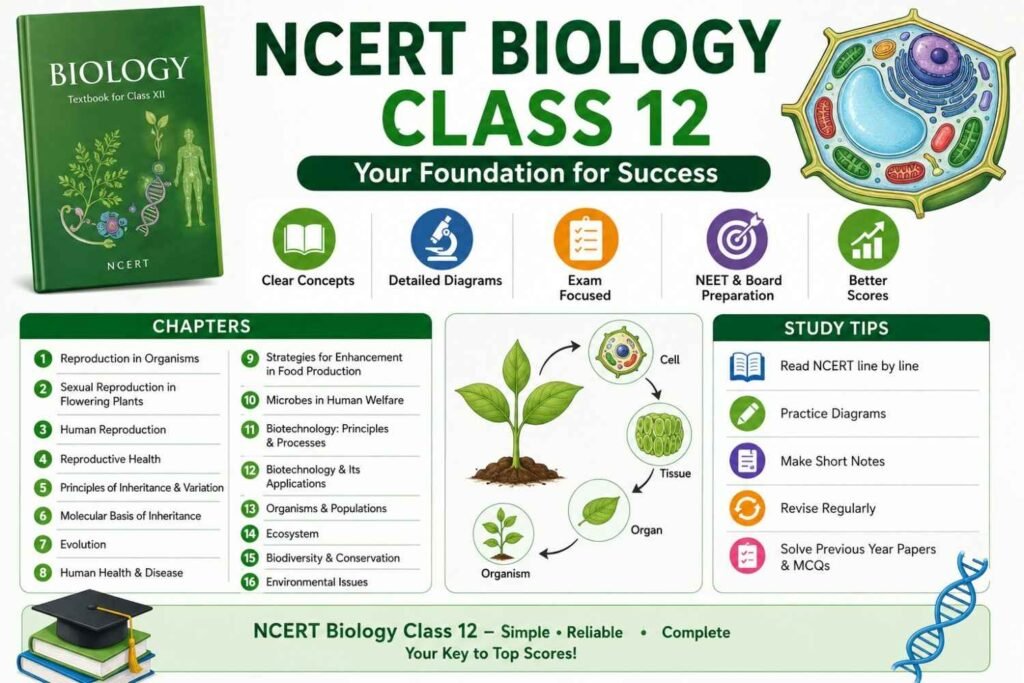
Quick Snapshot: NCERT Biology Class 12
| Feature | Details |
|---|---|
| Book Title | Biology — Textbook for Class XII |
| Publisher | NCERT (National Council of Educational Research and Training) |
| Total Units | 4 Units (as per latest NEP-aligned edition) |
| Total Chapters | 10 Chapters (revised 2023 edition) |
| Board Exams | CBSE Class 12 Board |
| Competitive Exams | NEET UG, AIIMS (now part of NEET), State PMTs |
| Official NCERT Bio PDF | ncert.nic.in (free, official download) |
| Medium | English and Hindi |
| Recommended Study Time | 3–4 hours/day for 3–4 months |
1. Why NCERT Biology Class 12 Is Non-Negotiable
Before we dive into chapters, let’s address the most common question students ask: “Do I really need to read NCERT word-for-word? Can’t I just use notes?”
Here’s the honest answer backed by years of NEET toppers’ strategies:
For NEET:
- 85–90% of NEET Biology questions are directly from NCERT Biology Class 11 and 12 textbooks
- Many questions use exact NCERT language — one changed word can make the difference between right and wrong
- NEET 2024 and 2025 papers consistently show that students who read NCERT multiple times significantly outperform those who rely on secondary sources
For CBSE Board Exams:
- Board questions are set by CBSE based entirely on NCERT content and NCERT exemplar
- 3-mark and 5-mark questions directly mirror NCERT diagrams and explanations
- One-word answers and MCQs in boards are lifted verbatim from NCERT lines
Bottom line: No reference book, no coaching notes, no YouTube summary replaces NCERT. Use everything else alongside NCERT — never instead of it.
2. NCERT Biology Class 12 — Complete Chapter List (Revised 2023 Edition)
NCERT revised its Class 12 Biology textbook in 2023, reducing chapters from 16 to 10. Here is the complete updated structure:
Unit 6: Reproduction
Chapter 1: Reproduction in Organisms Chapter 2: Sexual Reproduction in Flowering Plants Chapter 3: Human Reproduction Chapter 4: Reproductive Health
Unit 7: Genetics and Evolution
Chapter 5: Principles of Inheritance and Variation Chapter 6: Molecular Basis of Inheritance Chapter 7: Evolution
Unit 8: Biology in Human Welfare
Chapter 8: Human Health and Disease
Unit 9: Biotechnology
Chapter 9: Biotechnology: Principles and Processes Chapter 10: Biotechnology and Its Applications
Note: The NCERT Biology Class 12 book was revised in 2023 and reduced from 16 chapters to 10. If you’re using an older edition, make sure to cross-reference with the latest edition available at ncert.nic.in
3. Chapter-Wise Summary: What You Must Know
Chapter 1: Reproduction in Organisms
This chapter lays the foundation for all reproductive biology covered in subsequent chapters.
Key Concepts:
- Asexual vs Sexual Reproduction — definitions, differences, examples
- Types of asexual reproduction: Binary fission, Budding, Fragmentation, Spore formation, Vegetative propagation
- Sexual reproduction: Pre-fertilization, Fertilization, Post-fertilization events
- Juvenile/Vegetative phase vs Reproductive phase vs Senescence
- Oestrous cycle vs Menstrual cycle
Most Important for NEET/Boards:
- Definitions of: Parthenogenesis, Gametogenesis, Syngamy, Amphimixis
- Examples of organisms showing each type of asexual reproduction
- Why sexual reproduction creates more variation than asexual
Important NCERT Lines to Memorize:
- “Reproduction is essential for the continuity of species”
- Difference between internal and external fertilization with examples
Chapter 2: Sexual Reproduction in Flowering Plants
One of the highest-weightage chapters in both NEET and boards. Diagrams are critically important here.
Key Concepts:
- Flower structure: Male and female reproductive parts
- Microsporogenesis: Formation of pollen grains from microspore mother cell
- Megasporogenesis: Formation of embryo sac
- Pollination types: Autogamy, Geitonogamy, Xenogamy
- Pollination agents: Wind (Anemophily), Water (Hydrophily), Insects (Entomophily)
- Double fertilization — unique to angiosperms
- Endosperm development: Nuclear, Cellular, Helobial types
- Embryo development: Dicot embryo structure
- Seed structure, fruit development, apomixis, polyembryony
Must-Know Diagrams:
- T.S. of anther (showing microsporangia, tapetum, microspore mother cells)
- Structure of mature pollen grain (exine, intine, generative cell, vegetative cell)
- 7-celled 8-nucleate embryo sac (Polygonum type)
- Dicot embryo structure (radicle, plumule, cotyledons, epicotyl, hypocotyl)
NEET Tip: Double fertilization questions appear almost every year. Know the exact nuclei involved — one sperm fuses with egg (syngamy), another with secondary nucleus (triple fusion → endosperm).
Chapter 3: Human Reproduction
High-scoring chapter with clear factual content. Master this and you’re almost guaranteed full marks.
Key Concepts:
- Male reproductive system: Structure of testis, seminiferous tubules, Sertoli cells, Leydig cells
- Spermatogenesis: Spermatogonia → Primary spermatocyte → Secondary spermatocyte → Spermatid → Sperm
- Sperm structure: Head (acrosome + nucleus), Middle piece (mitochondria), Tail (flagellum)
- Female reproductive system: Ovary, Fallopian tube (infundibulum, ampulla, isthmus), Uterus, Vagina
- Oogenesis: Oogonia → Primary oocyte → Secondary oocyte → Ovum
- Menstrual cycle: Menstrual phase (1–5 days), Proliferative phase (6–13), Ovulatory phase (14), Secretory/Luteal phase (15–28)
- Fertilization in the ampulla of fallopian tube
- Implantation: Blastocyst embeds in endometrium
- Placenta: Functions (nutrition, respiration, excretion, hormone production — hCG, progesterone, estrogen)
- Parturition: Oxytocin role
Must-Know Diagrams:
- Section of seminiferous tubule
- Structure of sperm
- Section of ovary (showing different follicle stages: Primordial → Primary → Secondary → Graafian)
- Female reproductive system
NEET Tip: The order of hormones controlling the menstrual cycle — GnRH → FSH/LH → Estrogen → LH surge → Ovulation → Progesterone — appears frequently. Know this sequence perfectly.
Chapter 4: Reproductive Health
Conceptual chapter with national health programme details and terminology.
Key Concepts:
- Reproductive Health — WHO definition; National Reproductive and Child Health Care programme
- Population explosion: Reasons, impact
- Contraceptive methods:
- Natural: Periodic abstinence, Lactational amenorrhoea, Coitus interruptus
- Barrier: Condoms, Diaphragms, Cervical caps, Vaults
- IUDs: Non-medicated (Lippes Loop), Copper-releasing (CuT, Cu7, Multiload 375), Hormone-releasing (LNG-20, Progestasert)
- Oral contraceptives: Combined pills, Mini-pills
- Emergency contraceptives
- Surgical: Vasectomy, Tubectomy
- MTP (Medical Termination of Pregnancy): Legal up to 20 weeks in India
- STDs/RTIs: Types, examples (HIV, Gonorrhoea, Syphilis, Hepatitis B, Chlamydia)
- Infertility and Assisted Reproductive Technologies (ART): IVF-ET, ZIFT, GIFT, ICSI, AI
NEET Tip: ART full forms and procedures are frequently asked. Know: IVF = In Vitro Fertilisation; ZIFT = Zygote Intra Fallopian Transfer; GIFT = Gamete Intra Fallopian Transfer; ICSI = Intra Cytoplasmic Sperm Injection.
Chapter 5: Principles of Inheritance and Variation
One of the most concept-heavy and high-weightage chapters. Genetics problems are almost guaranteed in NEET.
Key Concepts:
- Mendel’s Laws: Law of Dominance, Law of Segregation, Law of Independent Assortment
- Monohybrid and Dihybrid crosses — ratios and exceptions
- Deviations from Mendelism:
- Incomplete dominance (Mirabilis jalapa — flower color)
- Codominance (ABO blood groups)
- Multiple alleles (ABO system — IA, IB, i)
- Polygenic inheritance (skin color)
- Pleiotropy (one gene affects multiple traits — sickle cell anaemia)
- Chromosomal Theory of Inheritance: Sutton and Boveri
- Linkage and Recombination: Morgan’s work on Drosophila
- Mutation: Point mutation (sickle cell anaemia), chromosomal aberrations
- Sex Determination: XX/XY (humans), ZW/ZZ (birds), XO (grasshopper)
- Sex-linked inheritance: Colour blindness, Haemophilia (X-linked recessive)
- Genetic disorders:
- Autosomal dominant: Myotonic dystrophy
- Autosomal recessive: Sickle cell anaemia, Phenylketonuria (PKU)
- Sex-linked: Colour blindness, Haemophilia A and B
- Chromosomal: Down syndrome (trisomy 21), Klinefelter (XXY), Turner (XO)
Must-Know Genetics Problems:
- Punnett squares for monohybrid and dihybrid crosses
- Blood group inheritance problems
- Sex-linked trait inheritance in pedigree charts
Chapter 6: Molecular Basis of Inheritance
The most important chapter for NEET. Every year, 5–8 questions come from this chapter directly.
Key Concepts:
- DNA structure: Watson and Crick double helix model
- Antiparallel strands, 3’→5′ and 5’→3′ directionality
- Base pairing: A=T (2 H-bonds), G≡C (3 H-bonds)
- B-form DNA: 34Å pitch, 10 base pairs per turn, 3.4Å between bases
- DNA packaging: Nucleosome (146 bp DNA + Histone octamer), Chromatin, Chromosome
- DNA Replication: Semi-conservative (Meselson-Stahl experiment)
- Enzymes: DNA helicase, DNA polymerase III, Primase, DNA ligase, Topoisomerase
- Origin of replication, Replication fork, Leading strand, Lagging strand, Okazaki fragments
- Transcription: Template strand, Coding strand, mRNA synthesis
- RNA polymerase, Promoter, Terminator
- hnRNA, Splicing, capping, tailing (post-transcriptional modifications)
- Genetic Code: Codons, Wobble hypothesis, Start codon (AUG), Stop codons (UAA, UAG, UGA)
- Translation: Ribosomes, tRNA (charged by aminoacyl tRNA synthetase), Initiation-Elongation-Termination
- Gene regulation: Lac Operon (Jacob and Monod) — Inducer, Operator, Structural genes (lacZ, lacY, lacA)
- Human Genome Project: VNTR, SNPs, Sequence assembly
- DNA Fingerprinting: Alec Jeffreys, Uses, Probes, Autoradiography
Must-Know Diagrams:
- DNA double helix with measurements
- Semi-conservative replication diagram
- Transcription unit (Template strand, Structural gene, Promoter, Terminator)
- Lac Operon (Inducible system) — both induced and uninduced states
NEET Tip: This chapter alone can make or break your NEET Biology score. Read every line of NCERT Biology Class 12 Chapter 6. The Meselson-Stahl experiment, lac operon diagram, and DNA replication enzyme functions appear almost every year.
Chapter 7: Evolution
Conceptual chapter — understand the logic, don’t just memorize.
Key Concepts:
- Origin of life: Miller and Urey experiment (amino acids from inorganic molecules), Oparin-Haldane hypothesis (Primordial soup)
- Evolution theories:
- Lamarckism: Inheritance of acquired characters (incorrect)
- Darwinism: Natural selection, Survival of the fittest
- Neo-Darwinism (Modern Synthesis): Genetic variation + Natural selection
- Evidences of evolution: Fossil record, Comparative anatomy (Homologous vs Analogous organs), Embryology, Biogeography
- Mechanisms of evolution: Mutation, Genetic drift (Founder effect, Bottleneck effect), Gene flow, Natural selection
- Hardy-Weinberg principle: Gene pool equilibrium (p² + 2pq + q² = 1)
- Adaptive radiation: Darwin’s finches, Marsupials in Australia
- Human evolution: Homo habilis → Homo erectus → Homo heidelbergensis → Homo sapiens
NEET Tip: Hardy-Weinberg numerical problems have appeared in NEET. Practice calculating allele frequencies.
Chapter 8: Human Health and Disease
High-yield chapter for NEET — questions are factual and directly from NCERT.
Key Concepts:
- Types of diseases: Congenital vs Acquired; Infectious vs Non-infectious
- Pathogens and their diseases:
- Bacteria: Typhoid (Salmonella typhi — Widal test), Pneumonia (Streptococcus pneumoniae), Cholera
- Viruses: Common cold, Dengue (Aedes mosquito), Chikungunya, Hepatitis, AIDS
- Protozoa: Malaria (Plasmodium — female Anopheles mosquito), Amoebiasis, Ascariasis
- Fungi: Ringworm (Microsporum, Trichophyton, Epidermophyton)
- Helminths: Ascariasis (Ascaris lumbricoides), Filariasis (Wuchereria bancrofti)
- Malaria life cycle: Sporozoites → Liver (schizogony) → RBCs (merozoites) → Sexual forms in mosquito
- Immunity:
- Innate (non-specific): Barriers, phagocytosis, inflammation
- Acquired (specific): Active (vaccines) and Passive (ready-made antibodies)
- Humoral immunity: B cells → Plasma cells → Antibodies (IgG, IgM, IgA, IgE, IgD)
- Cell-mediated immunity: T cells (Helper T, Cytotoxic T, Memory T)
- Antibody structure: Y-shaped, 4 polypeptide chains (2H + 2L), constant and variable regions
- Lymphoid organs: Primary (Thymus, Bone marrow), Secondary (Spleen, Lymph nodes, Tonsils, MALT)
- AIDS: HIV, retrovirus, attacks CD4+ T-helper cells, ELISA test
- Cancer: Types, carcinogens, oncogenes, proto-oncogenes, metastasis
- Drugs and Alcohol: Types of drugs, effects, dependence, de-addiction
NEET Tip: The Malaria life cycle, HIV replication cycle, and antibody structure are extremely high-yield. Draw and label these from memory before the exam.
Chapter 9: Biotechnology — Principles and Processes
Technical chapter with core molecular biology concepts.
Key Concepts:
- Principles of Biotechnology: Genetic engineering + Maintaining sterile ambience
- Tools of genetic engineering:
- Restriction enzymes (Restriction Endonucleases): EcoRI, BamHI, HindIII — palindromic sequences, sticky ends, blunt ends
- Vectors: Plasmids (pBR322 — has ampR, tetR genes), Bacteriophages (λ phage, M13), Cosmids, BAC, YAC
- Retroviruses as vectors
- Cloning: Steps — Isolation of DNA, Restriction digestion, Ligation, Insertion into host, Selection
- pBR322 details: ori, rop gene, ampicillin and tetracycline resistance genes
- PCR (Polymerase Chain Reaction): Denaturation, Annealing, Extension; Taq polymerase
- Gel Electrophoresis: Separation of DNA by size; agarose gel; EtBr staining; UV visualization
- Recombinant DNA technology in action: Insulin production (Eli Lilly)
- Bioreactors: Stirred tank, Sparged stirred tank; scale-up from lab to industrial
Must-Know Details:
- EcoRI cuts at: 5’…G↓AATTC…3′ / 3’…CTTAA↑G…5′
- Palindromic sequences concept
- pBR322 map with labeled components
Chapter 10: Biotechnology and Its Applications
Applied chapter — connecting biotechnology to real-world use cases.
Key Concepts:
- Genetically Modified Organisms (GMOs):
- Bt crops: Bacillus thuringiensis toxin genes (cry genes) — Bt cotton (bollworm resistance), Bt brinjal
- Herbicide-tolerant crops
- Golden Rice: β-carotene enriched, developed to address Vitamin A deficiency
- Flavr Savr tomato: Delayed ripening
- Biopiracy: Use of biological resources without authorization; Neem controversy, Turmeric patent case
- Gene therapy: Somatic vs Germline; ADA (Adenosine Deaminase) deficiency — first gene therapy case
- Molecular diagnostics: PCR for HIV, ELISA for various diseases
- Transgenic animals: Rosie the cow (human alpha-lactalbumin milk), transgenic mice for biomedical research
- Ethics in biotechnology: GMO debate, GEAC (Genetic Engineering Appraisal Committee) — India’s regulatory body
4. NCERT Biology Class 12 PDF: Where to Download Officially
Many students search for NCERT Biology Class 12 PDF or NCERT 12th Biology book PDF — here’s the official, free, legal way to get it:
Official Source: ncert.nic.in
Steps to download NCERT Bio Class 12 PDF:
- Go to ncert.nic.in
- Click on “Textbooks” in the top navigation
- Select “Class XII”
- Select “Biology”
- You can download the full book or individual chapters as PDF
What’s available free on the official NCERT website:
- Complete NCERT Biology Class 12 PDF (English and Hindi)
- Chapter-wise PDF downloads
- NCERT Exemplar problems (additional practice questions)
- NCERT Solutions (for some subjects)
Important: Always use the official NCERT website (ncert.nic.in) for your textbooks. Third-party sites may host outdated editions. The 2023 revised edition significantly changed the chapter structure — make sure you have the correct version.
NCERT DIKSHA App
The DIKSHA app (by NCERT/Government of India) also provides:
- Free NCERT textbooks in digital format
- QR code-based additional content
- Audio and video supplements for each chapter
Available on Android and iOS — completely free.
5. NCERT Biology Class 12: Important Diagrams You Cannot Skip
Diagrams carry significant marks in CBSE boards (often 2–3 marks each) and help visualize concepts for NEET MCQs. Here are the non-negotiable diagrams every Class 12 Biology student must be able to draw and label:
| Chapter | Must-Draw Diagrams |
|---|---|
| Ch 2 | T.S. of anther, Pollen grain structure, 7-celled embryo sac, Dicot embryo |
| Ch 3 | Seminiferous tubule section, Sperm structure, Graafian follicle, Female reproductive system |
| Ch 5 | Monohybrid cross (Punnett square), Dihybrid cross, Pedigree charts |
| Ch 6 | DNA double helix (with measurements), Semi-conservative replication, Lac operon, Transcription unit |
| Ch 8 | Antibody structure (Y-shape with H and L chains), HIV life cycle, Malaria life cycle |
| Ch 9 | pBR322 plasmid map, Gel electrophoresis, Bioreactor (stirred tank) |
How to practice diagrams: Draw each diagram 3–4 times from memory. Label every component. Compare with NCERT after each attempt. Focus on correct positioning of labels — CBSE examiners check specificity of labeling.
6. NCERT Biology Class 12: Chapter-Wise Weightage for NEET and CBSE Boards
NEET Biology Weightage (Class 12 Portion)
| Chapter | NEET Weightage (Approx.) |
|---|---|
| Molecular Basis of Inheritance | 8–10 questions |
| Human Reproduction | 4–6 questions |
| Sexual Reproduction in Flowering Plants | 4–6 questions |
| Principles of Inheritance and Variation | 4–6 questions |
| Human Health and Disease | 4–5 questions |
| Biotechnology Principles and Applications | 4–5 questions |
| Reproductive Health | 2–3 questions |
| Evolution | 2–3 questions |
| Reproduction in Organisms | 1–2 questions |
The Class 12 NCERT Biology syllabus contributes approximately 45–48 out of 90 questions in NEET Biology. Class 11 NCERT Biology covers the remaining 42–45 questions.
CBSE Board Exam Weightage (Theory: 70 marks)
| Unit | Marks |
|---|---|
| Unit 6: Reproduction | 16 marks |
| Unit 7: Genetics and Evolution | 20 marks |
| Unit 8: Biology and Human Welfare | 12 marks |
| Unit 9: Biotechnology | 12 marks |
| (Class 11 Units) | 10 marks |
7. Smart Study Strategy for NCERT Biology Class 12
The 3-Read Method That Toppers Use
First Read (Understanding):
- Read the full chapter without highlighting
- Focus on understanding the story/concept flow
- Don’t try to memorize — just comprehend
Second Read (Active Reading):
- Read with a pen in hand
- Underline key definitions, important organisms/examples, enzyme names, and numerical data
- Make margin notes of “Why does this happen?”
- Draw rough diagrams alongside
Third Read (Revision):
- Read only your underlined content
- Close the book and try to write key points from memory
- Check and fill gaps
Subject-Wise Daily Schedule (For NEET Preparation)
| Slot | Activity |
|---|---|
| Morning (2 hours) | NCERT Biology — 1 chapter detailed reading |
| Afternoon (1 hour) | Previous year NEET questions from that chapter |
| Evening (1 hour) | Diagram practice from today’s chapter |
| Night (30 minutes) | Revision of key terms and definitions |
The 30-Day NCERT Biology Class 12 Completion Plan
| Days | Chapters |
|---|---|
| Day 1–3 | Chapter 1: Reproduction in Organisms |
| Day 4–7 | Chapter 2: Sexual Reproduction in Flowering Plants |
| Day 8–11 | Chapter 3: Human Reproduction |
| Day 12–14 | Chapter 4: Reproductive Health |
| Day 15–19 | Chapter 5: Principles of Inheritance and Variation |
| Day 20–24 | Chapter 6: Molecular Basis of Inheritance |
| Day 25–26 | Chapter 7: Evolution |
| Day 27–28 | Chapter 8: Human Health and Disease |
| Day 29 | Chapter 9: Biotechnology Principles |
| Day 30 | Chapter 10: Biotechnology Applications |
After completing all chapters once, start the revision cycle: complete all 10 chapters again in 15 days, focusing only on high-weightage content and previous year questions.
8. NCERT Biology Class 12 Exemplar: Why You Need It
The NCERT Exemplar for Class 12 Biology is a separate book that contains higher-order thinking questions (HOTS) — going beyond the standard textbook exercises.
Why Exemplar is important:
- CBSE board 3-mark and 5-mark questions sometimes follow Exemplar patterns
- NEET questions increasingly test application of NCERT concepts — Exemplar bridges this gap
- Includes additional MCQs, short answer, and assertion-reason questions
Where to get it: Free PDF download at ncert.nic.in (same website as main textbook)
9. Common Mistakes Students Make with NCERT Biology Class 12
Mistake 1: Reading once and moving on NCERT Biology must be read at least 3–4 times. Once is never enough. Revision is where actual learning happens.
Mistake 2: Skipping in-text questions The questions within NCERT chapters (before exercises) are important. Many board and NEET questions are derived from in-text questions. Never skip them.
Mistake 3: Relying only on short notes Short notes and summaries are useful for quick revision, but they can’t replace reading the actual NCERT text. Many NEET questions hinge on specific words used in NCERT that don’t appear in notes.
Mistake 4: Ignoring the examples Organisms, examples, and specific species mentioned in NCERT (e.g., Penicillium notatum — penicillin; Agrobacterium tumefaciens — Ti plasmid) frequently appear in NEET as direct MCQ options.
Mistake 5: Not practicing diagrams Diagrams are 15–20% of board exam marks. Students who can draw accurate, labeled diagrams score significantly higher.
Mistake 6: Using an outdated edition NCERT revised Class 12 Biology in 2023. Using the old 16-chapter edition means studying removed content and potentially missing new content. Always verify your edition at ncert.nic.in.
10. Frequently Asked Questions
Q: Where can I download the NCERT Biology Class 12 PDF?
A: The official, free NCERT Biology Class 12 PDF is available at ncert.nic.in. Go to Textbooks → Class XII → Biology. You can download chapter-wise or the full book. This is completely free and always has the latest revised edition.
Q: How many chapters are in NCERT Biology Class 12?
A: The revised 2023 edition of NCERT Biology Class 12 has 10 chapters across 4 units. (Earlier editions had 16 chapters — always verify you’re using the latest edition.)
Q: Is NCERT Biology Class 12 sufficient for NEET?
A: NCERT Biology Class 12 (and Class 11) forms the backbone of NEET Biology. Around 85–90% of NEET Biology questions are directly from NCERT. However, NEET toppers also use NCERT Exemplar and solve 10 years of previous year papers alongside NCERT.
Q: Which chapter of NCERT Biology Class 12 is most important for NEET?
A: Chapter 6 (Molecular Basis of Inheritance) consistently yields the most NEET questions (8–10 per year). Chapters 2, 3, 5, and 8 are also very high-weightage.
Q: Is the 2023 revised NCERT Biology Class 12 different from the old version?
A: Yes, significantly. NCERT reduced the book from 16 to 10 chapters in the 2023 revision. Several chapters were removed or merged. If you’re preparing for 2025–26 boards or NEET 2026, use the current 10-chapter edition.
Q: Should I study NCERT Biology Class 12 in Hindi or English?
A: Study in whichever language you’re most comfortable with. The NCERT Biology content is identical in both Hindi and English editions. For NEET, note that the official question paper is available in English and regional languages — choose based on your comfort.
Q: What is the NCERT Bio Class 12 syllabus for CBSE 2025–26?
A: The CBSE 2025–26 syllabus for Biology Class 12 follows the revised NCERT textbook (2023 edition) with 10 chapters across 4 units. The full updated syllabus is available at cbseacademic.nic.in.
Final Thoughts: Your NCERT Biology Class 12 Action Plan
NCERT Biology Class 12 is not just another textbook. It’s the foundation of your board exam performance and your NEET score. Students who truly master it — who can recall NCERT lines, draw every diagram, and explain every concept from memory — are the ones who score 160+ in NEET Biology and 90+ in CBSE boards.
Here’s your immediate action plan:
- Download the latest edition from ncert.nic.in right now — verify it has 10 chapters
- Start with Chapter 6 (Molecular Basis of Inheritance) if you’re preparing for NEET — highest weightage
- Use the 3-Read Method — understand, then highlight, then revise
- Practice diagrams daily — 30 minutes every evening
- Solve 10 years of NEET past papers chapter by chapter alongside NCERT reading
- Download NCERT Exemplar and use it for HOTS practice
The book is free. The strategy is clear. All that’s left is you putting in the work.
Good luck — your NEET and board preparation starts with the book in your hands. 📚