Top Microbiology Colleges in India 2026: How to Choose the Best College for Your Future
You can’t see them with the naked eye — but bacteria, viruses, fungi, and microorganisms shape everything around us. They cause disease and cure it. They’re used to make life-saving antibiotics, ferment your food, clean up oil spills, and are now at the center of cutting-edge cancer immunotherapy.
If the invisible world of microbes fascinates you, then Microbiology might just be your calling.
In 2026, with India’s pharmaceutical industry ranked 3rd globally, the biotech sector growing at 14% annually, and the entire world having experienced a pandemic that underscored the critical importance of microbiologists — the demand for trained microbiology professionals has never been stronger.
But choosing between the hundreds of Microbiology colleges in India is genuinely confusing. B.Sc or B.Tech? Government or private? Mumbai or Bengaluru? This guide gives you the complete roadmap — from what Microbiology really is, to the top colleges, fees, careers, and how to make the smartest decision for your future.
Table of contents
- Top Microbiology Colleges in India 2026: How to Choose the Best College for Your Future
- Quick Snapshot: Microbiology in India 2026
- 1. What Is Microbiology? — The Field That Changes Everything
- 2. Microbiology Eligibility and Admission 2026
- 3. How to Choose the Best Microbiology College: 7 Factors That Matter
- 4. Top Microbiology Colleges in India 2026
- 5. Microbiology Fees: What to Expect
- 6. Microbiology Syllabus: What You’ll Study
- 7. Career Paths After Microbiology
- 8. Quick Decision Guide: Which Microbiology College Is Right for You?
- 9. Frequently Asked Questions
- Final Verdict: Choosing the Best Microbiology College for You
Quick Snapshot: Microbiology in India 2026
| Feature | Details |
|---|---|
| UG Programme | B.Sc Microbiology / B.Tech Microbiology |
| UG Duration | 3 Years (B.Sc) / 4 Years (B.Tech) |
| PG Programme | M.Sc Microbiology |
| PG Duration | 2 Years |
| Research Programme | PhD Microbiology (3–5 Years) |
| Eligibility | Class 12 with PCB or PCMB |
| Minimum Marks | 50–55% in Class 12 |
| Key Entrance Exams | CUET, State CETs, University Tests |
| Average Starting Salary | INR 3 – 6 LPA |
| Senior Microbiologist Salary | INR 10 – 25+ LPA |
| Top Employers | Sun Pharma, Biocon, CSIR Labs, WHO, ICMR, Cipla, Nestlé |
1. What Is Microbiology? — The Field That Changes Everything
Microbiology: Science at the Smallest Scale
Microbiology is the scientific study of microorganisms — bacteria, viruses, fungi, protozoa, algae, and prions. These invisible organisms influence virtually every aspect of life on Earth, from the food we eat and the air we breathe to the medicines that save lives.
A microbiologist works across a remarkable range of fields:
- Medical Microbiology — Understanding pathogens, diagnosing infections, developing antibiotics and antivirals
- Industrial Microbiology — Fermentation, biofuel production, enzyme manufacturing
- Food Microbiology — Ensuring food safety, developing probiotics, preventing contamination
- Environmental Microbiology — Bioremediation, water purification, soil health
- Pharmaceutical Microbiology — Drug development, quality control, sterility testing
- Immunology — Vaccines, immune system disorders, cancer immunotherapy
- Virology — Studying viruses, developing antiviral drugs, pandemic preparedness
- Microbial Genetics and Genomics — Gene editing, synthetic biology, CRISPR applications
Microbiology is not just a science — it’s the foundation of modern medicine, biotechnology, agriculture, and environmental science.
Who Should Study Microbiology?
You’re a strong fit for B.Sc or M.Sc Microbiology if you:
- Are fascinated by life at the microscopic level
- Enjoy laboratory work — experiments, cultures, microscopy
- Want to contribute to healthcare, pharmaceutical, or food science industries
- Are drawn to research, public health, or environmental science
- Have strong Biology and Chemistry knowledge from Class 12
Microbiology vs Biotechnology vs Biochemistry
| Programme | Focus | Career Path |
|---|---|---|
| Microbiology | Microorganisms, infections, fermentation, immunology | Clinical labs, pharma QC, research, food safety |
| Biotechnology | Genetic engineering, bioprocesses, drug development | Biotech industry, agri-biotech, biopharmaceuticals |
| Biochemistry | Chemical processes in living organisms | Clinical chemistry, drug metabolism, forensic science |
If you love organisms and their role in disease and industry → Microbiology If you love engineering biological systems → Biotechnology If you love chemistry inside living cells → Biochemistry
2. Microbiology Eligibility and Admission 2026
Eligibility for B.Sc Microbiology
- Class 12 with Biology and Chemistry as mandatory subjects (PCB or PCMB stream)
- Physics as an additional subject is preferred by most colleges
- Minimum 50–60% aggregate in Class 12 (some premier institutions require 60–70%)
- Students from the Commerce or Arts stream are generally not eligible unless they have Biology and Chemistry
Eligibility for M.Sc Microbiology
- B.Sc in Microbiology, Biotechnology, Life Sciences, Biochemistry, or a related field
- Minimum 55% aggregate in graduation (50% for SC/ST at many institutions)
- Some universities accept B.Pharma or B.Tech Biotechnology graduates as well
Entrance Exams for Microbiology Colleges in India
| Exam | Conducting Body | Institutions Accepting |
|---|---|---|
| CUET (UG) | NTA | Central and most private universities |
| CUET-PG | NTA | M.Sc admissions at central universities |
| BHU UET | Banaras Hindu University | BHU Varanasi |
| DUET / DU JAT | Delhi University | Miranda House, Hansraj, Lady Irwin |
| JEST | Dept. of Science & Technology | IISc, TIFR, national science institutions |
| JAM | IITs | M.Sc at IITs (Biological Sciences) |
| State CETs | Various state governments | State university B.Sc/M.Sc programmes |
| University Tests | Individual institutions | Amity, Manipal, Christ, etc. |
Pro Tip: For M.Sc Microbiology at IITs (via Biological Sciences), clearing IIT JAM is the gold standard. For government college B.Sc admissions, CUET is your most important exam.
3. How to Choose the Best Microbiology College: 7 Factors That Matter
Factor 1: NAAC Accreditation and UGC Recognition
Choose a UGC-recognized college with NAAC A or A+ accreditation. This ensures academic quality, valid degrees, and eligibility for government scholarships and fellowships.
Factor 2: Laboratory Infrastructure
Microbiology is 60% laboratory work. The quality of labs makes or breaks your education. Look for:
- Microbiology and bacteriology labs with proper biosafety cabinets
- Microscopy and imaging equipment (Phase contrast, fluorescence microscopes)
- PCR, gel electrophoresis, and molecular biology facilities
- Media preparation rooms and fermentation equipment
- Biosafety Level 2 (BSL-2) certified labs
Factor 3: Faculty Research and Publications
Is the faculty publishing research in peer-reviewed journals? Do professors have ongoing research projects in antimicrobial resistance, virology, or industrial microbiology? Active research faculty = better mentorship and thesis quality.
Factor 4: Industry and Hospital Tie-Ups
Top Microbiology colleges have partnerships with:
- Pharmaceutical companies (Sun Pharma, Cipla, Mankind, Lupin) for industrial microbiology internships
- Hospitals and diagnostic labs for clinical microbiology exposure
- Food companies (Nestlé, Amul, ITC) for food microbiology training
- CSIR labs (IMTECH, CCMB, NCCS) for research fellowships
Factor 5: Placement and Higher Education Records
Check specifically:
- What percentage of B.Sc graduates get placed vs go for M.Sc?
- Which pharmaceutical or biotech companies recruit from this campus?
- How many students qualify for CSIR-NET, IIT-JAM, or DBT-JRF every year? (This is the true quality indicator for science colleges)
Factor 6: Location Near Pharma/Biotech Hubs
Colleges near major pharma clusters have a natural internship and placement advantage:
- Hyderabad — India’s Genome Valley; home to Bharat Biotech, Dr. Reddy’s, Shantha Biotech
- Mumbai/Pune — Major pharma and food science hub
- Bengaluru — Biocon, Strand Life Sciences, multiple CSIR labs
- Delhi NCR — CSIR-IARI, DRDO biomedical, ICMR headquarters
Factor 7: Competitive Exam Track Record
For a science student, the ultimate career metric is:
- How many students from this college qualify CSIR-NET/JRF (the gateway to research fellowships)?
- How many clear IIT-JAM for M.Sc at IITs?
- How many crack DBT-BET JRF for biotech/microbiology research fellowships?
4. Top Microbiology Colleges in India 2026
Tier 1: Premier Research Institutions
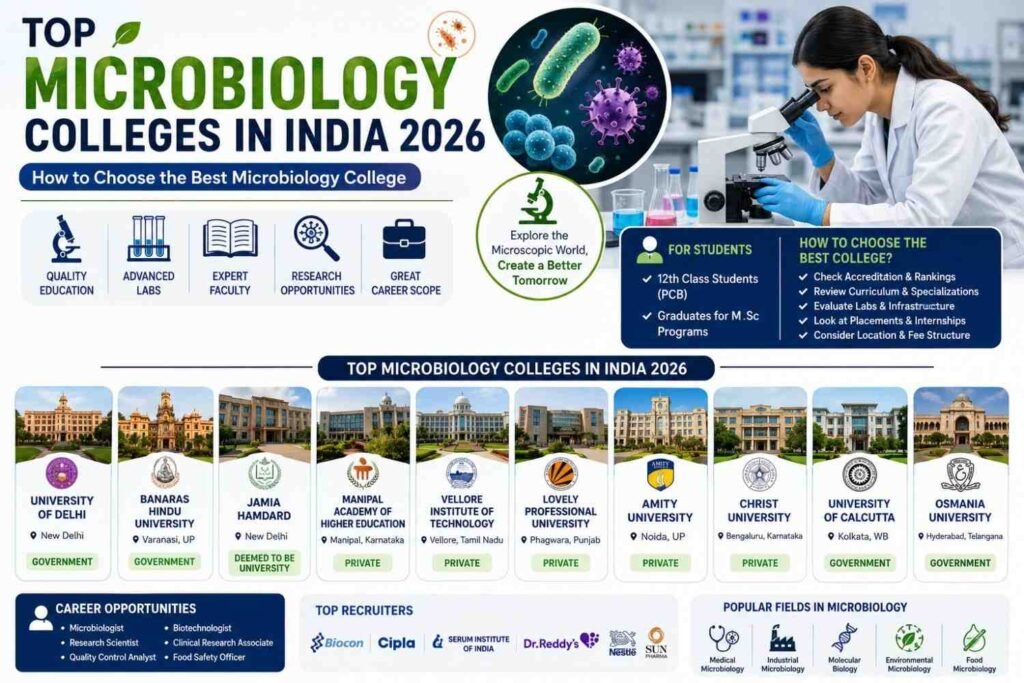
1. University of Delhi (Miranda House, Lady Irwin, Hansraj, Ramjas)
- Delhi University’s B.Sc (H) Microbiology is among India’s most competitive and prestigious UG science programmes
- Miranda House consistently ranks #1 among India’s women’s colleges (NIRF)
- Fees: INR 15,000 – 35,000/year | Admission: CUET + Merit
- Exceptional faculty, alumni network, and track record in CSIR-NET qualifiers
2. Banaras Hindu University (BHU), Varanasi
- One of India’s oldest and most respected central universities
- B.Sc and M.Sc Microbiology with excellent research infrastructure
- Fees: INR 10,000 – 25,000/year | Admission: CUET / BHU UET
- Strong PhD pipeline; central government college quality
3. University of Hyderabad (UoH)
- Among India’s top central universities for Life Sciences and Microbiology
- M.Sc Life Sciences / Microbiology with strong research culture
- Fees: INR 12,000 – 30,000/year | Admission: CUET-PG
- Excellent CSIR-NET qualifying rate; proximity to Hyderabad’s biotech industry
4. Savitribai Phule Pune University (SPPU), Pune
- Maharashtra’s most respected university for science programmes
- Multiple affiliated colleges offering quality B.Sc Microbiology
- Fees (University Departments): INR 15,000 – 40,000/year
- Strong placement in Pune’s pharma and food science sector
5. Presidency University, Kolkata
- Historic institution with excellent science departments
- B.Sc and M.Sc in Microbiology with strong research culture
- Fees: INR 8,000 – 20,000/year | Admission: State CET
- Eastern India’s premier government science college
6. Chandigarh University
- NAAC A+ | B.Sc Microbiology + M.Sc Microbiology
- Strong placement cell; 600+ recruiting companies
- Fees: INR 80,000 – 1.50 Lakh/year | Admission: CUET / CU Scholarship Test
- Scholarships available; North India’s best private option for Microbiology
Tier 2: Top Private Microbiology Colleges in India
1. Christ University, Bengaluru
- NAAC A+ | Consistently ranked among India’s top private universities for science
- B.Sc Microbiology with excellent lab infrastructure and faculty
- Fees: INR 1.20 – 2.00 Lakh/year | Admission: Christ University Entrance + CUET
- Strong placements in Bengaluru’s biotech and pharma sector; good higher study record
2. Manipal Academy of Higher Education (MAHE), Manipal
- NAAC A++ | B.Sc and M.Sc Microbiology
- Access to Manipal Hospitals for clinical microbiology exposure
- Fees: INR 1.50 – 2.50 Lakh/year | Admission: MET
- International collaborations; excellent research opportunities
3. SRM Institute of Science and Technology, Chennai
- NAAC A++ | B.Sc and M.Sc Microbiology with strong South India industry ties
- Research links with Chennai hospitals and pharma companies
- Fees: INR 1.20 – 2.20 Lakh/year | Admission: SRMJEEE / CUET
4. Amity University, Noida
- NAAC A+ | QS World Ranked | B.Sc Microbiology + M.Sc Microbiology
- Strong research centres; industry-aligned curriculum
- Fees: INR 1.50 – 3.00 Lakh/year | Admission: CUET / Amity Entrance
- 800+ recruiters on campus; proximity to Delhi-NCR pharma industry
5. Lovely Professional University (LPU), Phagwara
- NAAC A++ | B.Sc and M.Sc Microbiology with multiple electives
- Large placement cell; scholarships for meritorious students
- Fees: INR 80,000 – 1.50 Lakh/year | Admission: LPUNEST / CUET
6. Jain University, Bengaluru
- NAAC A++ | Strong science programmes; industry-integrated curriculum
- Good placement in Bengaluru’s biotech corridor
- Fees: INR 1.20 – 2.00 Lakh/year
7. Symbiosis International University, Pune
- NAAC A++ | B.Sc Microbiology with excellent research facilities
- Pune’s pharma proximity is a big advantage
- Fees: INR 2.00 – 3.00 Lakh/year | Admission: SET (Symbiosis Entrance Test)
Top Microbiology Colleges State-Wise
| State | Top Microbiology Colleges |
|---|---|
| Delhi | Miranda House (DU), Hansraj College (DU), Lady Irwin College, Ramjas College |
| Maharashtra | SPPU affiliated colleges (Pune), ICT Mumbai, Symbiosis, Fergusson College |
| Karnataka | Christ University (Bengaluru), Jain University, Manipal, St. Joseph’s College |
| Tamil Nadu | Stella Maris College (Chennai), PSG College (Coimbatore), SRM, Loyola College |
| Telangana/AP | University of Hyderabad, Osmania University, Bharat Biotech adjacent colleges |
| West Bengal | Presidency University, Calcutta University, Jadavpur University (affiliated) |
| Punjab/Chandigarh | Chandigarh University, Panjab University, LPU |
| UP | BHU Varanasi, AMU Aligarh, Amity University Noida, IFTM University |
5. Microbiology Fees: What to Expect
Government/Central University Colleges
| Institution Type | Annual Fee |
|---|---|
| Central Universities (BHU, UoH, DU) | INR 8,000 – 35,000 |
| State Government Colleges | INR 5,000 – 25,000 |
| Government-Aided Autonomous | INR 15,000 – 50,000 |
Private Colleges
| Institution Type | Annual Fee |
|---|---|
| Top Private (Christ, Manipal, Symbiosis) | INR 1.20 – 3.00 Lakh |
| Mid-Tier Private (Amity, SRM, LPU, CU) | INR 80,000 – 2.00 Lakh |
| Entry-Level Private | INR 30,000 – 80,000 |
Scholarships for Microbiology Students
- INSPIRE Scholarship (DST): INR 80,000/year for top 1% students in Class 12 science; renewable for the full B.Sc
- CSIR-JRF (after graduation): INR 37,000/month fellowship for NET-qualified researchers
- DBT-BET JRF: INR 37,000/month for Biotechnology/Microbiology research
- State Government Scholarships: Merit and means-based through NSP portal
- University Merit Scholarships: Most private universities offer 10–100% fee waivers
Key Tip: The INSPIRE Scholarship from the Department of Science & Technology is one of India’s best-kept secrets for science students. If you scored in the top 1% of your state board in Class 12 science — you may already be eligible.
6. Microbiology Syllabus: What You’ll Study
A strong B.Sc Microbiology curriculum covers:
Year 1 — Foundations
- General Microbiology (bacteria, fungi, viruses, protozoa)
- Biochemistry Basics
- Cell Biology
- Lab Techniques (microscopy, staining, sterilization)
- Mathematics and Statistics for Life Sciences
Year–2 — Core Microbiology
- Medical Microbiology
- Mycology (Fungi)
- Virology
- Immunology
- Environmental Microbiology
- Industrial Microbiology and Fermentation
- Microbial Genetics
Year 3 — Advanced and Applied Topics
- Molecular Microbiology and Genomics
- Food Microbiology and Safety
- Pharmaceutical Microbiology
- Antimicrobial Resistance (AMR)
- Clinical Diagnostic Techniques (PCR, ELISA, culture sensitivity)
- Project / Dissertation
M.Sc Microbiology (2 Years) — Specialization Areas
- Advanced Virology and Emerging Infectious Diseases
- Immunotechnology and Vaccines
- Microbial Biotechnology
- Environmental and Agricultural Microbiology
- Bioinformatics for Microbiologists
- Research Dissertation (Mandatory)
7. Career Paths After Microbiology
Jobs After B.Sc/M.Sc Microbiology
| Job Role | Description | Avg. Salary (3–5 yrs) |
|---|---|---|
| Microbiologist (Pharma QC) | Drug sterility and quality testing | INR 4 – 10 LPA |
| Clinical Microbiologist | Diagnostic labs, hospital pathology | INR 5 – 12 LPA |
| Food Microbiologist | Food safety, FSSAI compliance | INR 4 – 9 LPA |
| Research Scientist | Academic or industrial research | INR 6 – 15 LPA |
| Pharmaceutical Scientist | Drug development, fermentation | INR 6 – 14 LPA |
| Environmental Microbiologist | Water quality, bioremediation | INR 4 – 10 LPA |
| Medical Lab Technologist | Hospital diagnostic testing | INR 3 – 7 LPA |
| Regulatory Affairs Specialist | FSSAI, CDSCO compliance | INR 6 – 15 LPA |
| Virologist | Virus research, vaccine development | INR 8 – 20 LPA |
| Epidemiologist | Disease tracking, public health | INR 6 – 18 LPA |
Government Jobs After Microbiology
- CSIR/ICMR Research Fellow — Via CSIR-NET/JRF
- Drug Inspector (CDSCO) — Central Drugs Standard Control Organisation
- Food Safety Officer (FSSAI) — Food safety enforcement
- WHO/UNICEF/UNAIDS — International health organizations hire microbiologists
- Defence Research (DRDO) — Biological warfare defence and vaccines
- State Public Health Labs — Diagnostic and surveillance roles
Higher Education After Microbiology
In India:
- M.Sc Microbiology → IITs (via IIT-JAM), JNU, BHU, Hyderabad University
- PhD via CSIR-NET/JRF (best research fellowship in India for science students)
- MBA Healthcare / Regulatory Affairs
Abroad:
- USA: Johns Hopkins School of Public Health, Harvard School of Public Health, University of Michigan, University of Illinois
- UK: London School of Hygiene and Tropical Medicine, Imperial College London
- Germany/Netherlands: Minimal tuition; world-class research universities
8. Quick Decision Guide: Which Microbiology College Is Right for You?
| If you… | Choose… |
|---|---|
| Want the most prestigious science degree | Delhi University (Miranda House, Hansraj) via CUET |
| Want a Central University with minimal fees | BHU Varanasi, University of Hyderabad, Panjab University |
| Want private with hospital/industry exposure | Manipal MAHE, Christ University Bengaluru |
| Are in Maharashtra and want quality private | Symbiosis Pune, Fergusson College Pune |
| Want Delhi-NCR private with strong placements | Amity University Noida |
| Are in North India, want large campus + scholarships | Chandigarh University, LPU |
| Are a graduate targeting M.Sc at IIT | Prepare for IIT-JAM (Biological Sciences) — target IIT Bombay, IIT Delhi |
| Want to go into pharmaceutical research | Prioritize colleges near Hyderabad, Pune, or Mumbai pharma hubs |
9. Frequently Asked Questions
Q: Which is the best college for Microbiology in India in 2026? A: For government colleges: Miranda House (Delhi University), BHU Varanasi, and University of Hyderabad are top choices. For private colleges: Christ University Bengaluru, Manipal MAHE, and Symbiosis Pune are highly regarded.
Q: Is Microbiology a good career choice in 2026? A: Absolutely. Post-pandemic awareness has dramatically increased investment in infectious disease research, vaccine development, and pharmaceutical microbiology. India’s pharma and biotech sectors — both among the world’s fastest-growing — create thousands of microbiologist job openings annually.
Q: What is the salary after Microbiology in India? A: Starting salaries range from INR 3 – 6 LPA for B.Sc/M.Sc graduates. Research scientists with CSIR-JRF fellowship receive INR 37,000/month (plus HRA). With 5–7 years of industry experience, senior microbiologists earn INR 12 – 25 LPA.
Q: Can a PCM (non-Biology) student do Microbiology? A: Most B.Sc Microbiology programmes require Biology as a subject in Class 12. PCM students without Biology are typically not eligible for B.Sc Microbiology, though some private universities may make exceptions. It’s best to confirm with individual colleges.
Q: What entrance exam is needed for Microbiology colleges? A: CUET is the primary exam for central and many private university admissions. For M.Sc at IITs, IIT-JAM (Biological Sciences) is key. CSIR-NET/JRF is essential for pursuing PhD fellowships after graduation.
Q: What is the difference between B.Sc Microbiology and B.Tech Biotechnology? A: B.Sc Microbiology is a 3-year science degree focused on microorganisms, disease, immunology, and industrial applications. B.Tech Biotechnology is a 4-year engineering degree focused on genetic engineering, bioprocessing, and bioproducts. Both overlap significantly but have different career pathways.
Final Verdict: Choosing the Best Microbiology College for You
Microbiology in 2026 is not the passive lab science of a previous generation — it’s at the frontier of pandemic preparedness, precision medicine, synthetic biology, antimicrobial resistance research, and industrial biotechnology. The microbiologists graduating from India’s best colleges this decade will tackle some of humanity’s biggest challenges.
Choose a college that gives you strong lab experience, research exposure, and industry connections. The brand of your college matters less than the quality of your education, the depth of your lab skills, and your ability to clear competitive exams like CSIR-NET.
Whether you’re a Class 12 student choosing your first science degree or a graduate looking for an M.Sc that opens research doors — the right Microbiology college is out there for you.
Study the invisible world. Change the visible one. 🔬