Top Biomedical Engineering Colleges in India 2026: How to Choose the Best Programme
If you’re passionate about both medicine and technology — if you’ve ever wondered how an MRI machine works, how artificial limbs are designed, or how a wearable health monitor tracks your heartbeat — then Biomedical Engineering might be exactly the degree you’ve been looking for.
This field sits at one of the most exciting intersections in the world: engineering meets healthcare. And in 2026, with India’s medical device industry booming and the global healthtech sector valued at over $500 billion, the timing has never been better to pursue a career in Biomedical Engineering.
But as with any niche discipline, choosing from the top Biomedical Engineering colleges in India requires more thought than picking a standard B.Tech programme. This guide covers everything you need — what the field is, how admissions work, the best colleges for UG and PG, fees, careers, and a smart selection framework.
Table of contents
- Top Biomedical Engineering Colleges in India 2026: How to Choose the Best Programme
- Quick Snapshot: Biomedical Engineering in India 2026
- 1. What Is Biomedical Engineering? — The Field Explained
- 2. Biomedical Engineering Eligibility and Admission 2026
- 3. How to Choose the Best Biomedical Engineering College: 7 Key Factors
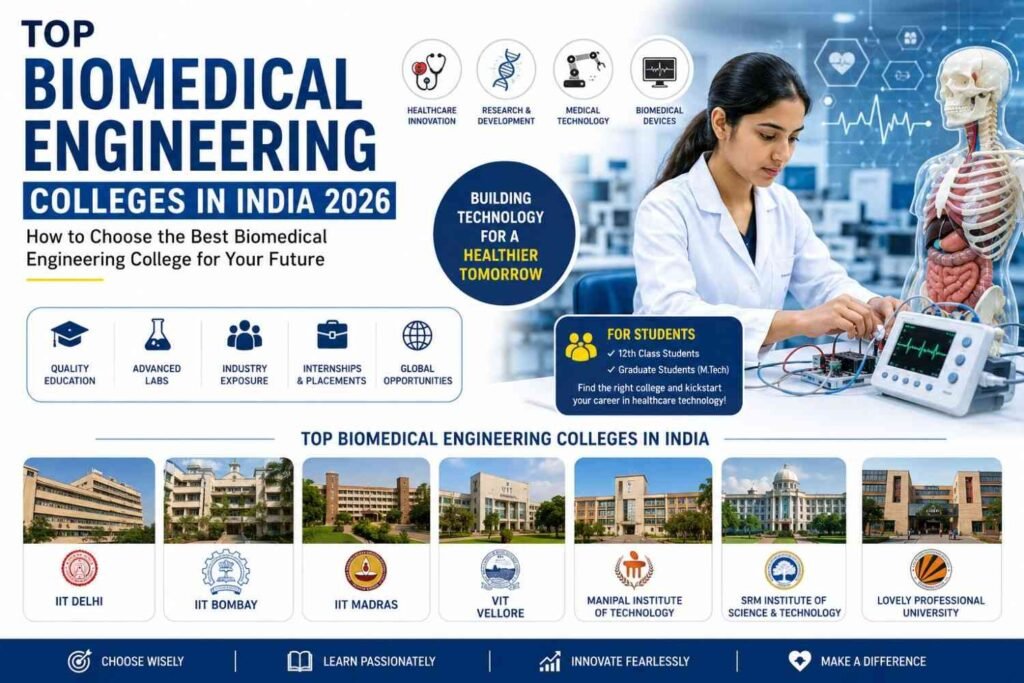
- 4. Top Biomedical Engineering Colleges in India 2026
- 5. NIRF and Rankings: Where BME Colleges Stand
- 6. B.Tech Biomedical Engineering Fees: Complete Breakdown
- 7. Biomedical Engineering Syllabus: What Will You Study?
- 8. Career Paths After Biomedical Engineering
- 9. Quick Decision Guide: Which BME College Is Right for You?
- 10. Frequently Asked Questions
- Final Verdict: Choosing Your Biomedical Engineering College
Quick Snapshot: Biomedical Engineering in India 2026
| Feature | Details |
|---|---|
| UG Programme | B.Tech / B.E. in Biomedical Engineering |
| Duration | 4 Years |
| PG Programme | M.Tech / M.E. in Biomedical Engineering |
| PG Duration | 2 Years |
| Regulatory Body | AICTE, UGC |
| Key Entrance Exams | JEE Main, CUET, NEET (some colleges), State CETs, GATE (PG) |
| Eligibility | Class 12 with PCB or PCM (Physics, Chemistry + Maths or Biology) |
| Average Starting Salary | INR 4 – 8 LPA |
| Senior Engineer Salary | INR 12 – 30+ LPA |
| Top Employers | Siemens Healthineers, GE Healthcare, Philips, Medtronic, Wipro GE, Biocon |
1. What Is Biomedical Engineering? — The Field Explained
Biomedical Engineering: Where Technology Heals
Biomedical–Engineering (BME) is the application of engineering principles and design concepts to medicine and biology for healthcare purposes. Biomedical engineers design, develop, and maintain:
- Medical devices — MRI machines, ventilators, pacemakers, dialysis equipment
- Prosthetics and orthotics — Advanced artificial limbs and braces
- Wearable health tech — Smartwatches, glucose monitors, ECG patches
- Medical imaging systems — CT scanners, ultrasound, X-ray machines
- Biomaterials — Implants, stents, surgical sutures compatible with the human body
- Tissue engineering and regenerative medicine — Lab-grown organs and tissues
- Hospital information systems — Electronic health records, AI diagnostic tools
- Rehabilitation engineering — Devices to help patients recover from injury or illness
Who Should Study Biomedical Engineering?
You’re a natural fit for B.Tech Biomedical Engineering if you:
- Love both biology/human anatomy AND physics/engineering
- Are fascinated by medical devices, healthcare technology, or healthcare innovation
- Want to contribute to saving lives through technology (not as a doctor, but as an engineer)
- Have strong analytical and problem-solving skills
- Are interested in research, innovation, and medical product development
Biomedical Engineering vs Biotechnology vs Bioinformatics
| Programme | Focus | Career |
|---|---|---|
| Biomedical Engineering | Medical devices, health systems, imaging | Device engineer, clinical engineer, R&D |
| Biotechnology | Biological processes, genetic engineering, drugs | Drug development, agri-tech, bioprocessing |
| Bioinformatics | Biological data, genomics, computational biology | Data scientist in pharma/genomics |
If your interest is physical devices and systems in healthcare → Biomedical Engineering is your path. If your interest is biological processes and genetic science → Biotechnology is a better fit.
2. Biomedical Engineering Eligibility and Admission 2026
Eligibility Criteria
- Class 12 with Physics and Chemistry (compulsory)
- Mathematics or Biology as the third subject (many colleges accept PCM OR PCB)
- Minimum 50–60% in Class 12 (varies by college)
- PCM students approach it from an engineering angle; PCB students bring biological science depth — both are valid pathways
Entrance Exams for B.Tech Biomedical Engineering
| Exam | Body | Colleges Accepting |
|---|---|---|
| JEE Main | NTA | NITs, IIITs, and most private engineering colleges |
| CUET | NTA | Central universities, many private universities |
| BITSAT | BITS Pilani | BITS campuses |
| MHT-CET | Maharashtra State | Maharashtra BME colleges |
| KCET | Karnataka | Karnataka BME colleges |
| TANCET | Anna University | Tamil Nadu colleges |
| University-Level Tests | Individual universities | VIT, SRM, Manipal, LPU, etc. |
For M.Tech Biomedical Engineering (PG)
- GATE (Biomedical Engineering / Life Sciences / Engineering Sciences) — Primary exam for government PG colleges
- CUET-PG — Accepted by many private and central universities
- Minimum: B.Tech/BE in Biomedical Engineering, Electrical, Electronics, Mechanical, or Life Sciences with 55–60%
3. How to Choose the Best Biomedical Engineering College: 7 Key Factors
Factor 1: AICTE Approval + NAAC Accreditation
Verify the college is AICTE-approved and NAAC accredited (A or A+). Without AICTE approval, your engineering degree is not recognized for professional practice.
Factor 2: Lab and Research Infrastructure
Biomedical Engineering is a lab-intensive discipline. Look for:
- Medical imaging labs (MRI simulation, ultrasound equipment)
- Biomechanics and prosthetics labs
- Tissue culture and biomaterials labs
- Signal processing labs (ECG, EEG, EMG analysis)
- Clinical simulation facilities (hospital tie-ups for exposure)
Factor 3: Hospital and Healthcare Industry Tie-Ups
The best BME colleges have partnerships with hospitals and medical device companies. This directly translates into:
- Internship opportunities in clinical environments
- Exposure to real medical equipment
- Placement pipelines with healthcare companies
Factor 4: Faculty with Dual Expertise
Biomedical Engineering requires faculty who understand both engineering and medicine. Look for faculty with:
- PhD in biomedical, electrical, or mechanical engineering with healthcare focus
- Research publications in medical imaging, biomaterials, or medical devices
- Industry experience with healthcare companies
Factor 5: Placement in Healthcare/Medtech Companies
Don’t just look at overall placement — specifically check:
- Do Siemens Healthineers, GE Healthcare, Philips Medical, Medtronic, or Stryker recruit from this campus?
- What percentage of BME graduates get placed in core healthcare/medical device roles vs generic IT?
Factor 6: Curriculum with Emerging Healthtech
The 2026-ready BME curriculum should include:
- AI in Medical Imaging
- Wearable Health Technologies
- 3D Bioprinting
- Robotics in Surgery
- Digital Health and Telemedicine
Factor 7: Higher Education Pathways (MS/PhD Abroad)
A strong BME college will have a track record of students going to MIT, Johns Hopkins, Duke, Carnegie Mellon, and IISc for M.S./PhD in biomedical engineering — one of the most popular higher study destinations for Indian BME graduates.
4. Top Biomedical Engineering Colleges in India 2026
Tier 1: IITs and IISc — Premier Research Institutions
1. IIT Bombay — Department of Biosciences and Bioengineering
- India’s top institution for biomedical and bioengineering research
- Offers M.Tech and PhD (not standalone B.Tech BME — BME exposure via inter-disciplinary courses)
- World-class research labs in biomaterials, medical imaging, and tissue engineering
- Why Choose: IIT brand + interdisciplinary research opportunities; unmatched for PG/PhD
2. IIT Madras — Department of Engineering Design + Healthcare Technology
- Strong BME focus through its Center for Healthcare Technologies
- Joint research with major hospitals; excellent medical device R&D
- M.Tech in Biomedical Technology available
- Fees: INR 90,000 – 2 Lakh/year | Admission: JEE Advanced / GATE
3. IIT Kharagpur — School of Medical Science and Technology
- Dedicated School of Medical Science and Technology offering B.Tech + M.Tech in Medical Science and Technology
- One of very few IITs with a dedicated undergraduate biomedical/medical engineering programme
- Fees: INR 2.31 Lakh/year | Admission: JEE Advanced
- Outstanding research culture; clinical exposure with IIT Kharagpur’s own hospital
4. IIT Hyderabad — Department of Biomedical Engineering
- One of the most active IITs in dedicated Biomedical Engineering research
- Offers both B.Tech and M.Tech in Biomedical Engineering
- Research focus: neural engineering, biosensors, medical imaging
- Fees: INR 2 Lakh/year | Admission: JEE Advanced
5. IISc Bangalore — Centre for BioSystems Science and Engineering (BSSE)
- India’s top research institution; not for B.Tech (offers B.S. Research programmes)
- M.Tech and PhD in Biosystems Science and Engineering
- World-class faculty, international research collaborations
- Admission: GATE + Interview | Fees: INR 30,000 – 60,000/year
Tier 2: NITs and Central Institutions
| College | Location | Programme | Annual Fee | Admission |
|---|---|---|---|---|
| NIT Rourkela | Odisha | B.Tech Biomedical Engineering | INR 1.68 Lakh | JEE Main |
| NIT Calicut | Kerala | B.Tech Biomedical Engineering | INR 2.23 Lakh | JEE Main |
| NIT Kurukshetra | Haryana | B.Tech Biomedical Engineering | INR 1.80 Lakh | JEE Main |
| NITS Silchar | Assam | B.Tech Biomedical Engineering | INR 1.60 Lakh | JEE Main |
| IIEST Shibpur | West Bengal | B.Tech Biomedical Engineering | INR 80,000 | JEE Main |
| Jadavpur University | Kolkata | B.Tech Biomedical Engineering | INR 30,000 | JEE Main / WBJEE |
NIT Rourkela deserves a special highlight — it has one of India’s strongest dedicated B.Tech BME programmes among NITs, with excellent lab infrastructure and placements with GE Healthcare and Philips.
Tier 3: Top Private Biomedical Engineering Colleges in India
1. VIT University, Vellore
- B.Tech in Biomedical Engineering — one of India’s most popular private BME programmes
- NAAC A++ | Strong placement record; Siemens Healthineers, GE Healthcare recruit on campus
- Fees: INR 2.00 – 2.80 Lakh/year | Admission: VITEEE
- Highest BME package: INR 25+ LPA | Multiple international research tie-ups
2. SRM Institute of Science and Technology, Chennai
- B.Tech Biomedical Engineering with hospital tie-ups in Chennai’s medical hub
- NAAC A++ | Strong South India placement
- Fees: INR 2.20 – 3.00 Lakh/year | Admission: SRMJEEE
- Research collaborations with AIIMS Delhi, Apollo Hospitals
3. Manipal Academy of Higher Education (MAHE), Manipal
- B.Tech Biomedical Engineering + unique access to Manipal Hospital Group for clinical exposure
- NAAC A++ | International collaborations with European universities
- Fees: INR 2.50 – 3.20 Lakh/year | Admission: MET
- One of the best private colleges for clinical exposure in India
4. Amity University, Noida
- B.Tech Biomedical Engineering with industry-aligned curriculum
- NAAC A+ | QS World Ranked | NIRF ranked
- Fees: INR 3.00 – 4.00 Lakh/year | Admission: JEE Main / CUET
- Access to Amity’s healthcare research centres; 800+ recruiters on campus
5. Chandigarh University
- B.Tech Biomedical Engineering — North India’s growing BME programme
- NAAC A+ | Strong scholarship options
- Fees: INR 1.80 – 2.50 Lakh/year | Admission: JEE Main / CUCET
- Tie-ups with Fortis and Max Healthcare for clinical exposure
6. BITS Pilani (Hyderabad / Goa)
- B.E. + M.Sc. Dual Degree options with strong BME research culture
- India’s most reputed private engineering university
- Fees: INR 2.50 – 3.50 Lakh/year | Admission: BITSAT
- Practice School system provides excellent real-world BME internships
7. Lovely Professional University (LPU), Phagwara
- B.Tech Biomedical Engineering with multiple specialization electives
- NAAC A++ | Affordable fees with strong scholarship matrix
- Fees: INR 1.60 – 2.20 Lakh/year | Admission: LPUNEST / JEE Main
8. KIIT University, Bhubaneswar
- B.Tech Biomedical Engineering with growing industry connections
- NAAC A++ | East India’s best private BME programme
- Fees: INR 1.80 – 2.50 Lakh/year | Admission: KIITEE
State-Wise Top Biomedical Engineering Colleges
| State | Top BME College |
|---|---|
| Maharashtra | VNIT Nagpur, Institute of Chemical Technology Mumbai, Symbiosis Institute of Technology |
| Karnataka | MS Ramaiah Institute of Technology, PES University Bengaluru, RV College of Engineering |
| Tamil Nadu | PSG College of Technology (Coimbatore), Anna University (CEG Chennai), Vellore Institute |
| West Bengal | Jadavpur University, IIEST Shibpur |
| Andhra Pradesh/Telangana | IIT Hyderabad, GITAM University |
| Delhi NCR | Amity University Noida, Delhi Technological University (BME adjacent programmes) |
| Punjab/Haryana | NIT Kurukshetra, Chandigarh University, Thapar Institute |
5. NIRF and Rankings: Where BME Colleges Stand
The NIRF does not have a separate “Biomedical Engineering” category — BME colleges are ranked within the Engineering category. Here’s how the top BME-offering institutions rank:
| NIRF Engineering Rank 2025 | College | BME Programme |
|---|---|---|
| 1–3 | IIT Madras, IIT Delhi, IIT Bombay | M.Tech BME / Research |
| 4–6 | IIT Kharagpur, IIT Roorkee, IIT Kanpur | B.Tech Medical Science & Tech / M.Tech |
| 7 | IIT Hyderabad | B.Tech + M.Tech Biomedical Engineering |
| 15–20 | NIT Rourkela, NIT Calicut | B.Tech Biomedical Engineering |
| 25–35 | VIT Vellore, Manipal MAHE | B.Tech BME |
| 37 | Amity University Noida | B.Tech Biomedical |
| 40–55 | Chandigarh University, SRM, LPU | B.Tech BME |
6. B.Tech Biomedical Engineering Fees: Complete Breakdown
| College Type | Annual Tuition Fee |
|---|---|
| IITs | INR 90,000 – 2.20 Lakh |
| NITs | INR 1.60 – 2.30 Lakh |
| Top Private (BITS, VIT, Manipal) | INR 2.20 – 3.50 Lakh |
| Mid-Tier Private (SRM, Amity, CU, LPU) | INR 1.80 – 4.00 Lakh |
| State Govt. Colleges | INR 20,000 – 80,000 |
Scholarships for BME Students
- JEE Main-based scholarships: Most private colleges offer 25–100% tuition waivers for high JEE percentiles
- Class 12 merit scholarships: 95%+ in CBSE/ISC can unlock full tuition waivers at several private universities
- GATE scholarships (PG): MHRD/AICTE scholarship of INR 12,400/month for GATE-qualified M.Tech students
- State government scholarships: SC/ST/OBC/EWS benefits via NSP portal
7. Biomedical Engineering Syllabus: What Will You Study?
A well-structured B.Tech Biomedical Engineering curriculum covers:
Year–1 — Foundations Mathematics, Physics, Chemistry, Biology, Programming (Python/MATLAB), Engineering Drawing
Year 2 — Core Engineering + Biomedical Basics
- Human Anatomy and Physiology
- Electrical Circuits and Electronic Devices
- Signals and Systems
- Biomechanics
- Biomedical Instrumentation
Year–3 — Advanced Biomedical Technology
- Medical Imaging (X-ray, CT, MRI, Ultrasound)
- Digital Signal Processing
- Biosensors and Transducers
- Biomaterials
- Rehabilitation Engineering
- Hospital Information Systems
Year 4 — Specialization + Projects
- AI in Healthcare and Medical Diagnosis
- 3D Bioprinting and Tissue Engineering
- Prosthetics and Orthotics Design
- Robotics in Surgery
- Capstone Project (device design or clinical application)
- Industry Internship
8. Career Paths After Biomedical Engineering
Direct Industry Roles
| Job Role | Description | Avg. Salary (3–5 yrs) |
|---|---|---|
| Biomedical Engineer | Design/maintain medical equipment | INR 6 – 15 LPA |
| Clinical Engineer | Hospital equipment management | INR 5 – 12 LPA |
| Medical Device Design Engineer | R&D at medical device companies | INR 8 – 20 LPA |
| Medical Imaging Scientist | CT/MRI system development | INR 8 – 18 LPA |
| Biomaterials Engineer | Develop implants, stents, scaffolds | INR 7 – 18 LPA |
| Rehabilitation Engineer | Design prosthetics, orthotic devices | INR 6 – 14 LPA |
| AI/ML Engineer in Healthcare | AI diagnostics, predictive health | INR 12 – 30 LPA |
| Regulatory Affairs Specialist | Medical device compliance (FDA, CDSCO) | INR 7 – 18 LPA |
Top Employers for BME Graduates in India
Global MedTech Companies (India Offices): Siemens Healthineers, GE Healthcare, Philips Healthcare, Medtronic, Stryker, Johnson & Johnson MedTech, Abbott, Becton Dickinson, Baxter
Indian Healthcare Companies: Wipro GE Healthcare, Biocon, Trivitron Healthcare, Skanray Technologies, Nidek Medical, Poly Medicure, Shalya
Hospitals and Clinical Research: Apollo, Fortis, AIIMS (government jobs), CSIR-CMERI (research), DRDO (biomedical division)
IT + Healthcare Tech Intersection: Cognizant Healthcare, TCS Healthcare, Infosys BPM (Healthcare), Optum (UnitedHealth Group), Practo, Niramai
Higher Education After B.Tech BME
In India:
- M.Tech Biomedical Engineering (IITs, NITs via GATE)
- MBA (Healthcare Management)
- M.Tech AI in Healthcare
Abroad (Most Popular):
- USA: Johns Hopkins, MIT, Stanford, Duke, Georgia Tech, University of Michigan — MS/PhD in Biomedical Engineering
- Germany: TU Munich, RWTH Aachen — highly affordable (minimal tuition)
- UK: Imperial College London, UCL
- Canada: University of Toronto, University of British Columbia
Biomedical Engineering is one of India’s strongest MS-abroad pipelines. A good B.Tech BME from a reputed college + strong GRE/GPA leads to top US university admissions in 60–70% of cases.
9. Quick Decision Guide: Which BME College Is Right for You?
| If you… | Choose… |
|---|---|
| Can crack JEE Advanced | IIT Kharagpur (B.Tech Medical Sc & Tech), IIT Hyderabad (B.Tech BME) |
| Have JEE Main 80–95 percentile | NIT Rourkela, NIT Calicut, NIT Kurukshetra |
| Want top private with strong placements | VIT Vellore, Manipal MAHE, BITS Pilani |
| Want clinical hospital exposure | Manipal MAHE (Manipal Hospital Group), SRM (Chennai hospitals) |
| Are in North India, want quality private | Chandigarh University, Amity University Noida, LPU |
| Are a graduate targeting M.Tech BME | IIT Hyderabad, IIT Madras, NIT Rourkela (via GATE) |
| Want to go abroad for MS after B.Tech | Any NIRF top 30 college + strong CGPA + research projects |
10. Frequently Asked Questions
Q: Which is the best college for Biomedical Engineering in India?
A: IIT Kharagpur and IIT Hyderabad are India’s top institutions offering dedicated Biomedical Engineering programmes. For private colleges, VIT Vellore and Manipal MAHE are highly regarded. NIT Rourkela is the best NIT for B.Tech BME.
Q: Is Biomedical Engineering a good career in India in 2026?
A: Yes. India’s medical device industry is expected to reach $50 billion by 2030. The demand for qualified biomedical engineers — especially those who understand AI, digital health, and medical imaging — is growing rapidly. International job markets (USA, UAE, Germany) are even more robust.
Q: What is the salary after Biomedical Engineering in India?
A: Entry-level salaries range from INR 4 – 8 LPA. With 5 years of experience in medical device R&D or clinical engineering, you can earn INR 12 – 20 LPA. Senior roles and international positions can reach INR 25 – 40+ LPA.
Q: Can PCB students (Biology background) do Biomedical Engineering?
A: Yes! Many colleges accept PCB students for B.Tech Biomedical Engineering, recognizing that biology knowledge is a valuable asset. However, you will need to strengthen your mathematics skills during the programme.
Q: What is the difference between Biomedical Engineering and Biotechnology?
A: Biomedical Engineering focuses on designing medical devices, instruments, and health systems. Biotechnology focuses on biological processes, genetic engineering, and drug development. BME is more device-and-systems oriented; Biotechnology is more biology-and-chemistry oriented.
Q: Which entrance exam is needed for B.Tech Biomedical Engineering?
A: JEE Main is accepted by most colleges. JEE Advanced is required for IITs. GATE is the primary exam for M.Tech BME. Many private colleges also accept university-level tests (VITEEE, SRMJEEE, MET, KIITEE).
Final Verdict: Choosing Your Biomedical Engineering College
Biomedical Engineering is one of the most purposeful degrees you can pursue in 2026 — you’ll spend your career at the intersection of technology and healing. The key to choosing the right college is matching your goals to the college’s strengths:
- Research and innovation focus → IIT Hyderabad, IIT Kharagpur, IISc
- Government quality at minimal cost → NIT Rourkela, NIT Calicut, Jadavpur University
- Clinical hospital exposure → Manipal MAHE, SRM Chennai
- MS abroad pipeline → Any top NIRF-ranked college + strong CGPA focus
- North India private with good placements → VIT (Chennai/Bhopal), Amity Noida, Chandigarh University
The biomedical engineers of 2026 will build the AI diagnostic tools of 2030, the robotic surgical systems of 2035, and the regenerative tissues of 2040. That future starts with the college choice you make today.
Choose wisely. Build what heals. 💙