NCERT Solutions Class 12 Maths – All Chapters, Step-by-Step Guide & Free PDF (2025–26)
Quick Summary: Looking for NCERT solutions class 12 maths? You’ve landed in the right place! This is your complete, chapter-by-chapter guide to all 13 chapters of mathematics class 12 — with step-by-step explanations, unit-wise marks weightage, preparation tips, and everything you need to score 95+ in your CBSE board exams. Let’s make Class 12 Maths your strongest subject! 🎯
Table of contents
- NCERT Solutions Class 12 Maths – All Chapters, Step-by-Step Guide & Free PDF (2025–26)
- 1. Why NCERT Solutions Class 12 Maths Matter
- 2. CBSE Class 12 Maths Exam Pattern & Marks Weightage (2025–26)
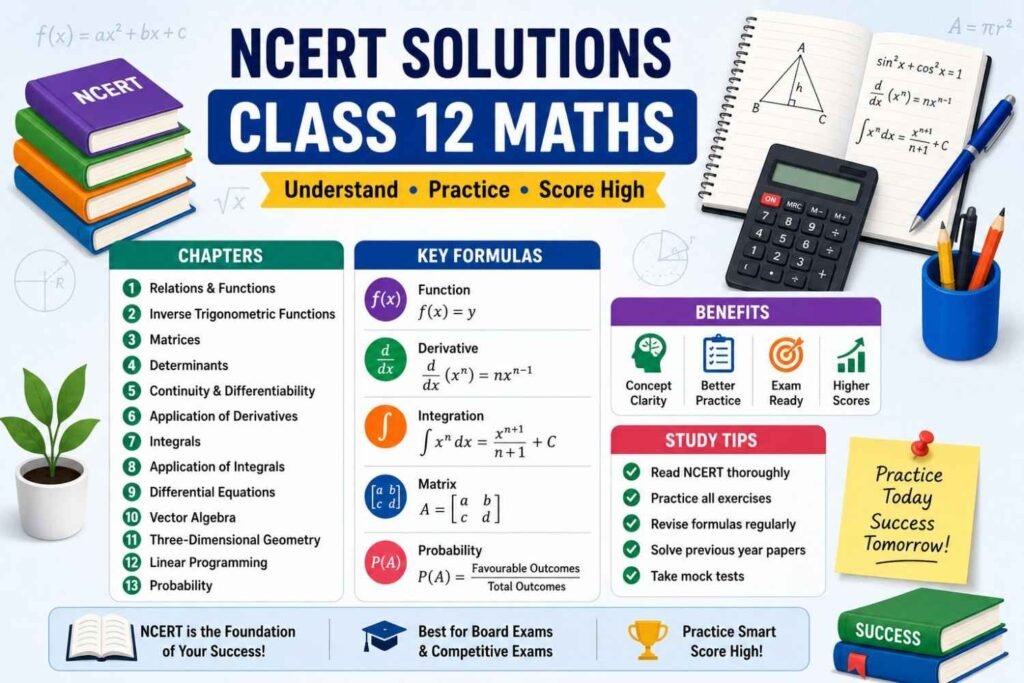
- 3. All 13 Chapters of Class 12 Maths – Quick Overview
- 4. Chapter-by-Chapter NCERT Class 12 Maths Solutions Guide
- 5. Unit-Wise Marks Weightage – Class 12 Maths 2025–26
- 6. Is NCERT Enough for Class 12 Maths Board Exams?
- 7. How to Use NCERT Class 12 Maths Solutions Effectively
- 8. Top Preparation Tips for Class 12 Maths Exam 2026
- 9. Common Mistakes Students Make in Class 12 Maths
- 10. Frequently Asked Questions (FAQs)
- Final Thoughts
1. Why NCERT Solutions Class 12 Maths Matter
Hey there, Class 12 student! 👋
So you’ve just opened your mathematics class 12 textbook and stared at those exercises wondering, “Where do I even begin?” — Trust me, we’ve all been there.
Here’s the thing: Class 12 Maths is not as scary as it looks. The moment you understand the logic behind each concept and practice the right problems in the right way, it becomes one of the most predictable — and high-scoring — subjects in your entire board exam.
And that’s exactly where NCERT solutions class 12 maths come in.
NCERT (National Council of Educational Research and Training) is the official body that prepares the textbooks prescribed by CBSE. The Class 12 Maths NCERT textbook covers all 13 chapters you’ll be tested on in the board exam, and the solutions to these exercises are your #1 study tool.
Here’s why:
Board Exam Questions Come Directly from NCERT: A vast majority of CBSE Class 12 Maths board exam questions are either directly taken from NCERT exercises or are closely based on NCERT examples. If you’ve solved every NCERT question, you’ve covered the most important base already.
Step-by-Step Format Earns You Maximum Marks: CBSE uses step-marking. That means even if your final answer is wrong, you still get marks for each correct step. NCERT solutions show you exactly how to present your work — step by step — in a way that aligns with the board’s expectations.
Foundation for Competitive Exams: Whether you’re preparing for JEE Main, BITSAT, CUET, or any other engineering/science entrance exam, NCERT class 12 maths solutions build the conceptual clarity you need to tackle higher-order problems.
Self-Study Made Easy: With detailed class 12 maths solutions, you can study at your own pace, identify where you’re going wrong, and fix your mistakes independently — without waiting for a tutor.
Now let’s get into the details!
2. CBSE Class 12 Maths Exam Pattern & Marks Weightage (2025–26)
Before diving into the ncert class 12 maths solutions chapter by chapter, let’s understand what you’re preparing for.
Exam Structure
| Component | Marks |
|---|---|
| Theory Paper | 80 marks |
| Internal Assessment | 20 marks |
| Total | 100 marks |
Theory Paper Duration: 3 hours (plus 15 minutes reading time)
Minimum Passing Marks: 33% in theory + 33% in internal assessment (both separately)
Question Paper Format
The CBSE Class 12 Maths paper is divided into 5 sections (A to E):
| Section | Question Type | Marks Per Question | Number of Questions |
|---|---|---|---|
| A | MCQs + Assertion-Reason | 1 mark | 20 questions |
| B | Very Short Answers | 2 marks | 5 questions |
| C | Short Answers | 3 marks | 6 questions |
| D | Long Answers | 5 marks | 4 questions |
| E | Case-Based Questions | 4 marks | 3 questions |
💡 Important: Around 33% internal choices are provided within sections. No overall choice in the paper.
Unit-Wise Marks Distribution (Theory: 80 Marks)
| Unit | Chapters | Marks |
|---|---|---|
| Unit 1 – Relations & Functions | Ch. 1, Ch. 2 | 8 marks |
| Unit 2 – Algebra | Ch. 3, Ch. 4 | 10 marks |
| Unit 3 – Calculus | Ch. 5, 6, 7, 8, 9 | 35 marks |
| Unit 4 – Vectors & 3D Geometry | Ch. 10, Ch. 11 | 14 marks |
| Unit 5 – Linear Programming | Ch. 12 | 5 marks |
| Unit 6 – Probability | Ch. 13 | 8 marks |
| Total | 80 marks |
Key Takeaway: Calculus (Unit 3) carries a massive 35 marks — that’s nearly 44% of the entire theory paper. It should be your primary focus area when using ncert class 12 maths solutions for preparation.
3. All 13 Chapters of Class 12 Maths – Quick Overview
Here’s a snapshot of all 13 chapters in the mathematics class 12 NCERT textbook:
| Chapter | Name | Unit | Approx. Board Marks |
|---|---|---|---|
| Chapter 1 | Relations and Functions | Relations & Functions | 4–5 marks |
| Chapter 2 | Inverse Trigonometric Functions | Relations & Functions | 3–4 marks |
| Chapter 3 | Matrices | Algebra | 5 marks |
| Chapter 4 | Determinants | Algebra | 5 marks |
| Chapter 5 | Continuity and Differentiability | Calculus | 8–10 marks |
| Chapter 6 | Application of Derivatives | Calculus | 8–10 marks |
| Chapter 7 | Integrals | Calculus | 8–10 marks |
| Chapter 8 | Application of Integrals | Calculus | 4–5 marks |
| Chapter 9 | Differential Equations | Calculus | 5–6 marks |
| Chapter 10 | Vector Algebra | Vectors & 3D | 6–7 marks |
| Chapter 11 | Three Dimensional Geometry | Vectors & 3D | 6–8 marks |
| Chapter 12 | Linear Programming | Linear Programming | 5 marks |
| Chapter 13 | Probability | Probability | 8 marks |
Now let’s explore each chapter in detail!
4. Chapter-by-Chapter NCERT Class 12 Maths Solutions Guide
Chapter 1: Relations and Functions
Unit: Relations & Functions | Marks: ~4–5 marks
What You’ll Learn: Chapter 1 is all about understanding how elements from two sets relate to each other. This chapter lays the algebraic foundation for the entire year.
Key Topics:
- Types of Relations: Reflexive, Symmetric, Transitive, and Equivalence Relations
- Types of Functions: One-one (Injective), Onto (Surjective), and Bijective
- Composition of Functions
- Invertible Functions
- Binary Operations (Commutative, Associative, Identity, Inverse)
Important Exercises:
- Exercise 1.1: Types of relations
- Exercise 1.2: Types of functions
- Exercise 1.3: Composition and inverse functions
- Exercise 1.4: Binary operations
- Miscellaneous Exercise: Mixed problems
What the Board Asks: Questions from this chapter are usually 1–2 marks (MCQs) or 2-mark short answers. Expect questions on identifying the type of relation/function or checking injectivity/surjectivity.
Study Tip: Make a table of all 4 types of relations with examples. For functions, draw arrows between sets to visualise one-one and onto properties.
Chapter 2: Inverse Trigonometric Functions
Unit: Relations & Functions | Marks: ~3–4 marks
What You’ll Learn: This chapter introduces the concept of inverse functions for trigonometric functions and focuses heavily on domain, range, and properties.
Key Topics:
- Definition and Principal Value Branch of sin⁻¹, cos⁻¹, tan⁻¹, etc.
- Graphs of Inverse Trigonometric Functions
- Properties and Identities of Inverse Trigonometric Functions
- Simplification of expressions using properties
Important Exercises:
- Exercise 2.1: Principal values and domains
- Exercise 2.2: Properties and simplification
- Miscellaneous Exercise
What the Board Asks: Expect graph-based MCQs, finding principal values, and simplifying expressions using identities. A 2-mark question on properties is very common.
Study Tip: Memorise the principal value branch table (domain and range for each inverse trig function). This is directly tested in MCQs.
| Function | Domain | Range (Principal Value Branch) |
|---|---|---|
| sin⁻¹x | [-1, 1] | [-π/2, π/2] |
| cos⁻¹x | [-1, 1] | [0, π] |
| tan⁻¹x | ℝ | (-π/2, π/2) |
| cosec⁻¹x | ℝ – (-1,1) | [-π/2, π/2] – {0} |
| sec⁻¹x | ℝ – (-1,1) | [0, π] – {π/2} |
| cot⁻¹x | ℝ | (0, π) |
Chapter 3: Matrices
Unit: Algebra | Marks: ~5 marks
What You’ll Learn: Matrices are rectangular arrays of numbers — think of them as organised tables that follow special rules of arithmetic. This chapter is very scoring and has predictable question types.
Key Topics:
- Order of a Matrix; Types of Matrices (Row, Column, Square, Diagonal, Scalar, Identity, Zero)
- Addition, Subtraction, and Multiplication of Matrices
- Transpose of a Matrix
- Symmetric and Skew-Symmetric Matrices
- Elementary Row and Column Operations
- Invertible Matrices (Finding Inverse using Elementary Operations)
Important Exercises:
- Exercise 3.1: Types and order
- Exercise 3.2: Operations on matrices
- Exercise 3.3: Transpose, symmetric, and skew-symmetric
- Exercise 3.4: Elementary transformations
What the Board Asks: Matrix multiplication, finding transpose, proving a matrix is symmetric/skew-symmetric, and finding inverses via elementary operations are all common.
Study Tip: Matrix multiplication is often tricky. Always check compatibility (m × n × n × p = m × p) before multiplying. Practice at least 10 multiplication problems!
Chapter 4: Determinants
Unit: Algebra | Marks: ~5 marks
What You’ll Learn: Determinants are scalar values associated with square matrices. This chapter builds directly on matrices and is heavily applied in solving systems of equations.
Key Topics:
- Evaluating 2×2 and 3×3 Determinants
- Properties of Determinants (7 key properties)
- Area of a Triangle using Determinants
- Minors and Cofactors
- Adjoint of a Matrix
- Inverse of a Matrix using Adjoint method
- Solution of Linear Equations using Matrix Method (Cramer’s Rule / AX = B method)
Important Exercises:
- Exercise 4.1: Evaluation
- Exercise 4.2: Properties
- Exercise 4.3: Area of triangle
- Exercise 4.4: Minors and cofactors
- Exercise 4.5: Adjoint and inverse
- Exercise 4.6: System of linear equations
- Miscellaneous Exercise
What the Board Asks: The AX = B method for solving a system of 3 linear equations is almost always asked as a 5-mark question. Properties of determinants are frequently tested in 2–3 mark questions.
Study Tip: Memorise all 7 properties of determinants and practice using them to simplify 3×3 determinants. This saves enormous calculation time in the exam.
Chapter 5: Continuity and Differentiability
Unit: Calculus | Marks: ~8–10 marks
What You’ll Learn: This chapter is the entry point into Calculus — one of the most important and highest-scoring units in class 12 maths. It covers the formal definition of continuity and extends your differentiation skills.
Key Topics:
- Continuity of a Function at a Point / over an Interval
- Algebra of Continuous Functions
- Differentiability and Relation between Continuity and Differentiability
- Differentiation of Composite Functions (Chain Rule)
- Differentiation of Implicit Functions
- Logarithmic Differentiation
- Differentiation of Inverse Trigonometric Functions
- Derivatives of Exponential and Logarithmic Functions
- Parametric Differentiation
- Second Order Derivatives
- Rolle’s Theorem and Mean Value Theorem (MVT)
Important Exercises:
- Exercise 5.1: Continuity
- Exercise 5.2: Differentiability
- Exercise 5.3: Derivatives of composite functions
- Exercise 5.4: Implicit functions
- Exercise 5.5: Logarithmic differentiation
- Exercise 5.6: Parametric differentiation
- Exercise 5.7: Second-order derivatives
- Exercise 5.8: Rolle’s and MVT
- Miscellaneous Exercise
What the Board Asks: Expect 1–2 MCQs on continuity, a 2-mark question on chain rule/implicit differentiation, and often a 3-mark problem on second-order derivatives or logarithmic differentiation.
Study Tip: Never skip Logarithmic Differentiation. It simplifies messy functions enormously and appears frequently in board exams. Practice the standard form: take log on both sides, then differentiate.
Chapter 6: Application of Derivatives
Unit: Calculus | Marks: ~8–10 marks
What You’ll Learn: This is where differentiation becomes practical! You’ll use derivatives to solve real-world problems involving rates of change, maxima/minima, tangents, and normals.
Key Topics:
- Rate of Change of Quantities
- Increasing and Decreasing Functions
- Tangents and Normals to a Curve
- Approximations using Differentials
- Maxima and Minima (First and Second Derivative Test)
- Absolute Maximum and Minimum
- Point of Inflexion
Important Exercises:
- Exercise 6.1: Rate of change
- Exercise 6.2: Increasing/decreasing functions
- Exercise 6.3: Tangents and normals
- Exercise 6.4: Approximations
- Exercise 6.5: Maxima and minima
- Miscellaneous Exercise
What the Board Asks: Finding maximum/minimum values is a perennial favourite — expect a 5-mark long answer on maxima/minima almost every year. Tangents and normals appear as 2–3 mark questions regularly.
Study Tip: For maxima/minima problems, always state whether the point is a maximum or minimum using the second derivative test. Don’t just find the critical point — verify it!
Chapter 7: Integrals
Unit: Calculus | Marks: ~8–10 marks
What You’ll Learn: Integration is the reverse of differentiation and one of the most calculation-intensive chapters in 12th maths. Mastering integration methods is key to excelling in Calculus.
Key Topics:
- Integration as Antiderivative
- Integration by Substitution
- Integration using Trigonometric Identities
- Integration by Partial Fractions
- Integration by Parts
- Special Integral Formulas
- Definite Integrals (Properties and Evaluation)
- Fundamental Theorem of Calculus
Important Exercises:
- Exercise 7.1 to 7.11: Various integration techniques
- Miscellaneous Exercise (Very Important!)
What the Board Asks: Integration is the single most mark-heavy chapter. Expect 2–3 integration questions covering substitution, partial fractions, by-parts, and definite integrals. The Miscellaneous Exercise is especially important for board exam preparation.
Key Integration Formulas to Memorise:
| Formula | Result |
|---|---|
| ∫xⁿ dx | xⁿ⁺¹/(n+1) + C |
| ∫sin x dx | -cos x + C |
| ∫cos x dx | sin x + C |
| ∫eˣ dx | eˣ + C |
| ∫(1/x) dx | ln |
| ∫sec²x dx | tan x + C |
| ∫1/(1+x²) dx | tan⁻¹x + C |
| ∫1/√(1–x²) dx | sin⁻¹x + C |
Study Tip: Practice integration by parts using the ILATE rule (Inverse trig → Logarithm → Algebra → Trigonometry → Exponential) to choose which function to differentiate.
Chapter 8: Application of Integrals
Unit: Calculus | Marks: ~4–5 marks
What You’ll Learn: After mastering integration techniques, you now apply them to find areas of geometric figures using curves and lines.
Key Topics:
- Area of Region Bounded by a Curve and the X-axis
- Area of Region Bounded by a Curve and the Y-axis
- Area Between Two Curves
- Application to Standard Shapes (Circles, Parabolas, Ellipses)
Important Exercises:
- Exercise 8.1: Area under simple curves
- Exercise 8.2: Area between two curves
- Miscellaneous Exercise
What the Board Asks: A 5-mark question asking you to find the area bounded by two curves (often a parabola and a line) appears almost every year. Drawing a clear diagram is essential.
Study Tip: Always sketch the graph first before setting up the integral. Identify which curve is above the other in the given interval — this determines whether you subtract or add.
Chapter 9: Differential Equations
Unit: Calculus | Marks: ~5–6 marks
What You’ll Learn: Differential equations connect functions with their derivatives, and this chapter covers methods to solve them systematically.
Key Topics:
- Order and Degree of Differential Equations
- General and Particular Solutions
- Formation of Differential Equations (Given General Solution)
- Variable Separable Method
- Homogeneous Differential Equations
- Linear Differential Equations (Integrating Factor Method)
Important Exercises:
- Exercise 9.1: Order and degree
- Exercise 9.2: Verification of solutions
- Exercise 9.3 & 9.4: Formation of DEs
- Exercise 9.5: Variable separable
- Exercise 9.6: Homogeneous equations
- Exercise 9.7: Linear DEs (IF method)
- Miscellaneous Exercise
What the Board Asks: Expect a 3–5 mark question on the Linear Differential Equation (Integrating Factor method) — it’s the most commonly asked type. Homogeneous equations appear as well.
Study Tip: The Integrating Factor (IF) method is the most exam-critical technique. Practice the formula: IF = e^∫P(x)dx, and multiply throughout to make the left side a perfect derivative.
Chapter 10: Vector Algebra
Unit: Vectors & 3D Geometry | Marks: ~6–7 marks
What You’ll Learn: Vectors are quantities with both magnitude and direction. This chapter gives you the tools to work with them algebraically.
Key Topics:
- Basics of Vectors (Magnitude, Direction, Types)
- Addition of Vectors (Triangle and Parallelogram Law)
- Components of a Vector
- Section Formula
- Scalar (Dot) Product and its Properties
- Projection of a Vector on a Line
- Vector (Cross) Product and its Properties
- Area of Parallelogram and Triangle using Cross Product
Important Exercises:
- Exercise 10.1: Basics
- Exercise 10.2: Addition and components
- Exercise 10.3: Dot product
- Exercise 10.4: Cross product
- Miscellaneous Exercise
What the Board Asks: Questions on finding dot product, cross product, and the angle between vectors appear frequently as 2–3 mark problems. Area of parallelogram/triangle using cross product is a common application question.
Study Tip: Remember: Dot product gives a scalar; Cross product gives a vector. The formula |a⃗ × b⃗| = |a⃗||b⃗|sin θ is used directly for area questions.
Chapter 11: Three Dimensional Geometry
Unit: Vectors & 3D Geometry | Marks: ~6–8 marks
What You’ll Learn: This chapter extends vector concepts into 3D space — finding equations of lines and planes, and calculating distances and angles.
Key Topics:
- Direction Cosines and Direction Ratios
- Equation of a Line in 3D (Cartesian and Vector forms)
- Angle Between Two Lines
- Distance Between Two Skew Lines
- Distance of a Point from a Line
- Equation of a Plane (3 forms: Point-Normal, 3 Points, Intercept form)
- Angle Between Two Planes
- Distance of a Point from a Plane
- Angle Between a Line and a Plane
- Coplanarity of Two Lines
Important Exercises:
- Exercise 11.1: Direction cosines
- Exercise 11.2: Lines in 3D
- Exercise 11.3: Planes
- Miscellaneous Exercise
What the Board Asks: A 5-mark question on planes (finding equation, distance, or angle) appears in almost every board exam. Distance of a point from a plane and angle between planes are perennial favourites.
Study Tip: Know all 3 forms of the equation of a plane by heart. Practice converting between vector and Cartesian forms — the board often asks for both.
Chapter 12: Linear Programming
Unit: Linear Programming | Marks: ~5 marks
What You’ll Learn: Linear Programming deals with finding the optimum (maximum or minimum) value of a linear objective function subject to certain constraints. It’s one of the most straightforward chapters in class 12 maths solutions — master it and it’s almost guaranteed marks!
Key Topics:
- Linear Programming Problem (LPP) – Formulation
- Graphical Method of Solution
- Feasible Region and Feasible Solution
- Corner Point Theorem
- Maximum and Minimum Values of the Objective Function
Important Exercises:
- Exercise 12.1: Solving LPPs graphically
- Exercise 12.2: More complex LPPs
- Miscellaneous Exercise
What the Board Asks: Linear Programming is asked as a 5-mark question in the Long Answer section — almost without exception. You’ll be given real-world constraints (manufacturing, diet, transportation) and asked to maximise profit or minimise cost.
Study Tip: The answer always lies at a corner point of the feasible region. Draw the graph accurately, identify all corner points, substitute in the objective function, and pick the optimal value.
Chapter 13: Probability
Unit: Probability | Marks: ~8 marks
What You’ll Learn: Probability is the final chapter in ncert class 12 maths and a very important one. It builds on Class 11 probability and adds Conditional Probability, Bayes’ Theorem, and the Binomial Distribution.
Key Topics:
- Conditional Probability
- Multiplication Theorem on Probability
- Independent Events
- Total Probability Theorem
- Bayes’ Theorem
- Random Variables and Probability Distribution
- Mean and Variance of a Probability Distribution
- Bernoulli Trials and Binomial Distribution
Important Exercises:
- Exercise 13.1: Conditional probability
- Exercise 13.2: Multiplication theorem and independence
- Exercise 13.3: Bayes’ theorem
- Exercise 13.4: Random variables and distribution
- Exercise 13.5: Bernoulli trials and binomial distribution
- Miscellaneous Exercise
What the Board Asks: Bayes’ Theorem is asked as a 5-mark question very frequently. Probability Distribution (finding mean and variance) is another common 5-mark question. Binomial Distribution appears as 3–4 mark questions.
Study Tip: For Bayes’ Theorem problems, always define events clearly at the start. Use the formula P(Aᵢ|B) = P(Aᵢ)·P(B|Aᵢ) / ΣP(Aⱼ)·P(B|Aⱼ). This formula is your best friend in this chapter!
5. Unit-Wise Marks Weightage – Class 12 Maths 2025–26
Here’s a detailed breakdown to help you prioritise your study time when using class 12 maths solutions:
| Unit | Chapters | Theory Marks | Priority Level |
|---|---|---|---|
| Calculus | Ch. 5, 6, 7, 8, 9 | 35 marks | 🔴 Highest |
| Vectors & 3D | Ch. 10, 11 | 14 marks | 🟠 High |
| Algebra | Ch. 3, 4 | 10 marks | 🟠 High |
| Probability | Ch. 13 | 8 marks | 🟡 Medium-High |
| Relations & Functions | Ch. 1, 2 | 8 marks | 🟡 Medium |
| Linear Programming | Ch. 12 | 5 marks | 🟢 Easy Scoring |
Study Allocation Advice:
- Spend 40% of your study time on Calculus (Chapters 5–9)
- Spend 20% on Vectors & 3D (Chapters 10–11)
- Give 15% to Algebra (Chapters 3–4)
- Reserve 15% for Probability (Chapter 13)
- Quick revision is enough for Relations & Functions (Chapters 1–2)
- Linear Programming (Chapter 12) is easiest — 1–2 days of practice is sufficient
6. Is NCERT Enough for Class 12 Maths Board Exams?
This is one of the most common questions students ask — and the answer is a confident YES for board exams, with a small caveat.
For Scoring 70–80%: NCERT textbook exercises + solved examples are more than sufficient. Most board questions are directly from NCERT.
For Scoring 85–95%: Supplement NCERT with NCERT Exemplar problems. These contain slightly harder problems that test deeper conceptual understanding.
For Scoring 95%+: Complete NCERT thoroughly → NCERT Exemplar → CBSE Sample Papers → Previous Year Papers (last 10 years). This combination is the gold standard.
For JEE/Competitive Exams: NCERT builds the foundation. You’ll additionally need books like RD Sharma (for board+), Cengage, or Arihant for JEE-level problems.
💡 Key Insight: Majority of the questions in CBSE boards come either directly from NCERT or are NCERT-based. Never underestimate the power of your NCERT textbook!
7. How to Use NCERT Class 12 Maths Solutions Effectively
Having the ncert class 12 maths solutions is great, but knowing how to use them properly is what separates good scorers from toppers. Here’s a proven method:
Step 1: Read the Theory First
Before attempting any exercise, read the theory section of the chapter carefully. Understand the definitions, theorems, and examples. Don’t skip any example — NCERT examples are often directly asked in board exams.
Step 2: Attempt the Exercise on Your Own
Close the solutions and try solving the exercise problems yourself. Write them out step by step. It’s okay if you can’t solve all of them — the attempt is what builds understanding.
Step 3: Check Your Method (Not Just the Answer)
When you refer to the solutions, compare your method, not just the final answer. Ask yourself: Did I follow the same steps? Is my presentation clear? Did I miss any important step?
Step 4: Identify Patterns
As you work through multiple exercises, you’ll notice patterns — certain types of questions repeat with slight variations. Mark these as important and practice them more.
Step 5: Revise Through Solutions
During revision, go through the solutions as “guided notes.” They’re a faster way to refresh your memory on how to approach a type of problem without re-doing it from scratch.
Step 6: Use for Cross-Checking in Exams
Right before your board exam, use solutions to quickly verify that your problem-solving approach for tricky topics is correct.
8. Top Preparation Tips for Class 12 Maths Exam 2026
Tip 1 – Master NCERT First Always begin with the NCERT textbook. Understand the theory, solve all examples, and complete all exercises. This is your non-negotiable foundation.
Tip 2 – Make a Formula Notebook Create a dedicated notebook of formulas, identities, and theorems for every chapter. Review this notebook daily. Before your exam, you should be able to recall any formula in under 5 seconds.
Tip 3 – Prioritise by Marks Weightage Spend the most time on Calculus (35 marks). A student who masters Chapters 5–9 has already secured 44% of the theory paper.
Tip 4 – Solve Previous Year Papers Solving the last 10 years of CBSE Class 12 Maths board papers is one of the most effective preparation strategies. You’ll notice repeating question types and high-frequency topics.
Tip 5 – CBSE Uses Step-Marking Always write your solutions step-by-step. Even if you get the final answer wrong, you earn marks for each correct intermediate step. Never skip steps — they’re marks!
Tip 6 – Don’t Avoid Difficult Chapters Many students skip Integration or 3D Geometry because they seem hard. But these chapters carry the most marks. Face them head-on with the right solutions guide.
Tip 7 – Practice Timed Tests Do timed mock tests at least 4–6 weeks before the exam. This builds speed and helps you identify which types of questions take too long.
Tip 8 – Solve NCERT Exemplar After completing NCERT exercises, move to NCERT Exemplar. These problems are harder and represent the boundary between board-level and competitive-level questions.
Tip 9 – Use Graph Paper for 3D/Integration For Application of Integrals and 3D Geometry, always draw clear, labelled diagrams. Examiners appreciate visual clarity and may award bonus presentation marks.
Tip 10 – Revise Smart, Not Just Hard Two weeks before the exam, shift from learning new things to revision. Focus on your formula notebook, key theorems, and one past year paper per day.
9. Common Mistakes Students Make in Class 12 Maths
Avoid these classic blunders and your class 12 maths solutions practice will pay off much better:
Mistake 1: Skipping Steps in Solutions CBSE’s step-marking system rewards every correct step. Writing only the final answer — even if correct — can cost you 2–3 marks per question.
Mistake 2: Not Reading Theory Many students jump straight into exercises without reading the chapter theory. This leaves gaps that show up in conceptual MCQs and Assertion-Reason questions.
Mistake 3: Ignoring Miscellaneous Exercises The Miscellaneous Exercise at the end of each NCERT chapter contains some of the best exam-level problems. Most students skip it — which is a costly mistake.
Mistake 4: Cramming Formulas Without Understanding If you memorise formulas without understanding why they work, you’ll struggle when questions have small variations. Always understand the derivation behind key formulas.
Mistake 5: Neglecting Easy Chapters Linear Programming carries 5 guaranteed marks and is straightforward. Many students neglect it because it “seems less important” — don’t make this error!
Mistake 6: Starting Exam Without Reading Fully Don’t start answering from Question 1 blindly. Read the full paper first (15 minutes reading time is given). Spot the questions you’re most confident about and attempt those first.
Mistake 7: Messy Presentation Unclear handwriting, unlabelled diagrams, and disorganised steps confuse examiners. Write neatly, draw graphs with a ruler, and label everything.
10. Frequently Asked Questions (FAQs)
Q1. How many chapters are there in NCERT Class 12 Maths?
There are 13 chapters in the NCERT Class 12 Maths textbook for 2025–26, grouped into 6 major units: Relations & Functions, Algebra, Calculus, Vectors & 3D Geometry, Linear Programming, and Probability.
Q2. Which chapter has the highest weightage in Class 12 Maths?
Calculus (Unit 3) has the highest weightage with 35 marks out of 80. It includes Chapters 5 to 9: Continuity & Differentiability, Application of Derivatives, Integrals, Application of Integrals, and Differential Equations.
Q3. Is NCERT sufficient for Class 12 Maths board exams?
Yes! NCERT textbook + examples + exercises are sufficient to score 80%+ in CBSE boards. For 95%+, add NCERT Exemplar and CBSE sample papers.
Q4. How many marks is the Class 12 Maths theory paper?
The theory paper is 80 marks, and internal assessment carries 20 marks, for a total of 100 marks.
Q5. What is the minimum passing marks for CBSE Class 12 Maths?
Students must score a minimum of 33% marks in theory (i.e., ~27/80) AND 33% in internal assessment separately to pass.
Q6. Which chapters in Class 12 Maths are most important for JEE?
For JEE Main and Advanced, the most critical chapters are: Integrals (Chapter 7), Application of Derivatives (Chapter 6), 3D Geometry (Chapter 11), Probability (Chapter 13), Matrices & Determinants (Ch. 3 & 4), and Continuity & Differentiability (Chapter 5).
Q7. Are NCERT Class 12 Maths solutions available for free?
Yes! NCERT class 12 maths solutions are freely available on the official NCERT website (ncert.nic.in), as well as various educational platforms. The NCERT textbook PDF is also freely downloadable from the official site.
Q8. How do I solve integration problems in Class 12 Maths?
Start by identifying the correct method: substitution, partial fractions, by-parts, or special formulas. Work through all NCERT examples before attempting exercises. Regular daily practice (at least 5–6 integrals per day) is the key to mastering integration.
Q9. How many hours per day should I study Class 12 Maths?
For board exam preparation, 2–3 focused hours of Maths daily is recommended. Quality matters more than quantity — active problem-solving is far more effective than passive reading.
Q10. What is the best way to score 90+ in Class 12 Maths?
Complete all NCERT exercises and examples → Solve NCERT Exemplar → Practice CBSE Sample Papers → Solve 10 years’ Past Year Papers → Revise your formula notebook daily. Follow this plan consistently and 90+ is absolutely achievable!
Q11. Which is the most difficult chapter in Class 12 Maths?
Students commonly find Integrals (Chapter 7) and Three Dimensional Geometry (Chapter 11) most challenging. However, with consistent NCERT practice and understanding of the core methods, these become manageable — and they carry the most marks!
Q12. Can I download NCERT Solutions Class 12 Maths as a PDF?
Yes! NCERT class 12 maths solutions PDFs are available chapter-wise on the official NCERT website and many educational platforms. You can download them for offline study.
Final Thoughts
And there you have it — your complete, chapter-by-chapter guide to NCERT solutions class 12 maths for the 2025–26 academic year! 🎉
Let’s do a quick recap of the most important points:
- 13 chapters covering Relations & Functions, Algebra, Calculus, Vectors & 3D, Linear Programming, and Probability
- Calculus carries 35 marks — it should be your primary focus
- NCERT is your most important resource — never underestimate it
- Always write step-by-step solutions for full step marks
- Practice previous year papers and NCERT Exemplar for 95%+
- Linear Programming (Chapter 12) is easy, guaranteed marks — don’t neglect it
Mathematics class 12 is not about memorising — it’s about understanding patterns, practising methods, and building the confidence to tackle any problem the board throws at you. With the right ncert class 12 maths solutions guide and consistent daily practice, scoring 90+ is absolutely within your reach.
Now close this tab, open your NCERT textbook, and start with Chapter 1! 💪
Best of luck for your Class 12 Maths exam! You’ve totally got this! 🌟