Top Music Colleges in India 2026: How to Choose the Best Music Institute for Your Career
Music is not just an art form — in 2026, it’s a full-fledged industry. India’s music market is worth billions, fuelled by Bollywood, independent artists, OTT platforms, live concerts, music streaming, and a growing demand for music educators, composers, and sound engineers across every medium.
If you’ve been told that music is “just a hobby” and not a “real career,” you’re reading the wrong decade’s advice. The right music education from the right institution can launch you into film composing, performing arts, music production, audio engineering, music therapy, or academia — all legitimate, rewarding, and increasingly well-paying career paths.
But choosing from the hundreds of music colleges in India is genuinely challenging. This guide cuts through the confusion and gives you a clear, honest answer to: which are the top music colleges in India 2026, how do you get in, what do you study, and where can a music degree take you?
Table of contents
- Top Music Colleges in India 2026: How to Choose the Best Music Institute for Your Career
- Quick Snapshot: Music Education in India 2026
- 1. Why Formal Music Education Matters in 2026
- 2. Types of Music Programmes Available in India
- 3. Music College Eligibility and Admission 2026
- 4. How to Choose the Best Music College in India: 7 Key Factors
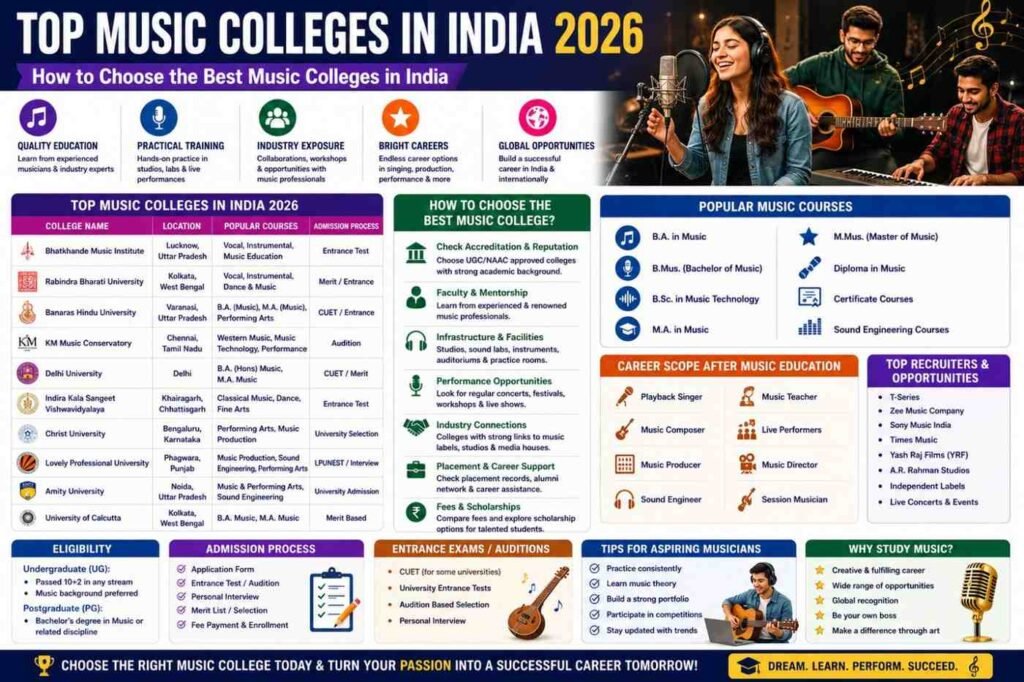
- 5. Top Music Colleges in India 2026
- 6. Top Music Colleges in India 2026: At a Glance
- 7. Career Paths After Music Education in India
- 8. Frequently Asked Questions
- Final Verdict: Choosing Your Music College in India
Quick Snapshot: Music Education in India 2026
| Feature | Details |
|---|---|
| Top UG Programme | B.A. Music / B.Mus / B.Performing Arts |
| UG Duration | 3 Years (B.A.) |
| Top PG Programme | M.A. Music / M.Mus |
| PG Duration | 2 Years |
| Doctoral Programmes | PhD / D.Mus |
| Diploma Programmes | 1–3 Years |
| Key Entrance Exams | CUET, University-Level Auditions, State CETs |
| Eligibility (UG) | Class 12 pass in any stream |
| Eligibility (PG) | BA Music / Graduation with music background |
| Average Starting Salary | INR 3 – 8 LPA |
| Senior Professional Salary | INR 15 – 50+ LPA |
| Top Career Paths | Film Composer, Vocalist, Music Producer, Sound Engineer, Music Educator |
1. Why Formal Music Education Matters in 2026
Before diving into the top music colleges in India, let’s address the real question many students face from their families: “Do I really need a degree in music? Can’t I just perform and make it?”
Here’s the honest 2026 picture:
- India’s music streaming industry is growing at 25%+ annually — creating demand for composers, arrangers, and producers at scale
- OTT platforms (Netflix, Amazon, Hotstar, Zee5) need original scores for every original show and film
- Music technology — digital audio workstations, sound design, live production — requires trained professionals
- Music education in schools and academies is a growing sector (NEP 2020 mandates arts education)
- International music programmes increasingly require formal degrees for collaboration, grants, and residencies
Formal music education gives you:
- Deep technical knowledge of ragas, western harmony, theory, and composition
- Performance discipline that self-taught musicians rarely develop
- Industry connections through faculty and alumni
- A credential that opens doors to teaching, research, and grants
- The framework to understand music across traditions — Hindustani, Carnatic, Western, Jazz, World Music
2. Types of Music Programmes Available in India
| Programme | Duration | Focus |
|---|---|---|
| B.A. Music (Hindustani/Carnatic/Percussion/Keyboard) | 3 Years | Classical performance and theory |
| B.Mus (Bachelor of Music) | 3–4 Years | Comprehensive music — theory, performance, composition |
| B.Performing Arts (Music) | 3 Years | Performance-oriented; theatre and music integrated |
| Diploma in Music | 1–3 Years | Classical or modern music skills |
| Certificate Courses | 3–12 Months | Specific instrument or genre |
| M.A. Music | 2 Years | Advanced theory, musicology, performance |
| M.Mus | 2 Years | Graduate music performance/composition |
| PhD in Music | 3–5 Years | Research and academia |
Major Music Streams Offered in India
- Hindustani Classical Vocal (North Indian classical)
- Carnatic Classical Vocal (South Indian classical)
- Hindustani Instrumental (Sitar, Sarod, Tabla, Flute, Violin)
- Carnatic Instrumental (Veena, Mridangam, Violin, Nadaswaram)
- Western Classical Music (Piano, Guitar, Violin, Orchestral instruments)
- Music Production and Audio Engineering (Digital, Bollywood, Electronic)
- Jazz and Contemporary Music
- Folk and World Music
- Music Therapy
- Musicology and Ethnomusicology
3. Music College Eligibility and Admission 2026
Eligibility for B.A. Music / B.Mus
- Class 12 pass from any recognized board — Science, Commerce, or Arts
- No stream restriction — any Class 12 background is eligible
- Minimum 45–60% aggregate in Class 12 (varies by college)
- Music background: Most premier colleges require prior music training — classical training of 3–7 years is expected at top institutions
Eligibility for M.A. Music / M.Mus
- B.A. Music, B.Mus, or B.Performing Arts with minimum 50–55% for most colleges
- Some universities accept graduates from other disciplines with strong music performance credentials
- Government university M.A. programmes typically require entrance tests
Entrance Exams and Auditions
| Exam / Process | Colleges/Universities Accepting |
|---|---|
| CUET (UG) | Central universities, BHU, DU affiliated colleges |
| CUET-PG | Central universities for M.A. Music admissions |
| BHU UET | Banaras Hindu University Music Faculty |
| DU Entrance | Delhi University music colleges |
| Audition + PI | Most premier music colleges (Gandharva, KM College, Viswa Bharati) |
| Prayag Sangeet Samiti | Allahabad-based music diploma examinations |
| State CETs | State university music departments |
| University-Level Tests | Amity, LPU, Christ University, etc. |
Critical Note: For most serious music institutions, the audition and practical examination matters far more than academic scores. Your performance — voice, instrument, raga knowledge, theory — is the primary selection criterion at premier music colleges.
4. How to Choose the Best Music College in India: 7 Key Factors
Factor 1: Tradition and Reputation in Your Music Genre
Indian music has distinct traditions — Hindustani, Carnatic, Western. The best music college for a Hindustani classical vocalist is not necessarily the best for a Western music producer. Match the college’s strength to your genre.
Factor 2: Faculty — Practicing Artists, Not Just Teachers
The greatest music institutions have faculty who are active performing artists, acclaimed gharana representatives, or working music directors. Ask: Who are the faculty? Are they performing professionals with established careers?
Factor 3: Infrastructure for Your Specific Discipline
- Classical music: Individual practice rooms, well-maintained instruments (tabla, tanpura, harmonium, sitar, veena), recording facilities
- Western/Production: Digital Audio Workstations (DAWs), MIDI studios, mixing consoles, acoustic treatment
- General: Concert hall, rehearsal spaces, music library (scores, recordings, musicology texts)
Factor 4: Performance Opportunities
Great music education includes regular concerts, recitals, festivals, collaborations, and competitions. Ask how many public performances students give per year and whether the college has its own regular music festival.
Factor 5: Industry and Alumni Connections
Does the college have alumni working in Bollywood, classical concert circuits, international orchestras, or music education? Strong alumni networks open doors that curriculum alone cannot.
Factor 6: UGC Recognition and Affiliating University
For academic credibility — especially if you plan to teach or pursue research — ensure the programme is UGC-recognized and the degree is from a recognized university.
Factor 7: Location and Music Ecosystem
- Mumbai: Bollywood; film and independent music industry
- Delhi: Institutional classical music; All India Radio; government cultural bodies
- Chennai: Carnatic classical; film music (Kollywood) ecosystem
- Varanasi (BHU): Hindustani classical; deeply traditional training
- Kolkata: Rabindra Sangeet; Tagore tradition; strong classical scene
- Pune/Bengaluru: Emerging music education hubs with modern production facilities
5. Top Music Colleges in India 2026
Tier 1: Premier Classical Music Institutions
1. Faculty of Performing Arts, Banaras Hindu University (BHU), Varanasi
BHU’s Faculty of Performing Arts is arguably India’s most revered classical music institution. Located in the cultural heartland of India — Varanasi — it has produced some of India’s greatest musicians across vocal, instrumental, and dance traditions.
- Programmes: B.A. Music, M.A. Music, PhD (Hindustani Vocal, Instrumental, Tabla, Sitar, Sarod, Violin)
- Fees: INR 10,000 – 30,000/year (central university; highly subsidized)
- Admission: CUET / BHU UET + Audition
- Faculty: Disciples of legendary gharana masters; accomplished performers
- Why Choose: If you’re a serious Hindustani classical student, BHU is India’s Juilliard. The cultural environment of Varanasi itself transforms your musical sensibility.
2. Indira Kala Sangeet University (IKSU), Khairagarh (Chhattisgarh)
India’s only dedicated music and fine arts university — IKSU is a rare gem that most students don’t know about.
- Programmes: B.Mus, M.Mus, PhD in Music, Dance, Drama, and Fine Arts
- Fees: INR 5,000 – 20,000/year (state government; extremely affordable)
- Admission: State-level entrance + Audition
- Specializations: Hindustani Vocal, Tabla, Sitar, Violin, Harmonium, Flute, Carnatic music
- Why Choose: India’s only standalone music university; degree has high classical music credibility; extremely low fees; deeply immersive environment away from city distractions
3. Faculty of Music, University of Delhi (Delhi University)
Delhi University’s music department — spread across colleges like KM College of Music and Technology, Miranda House, and Gargi College — offers one of India’s most academically rigorous music programmes.
- Programmes: B.A. (Hons.) Music, M.A. Music
- Fees: INR 15,000 – 40,000/year (government; very affordable)
- Admission: CUET + DU Admission Process + Audition
- Why Choose: DU brand; Delhi location (All India Radio, cultural events, Bollywood proximity); rigorous theoretical grounding alongside performance
4. KM College of Music and Technology, Delhi
Part of the University of Delhi system, KM College is a dedicated music college — one of the few in DU that focuses entirely on music.
- Programmes: B.A. (Hons.) Music (Hindustani, Carnatic, Western)
- Fees: INR 15,000 – 35,000/year
- Admission: CUET + Practical audition
- Why Choose: Dedicated music institution within DU; covers both classical Indian and Western music; excellent Delhi-based industry connections
5. Gandharva Mahavidyalaya, New Delhi
Founded in 1939, Gandharva Mahavidyalaya is one of India’s oldest and most respected classical music institutions.
- Programmes: Diploma and Degree in Hindustani Classical Music (Vocal, Tabla, Sitar, Harmonium, Flute)
- Fees: INR 10,000 – 30,000/year
- Admission: Practical examination + Interview
- Notable Alumni: Legends of Indian classical music have trained here
- Why Choose: Heritage institution; guru-shishya parampara maintained; uncompromising classical training; ideal for purist classical music aspirants
6. Sangeet Natak Akademi (Associated Programmes), New Delhi
India’s apex body for the performing arts has affiliated programmes and offers fellowships and residencies. While it doesn’t offer regular degree programmes, it is the most important government institution for India’s music and performing arts ecosystem — scholarships, awards, and recognition flow from here.
- Why Know About It: Apply for Sangeet Natak Akademi Junior Fellowships after completing your music degree — they fund research and training at the highest level
7. Prayag Sangeet Samiti, Allahabad (Prayagraj)
One of India’s most respected music examination bodies — not a college per se, but an essential certification system for Hindustani classical musicians.
- Diplomas and degrees recognised across India and many international institutions
- Programmes in Vocal, Tabla, Sitar, Harmonium, Violin, Flute
- Why Know About It: A Sangeet Prabhakar (senior diploma) from Prayag Samiti is equivalent to a degree and significantly boosts classical music credentials
Tier 2: Top Private and Deemed Music Institutions
8. SNDT Women’s University, Mumbai — Music Department
SNDT has one of Mumbai’s most respected music programmes — with proximity to Bollywood being a natural advantage.
- Programmes: B.A. Music, M.A. Music (Hindustani Classical + Western)
- Fees: INR 15,000 – 40,000/year
- Admission: Entrance test + Audition
- Why Choose: Mumbai location; exposure to film and independent music industry; respected classical faculty
9. Viswa Bharati University, Shantiniketan (West Bengal)
Founded by Rabindranath Tagore, Viswa Bharati’s Sangit Bhavana is one of India’s most unique music institutions — blending Hindustani classical with Rabindra Sangeet and world music traditions.
- Programmes: B.A. Music (Sangit Bhavana), M.A. Music, PhD
- Fees: INR 10,000 – 30,000/year (central university)
- Admission: CUET + Audition
- Why Choose: UNESCO World Heritage campus (Shantiniketan); Tagore’s musical legacy; unique Rabindra Sangeet training unavailable elsewhere; deeply artistic atmosphere
10. Christ University, Bengaluru — School of Performing Arts
Christ University offers one of South India’s most modern, industry-aligned music programmes.
- Programmes: B.A. Music / B.Performing Arts / B.A. (Film and Music Production)
- NAAC: A++ | Strong private university infrastructure
- Fees: INR 1.20 – 2.50 Lakh/year
- Admission: Christ University Entrance + Audition / CUET
- Why Choose: Modern production facilities; Bengaluru’s growing music scene; excellent for students interested in both classical foundations and contemporary music production
11. Amity School of Fine Arts, Amity University, Noida
- Programmes: BA (Hons.) Music / MA in Performing Arts
- NAAC: A+ | QS World Ranked
- Fees: INR 1.50 – 3.00 Lakh/year
- Admission: CUET + Audition / PI
- Why Choose: UGC-recognized university degree + music education; Delhi-NCR industry proximity; access to Amity’s production studios and media network; Study Abroad programme available
12. Lovely Professional University (LPU), Phagwara — School of Music
- Programmes: BA Music / B.Performing Arts / Music Production
- NAAC: A++ | India’s largest private university
- Fees: INR 1.20 – 2.00 Lakh/year
- Admission: LPUNEST + Audition / CUET
- Why Choose: North India’s largest music school at a private university; modern recording studios; exposure to diverse musical traditions; scholarships available; large music performance opportunities
13. Chandigarh University — Department of Music
- Programmes: BA Music / Music Production
- NAAC: A+
- Fees: INR 1.00 – 2.00 Lakh/year
- Why Choose: Growing music programme; North India location; industry connections; scholarship options
Specialized Music Institutions Worth Knowing
True School of Music, Mumbai
- India’s leading contemporary and Western music school (Rock, Jazz, Electronic, Film Scoring)
- 1-year and 2-year diplomas; affiliated with Berklee College of Music (USA)
- Fees: INR 3.00 – 5.00 Lakh
- Why Choose: If you want Western contemporary, jazz, or music production — True School is India’s best option; Berklee affiliation adds international recognition
Swarnabhoomi Music Academy, Chennai
- South India’s premier Rock and Jazz school
- Affiliated with MI (Musicians Institute, LA)
- Why Choose: Best for Western contemporary and jazz in South India
6. Top Music Colleges in India 2026: At a Glance
| Rank | College | Location | Best For | Fees/Year |
|---|---|---|---|---|
| 1 | BHU Faculty of Performing Arts | Varanasi | Hindustani Classical (All) | INR 10K–30K |
| 2 | Indira Kala Sangeet University | Khairagarh, CG | Dedicated Music University | INR 5K–20K |
| 3 | Viswa Bharati, Shantiniketan | West Bengal | Rabindra Sangeet, Hindustani | INR 10K–30K |
| 4 | KM College of Music (DU) | New Delhi | Hindustani + Western | INR 15K–35K |
| 5 | Gandharva Mahavidyalaya | New Delhi | Hindustani Classical (Pure) | INR 10K–30K |
| 6 | SNDT University | Mumbai | Classical + Bollywood Access | INR 15K–40K |
| 7 | Christ University | Bengaluru | Contemporary + Classical | INR 1.20–2.50 L |
| 8 | Amity University | Noida | University Degree + Production | INR 1.50–3.00 L |
| 9 | True School of Music | Mumbai | Western, Jazz, Production | INR 3–5 L |
| 10 | LPU / Chandigarh University | Punjab | North India; Modern Facilities | INR 1–2 L |
7. Career Paths After Music Education in India
A music degree in 2026 opens far more doors than most students (and parents) realise:
| Career Path | Description | Earnings |
|---|---|---|
| Classical Performer | Concerts, recordings, tours, festivals | INR 3–50+ LPA (experience-dependent) |
| Film/TV Composer | Scoring for Bollywood, regional cinema, OTT | INR 10–2 Crore+ (established composers) |
| Music Producer | Studio production, independent artists, label work | INR 5–40+ LPA |
| Sound Engineer | Live events, recording studios, film sets | INR 4–18 LPA |
| Music Educator | School teacher, college professor, private academy | INR 4–15 LPA |
| Music Director (Bollywood/Regional) | Full film score creation | INR 10–1 Crore+ |
| Music Therapist | Clinical and wellness settings | INR 4–12 LPA |
| Musicologist / Researcher | Academic research, publishing, cultural documentation | INR 5–15 LPA |
| Music Journalist / Critic | Publications, digital media, cultural commentary | INR 4–12 LPA |
| Corporate Events Musician | Live performances at corporate events, weddings | INR 5–30 LPA (freelance) |
8. Frequently Asked Questions
Q: Which is the best music college in India?
A: BHU’s Faculty of Performing Arts (Varanasi) is widely regarded as India’s premier classical music institution. For a dedicated music university, Indira Kala Sangeet University (IKSU) Khairagarh is unique. For contemporary and Western music, True School of Music (Mumbai) is India’s best.
Q: Can a Science or Commerce student do a music degree?
A: Yes! Music degrees — BA Music, B.Performing Arts — are open to students from all streams. There is no stream restriction. Your Class 12 subject does not bar you from applying for music programmes.
Q: What entrance exam is needed for music colleges?
A: CUET is accepted by central universities (BHU, DU, Viswa Bharati). Most colleges also require a practical audition — your performance on your instrument or voice is the primary selection criterion. Some private universities conduct their own entrance tests.
Q: What is the fee for music colleges in government institutions?
A: Government and central university music programmes are extremely affordable — ranging from INR 5,000 to INR 40,000 per year. This makes BHU, DU, and IKSU exceptional value for serious music students.
Q: Is a music degree worth it in India in 2026?
A: Absolutely — for the right student. The music industry, music education sector, and music technology space are all growing rapidly. A structured music degree provides discipline, theory, performance training, and industry connections that self-teaching cannot replicate.
Q: What is the best college for music production and Bollywood?
A: True School of Music (Mumbai) for Western music production. SNDT University (Mumbai) and Christ University (Bengaluru) for industry-adjacent classical programmes. Mumbai proximity is the biggest advantage for Bollywood.
Final Verdict: Choosing Your Music College in India
The right music college matches your genre, your goals, and your budget:
- Hindustani Classical purist? → BHU Varanasi or Gandharva Mahavidyalaya — unparalleled traditional training
- Unique, immersive music university? → IKSU Khairagarh — India’s only dedicated music university at minimal cost
- Rabindra Sangeet + Tagore tradition? → Viswa Bharati Shantiniketan — a UNESCO campus unlike any other
- Delhi-based classical + theory? → KM College of Music (DU) — strong academics + Delhi industry access
- Contemporary music and production? → True School of Music (Mumbai) or Christ University (Bengaluru)
- University degree + music + North India? → LPU, Chandigarh University, or Amity Noida
Music is one of humanity’s oldest and most enduring arts. In 2026, it’s also one of the most dynamic, technology-driven, and globally connected industries. The right music education doesn’t just make you a better musician — it makes you a professional who can build a sustainable, meaningful, joyful career doing what you love.
Start your training. Find your note. Build your legacy. 🎵