
Table of Contents
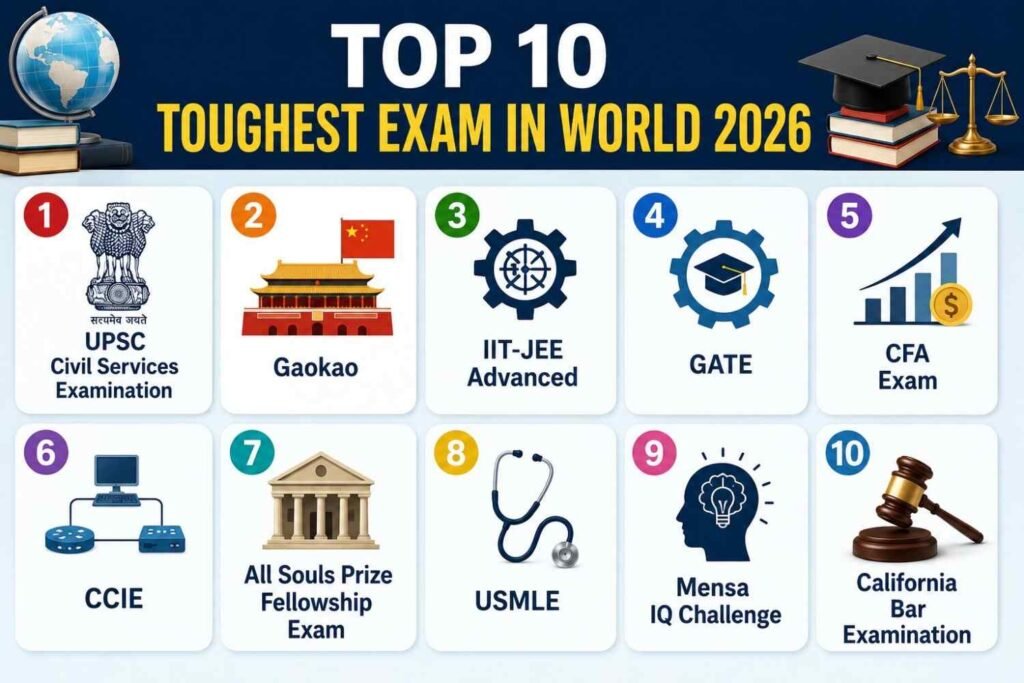
Top 10 Toughest Exams in the World 2026: The Ultimate List Every Student Should Know
Everyone talks about “tough exams.” Your parents say UPSC is impossible. Your coaching teacher says JEE Advanced is the hardest thing in India. Your friend who dreams of becoming a doctor says USMLE is brutal. But which exams are actually the toughest in the world — and what makes them so hard?
This is not a list of exams that are merely “competitive.” The toughest exams in the world are the ones where difficulty, depth, pressure, and failure rate combine to create a genuinely extraordinary challenge — one that reshapes the people who attempt them, whether they pass or not.
If you’re a Class 12 student wondering what lies ahead — or simply curious about what the hardest intellectual challenges in the world look like — this is the guide for you.
What Makes an Exam “The Toughest”?
Before the list, let’s define what we mean by “toughest exam.” We’re looking at four factors:
- Difficulty of content — How deep and complex is the knowledge required?
- Pass rate / Selection rate — What percentage of candidates actually succeed?
- Preparation time required — How many years does serious preparation take?
- Impact on life — How much rides on clearing this exam?
With that framework, here are the top 10 toughest exams in the world 2026.
Quick Snapshot: World’s Toughest Exams 2026
| Rank | Exam | Country | Pass Rate | Prep Time |
|---|---|---|---|---|
| 1 | Gaokao | China | ~50% (top universities: 0.1%) | 12 years |
| 2 | IIT JEE Advanced | India | ~1% of total takers | 2–4 years |
| 3 | UPSC Civil Services | India | ~0.1–0.3% | 2–5 years |
| 4 | CFA (Chartered Financial Analyst) | Global | ~40% (Level I) to 56% (Level III) | 4–5 years |
| 5 | USMLE (US Medical Licensing) | USA | Step 1: ~94% first-time, drops later | 4–6 years |
| 6 | Bar Exam (California) | USA | ~33% pass rate | 3–4 years |
| 7 | Mensa IQ Test | Global | Top 2% of IQ qualifies | No prep |
| 8 | GRE / GMAT (Competitive) | Global | Varies; top scorers: ~1–5% | 6–12 months |
| 9 | All Souls Prize Fellowship | Oxford, UK | 1–2 selected per year from thousands | Lifetime of study |
| 10 | Master Sommelier Diploma Exam | Global | ~10% historically | 3–10 years |
1. Gaokao — China’s College Entrance Exam
Country: China What it is: National College Entrance Examination (高考) Why it’s the toughest: 12 years of your life, compressed into 9 hours
What Is Gaokao?
Gaokao is China’s national university entrance examination — and arguably the most consequential exam on earth. Every year, approximately 13 million students sit for this single exam, and the result determines not just which university you attend, but in many ways, the trajectory of your entire life in China.
The exam covers:
- Chinese Language and Literature
- Mathematics (notoriously difficult)
- Foreign Language (English for most)
- Science subjects (Physics, Chemistry, Biology) OR Humanities (History, Geography, Politics)
Why Is It So Tough?
- Scale: 13 million+ students compete simultaneously
- Stakes: One exam decides everything — no second chances in the same year
- Competition for elite seats: Peking University and Tsinghua University (China’s top 2) accept roughly 0.03–0.1% of test-takers
- Provincial disparity: Students from less-developed provinces need higher scores for the same universities
- Cultural pressure: Chinese society places extraordinary social weight on Gaokao performance — entire families reorganize their lives around it
The Mathematics paper routinely stuns even the most prepared students with its depth and creativity.
2. IIT JEE Advanced — India’s Engineering Gateway
Country: India What it is: Joint Entrance Examination Advanced Why it’s the toughest: 1.4 million start; ~17,000 get IIT seats
What Is JEE Advanced?
JEE Advanced is the entrance exam for all 23 Indian Institutes of Technology — India’s most prestigious engineering institutions. Only the top 2.5 lakh JEE Main qualifiers can even attempt JEE Advanced, and of those, only about 17,000 get IIT seats.
The exam covers Physics, Chemistry, and Mathematics across 2 papers (6 hours total), testing:
- Deep conceptual understanding (not just formula application)
- Multi-step problem solving
- Creative mathematical thinking
- Ability to synthesize knowledge across topics
Why Is It So Tough?
- Multi-correct MCQs with negative marking: One wrong answer costs you marks — and you might not know which options are wrong
- No formula sheet: Every formula must be memorized and understood
- Questions that have no direct textbook precedent: JEE Advanced regularly creates new problem types
- Top IIT CSE cutoff: Only the top ~67 ranks out of 1.4 million original applicants get IIT Bombay CSE
Students who crack JEE Advanced in India often say it’s not just an exam — it’s a 2–4 year transformation of how you think.
3. UPSC Civil Services Examination — India’s Most Prestigious Exam
Country: India What it is: Union Public Service Commission Civil Services Exam Why it’s the toughest: 1 million applicants; ~180 IAS officers selected
What Is UPSC?
The UPSC Civil Services Examination selects India’s top administrative officers — IAS, IPS, IFS, and other Group A services. These are the people who run India’s districts, states, and central government machinery.
The exam has three stages:
- Prelims (June): 2 objective papers — General Studies + CSAT (aptitude)
- Mains (September): 9 descriptive papers over 5 days
- Interview/Personality Test (February–May): 275 marks
Total time from Prelims to final result: approximately 1 year per cycle
Why Is It So Tough?
- Breadth of knowledge required: History, Geography, Economy, Polity, Science and Technology, Environment, Current Affairs — all at a serious analytical level
- Essay writing at the highest level: Mains demands structured, nuanced, original thinking
- Optional subject depth: Candidates choose an optional subject (often their graduation discipline) and must master it at postgraduate level
- Psychological endurance: The process takes 12–18 months per attempt; most serious aspirants attempt 3–6 times
- Selection rate: Approximately 0.1–0.3% of applicants get selected for any service
Many IIT graduates, doctors, and lawyers give up high-paying careers to attempt UPSC — and still find it harder than anything they faced before.
4. CFA — Chartered Financial Analyst Exam
Country: Global (headquartered USA) What it is: 3-level financial analysis certification Why it’s the toughest: 4,000+ hours of study for all 3 levels; 10+ years for many
What Is CFA?
The CFA (Chartered Financial Analyst) designation is the gold standard in investment and financial analysis globally. It requires passing 3 progressive levels:
- Level I: 180 MCQs; tests financial knowledge breadth
- Level II: Vignette-based; tests financial analysis application
- Level III: Essay + vignette; tests portfolio management judgment
Why Is It So Tough?
- Time required: The CFA Institute recommends 300+ hours of study per level — over 900 hours total
- Pass rates: Level I passes ~40%, Level II ~45%, Level III ~56% — but these are people who have already cleared prior levels
- Sequential: You cannot skip levels; fail one and you start that level over
- Real-world application: Unlike academic exams, CFA tests judgment and application, not just knowledge
The average candidate takes 4 years to complete all 3 levels. Only about 20% of people who start Level I eventually earn the charter.
5. USMLE — United States Medical Licensing Examination
Country: USA (and for foreign medical graduates worldwide) What it is: 3-step medical licensing exam Why it’s the toughest: 10+ years of medical education; international doctors have <50% pass rates
What Is USMLE?
The USMLE is the licensing examination for practicing medicine in the United States — both for US medical graduates and International Medical Graduates (IMGs) including thousands of Indian MBBS graduates.
It consists of:
- Step 1: Basic medical sciences (anatomy, physiology, biochemistry, pathology)
- Step 2 CK: Clinical Knowledge — patient diagnosis and management
- Step 3: Clinical practice and management, including computer-based case simulations
Why Is It So Tough?
- Depth of knowledge: Step 1 alone covers years of medical school material
- International competition: For IMGs (Indian MBBS + others), competition for US residency spots is fierce
- Cost: Each step costs $1,000+ to take; retakes add up
- Impact: Failing USMLE means no US medical practice — full stop
For Indian MBBS graduates seeking US residency, USMLE preparation typically requires 1–2 years of dedicated study after graduation.
6. California Bar Exam — America’s Hardest Legal Exam
Country: USA What it is: State bar licensing examination for lawyers Why it’s the toughest: One of the world’s lowest bar exam pass rates
What Is the California Bar Exam?
Every US state has its own bar exam. California’s is consistently ranked the toughest — with a pass rate that hovers around 33–40% even for graduates of top law schools like Stanford, UCLA, and UC Berkeley.
The exam covers:
- Multi-state Bar Examination (MBE) — 200 MCQs
- Performance Test (PT) — practical legal writing
- Essay questions — 5 written essays on California-specific law
Why Is It So Tough?
- Scope: California tests more subjects than most states
- No formula: Every answer requires synthesis and legal reasoning
- Failed by top law graduates: Even JD graduates from top-10 US law schools regularly fail
- No partial credit: In a 33% pass rate environment, even strong candidates fail regularly
- Career impact: Failing the bar means you cannot practice law in California — a market with some of the world’s highest attorney salaries
7. Mensa IQ Admission Test
Country: Global What it is: IQ test for admission to Mensa International Why it’s the toughest: Only the top 2% of the global population qualifies
What Is Mensa?
Mensa is the world’s oldest and largest high-IQ society. To join, you must score in the top 2% of the population on a standardized IQ test — equivalent to an IQ of approximately 130+ on most scales.
The Mensa test is not something you can “study for” in a conventional sense. It measures:
- Spatial reasoning
- Pattern recognition
- Logical deduction
- Verbal and numerical reasoning
Why Is It Unique on This List?
Unlike other exams on this list, you can’t prepare for Mensa with textbooks. Your score reflects raw cognitive ability. Only 1 in 50 people globally qualifies — making it one of the most exclusive intellectual communities in the world.
Mensa members include Nobel Prize winners, CEOs, engineers, artists, and people from every walk of life — united by this single cognitive benchmark.
8. All Souls Prize Fellowship Examination — Oxford University
Country: United Kingdom What it is: Fellowship examination for All Souls College, Oxford Why it’s the toughest: Only 1–2 people selected annually from the world’s best graduates
What Is the All Souls Examination?
All Souls College, Oxford is unique — it has no undergraduates. It is a college of fellows engaged in academic research. Each year, it holds a Prize Fellowship examination open to recent Oxford graduates.
The exam traditionally includes:
- Four essay-type papers over 2 days
- Topics drawn from across all academic disciplines
- Previously included the famous “one word” exam (candidates write a 3-hour essay on a single word like “Bias” or “Innocence”)
Why Is It So Tough?
- Only 1–2 fellowships are awarded annually
- Applicants are already Oxford graduates — among the world’s best-educated people
- No specific syllabus — the exam tests breadth of knowledge, depth of thinking, and originality of expression
- A Fellowship at All Souls is one of the most prestigious academic honors in the world
The exam doesn’t test what you know — it tests how well you think.
9. Master Sommelier Diploma Examination
Country: Global (Court of Master Sommeliers) What it is: Wine expertise certification at the highest level Why it’s the toughest: Only ~270 Master Sommeliers exist in the entire world
What Is the Master Sommelier Exam?
The Master Sommelier Diploma is the highest credential in the world of wine and beverage service. The exam has 3 parts:
- Theory: Comprehensive written examination on wine, spirits, and beverage regions globally
- Service: Practical sommelier service under pressure at a formal dinner setting
- Blind Tasting: Identifying 6 wines blind — grape variety, region, vintage — with extreme precision
Why Is It So Tough?
- In some years, zero candidates pass
- Over the exam’s entire history, fewer than 270 people have earned the title
- Blind tasting requires identifying wines from the taste alone — after years of training your palate
- Preparation typically takes 5–10 years of dedicated study and experience
- The stakes are psychological as much as technical — many candidates fail at the last stage after years of preparation
10. GATE — Graduate Aptitude Test in Engineering (India)
Country: India What it is: Engineering/Science postgraduate and PSU entrance exam Why it’s the toughest: Only top scorers get IIT M.Tech seats and top PSU jobs
What Is GATE?
The Graduate Aptitude Test in Engineering (GATE) is India’s national examination for admission to M.Tech programmes at IITs, NITs, and IISc — and the primary gateway to top Public Sector Undertaking (PSU) jobs like ONGC, BHEL, IOCL, NTPC, and ISRO.
While the absolute pass rate is moderate, scoring competitively (top 1–2% with 800+ marks) for IIT M.Tech or top PSUs makes GATE exceptionally challenging.
Why Is It So Tough?
- Tests 4 years of engineering curriculum in a single 3-hour exam
- PSU recruiters (ISRO, DRDO, ONGC) use GATE scores to shortlist thousands of candidates for just a few dozen positions
- For IIT Bombay M.Tech: A GATE score of 900+/1000 is needed — achieved by less than 0.5% of candidates
- Working professionals competing while employed make the preparation context even harder
India-Specific Honorable Mentions
Beyond the global list, India has several exams that deserve recognition for their extraordinary difficulty:
| Exam | What It Is | Why It’s Tough |
|---|---|---|
| NEET UG | Medical entrance (MBBS) | 2.3 million compete; ~1.1 lakh seats; single attempt each year |
| CA Final | Chartered Accountancy | Pass rate: ~15–20%; 3–4 years of articleship + exams |
| NDA | National Defence Academy | Physical + written; elite few selected for IMA/INA/AFA |
| CLAT | National Law Universities | 70,000 students; 2,500 seats; top NLU cutoffs brutal |
| NET/JRF | National Eligibility Test for research fellowship | Only top 6% get JRF; highly competitive across all subjects |
What the Toughest Exams Have in Common
After looking at all 10, here’s what these exams share:
1. They test thinking, not just knowing Whether it’s All Souls’ single-word essay or JEE Advanced’s multi-concept physics problem — the best exams reward original, deep thinking over rote memorization.
2. Preparation is a way of life, not a sprint No one cracks UPSC in 3 months, or earns a CFA in one sitting. These exams demand sustained intellectual commitment over years.
3. Failure is the norm In most of these exams, most people fail — often multiple times. The ones who ultimately succeed are not necessarily the most naturally gifted; they’re the most resilient.
4. They reshape the people who attempt them Even students who ultimately don’t pass UPSC or JEE Advanced often find that the preparation process made them significantly better thinkers, more disciplined workers, and more knowledgeable people.
What Should You Do With This Information?
If you’re a Class 12 student reading this, here’s the takeaway:
- JEE Advanced — if engineering and IITs are your dream, this is your most immediate challenge
- NEET — if medicine is your calling, understand that 2.3 million compete for your seat
- UPSC — if public service calls you, begin building the reading habits now that UPSC rewards later
- CFA/USMLE — if finance or US medicine is your long-term goal, know that the hardest exam comes after your degree
The toughest exams in the world don’t just measure what you know — they measure who you’re willing to become through the process of preparing for them.
That process begins with the choices you make today.
Frequently Asked Questions
Q: What is the toughest exam in the world? A: By most measures, China’s Gaokao (scale + societal pressure) and India’s JEE Advanced (depth + selection rate) compete for the title of world’s toughest exam. The All Souls Prize Fellowship examination at Oxford is arguably the most intellectually exclusive.
Q: What is the toughest exam in India? A: UPSC Civil Services is widely considered India’s toughest exam — with a 0.1–0.3% selection rate and requiring 12–18 months of intense preparation per attempt. JEE Advanced is the toughest for technical examinations.
Q: Which is tougher — JEE Advanced or UPSC? A: They’re different in nature. JEE Advanced is technically deeper and tests mathematical and scientific reasoning at an elite level. UPSC is broader, tests analytical writing, and requires sustained preparation over years. Both are among the toughest exams in India — they simply test different kinds of excellence.
Q: What is the toughest exam for medical students? A: In India: NEET UG for undergraduate and NEET PG for postgraduate admissions. Globally: USMLE (US medical licensing) is considered among the world’s most difficult professional licensing exams.
Q: Why is Gaokao considered the world’s toughest exam? A: Gaokao is considered the toughest because of the extraordinary stakes (one exam = entire life trajectory in China), the scale (13 million+ takers), the extreme competition for top university seats (0.03–0.1% acceptance), and the societal pressure that accompanies it.
Q: Is JEE Advanced the toughest engineering exam in the world? A: JEE Advanced is widely considered among the world’s toughest undergraduate engineering exams, alongside Gaokao (for Chinese students). Its combination of conceptual depth, multi-correct negative marking, and extremely low IIT seat-to-applicant ratio makes it uniquely challenging.
Final Verdict
The toughest exams in the world 2026 are not just difficult tests — they are life-defining experiences that require years of preparation, extraordinary focus, and the kind of resilience most people never develop.
Whether it’s 13 million Chinese students facing Gaokao together, a thousand UPSC aspirants sitting across an essay paper, or a sommelier trying to identify a wine blind after a decade of training — these exams represent the full spectrum of human intellectual ambition.
For you as a Class 12 student, the most relevant of these are right in your future: JEE Advanced if you dream of IIT, NEET if medicine calls you, and UPSC if you want to serve the nation in its highest administrative roles.
The difficulty is real. The preparation is hard. But so is the reward — and so, most importantly, is the growth.
Choose your challenge. Begin today. 🏆


