
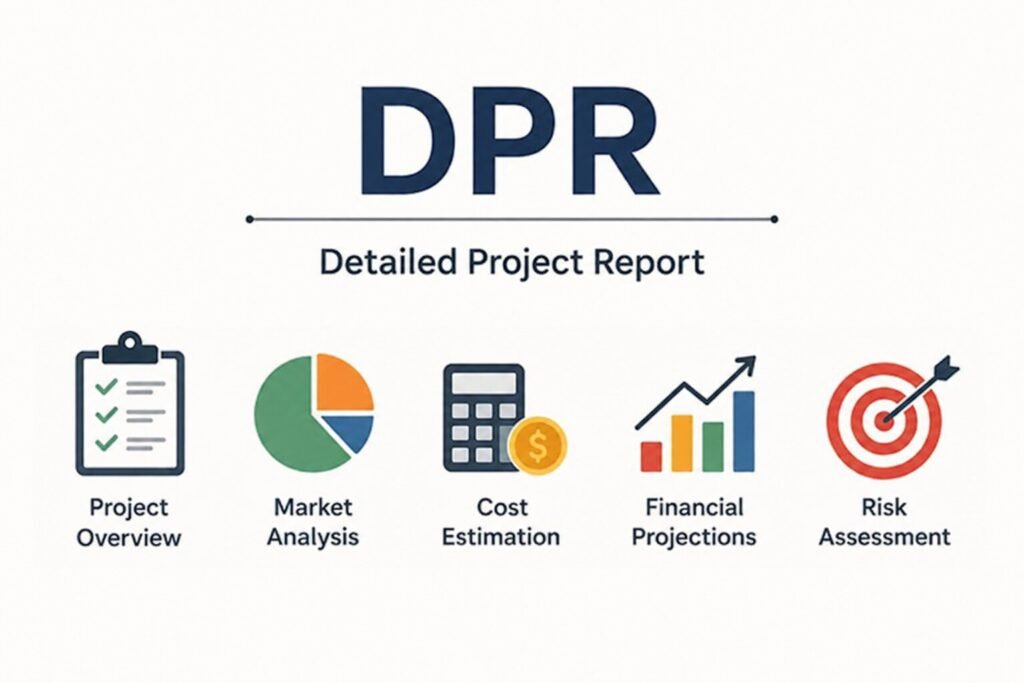
DPR Full Form: Meaning, Types, Importance, and Career Relevance
What is the DPR Full Form?
The DPR full form is Detailed Project Report. It is a comprehensive document prepared before starting a project. A DPR contains all the important details about a project, including objectives, costs, resources, timelines, technical requirements, risks, and expected outcomes.
Whether it is a road construction project, a business startup, a manufacturing unit, or a government development scheme, a Detailed Project Report helps stakeholders understand how the project will be executed successfully.
For Class 12 students, understanding the DPR full form is useful because it is commonly discussed in engineering, business management, government projects, and competitive examinations.
Introduction to DPR
Before investing money and resources into a project, organizations need a clear roadmap. This roadmap is called a Detailed Project Report (DPR).
A DPR helps answer important questions such as:
What is the purpose of the project?
How much will it cost?
How long will it take?
What resources are required?
Is the project financially viable?
A well-prepared DPR increases the chances of project success.
Definition of DPR
A Detailed Project Report (DPR) is a formal document that provides complete information about a proposed project. It acts as a blueprint for planning, financing, implementing, and monitoring the project.
The report is usually prepared by engineers, project managers, consultants, financial experts, and technical professionals.
Why is DPR Important?
The importance of a DPR cannot be overstated. It helps organizations make informed decisions before investing significant resources.
Key Benefits of DPR
Better Planning
A DPR provides a detailed plan for project execution.
Financial Assessment
It estimates project costs and expected returns.
Risk Management
Potential risks and challenges are identified in advance.
Funding Approval
Banks and financial institutions often require a DPR before approving loans.
Resource Allocation
It helps determine manpower, materials, and equipment requirements.
Main Components of a DPR
A Detailed Project Report consists of several important sections.
1. Executive Summary
This section provides a brief overview of the project.
It includes:
Project name
Objectives
Scope
Estimated cost
Expected outcomes
2. Project Background
This section explains:
Why the project is needed
Existing problems
Opportunities
Market demand
3. Project Objectives
Objectives define the goals that the project aims to achieve.
Examples:
Improve transportation facilities
Increase production capacity
Generate employment
Enhance public services
4. Technical Analysis
Technical analysis covers:
Technology used
Design specifications
Infrastructure requirements
Equipment details
This section is especially important in engineering projects.
5. Financial Analysis
The financial section includes:
Project cost estimation
Capital investment
Revenue projections
Profitability analysis
Break-even analysis
Investors often focus heavily on this part of the DPR.
6. Resource Requirements
This section lists:
Human resources
Machinery
Raw materials
Utilities
Proper resource planning ensures smooth project implementation.
7. Risk Assessment
Every project involves risks.
Common risks include:
Budget overruns
Delays
Technical failures
Market changes
A DPR identifies these risks and suggests mitigation strategies.
8. Implementation Schedule
This section outlines:
Project phases
Key milestones
Completion timelines
Project managers use this schedule to monitor progress.
Types of DPR
Different industries prepare DPRs according to their specific requirements.
Industrial DPR
Prepared for manufacturing and industrial projects.
Examples:
Factory setup
Production unit expansion
New manufacturing facilities
Infrastructure DPR
Used for infrastructure development projects.
Examples:
Roads
Bridges
Airports
Railways
Business DPR
Prepared by entrepreneurs and startups.
Examples:
New business ventures
Franchise expansion
Retail stores
Government Project DPR
Government departments prepare DPRs before implementing public welfare projects.
Examples:
Smart city projects
Water supply schemes
Rural development initiatives
Steps in Preparing a DPR
Creating a Detailed Project Report involves several stages.
Step 1: Project Identification
The need for a project is identified.
Step 2: Data Collection
Relevant technical, financial, and market data are gathered.
Step 3: Feasibility Study
Experts evaluate whether the project is practical and profitable.
Step 4: Cost Estimation
Expected expenses are calculated.
Step 5: Risk Analysis
Potential risks are identified and assessed.
Step 6: Documentation
All findings are compiled into a structured report.
Step 7: Approval
The DPR is submitted to stakeholders, investors, or government authorities for approval.
Importance of DPR in Government Projects
Government agencies heavily rely on DPRs before launching development projects.
Reasons
Ensures transparency
Helps manage public funds
Improves accountability
Reduces project delays
Enhances project quality
Large infrastructure projects often require extensive DPR preparation before receiving government approval.
Importance of DPR in Business
Businesses use DPRs to evaluate opportunities and secure financing.
Business Benefits
Attract investors
Obtain bank loans
Evaluate profitability
Plan resource utilization
Improve project success rates
Many startups prepare DPRs before approaching investors.
Difference Between DPR and Project Proposal
Students often confuse a DPR with a project proposal.
| Feature | DPR | Project Proposal |
|---|---|---|
| Full Form | Detailed Project Report | Project Proposal |
| Purpose | Detailed planning document | Initial project idea |
| Level of Detail | Extensive | Brief |
| Financial Analysis | Comprehensive | Basic |
| Technical Details | Included | Limited |
| Usage | Project execution | Project approval stage |
A project proposal may lead to the preparation of a DPR after approval.
Real-Life Examples of DPR
Road Construction Project
The DPR includes:
Route surveys
Engineering designs
Material requirements
Cost estimates
Construction schedule
School Building Project
The report contains:
Architectural plans
Budget details
Construction timeline
Resource planning
Manufacturing Plant
The DPR covers:
Machinery requirements
Production capacity
Investment analysis
Market demand forecasts
Careers Related to DPR Preparation
Many professionals work on preparing Detailed Project Reports.
Civil Engineers
Prepare technical and construction-related sections.
Project Managers
Coordinate planning and implementation.
Financial Analysts
Handle budgeting and profitability analysis.
Consultants
Provide expert recommendations.
Architects
Contribute design and infrastructure planning.
Business Analysts
Evaluate market opportunities and business viability.
Skills Required for DPR Preparation
Students interested in project management careers should develop these skills.
Analytical Thinking
Understanding data and project requirements.
Financial Knowledge
Budgeting and cost estimation skills.
Communication Skills
Preparing reports and presenting findings.
Technical Expertise
Industry-specific knowledge.
Problem-Solving Ability
Identifying and resolving project challenges.
Advantages of a Detailed Project Report
A well-prepared DPR offers several advantages.
Clear Vision
Everyone involved understands project goals.
Better Decision-Making
Stakeholders can evaluate project feasibility.
Improved Financial Planning
Budget estimates reduce financial uncertainty.
Effective Monitoring
Project progress can be tracked more efficiently.
Reduced Risks
Potential issues are identified early.
Challenges in DPR Preparation
Preparing a DPR is not always easy.
Common Challenges
Inaccurate data
Cost estimation errors
Changing market conditions
Technical complexities
Time constraints
Experienced professionals help overcome these challenges through detailed analysis and planning.
DPR Full Form in Other Contexts
Although DPR full form commonly means Detailed Project Report, it can have other meanings depending on the field.
Daily Progress Report
Used in project management and construction industries to track daily activities.
Department of Public Relations
Used in organizational and government communication departments.
However, in education, engineering, business, and competitive exams, Detailed Project Report is the most commonly accepted full form.
DPR Full Form in Hindi
The DPR full form in Hindi is:
विस्तृत परियोजना प्रतिवेदन
or
विस्तृत परियोजना रिपोर्ट
This document provides complete information regarding the planning, execution, and management of a project.
Frequently Asked Questions (FAQs)
1. What is the DPR full form?
The DPR full form is Detailed Project Report.
2. Why is a DPR prepared?
A DPR is prepared to provide complete information about a project’s technical, financial, and operational aspects.
3. Who prepares a DPR?
Engineers, project managers, consultants, financial analysts, and technical experts prepare DPRs.
4. What is included in a DPR?
A DPR includes objectives, costs, timelines, technical details, resource requirements, and risk analysis.
5. Why do banks require DPRs?
Banks use DPRs to assess project feasibility before approving loans.
6. What is the difference between DPR and a project proposal?
A project proposal presents an initial idea, while a DPR provides a detailed implementation plan.
7. What is the DPR full form in Hindi?
It is विस्तृत परियोजना प्रतिवेदन.
8. Can a business startup prepare a DPR?
Yes, startups often prepare DPRs to attract investors and secure funding.
Conclusion
The DPR full form is Detailed Project Report, an essential document used in business, engineering, infrastructure, and government projects. It serves as a comprehensive roadmap that helps organizations plan, finance, execute, and monitor projects effectively.
For Class 12 students, understanding the concept of a DPR is valuable because it introduces important principles of project management, financial planning, and business operations. Whether you aim to become an engineer, entrepreneur, project manager, or government officer, knowledge of DPR preparation can prove highly beneficial in your future career.
A well-prepared DPR not only improves project success rates but also ensures efficient use of resources, better decision-making, and long-term sustainability. That’s why the DPR full form remains one of the most important concepts in project planning and management.