How to Prepare for MBA Entrance Exams in 2026: The Complete Strategy Guide
So you’ve decided to do an MBA. Great decision. The question now isn’t whether to take the plunge — it’s how to crack the entrance exam that gets you there.
If you’re staring at the sheer number of MBA entrance exams available — CAT, MAT, XAT, GMAT, NMAT, CMAT, SNAP — and feeling mildly overwhelmed, you’re not alone. Every year, lakhs of graduates sit for these exams hoping to land a seat at a top B-school, and only a fraction make it to the colleges they actually want.
The good news? Cracking an MBA entrance exam in 2026 is not about being the smartest person in the room. It’s about having the right strategy, the right preparation plan, and the right mindset.
This guide gives you exactly that.
Table of contents
- How to Prepare for MBA Entrance Exams in 2026: The Complete Strategy Guide
- Quick Snapshot: MBA Entrance Exams 2026
- 1. Understand the Exam Before You Start Preparing
- 2. Choose Your Target Exam(s) First
- 3. Build Your MBA Entrance Exam Preparation Plan: Month-by-Month
- 4. Section-Wise Preparation Strategies
- 5. Resources for MBA Entrance Exam Preparation 2026
- 6. Common Mistakes That Kill Your MBA Entrance Exam Score
- 7. Beyond the Exam: The Complete MBA Application Picture
- 8. MBA Entrance Exam: Top B-Schools and What You Need to Get In
- 9. Frequently Asked Questions
- Final Verdict: Your MBA Entrance Exam Prep Starts Now
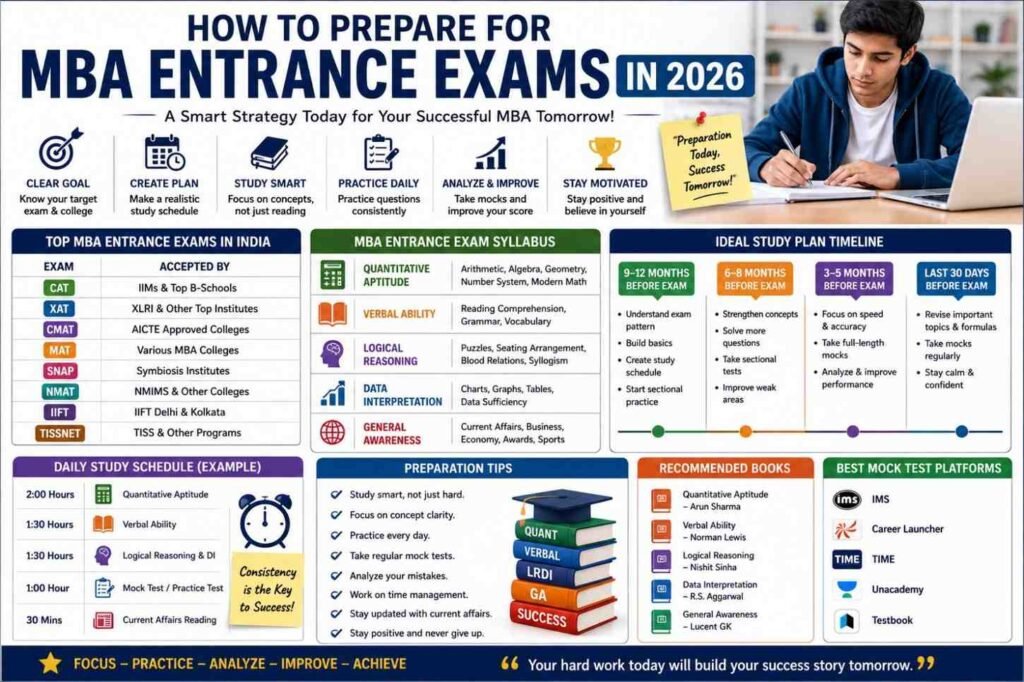
Quick Snapshot: MBA Entrance Exams 2026
| Exam | Conducting Body | Top Colleges | Best Score For |
|---|---|---|---|
| CAT | IIMs | All 21 IIMs + 1,000+ B-schools | IIMs, FMS, MDI, SPJIMR |
| XAT | XLRI | XLRI, XIMB, IMT, GIM | XLRI, top private B-schools |
| GMAT | GMAC | ISB, IIMs (Exec), Top Global | Global MBAs, ISB |
| NMAT | GMAC | NMIMS, SNU, Woxsen | NMIMS and NMAT-accepting colleges |
| SNAP | Symbiosis International | All 16 SIU institutes | Symbiosis B-schools |
| CMAT | NTA | AICTE-approved B-schools | State-level and mid-tier B-schools |
| MAT | AIMA | 600+ B-schools | Wide range of private colleges |
| IIFT | NTA | IIFT Delhi, Kolkata, Kakinada | International Business specialization |
| ATMA | AIMS | 700+ institutes | Alternative for mid-tier admissions |
1. Understand the Exam Before You Start Preparing
The first and most critical step in MBA entrance exam preparation is understanding what each exam actually tests — because they are not all the same.
What Most MBA Entrance Exams Test
Most major MBA entrance exams evaluate you across three broad areas:
1. Verbal Ability and Reading Comprehension (VARC)
- Reading Comprehension (RC) passages — 3 to 5 long passages with questions
- Para Jumbles, Para Summary, Odd Sentence Out
- Critical Reasoning (for GMAT and XAT)
- Vocabulary-based questions (MAT, CMAT)
2. Data Interpretation and Logical Reasoning (DILR)
- Data Interpretation sets — tables, charts, bar graphs, pie charts
- Logical Reasoning — arrangements, puzzles, blood relations, syllogisms
- This section is often the deciding factor in CAT specifically
3. Quantitative Ability (QA)
- Arithmetic — Percentages, Profit & Loss, Time-Speed-Distance, Work
- Algebra — Equations, Functions, Progressions
- Geometry and Mensuration
- Number Theory — Remainders, Factors, Divisibility
- Modern Maths — Probability, Permutations & Combinations, Set Theory
Understanding this framework helps you build a section-wise preparation plan rather than randomly studying everything.
2. Choose Your Target Exam(s) First
Here’s a mistake most aspirants make: they try to prepare for every exam simultaneously without a clear primary target.
How to Decide Which MBA Entrance Exam to Focus On
| If your goal is… | Primary Exam | Backup Exam |
|---|---|---|
| IIM A/B/C (Top 3 IIMs) | CAT (95–99 percentile) | XAT |
| Other IIMs / FMS / MDI | CAT (90–95 percentile) | GMAT |
| XLRI / XIMB | XAT | CAT |
| NMIMS Mumbai | NMAT | CAT |
| ISB Hyderabad / Delhi | GMAT (700+ score) | CAT |
| Symbiosis (SCMS, SIBM) | SNAP | CAT |
| IIFT (International Business) | IIFT | CAT |
| Wide range of B-schools | CMAT / MAT | CAT |
| GD Goenka / Amity / Private NCR | CAT / MAT / CMAT | University Test |
The golden rule: CAT first, everything else second. CAT is the most widely accepted MBA entrance exam in India, accepted by 1,000+ B-schools. A strong CAT score gives you options. Start with CAT as your anchor, and layer in other exams based on your target colleges.
3. Build Your MBA Entrance Exam Preparation Plan: Month-by-Month
Here is a practical, realistic preparation plan assuming you’re starting from scratch and targeting CAT 2026 (typically held in November).
Phase 1: Foundation Building (Months 1–3)
Goal: Understand concepts, identify your weak areas
Week-by-week focus:
Month 1 — Quantitative Ability
- Arithmetic: Percentages, Profit & Loss, Ratio & Proportion, Simple and Compound Interest
- Number Systems: Factors, LCM/HCF, Remainders
- Resources: NCERT Class 9 and 10 Maths (seriously — a solid foundation matters)
- Daily practice: 15–20 arithmetic questions; 1 mock exercise
Month–2 — Verbal Ability
- Reading habit: Read The Hindu, The Economist, or any quality English newspaper daily (30 minutes)
- RC practice: Solve 1–2 RC passages daily
- Grammar basics: Subject-verb agreement, tenses, sentence correction
- Vocabulary: Learn 10 new words/day using a dedicated app or flashcards
Month 3 — Data Interpretation and Logical Reasoning
- DI basics: Bar charts, pie charts, line graphs, tables — learn to calculate quickly
- LR basics: Arrangements, blood relations, directions, syllogisms
- Calculation speed: Practice mental maths and approximation techniques daily
Phase 2: Skill Building (Months 4–6)
Goal: Move from understanding to application; solve problems under time pressure
- Start topic-wise tests (50 questions per topic, timed)
- Take 1 sectional mock test per week (rotating across VARC, DILR, QA)
- Review every mistake — this is where real improvement happens
- Begin full-length mock tests (one per month) to build stamina
- Identify your weakest sub-topics and allocate extra time there
Phase 3: Mock Test Marathon (Months 7–9)
Goal: Simulate real exam conditions; develop exam temperament
- Take 1–2 full-length mocks every week (CAT-pattern mocks from IMS, TIME, Career Launcher, or free IIM simulators)
- Spend as much time analyzing each mock as you spent taking it
- Track your percentile improvement week by week
- Focus on:
- Accuracy over speed — Avoid negative marking traps
- Attempt strategy — Which questions to skip, which to solve first
- Section time management — DILR is the time sink; practice efficient triage
Phase 4: Revision and Refinement (Month 10 — October)
Goal: Consolidate, fix last remaining gaps, build exam-day confidence
- Revise formulas and shortcuts weekly
- Take 2 mocks per week; focus on maintaining percentile rather than chasing higher scores
- Practice DILR puzzles daily — this is where 10+ percentile can swing in CAT
- Do a full CAT 2020–2025 past paper in exam conditions (IIM-released papers are the best practice)
CAT 2026 Exam Day Preparation
- The week before: light revision only — do not start any new topics
- Sleep at least 8 hours the night before
- Reach the center 30 minutes early
- Section order strategy: most aspirants tackle VA first (fresh mind), then DILR, then QA — but know your own pace
4. Section-Wise Preparation Strategies
VARC Strategy: Reading Is Your Greatest Investment
Reading Comprehension accounts for roughly 70% of the VARC section in CAT. There’s no shortcut — you must read regularly.
What to read:
- Editorials: The Hindu, Indian Express, Livemint
- Long-form: The Economist, Aeon, Harvard Business Review
- Academic-style passages: Economic and Political Weekly
RC Approach:
- Read the passage actively — not passively
- Identify the author’s tone and central argument first
- Answer inference and main-idea questions from the passage, not memory
- For Para Jumbles: identify the opening sentence (no pronoun or connector at start), then find logical pairs
Target: 80%+ accuracy in RC; 60–70% in VILR (Verbal Inference and Logic Reasoning)
DILR Strategy: The Great Differentiator
DILR is where IIM dreams are made or broken. The key isn’t solving every set — it’s identifying the right sets to attempt.
Approach:
- In the first 3–4 minutes of DILR, scan all sets quickly
- Mark each set as Easy / Medium / Hard based on your first impression
- Start with Easy sets; do 2–3 fully before attempting Medium sets
- Leave Hard sets entirely if time is limited (a blank is better than a wrong guess with negative marking)
Daily practice: 1 complete DI set + 1 LR puzzle every day
Strongest topics to master first: Arrangements (Linear and Circular), Scheduling, Grid/Matrix puzzles, Venn Diagrams
QA Strategy: Accuracy First, Speed Second
Many aspirants panic about Quantitative Ability — especially engineers who haven’t touched maths in years. The secret: CAT QA is Class 10–12 level maths, not engineering maths.
Topic priority:
- High Priority (most questions): Arithmetic (Percentages, Ratio, TSD, Work), Algebra (Equations, Functions)
- Medium Priority: Geometry, Number Theory, Modern Maths
- Low Priority: Coordinate Geometry (few questions, high effort)
Shortcuts that save time:
- Percentage-fraction equivalence (1/6 = 16.67%; 1/7 = 14.28%) — memorize up to 1/20
- Units digit pattern recognition for power questions
- Approximation for DI calculations (±2% accuracy is fine for most MCQs)
Target: Attempt 20–24 questions with 85%+ accuracy rather than attempting 30 with 65% accuracy
5. Resources for MBA Entrance Exam Preparation 2026
Best Books
| Section | Recommended Books |
|---|---|
| QA | Arun Sharma — Quantitative Aptitude for CAT; Nishit K Sinha — The Pearson Guide |
| VARC | Arun Sharma & Meenakshi Upadhyay — Verbal Ability; Norman Lewis — Word Power Made Easy |
| DILR | Arun Sharma — Logical Reasoning; Nishit K Sinha — DILR for CAT |
| XAT/GMAT | Official GMAT Guide (for critical reasoning); XAT past papers (2015–2025) |
Online Platforms and Mock Series
- IMS, TIME, Career Launcher: The gold standard for mock tests and classroom coaching
- Unacademy / Byju’s / MBA Wallah (PW): Affordable online video content
- CAT Mock Series: Free IIM simulator (check iimcat.ac.in during registration period)
- Cracku and TestFunda: Strong DILR-specific practice sets
- GMAT Official Practice: Absolutely essential for GMAT-takers (gmac.com)
YouTube Channels Worth Following
- Rodha (CAT): Exceptional QA shortcuts and DILR explanations
- 2IIM (CAT): High-quality RC and VARC practice
- MBA Wallah: Comprehensive free content
6. Common Mistakes That Kill Your MBA Entrance Exam Score
Mistake 1: Attempting Too Many Questions
Negative marking in CAT means wrong answers hurt you. An 80-percentile accuracy on 45 attempts beats 60% accuracy on 66 attempts every single time.
Mistake 2: Ignoring DILR Until the Last Minute
DILR is the most time-consuming section to improve. If you start working on it only in the final month, you’ve wasted months of potential gains. Start Day 1.
Mistake-3: Only Taking Mocks, Not Analyzing Them
Taking 50 mock tests without analyzing them deeply is like going to the gym without doing any actual exercise. The analysis — understanding why you got a question wrong — is where improvement lives.
Mistake 4: Studying Sections in Isolation
The real CAT has a strict time limit per section. Practice with the section timer on from Month 5 onwards. Many students who score well on sectional tests collapse in real exams because they haven’t trained for timed pressure.
Mistake 5: Neglecting GK and Essay (for XAT and IIFT)
XAT has a General Knowledge section and an Essay paper. IIFT has a dedicated GK section. If XAT or IIFT is on your list, build in 15 minutes of daily current affairs reading from Month 6 onwards.
Mistake 6: Waiting to Apply Until Results Are Out
Top B-schools run application rounds well before January results are declared. Many accept applications based on NMAT/SNAP scores which come in November-December. Start your B-school research and applications in September — not after results.
7. Beyond the Exam: The Complete MBA Application Picture
Cracking the MBA entrance exam is Step 1. The full admission process at top B-schools also includes:
Written Ability Test (WAT) / Essay
IIMs and many top schools conduct a WAT immediately before or after PI. Practice structured 200-word essays on current business, economic, and social topics. Clarity of thought matters more than flowery language.
Group Discussion (GD)
Some B-schools (NMIMS, Symbiosis, many private) use GD in their selection process. Key skills: making a clear, data-backed point; building on others’ ideas; not interrupting; bringing the group toward a conclusion.
Personal Interview (PI)
The PI is your chance to make your MBA entrance score real. Prepare:
- “Why MBA?” — Have a crisp, authentic 3-minute answer
- “Why this college?” — Research the specific school’s faculty, clubs, alumni
- Work experience — If you have work experience, be ready to discuss it analytically
- Current affairs and business knowledge — Read business news for 3 months before interviews
- Academic background — Be ready to discuss any project, paper, or achievement from graduation
8. MBA Entrance Exam: Top B-Schools and What You Need to Get In
| B-School | Exam | Required Percentile/Score | Average Package |
|---|---|---|---|
| IIM Ahmedabad | CAT | 99+ percentile | INR 34+ LPA |
| IIM Bangalore | CAT | 99+ percentile | INR 33+ LPA |
| IIM Calcutta | CAT | 99+ percentile | INR 32+ LPA |
| IIM Lucknow | CAT | 97+ percentile | INR 27+ LPA |
| FMS Delhi | CAT | 98+ percentile | INR 28+ LPA |
| XLRI Jamshedpur | XAT | 95+ percentile | INR 30+ LPA |
| MDI Gurgaon | CAT | 95+ percentile | INR 25+ LPA |
| NMIMS Mumbai | NMAT | 210+ score | INR 22+ LPA |
| ISB Hyderabad | GMAT | 700+ | INR 34+ LPA |
| GD Goenka University | CAT/MAT/CMAT | 70+ percentile | INR 12.6 LPA (avg) |
| Amity University Noida | CAT/MAT/CMAT | 60+ percentile | INR 7.35 LPA (avg) |
9. Frequently Asked Questions
Q: How many months are enough to prepare for CAT 2026? A: 6–8 months of focused, structured preparation is sufficient for most candidates to reach the 90+ percentile range. Students targeting 99+ percentile at IIM A/B/C typically need 10–12 months.
Q: Can I prepare for MBA entrance exams while working? A: Absolutely. Many successful CAT crackers are working professionals. The key is consistency: 2 hours of focused study per day on weekdays + 6–8 hours on weekends is enough with the right plan.
Q: Which is easier — CAT or GMAT? A: They test different things. CAT is India-specific with a heavy emphasis on DILR and Indian-context reading. GMAT is internationally standardized with Critical Reasoning and Integrated Reasoning components. GMAT is arguably more predictable (same question types always); CAT is more variable.
Q: Is coaching mandatory for MBA entrance exam preparation? A: No. Many students crack CAT with self-study using good books, online resources, and mock tests. Coaching helps with structured guidance, doubt-clearing, and accountability — but it’s not essential if you’re self-disciplined.
Q: How many mock tests should I take for CAT 2026? A: At minimum, 25–30 full-length mocks by exam day. Quality analysis of each mock matters more than sheer quantity. Aim for at least 40 if you’re targeting 95+ percentile.
Q: Which MBA entrance exam should I take if I want an affordable but reputable B-school? A: CMAT and MAT scores are accepted by many solid mid-tier B-schools across India at affordable fee structures. Combined with CAT for better options, this gives you a wide safety net.
Final Verdict: Your MBA Entrance Exam Prep Starts Now
Here’s the simplest truth about MBA entrance exam preparation in 2026:
There is no magic formula. There is only consistent effort, smart strategy, and honest self-assessment.
Start early. Build your reading habit. Master DILR from Day 1. Take mocks seriously. Analyze every mistake. And remember — the exam is not the destination. The MBA and the career it enables are.
Whether you’re targeting IIM Ahmedabad or a quality private B-school in Delhi-NCR, the same principles apply: know your goal, prepare specifically for it, and trust the process.
The boardroom you’re imagining yourself in? It starts with the mock test you open today.
All the best. You’ve got this. 🎯