
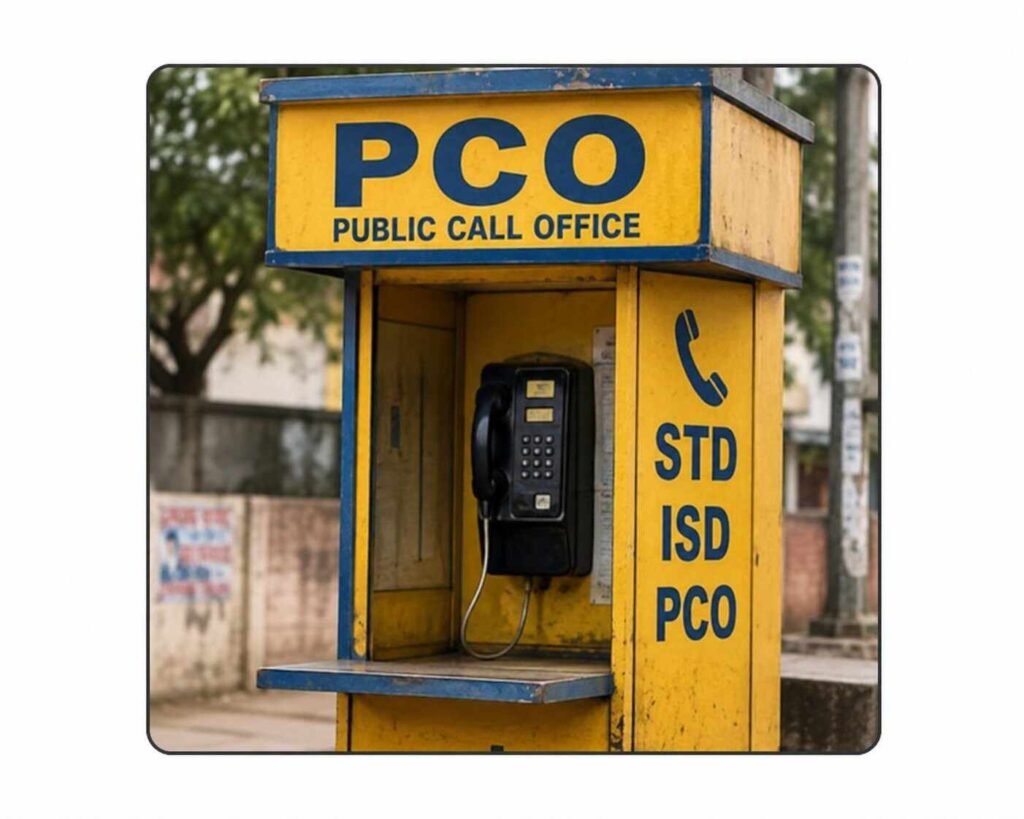
PCO Full Form: Meaning, History, Uses, Importance & Career Relevance
PCO Full Form
The PCO full form is Public Call Office.
A PCO was a public telephone facility that allowed people to make local, STD (Subscriber Trunk Dialing), and ISD (International Subscriber Dialing) calls by paying a fee. Before mobile phones became common, PCOs played an important role in communication across India.
Today, many students search for PCO full form, its meaning, history, and importance in general knowledge examinations. This article provides complete information about PCO in a simple and easy-to-understand manner.
What is PCO?
A Public Call Office (PCO) is a public telephone booth or communication center where people can make phone calls by paying charges based on call duration and destination.
PCOs were widely used throughout India during the 1980s, 1990s, and early 2000s when personal telephones and mobile phones were not available to everyone.
These facilities were usually operated by private shop owners under the authorization of telecom companies.
PCO Full Form in English
| Abbreviation | Full Form |
|---|---|
| PCO | Public Call Office |
The term is commonly used in competitive exams, school GK questions, and interviews.
History of PCO in India
The concept of Public Call Offices became popular when telephone services started expanding across India.
Before mobile phones:
Landline connections were expensive.
Many families did not own telephones.
Long-distance communication was difficult.
To solve this problem, telecom departments established PCO booths in cities, towns, and villages.
People could visit these booths and make calls to relatives, businesses, and government offices.
Why Were PCOs Important?
PCOs transformed communication in India.
Benefits of PCOs
Affordable communication
Easy access to long-distance calls
Available in rural and urban areas
Helped students and travelers stay connected
Supported business communication
For many years, PCOs served as the primary communication channel for millions of Indians.
Types of PCO Services
1. Local Calls
These calls were made within the same city or local area.
Features
Low call charges
Fast connectivity
Widely used by residents
2. STD Calls
STD Full Form
Subscriber Trunk Dialing
STD services enabled users to call another city without operator assistance.
Advantages
Quick long-distance communication
Available throughout India
3. ISD Calls
ISD Full Form
International Subscriber Dialing
ISD services allowed people to make calls to other countries.
Uses
Family communication abroad
Business discussions
International coordination
How Did a PCO Work?
The process was simple.
Step 1
A customer visited a PCO booth.
Step 2
The telephone number was dialed.
Step 3
The call duration was recorded automatically.
Step 4
The customer paid according to the call charges.
The amount depended on:
Call duration
Location
Time of call
Type of service
Features of a Public Call Office
A typical PCO offered:
Local calling
STD calling
ISD calling
Call charge display
Public accessibility
Many PCO booths were open for long hours to serve customers.
Yellow PCO Booths: A Symbol of Communication
One of the most recognizable features of Indian PCOs was the bright yellow signboard.
Why Yellow?
The yellow color made PCO booths easy to identify from a distance.
Most PCOs displayed:
STD • ISD • PCO
These signs became iconic across India.
PCO and Indian Telecommunications
PCOs played a major role in the growth of the telecommunications sector.
They helped:
Increase telephone usage
Improve connectivity
Promote communication in rural areas
Support economic development
PCOs bridged the communication gap between urban and rural India.
Decline of PCOs
Although PCOs were once extremely popular, their numbers declined significantly.
Reasons
1. Mobile Phones
The availability of affordable mobile phones reduced dependence on public telephones.
2. Internet Communication
Messaging applications and internet calling became common.
3. Lower Calling Costs
Telecom competition drastically reduced call charges.
4. Smartphone Revolution
Smartphones made communication instant and convenient.
As a result, many PCO operators shifted to other businesses.
PCO vs Mobile Phone
| Feature | PCO | Mobile Phone |
|---|---|---|
| Ownership | Public | Personal |
| Accessibility | Fixed Location | Anywhere |
| Communication | Voice Calls | Calls, Messages, Internet |
| Convenience | Moderate | High |
| Availability | Limited | Extensive |
Today, mobile phones have largely replaced the role of PCOs.
Importance of PCO in General Knowledge
Many competitive examinations ask questions about abbreviations and historical communication systems.
Students preparing for:
SSC
Railway Exams
Banking Exams
State PSC Exams
School GK Competitions
should remember the PCO full form.
Frequently Asked Questions (FAQs)
What is the PCO full form?
The PCO full form is Public Call Office.
What is a PCO?
A PCO is a public telephone facility that allows people to make calls by paying a fee.
Why were PCOs popular?
They provided affordable communication when personal phones were not widely available.
Are PCOs still available in India?
A few PCOs may still exist, but their numbers have drastically decreased due to mobile phones and internet-based communication.
What services were available at a PCO?
PCOs offered local calls, STD calls, and ISD calls.
What is STD?
STD stands for Subscriber Trunk Dialing.
What is ISD?
ISD stands for International Subscriber Dialing.
Key Points to Remember
PCO full form = Public Call Office
Used for public telephone communication
Popular before mobile phones became common
Offered local, STD, and ISD calling services
Played a significant role in India’s telecom growth
Frequently asked in competitive exams and interviews
Conclusion
Understanding the PCO full form is important for students preparing for school examinations, competitive exams, and general knowledge quizzes. A Public Call Office (PCO) was once the backbone of communication in India, allowing millions of people to stay connected through local, national, and international calls.
Although mobile phones and internet services have largely replaced PCOs, their contribution to India’s communication revolution remains significant. Learning about PCOs not only improves general knowledge but also helps students understand the evolution of telecommunications in India.