
OPD Full Form – What Does OPD Mean?
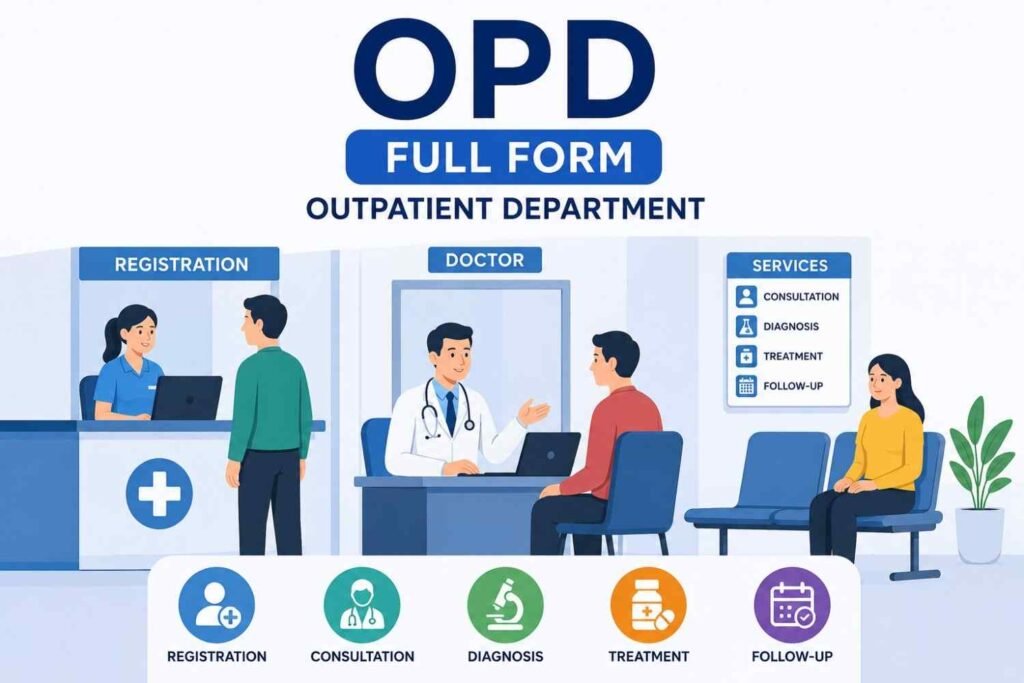
The OPD full form is Outpatient Department. It is one of the most important sections of a hospital where patients receive medical consultation, diagnosis, and treatment without being admitted to the hospital.
If you have ever visited a hospital for a routine check-up or consultation and returned home on the same day, then you have used the services of the OPD.
In this article, we will discuss the opd full form, its meaning, functions, benefits, departments, and much more in simple language suitable for students and competitive exam aspirants.
OPD Full Form in English
| Abbreviation | Full Form |
|---|---|
| OPD | Outpatient Department |
The Outpatient Department serves patients who do not require overnight hospitalization.
What is OPD?
An Outpatient Department (OPD) is the section of a hospital where patients visit doctors for medical advice, diagnosis, tests, and treatment without staying in the hospital.
OPD acts as the first point of contact between patients and healthcare professionals. It helps doctors identify illnesses and recommend medications or further treatment.
Why is OPD Important?
The OPD plays a significant role in healthcare services because it provides immediate medical attention to patients without requiring hospital admission.
Importance of OPD
Provides primary healthcare services.
Reduces unnecessary hospital admissions.
Saves time and money.
Offers consultation with specialist doctors.
Helps in early diagnosis of diseases.
Ensures proper follow-up care.
Functions of OPD
The Outpatient Department performs several important functions.
1. Patient Registration
Patients first register their details before meeting a doctor.
Information Collected
Name
Age
Gender
Address
Medical history
2. Medical Consultation
Doctors examine patients and identify health issues.
Common consultations include:
Fever
Cold and cough
Skin diseases
Diabetes
Blood pressure problems
3. Diagnostic Services
Doctors may recommend tests to diagnose diseases.
Examples include:
Blood tests
Urine tests
X-rays
CT scans
MRI scans
ECG
4. Prescription and Treatment
After diagnosis, doctors prescribe medicines and suggest treatment plans.
5. Follow-Up Visits
Patients may return for regular check-ups and monitoring of their health condition.
Departments Available in OPD
Most hospitals have multiple specialized OPD departments.
| Department | Purpose |
|---|---|
| General Medicine | Common illnesses |
| Pediatrics | Child healthcare |
| Orthopedics | Bone and joint problems |
| Cardiology | Heart diseases |
| Dermatology | Skin disorders |
| ENT | Ear, Nose, and Throat issues |
| Neurology | Brain and nervous system |
| Gynecology | Women’s health |
| Ophthalmology | Eye diseases |
| Dentistry | Dental care |
How Does OPD Work?
The process followed in an OPD is simple and systematic.
Step 1: Registration
Patients register and receive an OPD card.
Step 2: Consultation
Doctors examine symptoms and medical history.
Step 3: Tests (if required)
Laboratory tests or imaging procedures are conducted.
Step 4: Diagnosis
Doctors determine the disease or condition.
Step 5: Treatment
Medicines or therapies are prescribed.
Step 6: Follow-Up
Patients revisit if further treatment is needed.
Types of OPD Services
There are different kinds of OPD services available.
General OPD
Handles common diseases and routine check-ups.
Specialty OPD
Deals with specific health problems under specialist doctors.
Examples:
Cardiology OPD
Orthopedic OPD
Neurology OPD
Super Specialty OPD
Provides advanced treatment and consultation for complicated diseases.
Advantages of OPD
OPD services offer several benefits to patients.
Affordable Treatment
Patients do not have to pay hospitalization charges.
Time-Saving
Treatment is completed within a few hours.
Easy Access
People can consult doctors without staying overnight.
Early Diagnosis
Diseases can be detected at an early stage.
Better Patient Care
Doctors maintain records for future reference and follow-up.
Difference Between OPD and IPD
Students often confuse OPD with IPD.
| Feature | OPD | IPD |
|---|---|---|
| Full Form | Outpatient Department | Inpatient Department |
| Hospital Stay | Not Required | Required |
| Treatment Duration | Few Hours | Several Days |
| Cost | Lower | Higher |
| Admission | No | Yes |
| Suitable For | Minor Illnesses | Serious Diseases |
Facilities Available in OPD
Modern hospitals provide various facilities in their OPD sections.
Registration Counter
Maintains patient records.
Waiting Area
Provides seating arrangements for patients.
Consultation Rooms
Doctors examine patients privately.
Pharmacy
Medicines are available nearby.
Laboratory Services
Blood tests and diagnostic tests are conducted.
Radiology Services
X-rays, MRI, and CT scans are performed.
Role of Doctors and Nurses in OPD
Doctors
Doctors are responsible for:
Diagnosing diseases.
Prescribing medicines.
Advising treatment plans.
Monitoring patient progress.
Nurses
Nurses assist doctors by:
Measuring blood pressure.
Checking temperature.
Recording patient information.
Providing basic care and instructions.
Importance of OPD in Healthcare
The OPD is considered the backbone of healthcare services.
It helps in:
Early disease detection.
Reducing pressure on hospital beds.
Providing preventive healthcare.
Offering specialist consultations.
Maintaining patient records.
Ensuring continuity of treatment.
OPD in Government Hospitals
Government hospitals provide OPD services at affordable costs.
Benefits Include:
Low consultation fees.
Free medicines in many hospitals.
Diagnostic facilities.
Specialist doctor consultations.
Health programs and vaccinations.
Digital OPD and Telemedicine
With advances in technology, hospitals have introduced online OPD services.
Features of Digital OPD
Online doctor appointments.
Video consultations.
Electronic prescriptions.
Digital health records.
Telemedicine services.
These facilities make healthcare more convenient and accessible.
OPD Full Form in Hindi
OPD Full Form in Hindi:
बाह्य रोगी विभाग
It refers to the hospital section where patients receive treatment without being admitted.
Interesting Facts About OPD
OPD is usually the busiest department in a hospital.
Most patients are treated through OPD services.
It helps reduce hospital overcrowding.
Specialist doctors are available in different OPD sections.
Modern hospitals offer online OPD appointments.
OPD treatment is generally less expensive than inpatient treatment.
Frequently Asked Questions (FAQs)
What is the OPD full form?
The OPD full form is Outpatient Department.
What is OPD in a hospital?
OPD is the department where patients receive medical consultation and treatment without staying in the hospital.
What is the difference between OPD and IPD?
OPD patients return home after treatment, while IPD patients are admitted to the hospital for extended care.
Is OPD treatment expensive?
No, OPD treatment is generally more affordable than inpatient treatment.
What services are available in OPD?
OPD provides:
Consultation
Diagnostic tests
Prescriptions
Follow-up care
Specialist services
Can appointments be booked online?
Yes, many hospitals provide online OPD appointment facilities.
Conclusion
The OPD full form is Outpatient Department, which is an essential part of every hospital. It provides consultation, diagnosis, treatment, and follow-up care without requiring patients to stay overnight. OPD services are affordable, convenient, and play a crucial role in maintaining public health.
Understanding the opd full form is useful for students because questions related to opd frequently appear in school examinations, competitive exams, and general knowledge tests. As healthcare systems continue to evolve, OPD services are becoming more efficient and accessible through digital technology.