
TDS Full Form: Meaning, Types, Rules, Benefits, and Importance in India
What is the TDS Full Form?
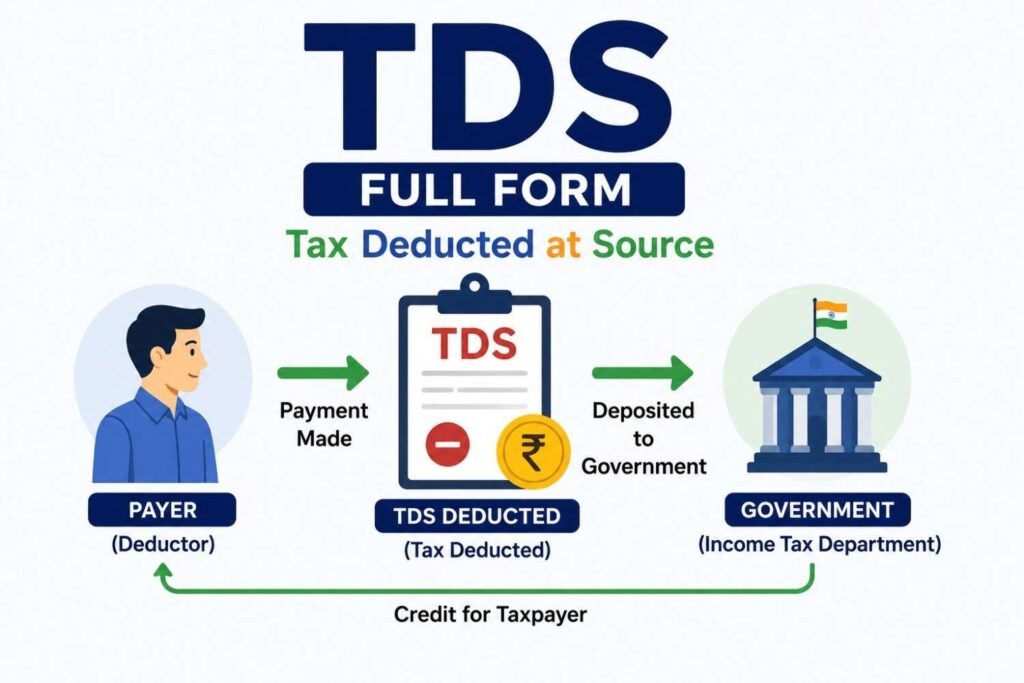
The TDS full form is Tax Deducted at Source. It is a system introduced by the Government of India under the Income Tax Act to collect tax directly at the source of income.
In simple words, TDS means that a certain amount of tax is deducted before the payment is made to a person. The deducted amount is then deposited with the Income Tax Department on behalf of the taxpayer.
Understanding the TDS full form is important for students preparing for competitive exams, commerce studies, and general knowledge.
Introduction to TDS
Taxes are one of the major sources of revenue for the government. Instead of collecting taxes only at the end of the financial year, the government introduced TDS to ensure regular and timely tax collection.
For example, if an employee receives a salary, the employer deducts a certain amount as tax and deposits it with the government. This deducted amount is called TDS (Tax Deducted at Source).
Today, TDS applies to various payments such as:
Salaries
Interest income
Rent
Commission
Professional fees
Contract payments
TDS Full Form and Meaning
TDS = Tax Deducted at Source
Let’s understand each word:
Tax
Money collected by the government for public welfare and development.
Deducted
A certain amount is subtracted from the payment.
Source
The tax is collected at the point where income is generated.
Thus, TDS means collecting tax directly from the source of income before the payment reaches the recipient.
What is TDS?
TDS is a mechanism through which tax is deducted by the payer before making payments to the receiver.
For example:
Suppose an employee earns ₹60,000 per month. The employer deducts income tax according to applicable rules and deposits it with the government. The employee receives the remaining amount after TDS deduction.
This system helps ensure that taxes are paid regularly throughout the year.
Why Was TDS Introduced?
The government introduced TDS to:
Ensure Timely Tax Collection
Taxes are collected throughout the year instead of waiting until year-end.
Reduce Tax Evasion
People cannot easily avoid paying taxes.
Increase Government Revenue
Regular tax collection supports economic development.
Simplify Tax Administration
It makes the tax collection process more efficient.
How Does TDS Work?
The process of TDS is simple.
Step 1: Income is Generated
The receiver earns income through salary, rent, interest, etc.
Step 2: Tax is Deducted
The payer deducts a specified percentage of tax.
Step 3: Deposit with Government
The deducted amount is deposited with the Income Tax Department.
Step 4: Credit to Taxpayer
The deducted tax appears in the taxpayer’s Form 26AS.
Who Deducts TDS?
The person or organization making the payment deducts TDS.
Examples include:
Employers
Banks
Companies
Partnership firms
Government departments
These entities are known as deductors.
The person receiving the income is called the deductee.
Types of Payments Subject to TDS
TDS is applicable to several kinds of income.
Salary
Employers deduct tax from employees’ salaries.
Interest Income
Banks deduct TDS on fixed deposit interest above prescribed limits.
Rent
TDS may apply to rent payments.
Commission
Commissions paid to agents are subject to TDS.
Professional Fees
Payments to consultants and professionals may attract TDS.
Contract Payments
Businesses deduct tax while making contract payments.
Objectives of TDS
TDS has several important objectives.
Regular Tax Collection
Ensures continuous revenue for the government.
Prevents Tax Evasion
Makes tax collection transparent.
Encourages Compliance
Promotes responsible tax payment.
Reduces Burden at Year-End
Taxpayers do not have to pay a large amount all at once.
Advantages of TDS
Steady Revenue for Government
The government receives regular tax income.
Convenient for Taxpayers
Tax liability gets distributed throughout the year.
Reduces Tax Defaults
Taxes are automatically collected.
Improves Transparency
All deductions are recorded and traceable.
Better Tax Compliance
People become more disciplined regarding tax payments.
Disadvantages of TDS
Despite its advantages, TDS has some limitations.
Reduced Immediate Income
The recipient gets less money after deduction.
Complex Procedures
Tax laws and rates can be difficult to understand.
Refund Delays
Excess TDS deductions may require refund claims.
Documentation Requirements
Proper records and filings are necessary.
TDS Certificate
After deducting tax, the deductor provides a TDS certificate.
Form 16
Issued for salary income.
Form 16A
Issued for non-salary payments.
These certificates help taxpayers while filing Income Tax Returns (ITR).
What is Form 26AS?
Form 26AS is a tax statement that contains details of:
TDS deducted
Tax deposited
Advance tax paid
Refunds received
Taxpayers can verify whether their deducted tax has been deposited with the government.
TDS and Income Tax: Difference
Students often confuse TDS with Income Tax.
| Feature | TDS | Income Tax |
|---|---|---|
| Full Form | Tax Deducted at Source | Income Tax |
| Collection Time | At source of income | During tax filing |
| Deducted By | Employer, bank, company | Paid by taxpayer |
| Purpose | Advance collection | Final tax liability |
TDS is actually a part of the overall income tax system.
Importance of TDS in India
TDS plays a vital role in India’s taxation system.
Strengthens Economy
Provides continuous revenue to the government.
Supports Development
Funds are used for infrastructure and welfare schemes.
Promotes Tax Discipline
Encourages citizens to comply with tax laws.
Reduces Tax Evasion
Ensures transparency in financial transactions.
Can Excess TDS Be Refunded?
Yes.
If more tax is deducted than required, taxpayers can claim a refund by filing an Income Tax Return (ITR).
After verification, the Income Tax Department processes the refund.
TDS in Banking
Banks deduct TDS mainly on:
Fixed Deposit interest
Recurring Deposit interest
Other interest incomes exceeding specified limits
Senior citizens often enjoy higher exemption limits.
Importance of TDS for Students
Students pursuing commerce, finance, or preparing for competitive examinations should understand TDS because:
Questions frequently appear in exams.
It helps in understanding taxation.
It improves financial literacy.
It is useful in professional careers.
Career Opportunities Related to Taxation
Students interested in taxation can explore careers such as:
Chartered Accountant (CA)
Specializes in accounting and taxation.
Tax Consultant
Provides tax advice to individuals and businesses.
Financial Analyst
Analyzes financial data and tax implications.
Accountant
Maintains financial records and tax compliance.
Banking Professional
Handles taxation and financial operations.
Income Tax Officer
Works under the Income Tax Department.
TDS Full Form in Hindi
The TDS full form in Hindi is:
स्रोत पर कर कटौती
It means that tax is deducted at the source of income before payment is made to the recipient.
Other Meanings of TDS
Although Tax Deducted at Source is the most popular meaning in India, TDS may also stand for:
Total Dissolved Solids (Water Quality)
Technical Data Sheet
Time Division Switching
However, in banking and taxation, TDS primarily means Tax Deducted at Source.
Frequently Asked Questions (FAQs)
1. What is the TDS full form?
The TDS full form is Tax Deducted at Source.
2. Why is TDS deducted?
TDS is deducted to ensure regular tax collection and prevent tax evasion.
3. Who deducts TDS?
Employers, banks, companies, and organizations deduct TDS while making payments.
4. What is Form 16?
Form 16 is a certificate issued for TDS deducted on salary income.
5. Can I get a TDS refund?
Yes. Excess TDS can be claimed by filing an Income Tax Return.
6. What is Form 26AS?
Form 26AS is a statement showing TDS and other tax-related details.
7. Is TDS and Income Tax the same?
No. TDS is a method of collecting income tax in advance.
8. What is the TDS full form in Hindi?
It is स्रोत पर कर कटौती.
Conclusion
The TDS full form is Tax Deducted at Source, an important mechanism that helps the Government of India collect taxes efficiently and transparently. It ensures timely tax payments, reduces tax evasion, and simplifies the taxation process.
For students, understanding the TDS full form is valuable because it builds awareness about financial systems and taxation. Whether you are preparing for board exams, competitive examinations, or future careers in finance and accounting, knowledge of TDS is highly beneficial.
As India’s economy continues to grow, TDS remains an essential component of the country’s taxation framework, ensuring financial discipline and supporting national development.