
What is the MLA Full Form?
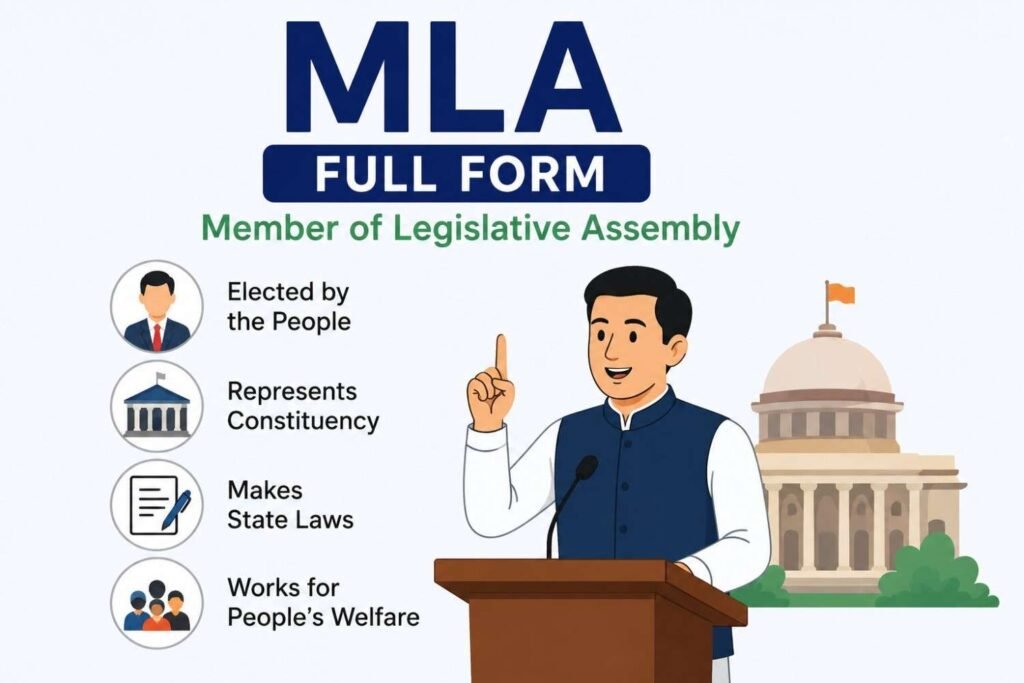
The MLA full form is Member of Legislative Assembly. An MLA is an elected representative chosen by the people of a constituency to represent them in the Legislative Assembly of a state in India.
MLAs play a crucial role in making laws, raising public issues, and ensuring the development of their constituencies. Every state in India has a Legislative Assembly, and its members are known as MLAs.
For students preparing for board exams, competitive exams, or general knowledge quizzes, understanding the MLA full form and its functions is very important.
Introduction to MLA
India is the world’s largest democracy, where people elect representatives to govern the country and states. At the state level, citizens elect Members of the Legislative Assembly (MLAs), who become lawmakers and represent public interests.
An MLA acts as a bridge between the government and the people, ensuring that local issues are addressed and developmental activities are carried out effectively.
MLA Full Form and Meaning
MLA = Member of Legislative Assembly
Let’s understand the meaning of each word:
Member
A person elected to be part of a governing body.
Legislative
Related to making laws.
Assembly
The law-making body of a state.
Thus, an MLA is a person elected by voters to represent them in the state’s Legislative Assembly.
What is an MLA?
A Member of Legislative Assembly (MLA) is a representative elected by the people of a specific constituency in a state.
Their responsibilities include:
Making state laws
Discussing public issues
Representing people in the Assembly
Supporting development projects
Monitoring government policies
MLAs are elected through direct elections conducted by the Election Commission of India.
How is an MLA Elected?
The election process for an MLA is simple and democratic.
Step 1: Formation of Constituencies
States are divided into different constituencies.
Step 2: Candidates Contest Elections
Political parties nominate candidates, while independent candidates can also participate.
Step 3: Voting by Citizens
Eligible citizens cast their votes.
Step 4: Counting of Votes
The candidate receiving the highest number of votes wins.
Step 5: Declaration of Results
The winning candidate becomes the MLA of that constituency.
Role of an MLA
MLAs perform several important functions in the state government.
Making Laws
MLAs discuss and pass laws for the state.
Representing People
They voice the concerns and problems of citizens.
Monitoring Government Activities
MLAs hold the government accountable for its actions.
Participating in Debates
They participate in discussions on important issues.
Supporting Development
They recommend projects related to roads, schools, hospitals, and public welfare.
Responsibilities of an MLA
An MLA has many duties toward society and the government.
Address Public Problems
They work to solve issues faced by residents.
Participate in Legislative Sessions
They attend Assembly meetings and discussions.
Raise Questions
MLAs can question government departments regarding public matters.
Recommend Development Projects
They suggest infrastructure and welfare projects.
Represent Constituents
They act as the voice of the people who elected them.
Qualifications Required to Become an MLA
According to the Constitution of India, a person must fulfill certain conditions.
Must Be an Indian Citizen
Only Indian citizens can contest MLA elections.
Minimum Age
The candidate should be at least 25 years old.
Registered Voter
The person must be registered as a voter.
No Disqualification
The candidate should not be disqualified under any law.
Tenure of an MLA
The normal tenure of an MLA is:
Five Years
An MLA serves for five years unless the Legislative Assembly is dissolved earlier.
After five years, fresh elections are conducted.
Powers of an MLA
MLAs have several important powers.
Legislative Powers
They participate in making laws.
Financial Powers
They discuss and approve the state budget.
Executive Powers
They help oversee the functioning of the government.
Electing the President
MLAs participate in the election of the President of India.
Difference Between MLA and MP
Students often confuse MLA and MP.
| Feature | MLA | MP |
|---|---|---|
| Full Form | Member of Legislative Assembly | Member of Parliament |
| Represents | State Constituency | Parliamentary Constituency |
| Law Making | State Laws | National Laws |
| Works In | Legislative Assembly | Lok Sabha or Rajya Sabha |
| Election Conducted By | Election Commission of India | Election Commission of India |
Both are elected representatives but work at different levels.
Difference Between MLA and MLC
| Feature | MLA | MLC |
|---|---|---|
| Full Form | Member of Legislative Assembly | Member of Legislative Council |
| Election Method | Direct Election | Indirect Election |
| House | Lower House | Upper House |
| Representation | Public Constituency | Special Electoral Groups |
| Tenure | 5 Years | 6 Years |
Not all Indian states have a Legislative Council.
Salary and Benefits of an MLA
The salary of MLAs varies from state to state.
They generally receive:
Basic salary
Travel allowances
Housing facilities
Medical benefits
Pension benefits
The exact amount depends on the rules of the respective state governments.
Importance of MLAs in Democracy
MLAs are essential for the smooth functioning of democracy.
Represent People’s Voice
They ensure public concerns are heard.
Promote Development
They support social and economic development.
Strengthen Governance
They help maintain transparency and accountability.
Protect Citizens’ Interests
They work for the welfare of society.
Legislative Assembly in India
Every state has a Legislative Assembly except some Union Territories and states with special arrangements.
The number of MLAs varies according to the population of each state.
Examples:
Uttar Pradesh has the highest number of MLAs.
Smaller states have fewer MLAs.
Functions of the Legislative Assembly
The Legislative Assembly performs important functions.
Law Making
Creates state laws.
Budget Approval
Approves financial expenditure.
Government Formation
The majority party forms the government.
Debates and Discussions
Discusses policies and public issues.
How Can Students Become an MLA?
Students interested in politics and public service can follow these steps:
Complete Education
Gain a good educational background.
Understand Political Systems
Learn about the Constitution and governance.
Participate in Social Work
Engage in community activities.
Join Political Parties
Many leaders begin their careers through political organizations.
Contest Elections
Meet eligibility criteria and participate in elections.
Skills Required to Become an MLA
Successful MLAs usually possess:
Leadership Skills
Ability to guide and influence people.
Communication Skills
Effective speaking and listening abilities.
Problem-Solving Skills
Capability to address public issues.
Decision-Making Skills
Taking timely and effective decisions.
Public Relations Skills
Building trust among citizens.
Career Opportunities in Politics
Apart from becoming an MLA, students interested in politics can pursue careers as:
Social Worker
Political Analyst
Civil Servant
Lawyer
Journalist
Policy Advisor
Public Relations Specialist
MLA Full Form in Hindi
The MLA full form in Hindi is:
विधान सभा सदस्य
or
विधानसभा का सदस्य
An MLA is an elected representative who serves in the Legislative Assembly of a state.
Other Meanings of MLA
Although Member of Legislative Assembly is the most common meaning in India, MLA can also stand for:
Modern Language Association
Medical Laboratory Assistant
Machine Learning Algorithm
However, in Indian politics and general knowledge, MLA refers to Member of Legislative Assembly.
Frequently Asked Questions (FAQs)
1. What is the MLA full form?
The MLA full form is Member of Legislative Assembly.
2. Who elects an MLA?
Citizens of a constituency elect an MLA through direct voting.
3. What is the minimum age to become an MLA?
A person must be at least 25 years old.
4. What is the tenure of an MLA?
An MLA normally serves for five years.
5. What is the difference between MLA and MP?
An MLA makes state laws, while an MP makes national laws.
6. Can independent candidates become MLAs?
Yes. Independent candidates can contest elections and become MLAs.
7. What is the MLA full form in Hindi?
It is विधान सभा सदस्य.
8. What are the main duties of an MLA?
MLAs make laws, represent people, discuss public issues, and support development activities.
Conclusion
The MLA full form is Member of Legislative Assembly, an important position in India’s democratic system. MLAs are elected representatives who work for the welfare and development of their constituencies while participating in the law-making process at the state level.
Understanding the MLA full form, roles, responsibilities, powers, and eligibility criteria helps students gain knowledge about India’s political structure and democratic values. Whether for competitive exams, general awareness, or civic education, learning about MLAs is essential for every student.
As representatives of the people, MLAs play a crucial role in ensuring that democracy functions effectively and that citizens’ voices are heard in the governance process.