Top Agriculture Entrance Exams in India 2026: Full Forms, Course Details, Fees and Complete Guide for Class 12 Students
Agriculture is not what it used to be. The image of traditional farming has been replaced by drone-monitored precision agriculture, AI-powered crop management, genetic engineering of seeds, food technology breakthroughs, and agri-startups raising millions in funding. India’s agriculture sector — which contributes nearly 18% to GDP and employs 55% of the population — is going through a digital, scientific, and entrepreneurial transformation.
If you’re a Class 12 student with Biology or Mathematics who wants to be part of this transformation, an Agriculture entrance exam is your gateway. But with multiple national and state-level exams available, knowing which one to take and why can be genuinely confusing.
This complete guide covers all top Agriculture entrance exams in India, their full forms, course details, fees, eligibility, and a smart preparation strategy — everything you need in one place.
Table of contents
- Top Agriculture Entrance Exams in India 2026: Full Forms, Course Details, Fees and Complete Guide for Class 12 Students
- Quick Snapshot: Agriculture Education in India 2026
- 1. What Is Agriculture? — Course Details and Programmes
- 2. Agriculture Fees: What You’ll Pay
- 3. Top Agriculture Entrance Exams in India 2026
- 4. All Agriculture Entrance Exams: Quick Comparison
- 5. Agriculture Entrance Exam Syllabus: What’s Common?
- 6. Top Agriculture Colleges in India 2026
- 7. Career After Agriculture: What Awaits You
- 8. Preparation Strategy: How to Crack Agriculture Entrance Exams
- 9. Which Agriculture Entrance Exam Should You Take?
- 10. Frequently Asked Questions
- Final Verdict: Your Agriculture Entrance Exam Strategy for 2026
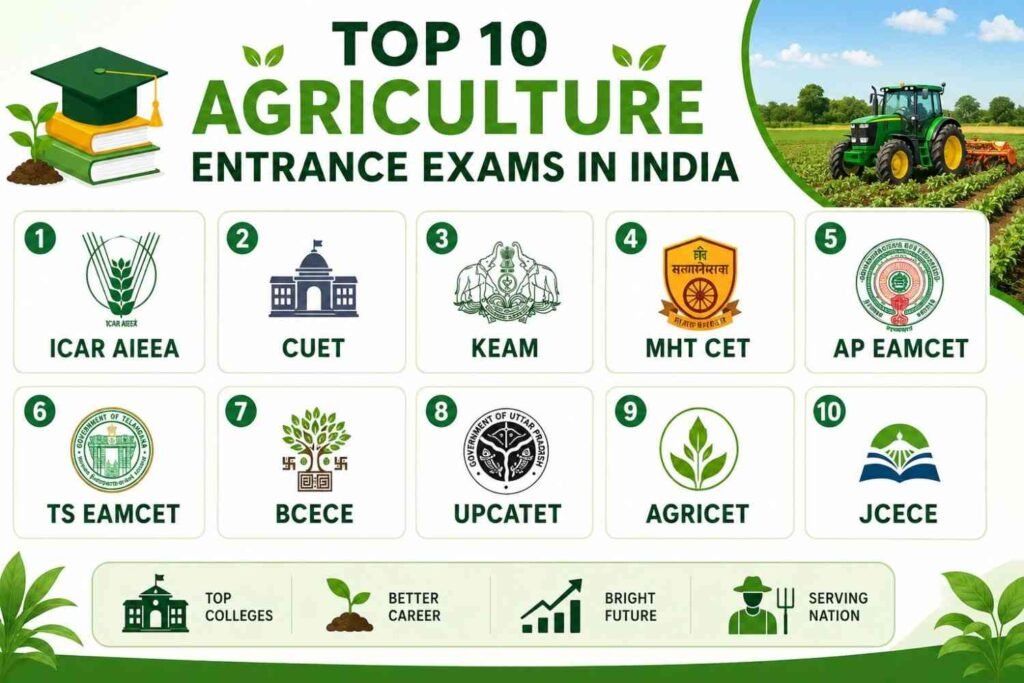
Quick Snapshot: Agriculture Education in India 2026
| Feature | Details |
|---|---|
| Top UG Programme | B.Sc Agriculture |
| Other Programmes | B.Tech Agriculture Engineering, B.Sc Horticulture, B.Sc Forestry, B.F.Sc (Fisheries) |
| Duration | 4 Years (B.Sc Ag) |
| Top National Exam | ICAR AIEEA (National Level) |
| Regulatory Body | ICAR (Indian Council of Agricultural Research) |
| Average Fees | INR 20,000 – 2.00 Lakh/year |
| Average Starting Salary | INR 3 – 7 LPA |
| Senior Salary | INR 10 – 30+ LPA |
| Top Employers | ICAR, NABARD, FCI, Agri MNCs (Monsanto, Syngenta, Bayer, ITC Agri) |
1. What Is Agriculture? — Course Details and Programmes
What Is Agriculture as a Career?
Agriculture as a professional field goes far beyond farming. An agriculture graduate works at the intersection of science, technology, business, and environment:
- Crop Science — Developing high-yield, disease-resistant crop varieties
- Soil Science and Agronomy — Managing soil health and crop nutrition
- Agricultural Biotechnology — GM crops, tissue culture, molecular breeding
- Horticulture — Fruits, vegetables, flowers, landscaping
- Agricultural Engineering — Farm machinery, irrigation systems, post-harvest technology
- Agricultural Economics — Policy, trade, rural finance, market analysis
- Food Technology and Processing — Value-added food products, preservation
- Fisheries and Aquaculture — Fish farming, marine resources management
- Forestry — Forest management, ecology, biodiversity conservation
- Agricultural Extension — Knowledge transfer from research to farmers
Agriculture Courses: Full Forms and Details
| Programme | Full Form | Duration | Focus |
|---|---|---|---|
| B.Sc Ag | Bachelor of Science in Agriculture | 4 Years | Crop science, agronomy, soil science |
| B.Tech AE | Bachelor of Technology in Agricultural Engineering | 4 Years | Farm machinery, irrigation, post-harvest tech |
| B.Sc Hort. | Bachelor of Science in Horticulture | 4 Years | Fruits, vegetables, floriculture |
| B.Sc Forestry | Bachelor of Science in Forestry | 4 Years | Forest ecology, wildlife, conservation |
| B.F.Sc | Bachelor of Fisheries Science | 4 Years | Aquaculture, marine science |
| B.Sc (CA&BM) | Community Agriculture & Bio-resource Management | 4 Years | Rural development, sustainable agriculture |
| M.Sc Ag | Master of Science in Agriculture | 2 Years | Advanced specialization |
| M.Tech (AE) | Master of Technology in Agricultural Engineering | 2 Years | Advanced engineering in agriculture |
| Ph.D Agriculture | Doctor of Philosophy in Agriculture | 3–5 Years | Research and academia |
Agriculture Eligibility: Who Can Apply?
- Class 12 with Biology and Chemistry (PCB) for B.Sc Agriculture, Horticulture, Forestry, Fisheries
- Class 12 with Physics, Chemistry, and Mathematics (PCM) for B.Tech Agricultural Engineering
- Some universities accept PCMB (Physics, Chemistry, Mathematics, Biology) for all agriculture programmes
- Minimum marks: 50–60% in qualifying subjects (45% for reserved categories)
2. Agriculture Fees: What You’ll Pay
Government Agricultural Universities
| Institution Type | Annual Fee |
|---|---|
| ICAR-deemed and central universities | INR 10,000 – 50,000 |
| State Agricultural Universities (SAUs) | INR 15,000 – 80,000 |
| Government-aided colleges | INR 20,000 – 60,000 |
Private Agricultural Colleges
| College Tier | Annual Fee |
|---|---|
| Top Private Universities (LPU, Amity, SRM, Chandigarh) | INR 80,000 – 2.00 Lakh |
| Mid-Tier Private | INR 50,000 – 1.20 Lakh |
| Entry-Level Private | INR 30,000 – 80,000 |
Total 4-Year Agriculture Degree Cost
| College Type | Total Cost (Tuition + Hostel) |
|---|---|
| State Agricultural University (SAU) | INR 3 – 8 Lakh |
| Central/ICAR institution | INR 2 – 6 Lakh |
| Top Private | INR 10 – 18 Lakh |
Scholarships for Agriculture Students
- ICAR JRF/SRF Fellowships (for PG/PhD): INR 31,000 – 37,000/month — most prestigious agriculture research fellowship
- PM KISAN Scholarship and state-level agricultural scholarships for merit students
- Inspire Scholarship (DST): INR 80,000/year for top 1% in board exams choosing science
- NABARD/State Bank scholarships for rural development and agricultural studies
- Most private universities offer 25–100% fee waivers based on entrance scores and board marks
3. Top Agriculture Entrance Exams in India 2026
Exam 1: ICAR AIEEA — The Most Important Agriculture Entrance Exam
- Full Form: Indian Council of Agricultural Research All India Entrance Examination for Admission
- Conducting Body: NTA (National Testing Agency) on behalf of ICAR
- Official Website: icar.nta.ac.in
ICAR AIEEA at a Glance
| Feature | Details |
|---|---|
| Exam Level | National |
| Purpose | Admission to ICAR deemed universities and state agricultural universities |
| Two Streams | UG (B.Sc Ag) and PG (M.Sc/M.Tech Ag) |
| Frequency | Once a year |
| Mode | Computer-Based Test (CBT) |
| Duration | 2 Hours 30 Minutes |
| Total Questions | 150 |
| Total Marks | 600 |
| Registration Fee | INR 1,000 (General); INR 600 (SC/ST/PwD) |
| Scholarship | ICAR Junior Research Fellowship (JRF) for top PG qualifiers |
ICAR AIEEA UG Exam Pattern
| Subject | Questions | Marks |
|---|---|---|
| Physics | 30 | 120 |
| Chemistry | 30 | 120 |
| Mathematics/Biology | 45 | 180 |
| Agriculture/Science | 45 | 180 |
| Total | 150 | 600 |
Marking Scheme: +4 for correct; -1 for incorrect answer
What ICAR AIEEA Gives You
- Admission to 75 ICAR-funded seats at various SAUs (State Agricultural Universities) across India
- Admission to ICAR-deemed universities including IARI (Indian Agricultural Research Institute, New Delhi) — the most prestigious agriculture institution in India
- ICAR JRF Scholarship for PG qualifiers: INR 31,000/month for M.Sc, INR 37,000/month for PhD
Why ICAR AIEEA Is Non-Negotiable
ICAR is to Agriculture what JEE is to Engineering. IARI New Delhi (often called the “IIT of Agriculture”) admits students through ICAR AIEEA. Every serious agriculture student should appear for this exam — the ICAR scholarship makes postgraduate education virtually free.
ICAR AIEEA Preparation Tips
- Biology (highest weightage): NCERT Biology Class 11 and 12 — read every chapter thoroughly
- Agriculture: NCERT Agriculture textbook + additional agriculture science books (soil science, crop production)
- Chemistry: NCERT Chemistry Class 11 and 12
- Physics: NCERT Physics Class 11 and 12 (for B.Tech Agriculture Engineering stream)
- Previous year papers: Most important preparation resource — solve 2018–2025 papers
Exam 2: CUET (Common University Entrance Test) — Agriculture Stream
- Full Form: Common University Entrance Test
- Conducting Body: National Testing Agency (NTA)
- Official Website: cuet.nta.nic.in
CUET for Agriculture at a Glance
| Feature | Details |
|---|---|
| Exam Level | National |
| Frequency | Once a year (May–June) |
| Agriculture Domain | Agriculture is a domain subject option in CUET |
| Accepting Colleges | BHU, Aligarh Muslim University, Jamia Millia, and 270+ universities |
| Mode | Computer-Based Test |
| Registration Fee | INR 650 (General); INR 600 (OBC); INR 550 (SC/ST) |
CUET Agriculture Domain Syllabus
The Agriculture domain in CUET covers:
- Genetics and Plant Breeding
- Crop Production and Management
- Agricultural Botany
- Soil Science
- Agricultural Economics and Extension
- Animal Husbandry and Dairying
- Post-Harvest Technology
CUET Agriculture is increasingly important as central universities adopt CUET for B.Sc Agriculture admissions. BHU (Banaras Hindu University), which has India’s second most prestigious agriculture faculty, now accepts CUET scores.
Exam 3: KEAM (Kerala Engineering Architecture Medical) — Agriculture Stream
- Full Form: Kerala Engineering Architecture Medical Entrance Examination
- Conducting Body: CEE (Commissioner for Entrance Examinations), Kerala
- Official Website: cee.kerala.gov.in
KEAM for Agriculture
| Feature | Details |
|---|---|
| Exam Level | State (Kerala) |
| Agriculture Programmes | B.Sc Agriculture, B.Sc Horticulture, B.Sc Forestry at Kerala Agricultural University |
| Mode | Offline (OMR-based) |
| Subjects Tested | Physics, Chemistry, Biology/Mathematics |
| Registration Fee | INR 700 – 1,000 |
Kerala Agricultural University (KAU) is one of India’s most respected state agricultural universities, particularly strong in tropical crop science and spice technology. KEAM is Kerala’s gateway to KAU programmes.
Exam 4: AP EAMCET — Andhra Pradesh Agriculture Gateway
- Full Form: Andhra Pradesh Engineering Agriculture and Medical Common Entrance Test
- Conducting Body: APSCHE (AP State Council of Higher Education)
- Official Website: sche.ap.gov.in/EAMCET
AP EAMCET for Agriculture
| Feature | Details |
|---|---|
| Exam Level | State (Andhra Pradesh) |
| Agriculture Stream | Separate Agriculture and Medical (AM) paper |
| Programmes | B.Sc Agriculture, B.Sc Horticulture, B.V.Sc at ANGRAU and SKLTSHU |
| Mode | Computer-Based Test |
| Duration | 3 Hours |
| Registration Fee | INR 550 – 750 |
ANGRAU (Acharya N G Ranga Agricultural University) — Andhra Pradesh’s premier agricultural university — admits students through AP EAMCET Agriculture stream. Known particularly for its rice research and groundnut improvement programmes.
Exam 5: TS EAMCET — Telangana Agriculture Entrance
- Full Form: Telangana State Engineering Agriculture and Medical Common Entrance Test
- Conducting Body: Jawaharlal Nehru Technological University (JNTU) Hyderabad
- Official Website: tseamcet.nic.in
TS EAMCET for Agriculture
| Feature | Details |
|---|---|
| Exam Level | State (Telangana) |
| Agriculture Programmes | B.Sc Agriculture at PJTSAU (Professor Jayashankar Telangana State Agricultural University) |
| Mode | Computer-Based Test |
| Duration | 3 Hours |
| Registration Fee | INR 650 |
PJTSAU (Hyderabad) is known for its strong research in dry-land agriculture, millet improvement, and agricultural biotechnology — aligning with Telangana’s Kharif-dominated farming landscape.
Exam 6: RAJUVAS / RCET — Rajasthan Agriculture CET
- Full Form: Rajasthan Combined Entrance Test (for Agriculture and related courses)
- Conducting Body: Board of Technical Education Rajasthan / Rajasthan University of Veterinary and Animal Sciences
- Official Website: hte.rajasthan.gov.in
RCET for Agriculture
| Feature | Details |
|---|---|
| Exam Level | State (Rajasthan) |
| Accepting Universities | Agriculture University Kota, Maharana Pratap University of Agriculture and Technology (MPUAT) |
| Programmes | B.Sc Agriculture, B.Sc Horticulture |
| Registration Fee | INR 500 – 800 |
Rajasthan’s arid and semi-arid landscape makes it particularly important for research in drought-resistant crops and water-efficient farming — Rajasthan agriculture students are highly valued in NABARD and government water management projects.
Exam 7: OUAT (Odisha University of Agriculture and Technology) Entrance
- Full Form: Odisha University of Agriculture and Technology Entrance Examination
- Conducting Body: OUAT, Bhubaneswar
- Official Website: ouat.ac.in
OUAT Entrance at a Glance
| Feature | Details |
|---|---|
| Exam Level | State (Odisha) |
| Mode | Offline (OMR-based) |
| Programmes | B.Sc Agriculture, B.Sc Horticulture, B.Tech Agricultural Engineering, B.F.Sc |
| Duration | 2 Hours |
| Registration Fee | INR 600 – 800 |
| Accepting Colleges | OUAT and affiliated colleges across Odisha |
OUAT Bhubaneswar is one of India’s most respected agricultural universities, particularly strong in rice research, aquaculture, and coastal agricultural management.
Exam 8: UPCATET — Uttar Pradesh Agriculture Entrance
- Full Form: Uttar Pradesh Combined Agriculture and Technology Entrance Test
- Conducting Body: Sardar Vallabhbhai Patel University of Agriculture and Technology
- Official Website: upcatet.org
UPCATET at a Glance
| Feature | Details |
|---|---|
| Exam Level | State (Uttar Pradesh) |
| Mode | Online / Computer-Based |
| Programmes | B.Sc Agriculture, B.Tech Agricultural Engineering, B.Sc Horticulture at SVPUAT and NDUAT (Narendra Dev University) |
| Subjects Tested | Physics, Chemistry, Biology/Agriculture |
| Registration Fee | INR 700 – 1,000 |
UP’s Tarai belt and eastern UP are among India’s most agriculturally rich zones — UPCATET students graduate into one of the country’s most active agricultural employment markets.
Exam 9: MCAER CET — Maharashtra Agriculture Entrance
- Full Form: Maharashtra Council of Agricultural Education and Research Common Entrance Test
- Conducting Body: MCAER, Pune
- Official Website: mcaer.org.in
MCAER CET at a Glance
| Feature | Details |
|---|---|
| Exam Level | State (Maharashtra) |
| Mode | Computer-Based Test |
| Accepting Universities | Dr. PDKV Akola, PDKV Nagpur, DBSKKV Dapoli, VNMKV Parbhani, Mahatma Phule Krishi Vidyapeeth (MPKV) Rahuri |
| Programmes | B.Sc Agriculture, B.Sc Horticulture, B.Tech Agricultural Engineering |
| Registration Fee | INR 800 – 1,200 |
Maharashtra’s five agricultural universities cover diverse agro-climatic zones — from the Vidarbha cotton belt to the Konkan horticulture coast. MCAER CET is the unified gateway to all five.
Exam 10: VNUEAT / University-Level Entrance Exams for Private Agricultural Universities
Several top private universities conduct their own agriculture entrance tests:
| University | Exam | Programmes |
|---|---|---|
| LPU | LPUNEST | B.Sc Agriculture, B.Tech (Ag. Eng.) |
| Chandigarh University | CUCET | B.Sc Agriculture |
| Amity University | Amity Entrance / CUET | B.Sc Agriculture, M.Sc |
| Sam Higginbottom University (SHUATS) | Own Entrance | B.Sc Agriculture, B.Sc Horticulture |
| GD Goenka University | GATA | B.Sc Agriculture |
| Lovely Professional University | LPUNEST / ICAR AIEEA | B.Sc Agriculture, B.Tech (Ag.) |
4. All Agriculture Entrance Exams: Quick Comparison
| Exam | Level | Best For | Accepting Institutions |
|---|---|---|---|
| ICAR AIEEA | National | IARI, ICAR-funded seats at SAUs | 75+ ICAR-funded seats; SAUs nationwide |
| CUET | National | BHU, AMU, central universities | 270+ universities |
| KEAM | Kerala | Kerala Agricultural University | KAU and affiliated |
| AP EAMCET | Andhra Pradesh | ANGRAU, SKLTSHU | AP agricultural universities |
| TS EAMCET | Telangana | PJTSAU Hyderabad | Telangana agricultural universities |
| RCET | Rajasthan | MPUAT Udaipur, AU Kota | Rajasthan agricultural universities |
| OUAT | Odisha | OUAT Bhubaneswar | OUAT and affiliates |
| UPCATET | Uttar Pradesh | SVPUAT, NDUAT | UP agricultural universities |
| MCAER CET | Maharashtra | 5 Maharashtra SAUs | All Maharashtra agricultural colleges |
| University Tests | Institution | Private universities | LPU, CU, Amity, SHUATS, GD Goenka |
5. Agriculture Entrance Exam Syllabus: What’s Common?
Most Agriculture entrance exams test you across:
Biology (Highest Weightage in Most Exams)
- Cell Biology and Genetics: Cell structure, Mendel’s laws, DNA and RNA
- Plant Kingdom: Classification, morphology, anatomy
- Physiology: Photosynthesis, respiration, plant hormones, mineral nutrition
- Ecology: Ecosystems, biodiversity, environmental issues
- Agriculture Botany: Crop plants, plant breeding basics
- Animal Husbandry basics
Agriculture Science (ICAR AIEEA and State CETs)
- Agronomy: Crop production, tillage, crop rotation, sowing methods
- Soil Science: Soil formation, soil pH, soil texture, nutrients and fertilizers
- Horticulture: Important fruits, vegetables, and plantation crops
- Genetics and Plant Breeding: Hybridization, GM crops, seed certification
- Agricultural Engineering: Irrigation methods, farm machinery basics
- Agricultural Economics: Market linkages, minimum support price (MSP), NABARD, cooperatives
- Agricultural Extension: Technology transfer, KVKs (Krishi Vigyan Kendras)
Chemistry
- Organic Chemistry: Pesticides, herbicides, organic molecules in agriculture
- Physical Chemistry: Solutions, electrochemistry (relevant for soil science)
- Inorganic Chemistry: Fertilizers, mineral nutrients for crops
Physics (For B.Tech Agricultural Engineering applicants)
- Mechanics, Thermodynamics, Electricity, Magnetism, Optics
6. Top Agriculture Colleges in India 2026
Premier Government Institutions
| College | Location | Known For |
|---|---|---|
| IARI (Indian Agricultural Research Institute) | New Delhi | India’s IIT of agriculture; top research |
| BHU (Faculty of Agriculture) | Varanasi | Oldest agriculture faculty; central university prestige |
| TNAU (Tamil Nadu Agricultural University) | Coimbatore | South India’s best; strong placement in agri industry |
| PAU (Punjab Agricultural University) | Ludhiana | Green Revolution heritage; best in wheat and rice research |
| GBPUAT (Govind Ballabh Pant University) | Pantnagar | India’s first agricultural university; strong industry |
| ANGRAU | Guntur, AP | Rice and groundnut research excellence |
| MPKV (Mahatma Phule Krishi Vidyapeeth) | Rahuri, MH | Maharashtra’s top SAU |
| OUAT | Bhubaneswar | East India’s best agriculture university |
| KAU (Kerala Agricultural University) | Thrissur | Tropical crops, spices, coconut research |
Top Private Agriculture Colleges
| College | NAAC | Annual Fee | Admission |
|---|---|---|---|
| Sam Higginbottom University (SHUATS) | A+ | INR 60,000 – 1.20 Lakh | SHUATS Entrance / CUET |
| LPU Phagwara | A++ | INR 1.00 – 1.80 Lakh | LPUNEST / ICAR |
| Amity University Noida | A+ | INR 1.50 – 2.00 Lakh | CUET / Amity Test |
| Chandigarh University | A+ | INR 80,000 – 1.50 Lakh | CUCET / ICAR |
| GD Goenka University | A+ | INR 1.00 – 1.50 Lakh | GATA / ICAR |
7. Career After Agriculture: What Awaits You
Government Jobs — Agriculture’s Biggest Strength
| Job Role | Recruiting Body | Salary |
|---|---|---|
| Agricultural Officer | State PSC / NABARD | INR 5 – 10 LPA + allowances |
| Agricultural Development Officer | State Agriculture Dept. | INR 4 – 8 LPA |
| Soil Conservation Officer | Ministry of Agriculture | INR 5 – 10 LPA |
| Research Scientist | ICAR Labs (80+ institutes) | INR 6 – 15 LPA |
| Rural Development Officer | NABARD | INR 6 – 12 LPA |
| Agricultural Inspector | FCI, Agriculture Ministry | INR 4 – 8 LPA |
| Subject Matter Specialist (KVK) | ICAR / SAUs | INR 4 – 8 LPA |
Private Sector Careers
| Job Role | Company | Salary |
|---|---|---|
| Agronomist / Farm Manager | Syngenta, Bayer, Corteva | INR 5 – 12 LPA |
| Seed Technologist | Mahyco, Pioneer, IARI-licensed | INR 4 – 10 LPA |
| Agricultural Analyst | Commodity trading firms | INR 6 – 15 LPA |
| Food Technologist | ITC Agri, HUL, Nestlé | INR 5 – 12 LPA |
| AgriTech Entrepreneur | Own venture / startup | Variable; high ceiling |
| Rural Finance Officer | NABARD, cooperative banks | INR 5 – 10 LPA |
Higher Education After B.Sc Agriculture
- M.Sc Agriculture (ICAR AIEEA PG + ICAR JRF Scholarship of INR 31,000/month)
- MBA Agri-Business — Specialization in agricultural value chains and agri-business management
- PhD Agriculture (ICAR SRF: INR 37,000/month)
- MS Abroad — USA, Netherlands (Wageningen — world’s #1 agriculture university), Germany, Australia
8. Preparation Strategy: How to Crack Agriculture Entrance Exams
For ICAR AIEEA (Most Important)
3-Month Plan:
Month 1 — NCERT Foundation
- Read NCERT Biology Class 11 (Chapters: Plant Kingdom, Morphology, Anatomy, Physiology, Ecology) completely
- Read NCERT Biology Class 12 (Genetics, Biotechnology chapters) — high weightage
- Read NCERT Agriculture textbook (if applicable to your state board)
- Chemistry: NCERT Class 11 and 12 — Physical and Organic chapters
Month–2 — Agriculture Science Deep Dive
- Agronomy: Kharif, Rabi, Zaid crops; major crop varieties; sowing methods; crop rotation
- Soil Science: Soil types of India; pH; macronutrients and micronutrients; NPK fertilizers
- Agricultural Economics: MSP, NABARD, cooperative farming, agricultural credit
- Agricultural Extension: KVK, ATMA, e-Nam, government schemes
- Practice 20 Agriculture MCQs daily
Month 3 — Mock Tests and Revision
- Solve ICAR AIEEA previous year papers (2018–2025) — highest priority
- Take 1 full mock test per week
- Revise key facts: crop names, botanical names, soil types, government schemes
- Final revision: ICAR exam pattern and section-wise time management
Key Agriculture Facts Every Student Must Know
- Kharif crops: Paddy, Maize, Soybean, Groundnut, Cotton (sown in June–July)
- Rabi crops: Wheat, Barley, Mustard, Pea, Gram (sown in October–November)
- Zaid crops: Watermelon, Muskmelon, Cucumber (short summer season)
- India’s largest producer: Rice (WB), Wheat (UP), Tea (Assam), Spices (AP), Groundnut (Gujarat)
- Important organizations: ICAR, NABARD, NSSO, FCI, IARI, NDDB, NRSC
- Green Revolution: 1960s, Norman Borlaug + MS Swaminathan, wheat and rice
9. Which Agriculture Entrance Exam Should You Take?
| Your Situation | Primary Exam | Backup |
|---|---|---|
| Targeting IARI, national-level best colleges | ICAR AIEEA | CUET |
| Central university (BHU, AMU, JMI) | CUET | ICAR AIEEA |
| Kerala state | KEAM | ICAR AIEEA |
| Andhra Pradesh state | AP EAMCET | ICAR AIEEA |
| Telangana state | TS EAMCET | ICAR AIEEA |
| Maharashtra state | MCAER CET | ICAR AIEEA |
| Uttar Pradesh state | UPCATET | ICAR AIEEA + CUET |
| Odisha state | OUAT | ICAR AIEEA |
| Rajasthan state | RCET | ICAR AIEEA |
| Private universities | University Test + ICAR AIEEA | CUET |
Universal Advice: Always appear for ICAR AIEEA regardless of which state you’re targeting. It gives you national-level options and the prestigious ICAR scholarship for PG studies.
10. Frequently Asked Questions
Q: What is ICAR AIEEA full form?
A: ICAR AIEEA full form is Indian Council of Agricultural Research All India Entrance Examination for Admission — India’s most important Agriculture entrance exam, conducted by NTA on behalf of ICAR.
Q: What is B.Sc Agriculture?
A: B.Sc Agriculture (Bachelor of Science in Agriculture) is a 4-year professional degree covering crop science, agronomy, soil science, horticulture, agricultural economics, and extension. It is the foundational qualification for agricultural science and research careers.
Q: What is the Agriculture entrance exam fee?
A: ICAR AIEEA fee is INR 1,000 (General) and INR 600 (SC/ST). State CET fees range from INR 500 – 1,200. CUET fees are INR 650 for general category.
Q: Is NEET required for Agriculture?
A: No — NEET is for MBBS, BDS, and other medical programmes. Agriculture uses separate entrance exams: ICAR AIEEA nationally, and state-level CETs (KEAM, AP EAMCET, TS EAMCET, MCAER CET, etc.) for state colleges.
Q: What are the government job options after Agriculture?
A: Agriculture graduates have strong government job prospects — Agricultural Officer, Soil Conservation Officer, ICAR Scientist, NABARD Rural Development Officer, FCI Agricultural Inspector, and various state agricultural department roles through State PSC exams.
Q: What is the salary after B.Sc Agriculture in India?
A: Entry-level agriculture professionals earn INR 3 – 7 LPA. With 5+ years of experience in private agri-companies or government positions, salaries range from INR 10 – 20 LPA. ICAR scientists and senior agri-business professionals can earn INR 20 – 30+ LPA.
Q: Which is the best Agriculture college in India?
A: IARI (Indian Agricultural Research Institute), New Delhi is India’s premier agriculture research institution. Among universities, TNAU Coimbatore, PAU Ludhiana, BHU Varanasi, and GBPUAT Pantnagar are top choices for B.Sc Agriculture.
Final Verdict: Your Agriculture Entrance Exam Strategy for 2026
Agriculture is India’s most essential industry — and in 2026, it’s also one of its most technologically exciting. The best step you can take right now:
Step 1: Register for ICAR AIEEA — the gold standard for agriculture admissions nationwide
Step-2: Register for your state CET (AP EAMCET, TS EAMCET, MCAER CET, UPCATET, OUAT, KEAM, RCET) based on where you want to study
Step 3: Register for CUET if you’re targeting BHU, AMU, or any central university
Step-4: Apply to private university entrance tests (LPUNEST, CUCET, GATA) for scholarship eligibility alongside government options
The farmers of tomorrow will be scientists, technologists, and entrepreneurs. A strong agriculture education from the right institution is your foundation for a career that feeds a nation — and earns you a fulfilling, impactful livelihood.
The field is ready. Are you? 🌾