Best Mass Communication Colleges in Delhi 2026: The Complete Guide for Students
Table of contents
- Best Mass Communication Colleges in Delhi 2026: The Complete Guide for Students
- What is Mass Communication?
- Why Study Mass Communication in Delhi? {#why-study-in-delhi}
- Top Mass Communication Colleges in Delhi 2026 {#top-colleges}
- 1. Indian Institute of Mass Communication (IIMC), New Delhi
- 2. AJK Mass Communication Research Centre, Jamia Millia Islamia
- 3. Delhi College of Arts and Commerce (DCAC), University of Delhi
- 4. Lady Shri Ram College (LSR), University of Delhi
- 5. Apeejay Institute of Mass Communication (AIMC), New Delhi
- 6. Amity School of Communication, Amity University
- 7. Delhi School of Communication (DSC), Saket
- 8. IAAN School of Mass Communication, New Delhi
- Government vs Private Colleges: Which is Better for You?
- Courses Offered in Mass Communication
- Eligibility & Admission Process
- Fees Structure at Top Delhi Colleges
- Career Scope After Mass Communication
- How to Choose the Right Mass Communication College in Delhi {#how-to-choose}
- Frequently Asked Questions (FAQs)
- Conclusion
What is Mass Communication?
If you’ve ever dreamed of becoming a journalist, news anchor, filmmaker, content creator, or PR professional — mass communication is the field for you. In simple terms, mass communication is the study of how information is shared with large audiences through media like television, radio, newspapers, digital platforms, and films.
It’s one of the most exciting and dynamic fields to study today, especially with the explosion of digital media, social platforms, and content-driven careers. And Delhi? It’s the perfect city to pursue it.
Why Study Mass Communication in Delhi?
Delhi is not just India’s capital — it’s also the media capital of India. Here’s why choosing Delhi for mass communication makes so much sense:
- Home to India’s top media houses — NDTV, Zee Media, Times of India, India Today, and Aaj Tak all have major operations in Delhi.
- Internship opportunities galore — Being in Delhi means easy access to newsrooms, PR agencies, advertising firms, and film production houses.
- Top-ranked institutions — Delhi houses IIMC, Jamia Millia Islamia, and Delhi University colleges, which are consistently ranked among India’s best.
- Strong alumni networks — Graduates from Delhi colleges are placed across every major media organization in India.
- Affordable living — Compared to Mumbai, Delhi offers much better value for students staying on a budget.
Whether you’re a Class 12 student exploring undergraduate options or a graduate ready to specialize at the postgraduate level, Delhi has something for everyone.
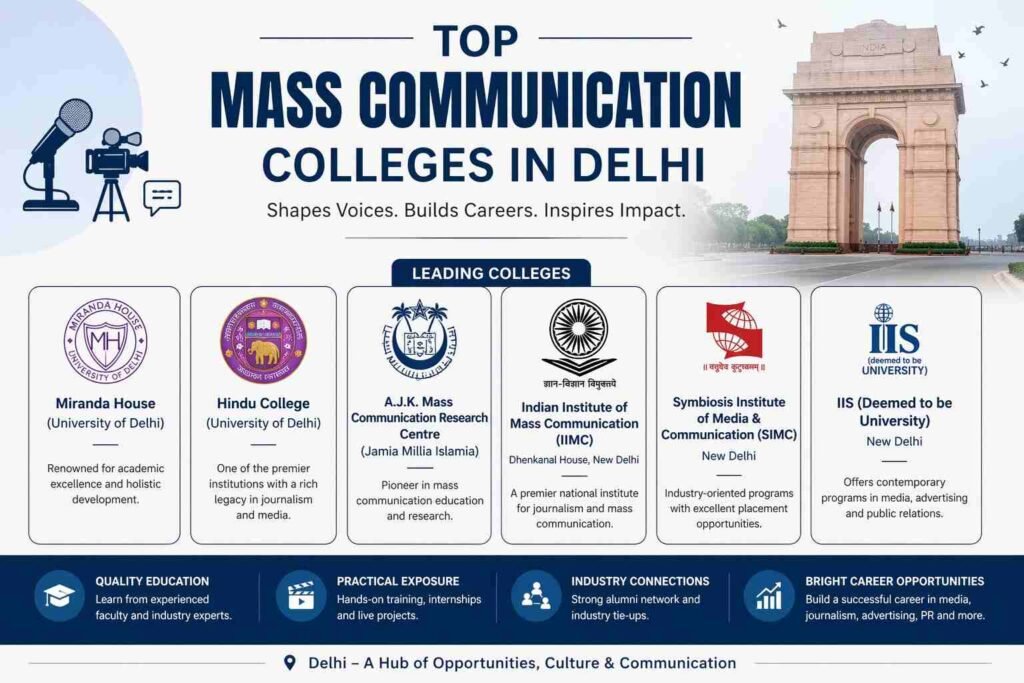
Top Mass Communication Colleges in Delhi 2026
Here’s a curated list of the best mass communication colleges in Delhi, covering both government and private institutions:
1. Indian Institute of Mass Communication (IIMC), New Delhi
Type: Government (Ministry of Information & Broadcasting) Established: 1965 NIRF Ranking: #1 in Mass Communication in Delhi
IIMC is the gold standard of mass communication education in India. Established in 1965, it is an autonomous institution under the Ministry of Information and Broadcasting and is accredited A++ by NAAC — the highest possible grade. If you’re serious about journalism, this is the place to be.
Courses Offered:
- PG Diploma in Journalism (English & Hindi)
- PG Diploma in Radio & TV Journalism
- PG Diploma in Advertising & Public Relations
- MA in Strategic Communication
- MA in Media Business Studies
- PhD
Fees: PG Diploma fees range from ₹1.28 lakh to ₹2 lakh; MA programme fees are approximately ₹4.8 lakh total.
Admission: Based on CUET-PG scores + Personal Interview (85% weightage on entrance exam, 15% on interview).
Placements: Top recruiters include NDTV, Zee Media, Network18, Times of India, ABP News, and All India Radio. Highest package reported at ₹20 LPA; average package is ₹4–5 LPA.
Best for: Graduates looking for the most prestigious PG Diploma or MA in journalism and media.
2. AJK Mass Communication Research Centre, Jamia Millia Islamia
Type: Government (Central University) NIRF Ranking: #2 in Mass Communication in Delhi
Founded in 1982, the AJK MRC at Jamia Millia Islamia is one of the finest media institutions in India. It focuses on research-based learning with strong practical components. Being part of a Central University makes it affordable and highly credible.
Courses Offered:
- MA in Mass Communication
- PG Diploma in Journalism
- PhD in Mass Communication
Best for: Students who want a research-oriented PG programme with strong academic depth.
3. Delhi College of Arts and Commerce (DCAC), University of Delhi
Type: Government (DU Affiliated) Best for: Class 12 students looking for an undergraduate programme under Delhi University.
DCAC offers BA (Hons.) Journalism — one of the most sought-after undergraduate mass communication programmes under Delhi University. Admission is based on CUET UG scores.
Courses Offered:
- BA (Hons.) Journalism
Best for: Class 12 students from any stream (Arts, Commerce, or Science) wanting an affordable, DU-affiliated degree.
4. Lady Shri Ram College (LSR), University of Delhi
Type: Government (DU Affiliated) Established: 1956
LSR is one of Delhi University’s most prestigious colleges, and its journalism programme is consistently ranked among the best. The college is known for its academic rigour, strong alumni network, and vibrant campus life.
Best for: Class 12 students (especially women) aiming for a top-tier DU journalism degree.
5. Apeejay Institute of Mass Communication (AIMC), New Delhi
Type: Private Established: 2003 Ranking: Ranked in the top 10 mass communication colleges in India by The Week magazine.
AIMC offers specialized, skill-based education with a strong industry connect. It’s particularly well-known for its programmes in Broadcast Journalism, Advertising, Public Relations, Digital Media, and Event Management.
Courses Offered:
- PG Diploma in Broadcast Journalism
- PG Diploma in Advertising & PR
- PG Diploma in Digital Media
- MA in Journalism & Mass Communication (via lateral entry to Apeejay Stya University)
Unique Feature: Students completing the 1-year PG course can get lateral entry into the 2nd year of the MA programme at Apeejay Stya University — effectively saving one full year.
Best for: Graduates who want practical, industry-focused training with strong placement support.
6. Amity School of Communication, Amity University
Type: Private Established: 1999
Amity is one of Delhi NCR’s largest and most recognized private universities. Its School of Communication offers a wide range of UG and PG programmes with modern infrastructure and international exposure opportunities.
Courses Offered:
- BA (Hons.) Journalism & Mass Communication
- MBA in Media Management
- MA in Mass Communication
- PG Diplomas
Best for: Students who want a wide variety of courses, modern campus facilities, and an internationally recognized degree.
7. Delhi School of Communication (DSC), Saket
Type: Private Ranking: Ranked among the top 10 mass communication colleges in India.
DSC is especially well-regarded for Public Relations and Corporate Communications — a field that has seen massive industry growth. It offers MA and PG programmes with 100% placement assistance for its students.
Best for: Students interested in PR, corporate communications, advertising, and brand management.
8. IAAN School of Mass Communication, New Delhi
Type: Private Established: 1999
IAAN is the only authorized institute of Makhanlal Chaturvedi National University of Journalism & Communication in Delhi. It offers both degree and diploma courses and is known for giving students access to real newsrooms and media organizations early in their education.
Best for: Students who want a strong foundation in journalism with hands-on practical training.
Government vs Private Colleges: Which is Better for You?
This is one of the most common questions students ask — and honestly, the answer depends on your goals.
| Factor | Government Colleges | Private Colleges |
|---|---|---|
| Fees | ₹52,000 – ₹3 lakh/year | ₹4–5 lakh/year (average) |
| Brand Value | Very High (IIMC, Jamia, DU) | Varies by institution |
| Placements | Moderate to Strong | Often Strong with industry tie-ups |
| Infrastructure | Good | Often Modern & Advanced |
| Admission | Entrance exam-based (competitive) | Entrance + interview |
| Scholarships | More widely available | Limited |
Bottom line: If you can clear the entrance exams, government colleges like IIMC and Jamia offer incredible ROI. If you’re looking for modern facilities, flexible admissions, and strong industry connections, reputed private colleges like AIMC or DSC are excellent choices.
Courses Offered in Mass Communication
Mass communication is not just journalism. Here’s a quick overview of the types of courses available in Delhi:
Undergraduate (for Class 12 students):
- BA (Hons.) Journalism & Mass Communication — 3 years
- BJMC (Bachelor of Journalism & Mass Communication) — 3 years
- BMC (Bachelor of Mass Communication) — 3 years
Postgraduate (for graduates):
- MA in Mass Communication / Journalism — 2 years
- PG Diploma in Journalism (English/Hindi) — 1 year
- PG Diploma in Radio & TV Journalism — 1 year
- PG Diploma in Advertising & Public Relations — 1 year
- MBA in Media Management — 2 years
Short-term / Certificate Courses:
- Digital Marketing & Content Creation
- Video Production & Editing
- Social Media Management
- Documentary Filmmaking
Eligibility & Admission Process
For Undergraduate Courses (Class 12 students):
- Pass Class 12 from any stream (Arts, Commerce, Science — all eligible)
- Appear for CUET UG for DU-affiliated colleges
- Some private colleges conduct their own entrance tests or personal interviews
- No minimum percentage restriction in most cases, but competitive cutoffs apply
For Postgraduate Courses (Graduate students):
- Bachelor’s degree in any discipline from a recognized university
- Minimum 50–55% aggregate marks (varies by college)
- Appear for CUET PG for IIMC, Jamia, and DU colleges
- Some private colleges conduct GD/PI rounds
Pro Tip: For IIMC, aim for a CUET PG score of at least 120 to have a good chance of being selected in the general round. The overall cutoff rank for IIMC ranges from 104 to 9,107 depending on the course and category.
Fees Structure at Top Delhi Colleges
| College | Course | Approx. Total Fees |
|---|---|---|
| IIMC, Delhi | PG Diploma | ₹1.28 – ₹2 lakh |
| IIMC, Delhi | MA Programme | ₹4.8 lakh (total) |
| Jamia Millia Islamia | MA Mass Communication | ₹50,000 – ₹1 lakh/year |
| DCAC (DU) | BA (Hons.) Journalism | ₹20,000 – ₹30,000/year |
| AIMC | PG Diploma | ₹2 – ₹3 lakh |
| Amity University | BA JMC | ₹3 – ₹5 lakh/year |
| DSC | PG Mass Comm | ₹3 – ₹4 lakh |
Scholarships: IIMC offers need-cum-merit scholarships, and several colleges have reserved category fee waivers. Always check the official college website for the latest scholarship details.
Career Scope After Mass Communication
One of the biggest questions students ask is: “Is mass communication a good career in India?” The answer is a resounding yes — especially in today’s digital-first world. Here are some of the exciting career paths open to you:
- Journalism: Reporter, Correspondent, Editor, News Anchor
- Television & Film: Producer, Director, Scriptwriter, Video Editor
- Digital Media: Content Creator, Social Media Manager, YouTuber, Podcast Host
- Advertising: Copywriter, Creative Director, Brand Strategist
- Public Relations: PR Manager, Corporate Communications Executive
- Radio: RJ, Radio Producer, Programme Director
- Academics & Research: Lecturer, Media Researcher
Top companies hiring mass communication graduates include NDTV, Zee Media, Sony Entertainment, Network18, Star India, Ogilvy, Weber Shandwick, Publicis, and hundreds of digital startups.
How to Choose the Right Mass Communication College in Delhi {#how-to-choose}
Step 1 — Define your career goal first. Do you want to be a journalist, a PR professional, a filmmaker, or a digital content creator? Different colleges specialize in different areas. IIMC is best for journalism; DSC is known for PR; Amity covers a broader range.
Step 2 — Decide on UG vs PG. Class 12 students should look at BA (Hons.) Journalism at DU colleges or BJMC programmes. Graduates should target PG Diplomas at IIMC or MA programmes at Jamia.
Step 3 — Consider your budget. Government colleges are far more affordable. If you’re budget-conscious, IIMC, Jamia, or DU colleges offer world-class education at a fraction of the private college cost.
Step 4 — Check placements and industry connections. Always look at the college’s placement record, internship opportunities, and industry tie-ups before applying. Ask alumni on LinkedIn for honest feedback.
Step 5 — Visit the campus if possible. Infrastructure, studios, newsrooms, and labs matter in mass communication education. A college with working TV studios and radio booths gives you hands-on experience that is invaluable.
Step 6 — Look at faculty profiles. Experienced faculty with real-world journalism or PR experience will prepare you far better than purely academic professors.
Frequently Asked Questions (FAQs)
Q1. Which is the No.1 mass communication college in Delhi?
According to NIRF 2025 rankings, the Indian Institute of Mass Communication (IIMC), New Delhi is the top-ranked mass communication college in Delhi, followed by AJK Mass Communication Research Centre at Jamia Millia Islamia.
Q2. Can Class 12 students from Science or Commerce pursue mass communication?
Absolutely! Mass communication is open to students from all streams — Arts, Commerce, and Science. There is no stream restriction at the Class 12 level for admission to most mass communication courses.
Q3. What entrance exam is required for mass communication in Delhi?
For DU-affiliated colleges and IIMC, students need to appear for CUET UG (for undergraduate) or CUET PG (for postgraduate) exams. Some private colleges also conduct their own entrance tests or rely on merit + personal interviews.
Q4. What is the average salary after mass communication?
Entry-level salaries typically range from ₹2.5 – ₹5 lakh per annum, depending on the specialization and college. IIMC graduates have reported average packages of ₹4–5 LPA with the highest touching ₹20 LPA. Salaries grow significantly with experience, especially in digital media and PR.
Q5. Is mass communication a good career in India in 2026?
Yes, mass communication is a very promising career in 2026. The rise of digital media, OTT platforms, influencer marketing, and content-driven brands has dramatically expanded career opportunities beyond traditional journalism. Fields like digital media, PR, content creation, and advertising are growing rapidly.
Q6. What is the difference between journalism and mass communication?
Journalism is a subset of mass communication. Journalism focuses specifically on news gathering, writing, and reporting, while mass communication covers a broader range of fields including advertising, PR, film production, radio, digital media, and communication research.
Conclusion
Delhi is one of the best cities in India to pursue a career in mass communication, and the city has no shortage of excellent institutions. Whether you’re a Class 12 student just starting your journey or a graduate ready to specialize, there’s a college in Delhi that’s the perfect fit for you.
To quickly recap the best choices:
- Best Government College: IIMC, New Delhi (the gold standard for journalism)
- Best DU College for UG: Delhi College of Arts and Commerce or Lady Shri Ram College
- Best for PG Research: AJK MRC, Jamia Millia Islamia
- Best Private College: Apeejay Institute of Mass Communication or Delhi School of Communication
Do your research, visit campuses, talk to alumni, and apply to multiple colleges to maximize your options. The media world is waiting for you — and Delhi is the perfect place to start.