MP Board Class 12th Biology Paper 2019 – Question Paper, Pattern, Key Topics & Free PDF Download
Quick Summary: Searching for the MP Board class 12th biology paper 2019? You’re in exactly the right place! This guide gives you a full breakdown of the 12th biology paper 2019 MP board — including the exam pattern, section-wise structure, unit-wise weightage, important topics that were asked, answer-writing tips, and where to download the biology question paper 2019 in English for free. Let’s dive right in! 🌿
Table of contents
- MP Board Class 12th Biology Paper 2019 – Question Paper, Pattern, Key Topics & Free PDF Download
- 1. Overview – MP Board Class 12th Biology Paper 2019
- 2. Exam Pattern & Structure of the 2019 Paper
- 3. Section-Wise Breakdown of the Biology Paper 2019
- 4. Unit-Wise Marks Weightage (MP Board Class 12 Biology)
- 5. Important Topics Covered in the 2019 Paper
- 6. Most Important Diagrams Asked in the Paper
- 7. How to Download Biology Question Paper 2019 in English – Free PDF
- 8. Why Solving the 2019 Paper Is Still Useful in 2025–26
- 9. Tips to Score Well Using Previous Year Papers
- 10. Frequently Asked Questions (FAQs)
- Final Thoughts
1. Overview – MP Board Class 12th Biology Paper 2019
Hey there, Class 12 MP Board student! 👋
If you’re preparing for your Biology board exam and want to understand what the actual paper looks like, there’s no better reference than the MP Board class 12th biology paper 2019. It’s one of the most searched previous year papers — and for good reason!
Here’s a quick snapshot of everything about the paper:
| Detail | Information |
|---|---|
| Conducting Body | Madhya Pradesh Board of Secondary Education (MPBSE) |
| Exam Date | March 18, 2019 |
| Exam Timing | Morning Session – 9:00 AM to 12:00 PM |
| Duration | 3 Hours |
| Total Marks (Theory) | 70 Marks |
| Practical Marks | 30 Marks |
| Total | 100 Marks |
| Total Questions | 18 Questions |
| Number of Sections | 4 Sections (A, B, C, D) |
| Medium Available | Hindi & English |
| Difficulty Level | Moderate |
The exam was conducted by Madhya Pradesh Board of Secondary Education, MPBSE on March 18, 2019 in the Morning Session 9 AM to 12 PM. The question paper comprised a total of 18 questions divided among sections.
The paper was considered moderate in difficulty overall. It tested students’ understanding of concepts and their ability to apply them. Students who had revised their NCERT textbook thoroughly and practiced previous year papers found the paper manageable within the three-hour window.
2. Exam Pattern & Structure of the 2019 Paper
Understanding the pattern of the 12th biology paper 2019 MP board is the first step to preparing smart. Here’s the complete structure:
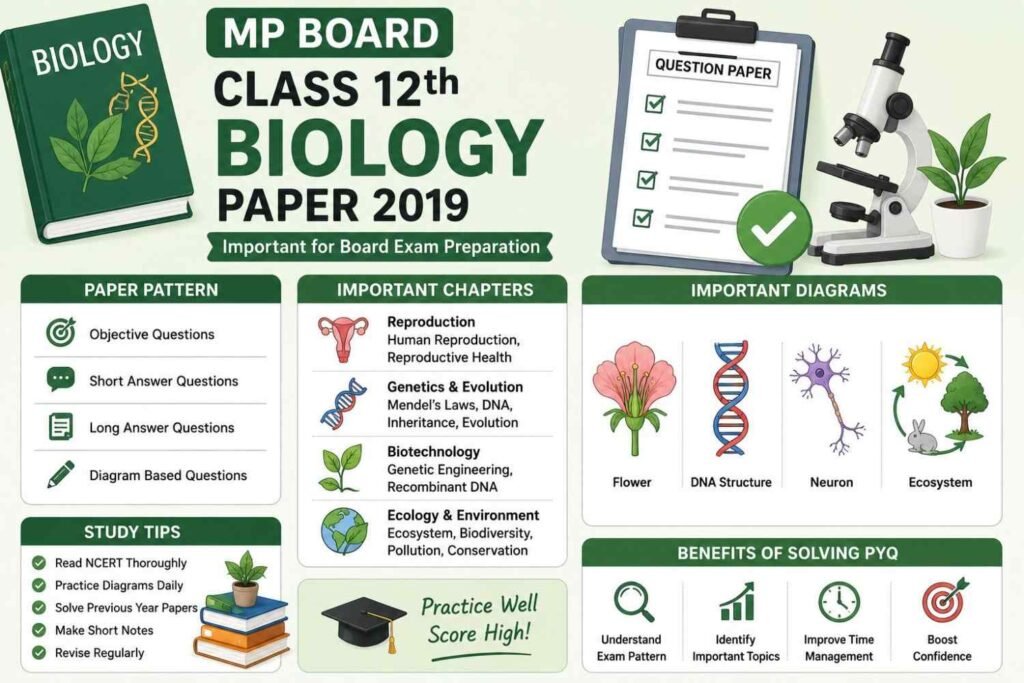
MP Board conducts a class 12 Biology exam of 70 marks which is written. A total of 18 questions will be asked in the exam. Types of questions are Objective, Very Short, Short, Long, and Essay Answer Types Questions. The difficulty level of questions differs as 40% of questions are of easy level, 45% of questions are of the medium level and 15% of questions are of difficult level.
Marks Distribution at a Glance
| Component | Marks |
|---|---|
| Theory Paper | 70 Marks |
| Practical Exam | 30 Marks |
| Grand Total | 100 Marks |
The theory paper was divided into four sections — Section A, B, C, and D — each testing a different level of understanding and answer length.
3. Section-Wise Breakdown of the Biology Paper 2019
Here’s the detailed section-wise structure of the MP Board class 12th biology paper 2019:
Section A – Very Short Answer Questions (1 Mark Each)
This section consisted of five very short answer questions (1 mark each) on key ideas from the syllabus. These questions examined students’ memory and knowledge of fundamental standards.
What to expect: single-word answers, definitions, fill in the blanks, and identification-based questions. These are the fastest marks you can earn in the paper — aim for all 5!
Tips for Section A:
- Answer in one word or one sentence only — don’t over-explain
- Don’t skip any question — 1-mark questions carry zero risk
- These questions directly test NCERT facts, organisms names, and definitions
Section B – Short Answer Questions (2 Marks Each)
This section consisted of 5 short answer questions (2 marks each). These questions were designed to evaluate students’ capability to explain concepts concisely and clearly.
What to expect: short 2–3 line answers, simple comparisons, give examples, name and explain type questions. Draw small diagrams if needed — they earn extra marks!
Tips for Section B:
- Write 2–3 sentences maximum per answer
- If a diagram can support your answer, draw it with labels
- Use scientific names and terms wherever possible
Section C – Short Answer Questions (3 Marks Each)
This section consisted of 12 short answer questions (3 marks each). These questions required students to offer targeted answers, detailed explanations, or problem-solving based on the syllabus.
This is the biggest section of the paper — 12 questions × 3 marks = 36 marks. Performing well in Section C essentially decides your overall Biology score.
What to expect: processes explained step-by-step, differences/comparisons, describe-and-draw, genetic problems, and passage or diagram-based questions.
Tips for Section C:
- Structure your answer in 3 distinct points — one per mark
- Always label diagrams fully — each missing label can cost you a mark
- Internal choices may be provided — pick the one you know best
Section D – Long Answer / Essay Questions (5 Marks Each)
This section consisted of 3 lengthy answer questions (5 marks each). These questions were in-depth and required students to demonstrate a deep knowledge of the topics covered in the course.
These are the “make or break” questions. 3 questions × 5 marks = 15 marks. Long answers require detailed explanations, diagrams, and a structured presentation.
Tips for Section D:
- Use headings or numbered points for clarity
- Include a well-labelled diagram wherever relevant — it can add 1–2 marks
- Cover all aspects of the question — introduction, main explanation, conclusion
- Write at least half a page per long answer
4. Unit-Wise Marks Weightage (MP Board Class 12 Biology)
Knowing which units carry more marks helps you study smarter. As per the MP Board, there are five units in class 12 biology which are as follows: Unit I – Reproduction which contributes 14 marks out of 70; Unit II – Genetics and Evolution which contributes 18 marks out of 70; Unit III – Biology in Human Welfare which contributes 14 marks out of 70; Unit IV – Biotechnology which contributes 10 marks out of 70; Unit V – Ecology which contributes 14 marks out of 70.
| Unit | Topic | Marks (Theory) | Priority |
|---|---|---|---|
| Unit II | Genetics and Evolution | 18 marks | 🔴 Highest |
| Unit I | Reproduction | 14 marks | 🟠 High |
| Unit III | Biology and Human Welfare | 14 marks | 🟠 High |
| Unit V | Ecology | 14 marks | 🟡 Medium-High |
| Unit IV | Biotechnology | 10 marks | 🟡 Medium |
| Total | 70 marks |
Key Takeaway: Genetics and Evolution carries the highest weightage at 18 marks. A student who masters this unit has already secured more than 25% of the theory paper. Focus on this unit first!
5. Important Topics Covered in the 2019 Paper
Based on the biology question paper 2019 in English and the MP Board syllabus, the following topics and chapters were prominently covered:
From Unit I – Reproduction
- Sexual reproduction in flowering plants — double fertilisation, pollination
- Human reproductive system — male and female anatomy
- Gametogenesis — spermatogenesis and oogenesis
- Menstrual cycle and its hormonal regulation
- Embryo development and implantation
- Reproductive health, contraceptive methods, STDs
From-Unit II – Genetics and Evolution
- Mendel’s laws — monohybrid and dihybrid crosses
- Chromosomal theory of inheritance
- Linkage and crossing over
- Sex determination (XX-XY mechanism)
- DNA structure (Watson & Crick model)
- DNA replication — semi-conservative method
- Transcription and translation
- Genetic disorders — haemophilia, Down syndrome, sickle-cell anaemia
- Origin of life — Miller and Urey experiment
- Darwin’s theory of natural selection
- Hardy-Weinberg principle
From Unit III – Biology and Human Welfare
- Common diseases — typhoid, malaria (Plasmodium life cycle), AIDS
- Innate and acquired immunity
- Vaccination and immunisation
- Useful microbes — antibiotics, biogas, fermentation
- Sewage treatment process
From-Unit IV – Biotechnology
- Recombinant DNA technology — restriction enzymes, vectors, PCR
- Bt crops and pest-resistant plants
- Genetically engineered insulin
From Unit V – Ecology
- Population growth models — logistic and exponential
- Food chains, food webs, ecological pyramids
- Energy flow — 10% law (Lindeman)
- Nitrogen cycle, carbon cycle
- Biodiversity and conservation
- Ecosystem productivity
💡 Pro Tip: The paper covered topics such as Reproduction, Genetics and Evolution, Biology and Human Welfare, Biotechnology and its Applications, and Ecology and Environment. All five units contributed questions — so don’t skip any unit while preparing!
6. Most Important Diagrams Asked in the Paper
Biology diagrams are worth serious marks in every MP Board paper. Diagrams and labelling are crucial as they carry marks and help in better understanding of concepts. Students should practice drawing and labelling diagrams related to the syllabus.
Based on the 2019 paper and recurring patterns in MP Board Biology exams, these are the must-practice diagrams:
| Diagram | Chapter | Marks Potential |
|---|---|---|
| 7-celled embryo sac (female gametophyte) | Flowering Plants | 3–5 marks |
| Life cycle of Plasmodium | Human Health & Disease | 3–5 marks |
| Male & female reproductive system | Human Reproduction | 3 marks each |
| DNA double helix (Watson-Crick model) | Molecular Basis | 3 marks |
| Replication fork (leading & lagging strand) | Molecular Basis | 3 marks |
| L.S. of ovary / flower | Flowering Plants | 3 marks |
| Pyramid of energy | Ecosystem | 3 marks |
| Nitrogen cycle | Ecosystem | 3–5 marks |
| Lac operon | Molecular Basis | 3–5 marks |
| Antibody (Y-shaped structure) | Human Health | 2–3 marks |
How to practice diagrams:
- Draw each diagram at least 5–7 times without looking
- Label every part completely — partial labelling loses marks
- Use pencil for drawing; write labels in ink or pencil clearly
- Always draw a proper border/title above the diagram
7. How to Download Biology Question Paper 2019 in English – Free PDF
Want to practice the actual biology question paper 2019 in English (or Hindi)? Here’s exactly where to get it for free:
Option 1: MPBSE Official Website
- Visit mpbse.nic.in
- Click on “Question Bank” or “Previous Year Papers”
- Select Class 12 → Biology → 2019
- Download the PDF directly
8. Why Solving the 2019 Paper Is Still Useful in 2025–26
Reason 1 – Pattern Remains Consistent Every year, there might be some slight changes in the format of the paper. With the practice of the MP Board Class 12th Biology 2019 question paper with answers, you can get familiar with any new types of questions, marking scheme, distribution of topics, and so on. The core structure of 4 sections with 1, 2, 3, and 5 mark questions has stayed largely the same.
Reason 2 – Questions Repeat (With Variations) You will not get the exact questions always from the MPBSE 12th Biology previous year question paper. You will find that the same questions are given in a different manner. However, if you practice, you will get accustomed to the types of questions.
Reason 3 – Builds Time Management Skills One of the most important factors these papers address is the management of time. Many students would have studied hard and learnt the concepts well, but still struggle to finish answering the paper. Solving 2019 Biology previous question papers for class 12 familiarizes the student with the format of the paper beforehand.
Reason 4 – Identifies Your Weak Areas Solving the MP Board Class 12th Biology 2019 question paper is an excellent tool to understand where you should focus your studies. After solving it, you’ll clearly see which chapters are your strong suits and which need more revision.
Reason 5 – Reduces Exam Anxiety When you practice the paper on a regular basis, it will help to reduce your last-minute stress as well as boost confidence. Walking into the exam hall having already “seen” a real board paper makes a huge psychological difference.
9. Tips to Score Well Using Previous Year Papers
Step 1 – Complete the Syllabus First There is no ideal time to start solving the MPBSE 12th Biology previous year question papers as the pace of completing the MP Board 12th syllabus differs with every student. Therefore, when you are confident that you have completed the syllabus, start practising the MPBSE 12th Biology previous year question papers.
Step 2 – Solve in Real Exam Conditions Sit in a quiet room, set a timer for 3 hours, and solve the 2019 paper without any help. This is the single most effective practice method. Attempting the 2019 question paper as a mock test gives you an excellent opportunity to replicate the exam day conditions. This practice will also build your writing stamina and enhance time management.
Step 3 – Maintain a Mistake Tracker Notebook You must maintain a ‘mistake tracker’ notebook. In this, record every error that you make. Also, mention the correct solution and the reason for the particular mistake. Then, revise this notebook on a regular basis. This single habit alone can improve your score significantly over time.
Step 4 – Attempt the Paper 2–3 Times Experts recommend that ideally, you should attempt the MP Board Class 12th Biology 2019 question paper around 2 to 3 times before the actual exam. Each time you re-attempt, you’ll write faster, answer more completely, and cover more marks.
Step 5 – Focus on High-Weightage Units Based on the marks distribution, always prioritise Genetics and Evolution (18 marks) and Reproduction (14 marks) when revising. These two units together make up 32 out of 70 marks — nearly half the paper!
Step 6 – Don’t Skip Diagram Practice Many students skip diagram practice because it feels time-consuming. But in Biology, a well-drawn and labelled diagram can earn you 2–3 marks in seconds. Practice at least 2 diagrams daily during revision week.
10. Frequently Asked Questions (FAQs)
Q1. When was the MP Board Class 12th Biology Paper 2019 conducted?
The MP board class 12th biology paper 2019 was conducted on March 18, 2019, in the morning session from 9:00 AM to 12:00 PM (3 hours).
Q2. How many marks is the MP Board Class 12 Biology theory paper?
The theory paper carries 70 marks. The practical exam carries 30 marks, making the total 100 marks.
Q3. How many questions were in the 12th biology paper 2019 MP board?
The question paper comprised a total of 18 questions divided among 2 sections. The paper was divided into four question types — very short (1 mark), short (2 marks), short detailed (3 marks), and long answer (5 marks).
Q4. Which unit carries the most marks in MP Board Class 12 Biology?
Genetics and Evolution (Unit II) carries the highest weightage at 18 marks out of 70 in the theory paper.
Q5. Where can I download the biology question paper 2019 in English?
You can download the biology question paper 2019 in English for free from MPBSE’s official website (mpbse.nic.in), as well as educational platforms like Vedantu, CollegeDekho, SelfStudys, and CollegeDunia.
Q6. How difficult was the MP Board 12th Biology Paper 2019?
The paper was considered moderate in difficulty. It tested students’ understanding of concepts and their ability to apply them. Students who had prepared NCERT thoroughly found it manageable.
Final Thoughts
The MP Board class 12th biology paper 2019 is one of the most valuable study tools you have in your exam toolkit. It tells you exactly what the board expects, how questions are framed, how marks are distributed, and what kind of depth is needed in your answers.
Here’s your quick action plan:
✅ Download the biology question paper 2019 in English from a trusted platform ✅ Solve it in 3 hours — no breaks, no books — just like the real exam ✅ Check your answers and fill in your mistake tracker notebook ✅ Revise the chapters where you lost marks ✅ Repeat 2–3 times before your board exam
Biology is one of those subjects where consistent, structured practice beats last-minute cramming every single time. The student who solves more papers wins — simple as that.
Best of luck for your MP Board Class 12 Biology exam! You’re going to do brilliantly! 🌱💪