Data Science or Artificial Intelligence: Which Programme Should You Choose in 2026?
So, you’ve made up your mind — you want a career in tech. You know the future is digital. You’ve heard the buzz around AI and Data Science, and you’re pretty sure one of these fields is your calling. But here’s the problem nobody warns you about:
You can’t choose between them because you’re not entirely sure what the difference is.
Don’t worry — you’re not alone. Thousands of Class 12 students and graduates across India search for terms like “difference between AI and data science” or “data science vs machine learning vs artificial intelligence” every single day. These fields sound alike, overlap a lot, and are often used interchangeably — even by people who should know better.
By the time you finish reading this article, you’ll know exactly what data science and artificial intelligence are, how they differ, where they overlap, what careers they lead to, and most importantly — which programme is right for you.
Let’s get into it.
Quick Answer (For Those in a Hurry)
| If you… | Choose… |
|---|---|
| Love working with data, statistics, and business insights | Data Science |
| Love building intelligent systems, robots, or smart apps | Artificial Intelligence |
| Want faster job placement with more entry-level roles | Data Science |
| Want to work on cutting-edge, futuristic tech | Artificial Intelligence |
| Are strong in Maths and Statistics | Data Science |
| Are strong in Maths, Logic, and Programming | Artificial Intelligence |
| Want flexibility across industries | Data Science |
| Want to specialize deeply in one niche | Artificial Intelligence |
Still not sure? Keep reading — we’re going to unpack everything.
1. What Is Data Science and Artificial Intelligence? (Let’s Clear the Confusion)
What Is Data Science?
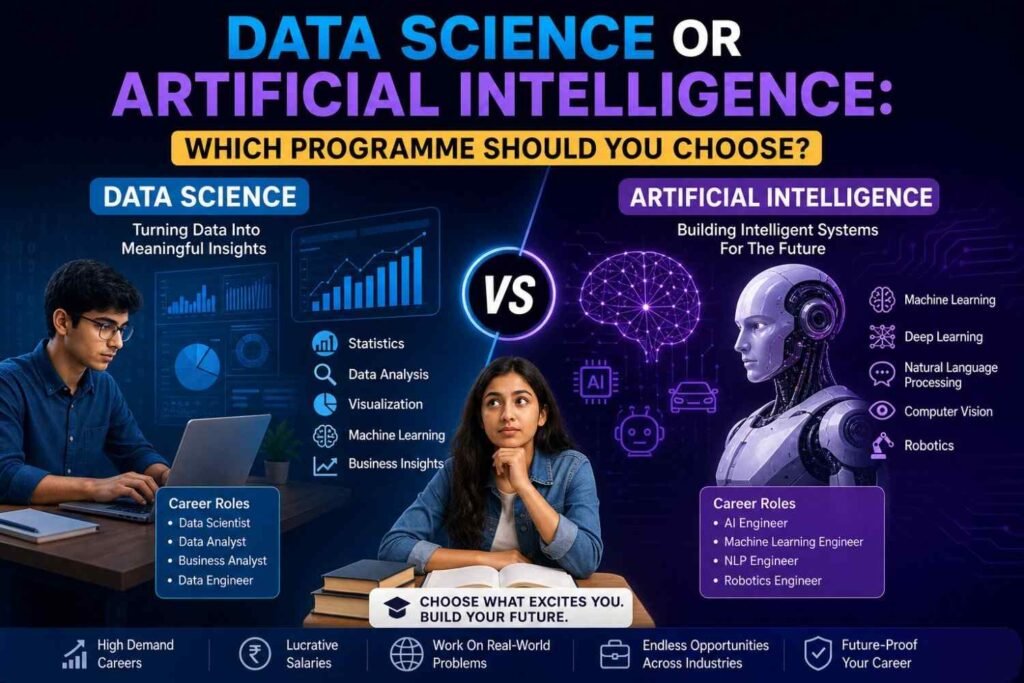
Data science is the art and science of extracting meaningful insights from large volumes of data. Think of a data scientist as a modern-day detective — they gather raw, messy data, clean it, analyze it, visualize it, and turn it into stories that help businesses make smarter decisions.
Data science involves:
- Collecting and cleaning large datasets
- Statistical analysis and pattern recognition
- Data visualization (turning numbers into charts and dashboards)
- Predictive modeling (using past data to forecast future trends)
- Tools like Python, R, SQL, Tableau, Excel
- Machine Learning (a subset used within data science)
A data scientist at a bank, for example, might analyze customer transaction data to identify fraud patterns, predict loan defaults, or personalize product recommendations.
What Is Artificial Intelligence?
Artificial intelligence (AI) is the science of making machines think, reason, learn, and act like humans. If data science is about understanding data, AI is about using that understanding to build machines that can do things — like understand speech, recognize faces, drive cars, or beat a chess grandmaster.
Artificial intelligence involves:
- Machine Learning (ML) — teaching machines to learn from data
- Deep Learning — using neural networks to mimic the human brain
- Natural Language Processing (NLP) — making machines understand human language
- Computer Vision — enabling machines to “see” and interpret images
- Robotics and Automation
- Reinforcement Learning
An AI engineer might build the voice recognition system in your phone’s assistant, the recommendation engine on Netflix, or the self-driving module in a Tesla.
So, Is Data Science and Artificial Intelligence the Same?
Short answer: No — but they’re closely related.
Here’s the simplest way to think about it:
AI is the destination. Data Science is the vehicle that helps get you there.
Data science uses AI tools (like machine learning) to make sense of data. AI, in turn, relies heavily on data — and data science — to train its models and algorithms. They’re not the same, but they’re deeply intertwined. A strong professional in either field will inevitably touch the other.
2. The Difference Between Data Science and Artificial Intelligence: A Deep Dive
Let’s now look at the difference between AI and data science across key parameters, since this is what most students are really trying to understand.
Data Science vs Artificial Intelligence: Core Comparison
| Parameter | Data Science | Artificial Intelligence |
|---|---|---|
| Primary Goal | Extract insights from data | Build machines that mimic human intelligence |
| Focus | Analysis, visualization, prediction | Automation, cognition, decision-making |
| Key Skills | Statistics, Python/R, SQL, ML, Visualization | ML, Deep Learning, NLP, Computer Vision, Robotics |
| Main Tools | Python, R, Tableau, Power BI, SQL, Spark | TensorFlow, PyTorch, Keras, OpenCV, NLTK |
| Output | Dashboards, Reports, Models, Predictions | Intelligent Systems, Chatbots, Autonomous Machines |
| Math Requirement | Statistics-heavy | Linear Algebra, Calculus, Probability-heavy |
| Entry-Level Jobs | Data Analyst, Junior Data Scientist | ML Engineer, AI Research Assistant |
| Industries | Finance, Healthcare, Retail, Marketing, HR | Tech, Automotive, Defence, Healthcare, Gaming |
| Average Starting Salary (India) | INR 4 – 8 LPA | INR 5 – 10 LPA |
| Course Duration (B.Tech) | 4 Years | 4 Years |
Data Science vs Machine Learning vs Artificial Intelligence: How Are They Related?
This is one of the most searched questions, and it’s easy to understand with a simple diagram in your head:
Artificial Intelligence (Broadest Field)
    └── Machine Learning (A subset of AI)
            └── Deep Learning (A subset of ML)
                    └── Neural Networks

Data Science (Intersects with AI and ML)
    ├── Uses Machine Learning as a tool
    ├── Uses Statistical Analysis
    └── Uses Data Engineering & Visualization
Think of it like this:
- AI is the big umbrella — the idea that machines can be intelligent
- Machine Learning is the most popular approach to achieving AI — machines learn from data instead of being explicitly programmed
- Deep Learning is a powerful subset of ML that uses multi-layered neural networks, great for image and speech recognition
- Data Science is a broader discipline that uses ML and AI as tools, alongside statistics, data engineering, and business analytics
So when people say data science vs machine learning, they’re really comparing a broad interdisciplinary field (DS) with a specific technique (ML) that DS uses as a tool. And artificial intelligence with data science represents the modern convergence of both worlds — which is why many universities now offer integrated AI and Data Science programmes.
3. Data Science and Artificial Intelligence Course: What Will You Actually Study?
Let’s get into the specifics of what you’ll learn if you choose either of these programmes — whether at the B.Tech, B.Sc., or postgraduate level.
Data Science Programme: Curriculum Overview
A typical data science and artificial intelligence course at the undergraduate level covers:
Year-1 — Foundations
- Mathematics for Data Science (Probability, Statistics, Linear Algebra)
- Introduction to Programming (Python/R)
- Data Structures and Algorithms
- Database Management Systems (SQL)
Year 2 — Core Data Science
- Machine Learning (Supervised, Unsupervised, Reinforcement)
- Exploratory Data Analysis (EDA)
- Data Wrangling and Preprocessing
- Data Visualization (Tableau, Power BI, Matplotlib)
- Big Data Technologies (Hadoop, Spark)
Year–3 — Advanced Topics
- Deep Learning and Neural Networks
- Natural Language Processing
- Time Series Analysis
- Cloud Computing for Data Science (AWS, GCP, Azure)
- Business Analytics and Decision Science
Year 4 — Specialization and Projects
- Capstone Projects / Industry Projects
- Data Science in specific domains (Finance, Healthcare, Marketing)
- Ethics in AI and Data
- Internship / Research
Artificial Intelligence Programme: Curriculum Overview
A typical artificial intelligence and data science engineering programme covers:
Year 1 — Foundations
- Discrete Mathematics and Logic
- Programming in Python and C++
- Data Structures and Algorithms
- Introduction to AI Concepts
Year–2 — Core AI
- Machine Learning Algorithms
- Pattern Recognition
- Computer Vision and Image Processing
- Probability and Statistical Inference
Year 3 — Advanced AI
- Deep Learning (CNNs, RNNs, Transformers)
- Natural Language Processing (NLP)
- Reinforcement Learning
- Robotics and Autonomous Systems
- AI Ethics and Responsible AI
Year-4 — Specialization
- Generative AI (LLMs, GANs, Diffusion Models)
- AI in Healthcare / Finance / Defence
- Capstone AI Projects
- Research Publications / Internship
As you can see, there’s significant overlap — particularly in the ML, Deep Learning, and NLP space. The key difference is that Data Science programmes spend more time on statistics, data handling, and business applications, while AI programmes go deeper into cognitive systems, robotics, and autonomous decision-making.
4. AI and Data Science: Career Paths and Job Roles
This is where it gets really exciting. Both AI and DS lead to some of the most in-demand, highest-paying careers in the world right now. Let’s look at what you can become.
Career Options After a Data Science Programme
| Job Role | What You’ll Do | Avg. Salary (India) |
|---|---|---|
| Data Analyst | Analyze datasets, create reports and dashboards | INR 4 – 7 LPA |
| Data Scientist | Build predictive models, extract business insights | INR 7 – 18 LPA |
| Business Analyst | Translate data findings into business strategy | INR 5 – 12 LPA |
| ML Engineer | Build and deploy machine learning models | INR 8 – 20 LPA |
| Data Engineer | Build data pipelines and infrastructure | INR 6 – 16 LPA |
| BI Analyst | Create business intelligence dashboards | INR 4 – 10 LPA |
| Quantitative Analyst | Use data models in finance and trading | INR 8 – 25 LPA |
| NLP Engineer | Build language models and chatbots | INR 8 – 18 LPA |
Career Options After an Artificial Intelligence Programme
| Job Role | What You’ll Do | Avg. Salary (India) |
|---|---|---|
| AI Engineer | Design, build, and deploy AI systems | INR 8 – 22 LPA |
| ML Engineer | Develop and optimize machine learning models | INR 8 – 20 LPA |
| Deep Learning Engineer | Build neural network-based models | INR 10 – 25 LPA |
| Computer Vision Engineer | Build systems that process and interpret images | INR 8 – 20 LPA |
| NLP Engineer | Develop language models, chatbots, translators | INR 8 – 20 LPA |
| AI Research Scientist | Conduct cutting-edge research in AI | INR 12 – 40 LPA |
| Robotics Engineer | Build and program autonomous robots | INR 6 – 18 LPA |
| AI Product Manager | Manage AI-powered product development | INR 10 – 30 LPA |
Which Field Has More Jobs Right Now?
If you’re looking purely at the volume of job openings, Data Science currently has a slight edge — because data analyst and data scientist roles exist across virtually every industry, from e-commerce to banking to government. There are more entry-level pathways.
AI roles are typically more specialized and often require stronger technical depth — but they also tend to command higher salaries at the senior level, especially in areas like Deep Learning, Computer Vision, and Generative AI.
The good news? AI in data science is increasingly blending the two. Companies want professionals who can both analyze data and build intelligent systems. Hybrid profiles are the future.
5. Industries That Hire AI and Data Science Professionals
Both artificial intelligence and data science graduates are in demand across a wide range of industries. Here’s a snapshot:
Industries Hiring Data Science Professionals
- Banking & Finance — Fraud detection, credit scoring, risk analysis, algo trading
- Healthcare — Patient outcome prediction, drug discovery, medical imaging analysis
- E-commerce & Retail — Recommendation engines, demand forecasting, customer segmentation
- Marketing & Advertising — Campaign optimization, customer analytics, attribution modeling
- Human Resources — Talent analytics, attrition prediction, workforce planning
- Agriculture — Crop yield prediction, weather modeling, supply chain optimization
- Telecom — Churn prediction, network optimization, customer lifetime value modeling
Industries Hiring AI Professionals
- Technology — Building AI-powered products, platforms, and tools
- Automotive — Self-driving vehicles, driver assistance systems
- Healthcare — AI diagnostics, robotic surgery, drug discovery (AlphaFold!)
- Defence & Aerospace — Autonomous drones, surveillance systems, threat detection
- Gaming — Intelligent NPCs, procedural content generation
- Finance — Algorithmic trading, fraud prevention, AI-powered robo-advisors
- Manufacturing — Predictive maintenance, quality control, industrial robotics
6. Data Science vs Artificial Intelligence: Skills You Need to Develop
Core Skills for Data Science
- Programming: Python (Pandas, NumPy, Scikit-Learn), R, SQL
- Statistics: Hypothesis testing, regression, probability distributions
- Data Visualization: Tableau, Power BI, Matplotlib, Seaborn
- Machine Learning: Supervised and unsupervised learning, model evaluation
- Big Data: Hadoop, Apache Spark, Kafka
- Cloud: AWS, GCP, or Azure for deploying models
- Communication: Translating technical findings into business language (super underrated!)
- Domain Knowledge: Understanding the industry you’re working in
Core Skills for Artificial Intelligence
- Programming: Python, C++, Java
- Deep Learning Frameworks: TensorFlow, PyTorch, Keras
- Mathematics: Linear Algebra, Calculus, Probability (at a deeper level)
- Computer Vision: OpenCV, CNNs, image processing
- NLP: NLTK, SpaCy, Transformers (BERT, GPT)
- Reinforcement Learning: Q-learning, policy gradients
- MLOps: Deploying and monitoring AI systems at scale
- Research Skills: Reading and implementing research papers
7. What Is Data Science and Artificial Intelligence in the Indian Education Context?
In India, the terms “AI and Data Science” and “Artificial Intelligence and Data Science” are used for both standalone courses and integrated programmes. Here’s how the landscape looks:
Types of Programmes Available
At the Undergraduate Level (After Class 12):
- B.Tech in Artificial Intelligence and Data Science (4 years)
- B.Tech in Computer Science & Engineering with AI/ML Specialization (4 years)
- B.Sc. in Data Science (3 years)
- B.Sc. in Artificial Intelligence (3 years)
- BCA with AI and Data Science specialization (3 years)
At the Postgraduate Level (After Graduation):
- M.Tech in AI and Data Science (2 years)
- M.Sc. in Data Science (2 years)
- MBA in Business Analytics (2 years)
- MCA with AI specialization (2 years)
- PG Diploma / Certificate in Data Science or AI (6 months – 1 year)
Entrance Exams to Get Into These Programmes
For B.Tech (AI & Data Science) in India:
- JEE Main — Required for most private and central universities
- CUET — Common University Entrance Test, accepted widely
- State CETs — MHT-CET, KCET, TANCET, etc.
- University-Level Tests — GATA, KIITEE, VITEEE, SRMJEEE, etc.
For PG programmes:
- GATE — For M.Tech admissions
- CAT/MAT/GMAT — For MBA in Business Analytics
- CUET-PG — For M.Sc. and MA programmes
8. Data Science with Artificial Intelligence: The Rise of Integrated Programmes
Here’s a trend worth paying close attention to: many top universities in India and globally are now offering integrated B.Tech programmes in Artificial Intelligence and Data Science — combining the best of both worlds into a single 4-year degree.
This makes a lot of sense because:
- The boundary between data science artificial intelligence is increasingly blurred
- Companies want professionals who can do both — analyze data and build AI systems
- Integrated programmes are more job-ready and industry-aligned
- You get exposure to the full AI/DS pipeline: from data collection to model deployment
What Does an Integrated AI and Data Science Engineering Programme Cover?
A well-designed artificial intelligence and data science engineering course will take you through:
- Data Foundation Layer — Data collection, cleaning, storage (SQL, NoSQL, Cloud)
- Analytics Layer — Statistical analysis, business intelligence, visualization
- ML Layer — Classical machine learning algorithms, model training, evaluation
- AI Layer — Deep learning, computer vision, NLP, reinforcement learning
- Deployment Layer — MLOps, cloud deployment, AI product development
- Application Layer — AI in healthcare, finance, autonomous systems, NLP applications
This end-to-end coverage makes graduates from such programmes extremely attractive to employers. You’re not just a data person or an AI person — you’re a complete AI data science professional.
9. Artificial Intelligence vs Data Science: Myths Busted
Let’s address some common misconceptions that students often have:
Myth 1: “AI is only for geniuses or PhD holders.” Reality: AI has become significantly more accessible. With the right undergraduate programme, strong mathematical foundations, and hands-on project experience, you can build a solid AI career without a PhD. Research roles may benefit from a Master’s, but engineering roles are very much available to B.Tech graduates.
Myth 2: “Data Science is just Excel and graphs.” Reality: Modern data science is deeply technical. You’ll write complex Python code, build ML models, handle terabytes of data, and work with cloud platforms. It’s far more sophisticated than just making charts.
Myth 3: “AI will replace Data Scientists.” Reality: AI is changing the job but not eliminating it. Tools like AutoML automate some routine tasks, but the need for human judgment, domain expertise, and critical thinking in data science is growing — not shrinking.
Myth 4: “You need to know everything about both to get a job.” Reality: Entry-level roles in both fields have clear, well-defined skill requirements. You don’t need to know everything on Day 1. Focus on core fundamentals and 2–3 specializations, and you’ll be job-ready.
Myth 5: “Is data science and artificial intelligence the same? Yes.” Reality: As we’ve established — they’re related but not the same. Data Science is about insights from data; AI is about intelligent autonomous systems. They use many of the same tools but have different goals and career paths.
10. How to Decide: A Simple Framework for Students
Ask Yourself These Questions
1. What do I find more exciting?
- Analyzing sales trends to help a company grow → Data Science
- Building a chatbot that can have real conversations → AI
2. What am I better at?
- Statistics, data interpretation, storytelling with data → Data Science
- Algorithms, logic, building systems that “think” → AI
3. What kind of work environment do I want?
- Working with business teams, dashboards, strategy → Data Science
- Working in R&D labs, cutting-edge product teams → AI
4. How patient am I with long research cycles?
- I want to see impact quickly → Data Science
- I’m okay with long development cycles for breakthrough results → AI
5. What’s my math comfort level?
- I’m good at stats and probability → Data Science
- I’m comfortable with advanced calculus and linear algebra → AI
6. What’s my career goal?
- I want to work across many industries and have flexibility → Data Science
- I want to work at the frontier of technology → AI
Our Recommendation for Class 12 Students
If you’re finishing Class 12 right now and aren’t sure which to pick — go for a B.Tech in AI and Data Science (combined programme). Here’s why:
- You get exposure to both fields before specializing
- You can decide your niche in Year 2 or 3 based on what you enjoy
- Integrated programmes are currently among the most employable degrees in India
- The job market rewards professionals who understand both sides of the AI/DS ecosystem
Our Recommendation for Graduate Students
If you’re already a graduate and looking to upskill or switch careers:
- B.Sc./B.Tech background in any field + interest in analytics → PG Diploma or M.Sc. in Data Science
- Engineering/CS background + interest in AI research or products → M.Tech in AI or specialized online AI courses + projects
- Business background → MBA in Business Analytics (blends both fields with a management lens)
11. Top Skills That Make You Stand Out in Both Fields
Regardless of whether you choose AI and DS or one over the other, these skills will make you genuinely employable:
- Python proficiency — The lingua franca of both fields. Non-negotiable.
- Strong fundamentals in math — Don’t skip linear algebra, calculus, and probability.
- Hands-on projects — Build and showcase real projects on GitHub. Recruiters look here.
- Kaggle competitions — Great for practice and for building a visible portfolio.
- Cloud certifications — AWS, GCP, or Azure certifications add significant weight to your resume.
- Communication skills — The ability to explain complex models to non-technical stakeholders is a superpower.
- Domain knowledge — Pick an industry you’re interested in (healthcare, finance, e-commerce) and go deep.
12. The Future of AI and Data Science: What’s Coming?
The world of data science and artificial intelligence is evolving at breathtaking speed. Here’s what’s shaping the next decade:
- Generative AI (ChatGPT, DALL-E, Gemini, Claude) is creating entirely new job categories: Prompt Engineers, AI Product Managers, LLM Fine-tuners
- AI in Healthcare is poised to revolutionize diagnostics, drug discovery, and personalized medicine
- Autonomous Systems — Self-driving cars, delivery drones, and robotic warehouses are becoming mainstream
- AI Ethics and Governance — As AI becomes more powerful, so does the need for professionals who understand its risks and can ensure responsible deployment
- Edge AI — Running AI models on devices (phones, IoT sensors) without cloud connectivity
- Multimodal AI — Models that can process text, images, audio, and video simultaneously
- Data-Centric AI — A shift from “better models” to “better data” — making data science even more critical
Whether you choose Data Science or AI, you’re stepping into a field that will be central to human civilization for the next 50 years. That’s not hype — that’s the reality of where the world is heading.
13. Frequently Asked Questions
Q: What is the difference between data science and artificial intelligence?
A: Data Science focuses on extracting insights and predictions from data using statistics, programming, and ML. Artificial Intelligence focuses on building systems that can perform tasks that typically require human intelligence — like reasoning, recognition, and decision-making. They overlap significantly but have different core goals.
Q: Is data science and artificial intelligence the same?
A: No, they’re not the same — but they’re closely related and deeply interconnected. AI uses data science techniques, and data science uses AI tools like machine learning. Many modern professionals work at the intersection of both.
Q: Which is better — AI or Data Science?
A: Neither is objectively better. It depends on your interests, strengths, and career goals. If you love analytics and business insights, Data Science is a better fit. If you love building intelligent systems and cutting-edge technology, AI is more exciting. An integrated AI and Data Science programme gives you the best of both worlds.
Q: What is data science vs machine learning vs artificial intelligence?
A: AI is the broadest concept — the idea of intelligent machines. Machine Learning is a subset of AI where machines learn from data. Data Science is a multidisciplinary field that uses ML, statistics, and data engineering to derive insights. They exist in a nested, overlapping relationship.
Q: Which has a higher salary — AI or Data Science?
A: Both offer excellent salaries. AI roles (especially Deep Learning and Computer Vision) tend to command higher salaries at the senior level, while Data Science has more entry-level opportunities with competitive starting pay. Senior professionals in both fields can earn INR 20–50+ LPA in India.
Q: Can I do both AI and Data Science?
A: Absolutely! In fact, many universities now offer integrated B.Tech in Artificial Intelligence and Data Science programmes that cover both. Many working professionals also combine both skill sets.
Q: What should a Class 12 student choose between AI and Data Science?
A: We recommend looking for an integrated AI and Data Science Engineering programme that covers both fields. This gives you flexibility to specialize later based on your interests.
Q: What entrance exam do I need to take for AI and Data Science courses?
A: For B.Tech programmes, JEE Main and CUET are the most widely accepted. Many universities also accept their own entrance tests. For PG programmes, GATE, CAT, MAT, or CUET-PG are relevant depending on the programme.
Final Verdict: Data Science or Artificial Intelligence?
Here’s the honest truth: there’s no universally “right” answer. Both artificial intelligence and data science are phenomenal fields with explosive growth, excellent salaries, and meaningful impact on the world.
What matters most is aligning your choice with who you are:
- Choose Data Science if you’re curious about understanding the world through data, love working with numbers and patterns, and want a versatile career across industries.
- Choose Artificial Intelligence if you’re fascinated by building machines that think, love pushing the boundaries of what’s possible, and want to work at the cutting edge of technology.
- Choose an integrated AI and Data Science programme if you’re still exploring and want to keep your options open — which, honestly, is the smartest move for most students right now.
Whichever path you take, one thing is certain: the skills you build in data science with artificial intelligence will be among the most valuable assets you carry through your entire professional life. The future belongs to those who can work with data and intelligence — and that future starts with the choice you make today.