
Top Design Colleges in India 2026: The Ultimate Guide to Choosing the Right One
Table of contents
- Top Design Colleges in India 2026: The Ultimate Guide to Choosing the Right One
- Why Pursue Design in India in 2026?
- Design Specializations You Can Choose From
- Top Design Colleges in India 2026
- Government vs Private Design Colleges: What’s the Real Difference?
- Fees at Top Design Colleges in India 2026
- Key Entrance Exams for Design Admissions
- Eligibility Criteria
- Career Scope and Salary After Design
- How to Choose the Right Design College in India
- Frequently Asked Questions (FAQs)
- Conclusion
Why Pursue Design in India in 2026?
Let’s be honest — there’s never been a better time to study design in India. The country is going through a massive creative revolution. From booming e-commerce and fashion retail to the explosive growth of digital products, UI/UX, and content-driven media, skilled designers are in higher demand than ever before.
India’s design industry is no longer just about fashion and fine arts. Today’s design careers span product innovation, tech interfaces, branding, packaging, animation, game design, and sustainable architecture. Companies like Apple, Flipkart, Amazon, Samsung, and Myntra are actively hiring Indian design graduates — and paying very well for it.
What makes India special is that it combines a rich tradition of art and craftsmanship with a rapidly modernizing economy. This means students at India’s top design colleges get the best of both worlds: deep cultural roots and cutting-edge global design thinking.
Whether you’re a Class 12 student figuring out your next step or a graduate ready to specialize, a design degree from a top Indian institute can genuinely change your life.
Design Specializations You Can Choose From
Design is not a single career — it’s an entire universe of specializations. Here’s a quick map of what’s available at India’s top design colleges:
- Fashion Design — Clothing, textiles, accessories, and styling. The most popular design stream in India, led by NIFT campuses nationwide.
- Product & Industrial Design — Designing physical objects, consumer goods, furniture, and systems. Best learned at NID and IIT design departments.
- Graphic & Communication Design — Visual identity, typography, branding, advertising, and editorial design. Offered at NID, NIFT, and Pearl Academy.
- UI/UX & Interaction Design — Designing digital apps, websites, and user experiences. One of the fastest-growing specializations in 2025.
- Interior & Space Design — Designing homes, hotels, offices, and public spaces. Offered at NID, Pearl Academy, and CEPT University.
- Textile Design — Fabric, weaves, prints, and surface decoration. Offered primarily at NIFT.
- Animation & Game Design — Digital storytelling, motion graphics, and interactive media. Available at private colleges like Pearl Academy and Srishti Manipal.
- Jewellery & Accessory Design — A niche but well-paying specialization available at NIFT and NID.
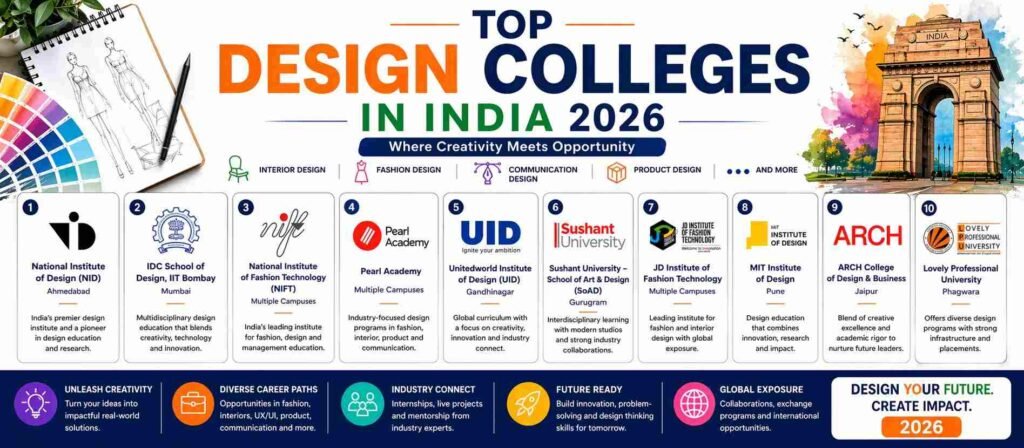
Top Design Colleges in India 2026
India’s best design institutions — both government and private — ranked by credibility, placements, and overall student experience:
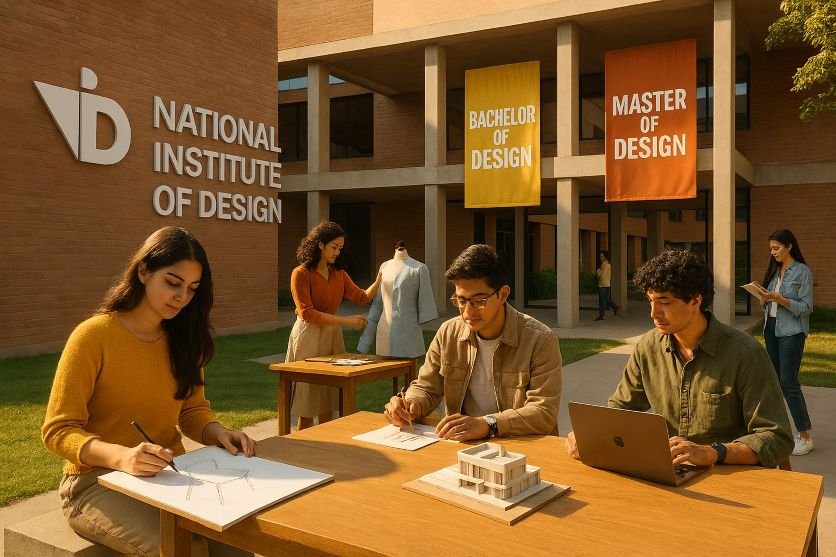
1. National Institute of Design (NID), Ahmedabad
Type: Government (Institution of National Importance) Location: Ahmedabad, Gujarat Ranking: #1 Design College in India — India Today 2024, CEO World 2024, IIRF 2025
NID Ahmedabad is the crown jewel of India’s design education system. The overall cost of NID Ahmedabad’s B.Des is approximately ₹13.18 lakh for the full programme. Declared an Institution of National Importance by an Act of Parliament, it’s the most prestigious non-fashion design school in the country — think of it as the IIT of design.
NID specializes in product design, communication design, textile design, furniture design, animation, and many more disciplines. Its graduates are recruited by some of the world’s biggest brands.
Courses Offered:
- B.Des (4 years) in 15+ specializations
- M.Des (2.5 years) in 19 disciplines
- PhD in Design
Placements: As per the NID Ahmedabad placement report 2024, the college offered ₹36 LPA and ₹3 LPA as the highest and lowest packages respectively, with a total of 476 offers made for full-time jobs. Top recruiters include Microsoft, Samsung, Infosys, and SAP.
Admission: Through NID DAT (Design Aptitude Test) — a two-stage entrance exam testing creative and analytical ability.
Best for: Students who want to pursue product design, communication design, furniture, or animation at India’s most prestigious multi-discipline design institute.
2. Indian Institutes of Technology (IIT) — Design Departments
Type: Government (Institutions of National Importance) Key Campuses: IIT Bombay (IDC), IIT Delhi, IIT Guwahati, IIT Kanpur
The IITs are synonymous with academic excellence in India, and their design departments are no different. According to IIRF Rankings 2025, IIT Bombay and IIT Delhi are among the top design colleges in India, alongside NID campuses. What makes IIT design programmes unique is the powerful combination of engineering rigour, technology thinking, and creative problem-solving.
IIT Guwahati is particularly notable for its strong placement record in design. At IIT Guwahati, the average package for design students stands at ₹21.94 LPA, with the highest packages reaching up to ₹52 LPA — with some international offers crossing ₹57.7 LPA.
Courses Offered:
- B.Des (via UCEED at IIT Bombay, IIT Delhi, IIT Hyderabad, IIITDM)
- M.Des (via CEED at most IIT campuses)
- PhD in Design
Admission: UCEED (for B.Des) and CEED (for M.Des) — among the most competitive design entrance exams in India.
Best for: Students who want to combine technology, engineering thinking, and design — especially for product design, interaction design, mobility design, or UX.
3. National Institute of Fashion Technology (NIFT) — All Campuses
Type: Government (Ministry of Textiles, GoI) Key Campuses: Delhi, Mumbai, Bengaluru, Chennai, Hyderabad, Gandhinagar, Kolkata — 19 campuses total Ranking: #1 Fashion Design Institute in India — India Today 2025, The Week 2025
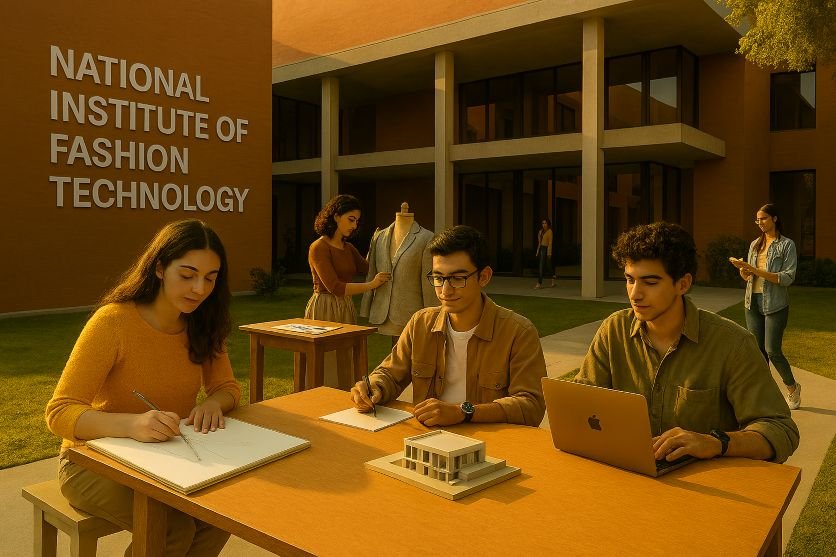
NIFT is India’s largest and most dominant fashion and design education network. In India Today rankings, eight of the top ten positions in the fashion design category are occupied by NIFT campuses, which tells you everything about its dominance. The flagship NIFT Delhi campus alone offers all seven bachelor’s and three master’s programmes.
NIFT graduates are placed at India’s and the world’s top fashion and retail brands. NIFT Delhi’s tuition fee amount is ₹12.34 lakh, with hostel fees of ₹4.19 lakh and a one-time fee of ₹27,200.
Courses Offered:
- B.Des in Fashion Design, Textile Design, Accessory Design, Knitwear Design, Leather Design, Fashion Communication
- B.F.Tech in Apparel Production
- M.Des, MFM (Master of Fashion Management), M.F.Tech
- PhD
Placements: NIFT Delhi reported a 99% B.Des placement rate in 2024, with a highest package of ₹22 LPA and an average of ₹7 LPA. Top recruiters include Myntra, Nike, Titan, FabIndia, H&M, Decathlon, and Aditya Birla Group.
Admission: NIFT Entrance Exam (Creative Ability Test + General Ability Test + Situation Test), conducted by NTA.
Best for: Class 12 students and graduates passionate about fashion, apparel, accessories, or fashion management wanting India’s top government fashion institution.
4. Pearl Academy — Delhi, Mumbai, Jaipur, Bengaluru
Type: Private Ranking: #1 Design & Fashion College in India — ASSOCHAM, India Today, Outlook, The Week
Pearl Academy is India’s leading private design institution with four campuses across the country. It’s particularly known for its strong industry connections, modern studios, and impressive placement record. Pearl Academy is well-known for producing a 98% placement rate among graduates, whose successful careers drive the creative industry.
Unlike government colleges, Pearl Academy conducts entrance exams six times a year, giving students more flexibility in their application timeline.
Courses Offered:
- B.Des in Fashion Design, Graphic Design, Interior Design, Product Design, Textile Design, Fashion Communication, Animation & VFX
- M.Des in various specializations
- Certificate programmes
Placements: Top recruiters include Amazon, Myntra, Walt Disney, Tommy Hilfiger, Vogue, Accenture, and IBM.
Admission: Pearl Academy Entrance Exam (General Proficiency Test + Design Aptitude Test) + Personal Interview + Portfolio.
Best for: Students seeking a top private design college with a wide range of specializations, flexible admissions, international collaborations, and excellent placement support.
5. Srishti Manipal Institute of Art, Design and Technology, Bengaluru
Type: Private (Deemed University) Location: Bengaluru, Karnataka
Srishti Manipal is one of India’s most progressive design and art institutions, known for its interdisciplinary approach. It encourages students to think beyond traditional design boundaries and experiment across disciplines like art, design, technology, and social innovation.
Courses Offered:
- B.Des in multiple specializations
- M.Des
- BA in Design Studies, Fine Arts, and Liberal Arts
Best for: Students who value experimental, interdisciplinary design education in a vibrant creative city.
6. MIT Institute of Design (MIT-ID), Pune
Type: Private Location: Pune, Maharashtra
MIT Institute of Design is one of the fastest-growing design colleges in India, consistently appearing in national rankings. It offers a wide range of undergraduate and postgraduate design programmes with a strong focus on industry projects, international collaboration, and entrepreneurship.
Courses Offered:
- B.Des in Industrial Design, Graphic Design, Interior Design, Fashion Design, Textile Design, Game Design
- M.Des
Best for: Students looking for a well-ranked private design college in western India with strong industry links and a modern curriculum.
7. CEPT University, Ahmedabad — Faculty of Design
Type: Private University Location: Ahmedabad, Gujarat
CEPT University is a specialized institution focused on the built environment — architecture, planning, technology, and design. Its Faculty of Design is particularly strong in interior design, furniture design, and urban design, making it unique among India’s design colleges.
Best for: Students interested in space-based design disciplines like interior design, exhibition design, and environmental design.
8. Amity School of Fashion Technology, Amity University
Type: Private University Key Locations: Noida, Mumbai, Jaipur, and other campuses
Amity University is one of India’s largest private universities, with design and fashion programmes across multiple campuses. It’s a solid choice for students who want a broad university experience with design specializations and access to Amity’s vast alumni and industry network.
Best for: Students who want a large, well-known private university with diverse programme options.
Government vs Private Design Colleges: What’s the Real Difference?
| Factor | Government Colleges (NID, NIFT, IIT) | Private Colleges (Pearl Academy, Srishti, MIT-ID) |
|---|---|---|
| Fees | ₹6–18 lakh (total) | ₹12–30 lakh (total) |
| Brand Value | Very High — globally recognized | Strong, especially Pearl Academy |
| Admission Process | Highly competitive entrance exams | Own entrance exam + interview |
| Infrastructure | Campus-focused, well-equipped | Often modern & international-standard |
| Industry Connect | Strong across fashion, tech, product sectors | Often very strong private sector links |
| Scholarships | Widely available (merit-cum-means, SC/ST/OBC) | Limited; mostly merit-based |
| Placement Rate | 70–99% depending on campus | 95–99% at top private colleges |
The honest verdict: If you can crack the entrance exam, government institutions like NID Ahmedabad, IIT design departments, and NIFT campuses deliver exceptional ROI. If you’re looking for flexible admissions, a wider range of specializations, or a more international-style creative environment, Pearl Academy and Srishti Manipal are the top private alternatives.
Fees at Top Design Colleges in India 2026
Here’s a clear comparison to help you and your family plan:
| College | Programme | Approximate Total Fees |
|---|---|---|
| NID Ahmedabad | B.Des (4 years) | ₹13–18 lakh |
| NID Ahmedabad | M.Des (2.5 years) | ₹6–8 lakh |
| NIFT Delhi | B.Des (4 years) | ₹12–14 lakh |
| NIFT Delhi | M.Des (2 years) | ₹6.85 lakh |
| IIT Bombay (IDC) | M.Des (2 years) | ₹70,000 – ₹11.56 lakh |
| Pearl Academy | B.Des (4 years) | ₹12–30 lakh (campus-wise) |
| Srishti Manipal | B.Des (4 years) | ₹10–15 lakh |
| MIT Institute of Design | B.Des (4 years) | ₹10–18 lakh |
| Amity University | B.Des (4 years) | ₹8–12 lakh |
Scholarship Tip: NID, NIFT, and IIT campuses all offer need-cum-merit scholarships, SC/ST/OBC fee concessions, and reserved category seats. Always visit official websites for the most updated scholarship details before applying.
Key Entrance Exams for Design Admissions
Unlike engineering or medical, design admissions are almost entirely entrance-exam based with a strong emphasis on creative ability. Here are the exams you need to know:
NID DAT (Design Aptitude Test) For admission to all National Institute of Design campuses (Ahmedabad, Bengaluru, and others). Two stages: Prelims (creative & analytical test) + Mains (studio test + interview). One of the most prestigious design entrance exams in India.
NIFT Entrance Exam (NIFTEE) For all 19 NIFT campuses across India. Components: Creative Ability Test (CAT) — 50% weight + General Ability Test (GAT) — 30% weight + Situation Test — 20% weight (for B.Des). Conducted by NTA (National Testing Agency).
UCEED (Undergraduate Common Entrance Examination for Design) For B.Des programmes at IIT Bombay, IIT Delhi, IIT Hyderabad, IIT Guwahati, and IIITDM Jabalpur. Tests design aptitude, visualization, and logical reasoning. Considered among the toughest.
CEED (Common Entrance Examination for Design) For M.Des programmes at IIT campuses. Two parts: Qualitative (sketching, design problems) + Quantitative (MCQs, visualization).
Pearl Academy Entrance Exam Conducted six times a year — one of the most flexible design entrance options in India. Components: General Proficiency Test (GPT) + Design Aptitude Test (DAT) + Personal Interview + Portfolio.
AIEED (All India Entrance Examination for Design) A national-level design entrance exam accepted by several private design colleges across India.
Quick Tip: Most design entrance exams test your creative thinking, observation, visualization, and drawing skills — not your Class 12 marks. Start building your sketch practice and observation skills at least 6–12 months before you plan to appear.
Eligibility Criteria
For Class 12 Students (Undergraduate Design Programmes):
- Passed or appearing in Class 12 from any recognized board
- All streams eligible — Arts, Commerce, and Science students can all apply
- Age limit: Maximum 24 years (as of August 1 of admission year) for NIFT; no upper age limit at most private colleges
- Minimum marks: 50–60% in Class 12 (varies by college; many exams are purely merit-on-entrance-exam based)
For Graduates (Postgraduate Design Programmes):
- Bachelor’s degree in any discipline from a recognized university
- Minimum 50–55% aggregate marks
- Relevant entrance exam (CEED for IITs, NID DAT for NID, NIFT Entrance for NIFT)
- No upper age limit at most PG design programmes
Important for all students: You do not need a background in fine arts or drawing to apply. However, developing your creative and sketching skills before the entrance exam will give you a significant advantage.
Career Scope and Salary After Design
One of the biggest fears students have is: “Will I get a good job after design?” The data says — absolutely yes. Here’s what you can expect:
Fashion & Retail Careers: Fashion Designer, Merchandiser, Textile Designer, Brand Manager — at brands like H&M, Zara, Myntra, Nykaa Fashion, and Indian fashion houses. Entry-level NIFT graduates earn ₹4–7 LPA, with experienced professionals reaching ₹20+ LPA.
Product & Industrial Design: Product Designer, Industrial Designer, Packaging Designer — at companies like Samsung, Godrej, Philips, Titan, and global consumer goods brands. NID graduates working in product and industrial design typically receive starting salaries of ₹17–18 LPA in fields like graphic design, textile design, furniture, and interior design.
UI/UX & Digital Design: UX Designer, Interaction Designer, Product Designer — at tech companies including Flipkart, Swiggy, Dunzo, Google, and hundreds of startups. This is the fastest-growing design career in 2025.
Graphic & Communication Design: Brand Designer, Art Director, Creative Director — at agencies like Ogilvy, BBDO, and Leo Burnett, or in-house creative teams at major corporations.
Animation & Media: Animator, Motion Designer, Game Designer, VFX Artist — at studios, OTT platforms, and gaming companies.
Entrepreneurship: Many top design graduates launch their own fashion labels, design studios, consultancies, or creative agencies. NID and NIFT produce a significant number of entrepreneur alumni every year.
Top Placement Facts:
- NID Ahmedabad 2024: Highest package ₹36 LPA; 476 total offers
- NIFT Delhi 2024: 99% placement rate; highest ₹22 LPA; average ₹7 LPA
- IIT Guwahati Design 2023–24: Average ₹21.94 LPA; highest ₹52 LPA
How to Choose the Right Design College in India
Step 1 — Know your specialization first. Fashion, product, UI/UX, interiors, graphics — each college excels at something different. NID is king for product and communication design. NIFT dominates fashion. IIT design departments shine in product-technology intersection. Don’t apply to a college blindly — match your passion to the college’s strength.
Step 2 — Shortlist by type: Government vs Private. If budget is a concern, prioritize government colleges. NID, NIFT, and IIT design programmes offer world-class education at a fraction of private college costs. If you need more admission flexibility or want modern private campus life, Pearl Academy and Srishti Manipal are the top private picks.
Step 3 — Research placement data realistically. Look beyond the “highest package” headline. Research the average package, placement percentage, and which companies regularly recruit from the campus. A 99% placement rate at ₹5 LPA average is more meaningful than a 40% rate with one outlier at ₹50 LPA.
Step 4 — Assess the entrance exam and start preparing early. NID DAT, UCEED, and CEED are highly competitive and require months of specific preparation. If you’re a Class 12 student, start practising sketching, observation exercises, and creative problem-solving at least 6–12 months before the exam.
Step 5 — Build your portfolio early. Almost all top design college admissions involve a portfolio or studio test. Start documenting your creative work — sketches, design projects, photographs, illustrations — from Day 1 of your preparation journey.
Step 6 — Visit campuses or attend open days. Design education is studio-based. Labs, workshops, printing facilities, and the creative atmosphere of the campus matter enormously. Try to visit at least two or three campuses before making your final decision.
Step 7 — Talk to students and alumni on LinkedIn. Current students and recent graduates will give you the most honest feedback about faculty quality, hostel life, internship support, and career outcomes. Search for NIFT/NID/Pearl Academy alumni on LinkedIn and reach out with specific questions.
Frequently Asked Questions (FAQs)
Q1. Which is the No. 1 design college in India?
According to India Today 2024 and CEO World 2024, NID Ahmedabad (National Institute of Design) is ranked the best overall design college in India. For fashion design specifically, NIFT Delhi holds the #1 position by India Today 2025, The Week 2025, and Outlook 2024. For product and industrial design at the intersection of technology, IIT Bombay’s IDC School of Design is a top choice.
Q2. Can Class 12 students from Science or Commerce pursue design?
Yes, absolutely. Design programmes in India — including NID, NIFT, and Pearl Academy — are open to students from all streams: Arts, Commerce, and Science. There is no stream restriction for most B.Des programmes. What matters is your performance in the design entrance exam and your creative aptitude.
Q3. What entrance exam do I need for design colleges in India?
The main entrance exams are: NID DAT (for NID campuses), NIFT Entrance Exam (for all NIFT campuses), UCEED (for IIT B.Des), CEED (for IIT M.Des), and Pearl Academy’s own entrance exam. Each tests creative ability, design aptitude, and general reasoning differently.
Q4. What is the average salary after a design degree from a top college in India?
It varies by specialization and college. NIFT Delhi graduates earn an average of ₹7 LPA at entry level (highest ₹22 LPA). NID graduates earn average starting packages of ₹17–18 LPA in several design fields, with highest packages reaching ₹36–50 LPA. IIT design graduates from top campuses have reported averages of ₹20+ LPA.
Q5. What is the difference between NID and NIFT?
NID (National Institute of Design) focuses on a broader range of design disciplines including product design, graphic design, communication design, furniture, animation, and more. NIFT (National Institute of Fashion Technology) focuses primarily on fashion design, textile design, accessories, fashion technology, and fashion management. If you want to design clothes — NIFT. If you want to design products, experiences, or visual communication — NID or IIT.
Q6. Is design a good career choice in India in 2025?
Absolutely yes. The rise of digital products, e-commerce, OTT content, sustainable fashion, and brand-driven businesses has made design one of the most in-demand skills in India. UI/UX design in particular is experiencing explosive growth, with freshers earning ₹8–15 LPA at top tech companies. It’s one of the few creative fields where both artistic talent and analytical thinking are rewarded equally.
Conclusion
India’s design education landscape is richer than most students realize. From the prestigious government institutions like NID Ahmedabad, NIFT Delhi, and IIT design departments to world-class private colleges like Pearl Academy and Srishti Manipal — there is a perfect design college for every kind of creative mind in India.
- Best for Product & Communication Design: NID Ahmedabad (Government, #1 overall)
- Best for Fashion Design: NIFT Delhi (Government, #1 in fashion)
- Best for Design + Technology: IIT Bombay IDC or IIT Delhi
- Best Private Design College: Pearl Academy (Delhi/Mumbai/Jaipur/Bengaluru)
- Best for Interdisciplinary & Experimental Design: Srishti Manipal, Bengaluru
Start your preparation early, build your creative portfolio, practise your drawing skills daily, and research colleges that align with your specific design passion. The creative industry is booming — and India’s best design colleges are your launchpad into it.