
SOS Full Form: Meaning, History, Uses, Importance, and Facts You Should Know
What is the SOS Full Form?
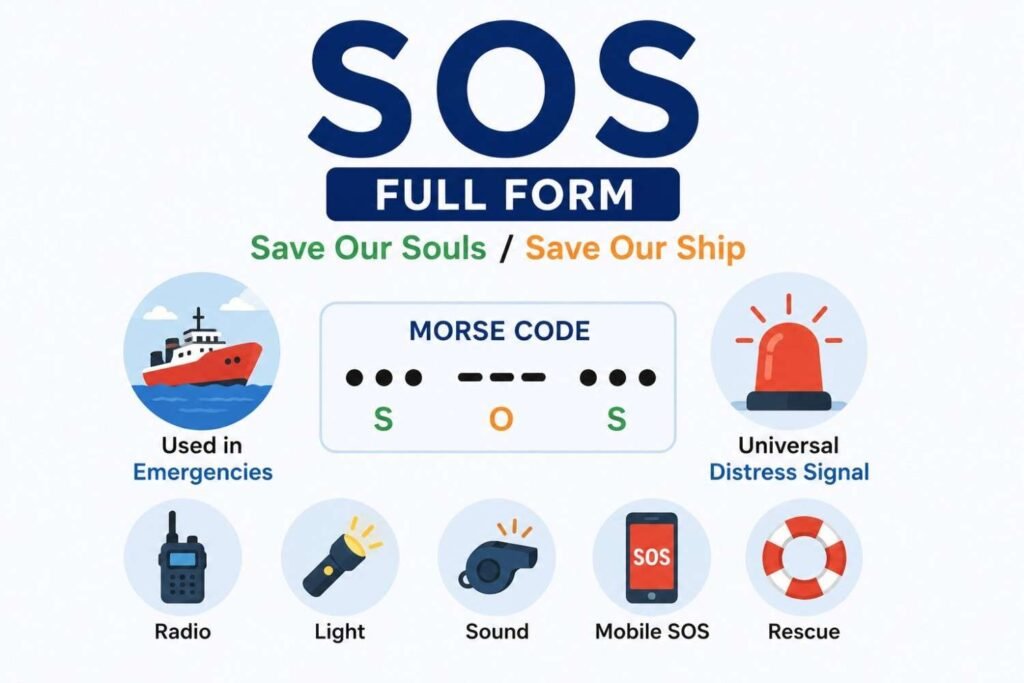
The SOS full form is commonly understood as Save Our Souls or Save Our Ship. It is an internationally recognized distress signal used to indicate emergencies and request immediate help.
Although many people believe that SOS officially stands for “Save Our Souls” or “Save Our Ship,” the truth is that SOS is not an abbreviation. It was chosen because the Morse code pattern for SOS is easy to recognize and transmit.
The signal is represented in Morse code as:
··· — ···
Three dots, three dashes, and three dots.
Understanding the SOS full form is important for students because it is a common topic in general knowledge, competitive exams, and science subjects.
Introduction to SOS
Communication is essential during emergencies. Before modern technologies like mobile phones and satellite communication, ships and radio operators relied on Morse code signals to request assistance.
The SOS signal became one of the most important emergency signals in the world. Even today, it symbolizes danger and the need for immediate rescue.
Whether at sea, in aviation, or in daily life, SOS remains a universally recognized call for help.
SOS Full Form and Meaning
People commonly use two meanings for SOS:
Save Our Souls
A request for help during life-threatening situations.
Save Our Ship
Used mainly in maritime emergencies.
However, historians and communication experts explain that SOS was selected because of its simplicity in Morse code and not because it officially stood for any phrase.
What is SOS?
SOS is an international distress signal used when a person, ship, aircraft, or group is facing danger and requires urgent assistance.
It can be transmitted through:
Morse code
Radio communication
Flashlights
Whistles
Flags
Emergency devices
The signal is recognized worldwide and is associated with emergency situations.
History of SOS
The SOS signal was officially adopted in 1906 during the International Radiotelegraphic Convention.
Before SOS, different countries used various distress signals, creating confusion.
To establish a universal standard, SOS was introduced because:
It is easy to send.
It is easy to recognize.
It reduces communication errors.
It can be transmitted quickly.
Since then, SOS has become the global distress signal.
SOS in Morse Code
The SOS signal is represented as:
··· — ···
This means:
Three short signals
Three long signals
Three short signals
In Morse code:
Dot (·) = Short signal
Dash (—) = Long signal
The pattern is simple and difficult to misunderstand, making it ideal for emergencies.
Why Was SOS Chosen?
SOS was selected because of several advantages.
Easy to Remember
Its pattern is simple and memorable.
Quick to Transmit
The sequence can be sent rapidly.
Universally Recognized
People worldwide understand its meaning.
Suitable for Different Communication Methods
It works with radio, lights, sounds, and signals.
Uses of SOS
SOS is used in various situations.
Maritime Emergencies
Ships use SOS when facing danger at sea.
Aviation Emergencies
Aircraft may use emergency distress signals.
Rescue Operations
Rescue teams identify distress calls quickly.
Personal Emergencies
People use SOS features on smartphones and smartwatches.
Disaster Situations
SOS helps alert authorities during natural disasters.
How to Send an SOS Signal
There are several ways to send an SOS signal.
Using Morse Code
Transmit:
··· — ···
Using Flashlights
Three short flashes
Three long flashes
Three short flashes
Using Sound Signals
Whistles or horns can follow the same pattern.
Using Hand Gestures
In remote areas, repeated signals may attract attention.
Using Mobile Phones
Modern smartphones include emergency SOS features.
Importance of SOS
SOS plays a vital role in saving lives.
Provides Quick Assistance
Emergency responders recognize the signal immediately.
Universal Understanding
The signal transcends language barriers.
Effective Communication
It helps communicate distress even when normal communication fails.
Life-Saving Tool
SOS has helped save countless lives around the world.
Difference Between SOS and Mayday
Students often confuse SOS with Mayday.
| Feature | SOS | Mayday |
|---|---|---|
| Type | Morse code signal | Voice distress signal |
| Communication Method | Radio, lights, sound | Spoken communication |
| Used In | Ships, emergencies | Aviation and maritime |
| Pattern | ··· — ··· | Spoken “Mayday” three times |
Both are distress signals but are used differently.
SOS in Smartphones
Modern smartphones have emergency SOS features.
These features can:
Call emergency services automatically.
Share location with contacts.
Send emergency messages.
Alert family members.
Popular smartphone brands provide built-in SOS functions for user safety.
SOS in Smartwatches
Many smartwatches support emergency features.
They can:
Detect falls.
Contact emergency services.
Share health information.
Notify emergency contacts.
These technologies improve safety and response times.
SOS in Maritime Communication
Ships rely heavily on distress signals.
When a vessel encounters:
Storms
Collisions
Mechanical failures
Fire incidents
SOS signals help nearby ships and rescue authorities provide assistance quickly.
Advantages of SOS
Simple Signal
Easy to learn and remember.
Worldwide Recognition
Accepted globally.
Multiple Transmission Methods
Can be sent using lights, sound, and radio.
Effective During Emergencies
Works even with limited resources.
Saves Lives
Enables faster rescue operations.
Interesting Facts About SOS
SOS Does Not Officially Stand for Anything
The phrases “Save Our Souls” and “Save Our Ship” were created later.
Adopted in 1906
SOS became the international distress signal after the Radiotelegraphic Convention.
Titanic Used Distress Signals
The famous RMS Titanic disaster involved distress communications.
Still Recognized Today
Despite advanced technologies, SOS remains a universal emergency symbol.
Role of SOS in Disaster Management
Emergency management agencies use SOS principles for:
Search and rescue operations
Maritime safety
Aviation safety
Natural disaster response
Mountain rescue missions
Rapid communication improves survival rates.
Importance of Learning SOS for Students
Students should understand SOS because:
It improves general knowledge.
Questions appear in competitive exams.
It promotes safety awareness.
It teaches emergency preparedness.
It develops communication knowledge.
Knowing how to use SOS may even help save lives.
Other Meanings of SOS
Apart from emergency communication, SOS may also refer to:
Signs of Stroke
School of Science
Service Order System
Save Our Seas
However, in general knowledge and communication, SOS mainly refers to the international distress signal.
SOS Full Form in Hindi
The SOS full form in Hindi is commonly understood as:
हमारी जान बचाओ or हमारे जहाज़ को बचाओ
However, technically, SOS is not an abbreviation but a distress signal represented in Morse code.
Frequently Asked Questions (FAQs)
1. What is the SOS full form?
The SOS full form is commonly known as Save Our Souls or Save Our Ship.
2. Does SOS officially stand for anything?
No. SOS is not an official abbreviation. It was chosen because of its simple Morse code pattern.
3. What is the Morse code for SOS?
The Morse code for SOS is:
··· — ···
4. When was SOS adopted?
SOS became the international distress signal in 1906.
5. Why is SOS important?
It helps communicate emergencies and enables quick rescue operations.
6. Can smartphones send SOS alerts?
Yes. Modern smartphones include emergency SOS features.
7. What is the difference between SOS and Mayday?
SOS is a Morse code distress signal, while Mayday is a spoken emergency call.
8. What is the SOS full form in Hindi?
It is commonly interpreted as हमारी जान बचाओ, although SOS itself is not an abbreviation.
Conclusion
The SOS full form is popularly understood as Save Our Souls or Save Our Ship, although technically it is not an abbreviation. It is an internationally recognized distress signal represented by the Morse code ··· — ···.
For over a century, SOS has played a crucial role in saving lives by enabling people to communicate emergencies quickly and effectively. From ships and aircraft to smartphones and smartwatches, the importance of SOS continues to grow in the modern world.
For students, learning about the SOS full form, its history, uses, and significance enhances general knowledge and promotes awareness about emergency communication and safety.