
Top 10 Design Entrance Exams in India 2026 – Complete Guide, Fees, Syllabus & Top Colleges
Quick Summary: Dreaming of a career in fashion design, product design, UI/UX, graphic design, or industrial design? You’re in the right place! This is your complete guide to the Top 10 Design Entrance Exams in India 2026 — covering every exam’s full form, eligibility, fees, exam pattern, duration, syllabus, and top colleges. Whether you want IIT, NID, or NIFT, we’ve got everything mapped out for you. Let’s dive in! 🎨
Table of contents
- Top 10 Design Entrance Exams in India 2026 – Complete Guide, Fees, Syllabus & Top Colleges
- 1. What Is a Design Entrance Exam? (And Why It Matters)
- 2. Design Courses You Can Pursue After Class 12
- 3. Design Exam Eligibility – The Common Rules
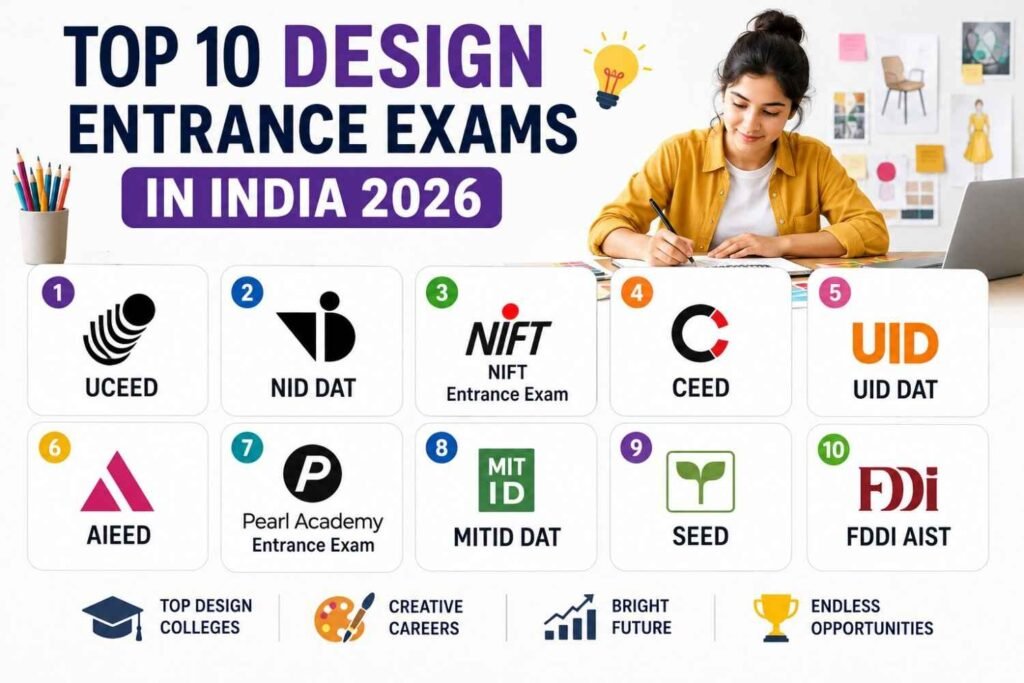
- 4. Top 10 Design Entrance Exams in India 2026 – Overview Table
- 5. Detailed Guide to Each Design Exam
- 6. Top Design Colleges in India 2026
- 7. Design Specialisations – What Can You Study?
- 8. Design Exam Salary & Career Scope
- 9. How to Prepare for Design Entrance Exams
- 10. Frequently Asked Questions (FAQs)
- Final Thoughts
1. What Is a Design Entrance Exam? (And Why It Matters)
Hey there, Class 12 student! 👋
If you’re someone who loves sketching, doodling, building things, reimagining spaces, creating patterns, or just seeing the world in a more visually rich way than most people — design could be your calling. And design entrance exams are the doorway into India’s best design institutes.
So what is a design entrance exam?
Design entrance exams are standardised tests used by top design institutes — like NID, NIFT, IITs, and BITS — to select students for undergraduate (B.Des) and postgraduate (M.Des) design programmes. Unlike engineering or medicine entrance exams that test pure academics, design exams test a unique combination of:
- Visual and spatial reasoning — how well you observe and interpret the world around you
- Creativity and imagination — can you generate original ideas and solutions?
- Drawing and sketching ability — can you communicate your ideas visually?
- Analytical and logical thinking — can you solve design problems systematically?
- General awareness and current affairs — especially for fashion and communication design exams
Design entrance exams are kept to test the candidates’ Spatial Ability, Analytical and Logical Reasoning, Observation and Design Sensitivity, Environmental and Social Awareness, Language and Creativity, along with problem identification skills.
These exams are uniquely exciting — you don’t just fill in OMR circles. You sketch, draw, create, and demonstrate your thinking through creative tasks. For the right student, they’re the most enjoyable entrance exam they’ll ever take!
Why design careers are booming in 2026: India’s design industry is growing exponentially — driven by the boom in UI/UX design, product design, sustainable packaging, fashion, gaming, animation, and interior design. Top design graduates from NID, NIFT, and IIT are placed at companies like Google, Apple, Tanishq, Unilever, Zara, Infosys, Myntra, and global design studios at ₹8–20 LPA and beyond.
2. Design Courses You Can Pursue After Class 12
Through design entrance exams, you can access these degree programmes:
| Programme | Full Form | Duration | Level |
|---|---|---|---|
| B.Des | Bachelor of Design | 4 Years | Undergraduate |
| BFTech | Bachelor of Fashion Technology | 4 Years | Undergraduate |
| M.Des | Master of Design | 2 Years | Postgraduate |
| MFM | Master of Fashion Management | 2 Years | Postgraduate |
| MFTech | Master of Fashion Technology | 2 Years | Postgraduate |
💡 Note: B.Des is the most sought-after undergraduate design degree in India. It is offered at IITs (via UCEED), NID, NIFT, and hundreds of private design colleges. Most design entrance exams after 12th lead to B.Des programmes.
3. Design Exam Eligibility – The Common Rules
Here are the general eligibility rules that apply across most design entrance exams:
- Education: Class 12 pass (or appearing) from any recognised board
- Stream: Any stream — Science, Commerce, AND Arts are all welcome! Unlike engineering, design doesn’t require PCM.
- Minimum Marks: Generally 50% aggregate in Class 12 (some exams have no minimum percentage)
- Age Limit: Typically no strict upper age limit; minimum age is usually 17–18 years
🎨 Great News for Arts Stream Students: Design is one of the few professional career fields in India that genuinely welcomes ALL streams. Commerce students who loved aesthetics, Science students with creative minds, and Arts students who’ve always sketched — all are equally eligible!
4. Top 10 Design Entrance Exams in India 2026 – Overview Table
Here’s a quick snapshot of all 10 major design entrance exams:
| Rank | Exam | Full Form | Conducted By | Level | For |
|---|---|---|---|---|---|
| 1 | NIFT | National Institute of Fashion Technology Entrance | NIFT (Ministry of Textiles) | National | B.Des, BFTech, M.Des, MFM, MFTech |
| 2 | NID DAT | National Institute of Design Aptitude Test | NID (Ministry of Commerce) | National | B.Des, M.Des |
| 3 | UCEED | Undergraduate Common Entrance Exam for Design | IIT Bombay | National (IIT) | B.Des at IITs |
| 4 | CEED | Common Entrance Exam for Design | IIT Bombay | National (IIT) | M.Des at IITs & IISc |
| 5 | MITID DAT | MIT Institute of Design Aptitude Test | MIT Institute of Design, Pune | University | B.Des, M.Des |
| 6 | FDDI AIST | Footwear Design & Development Institute All India Selection Test | FDDI (Ministry of Commerce) | National | B.Des (Footwear, Fashion, Leather) |
| 7 | Pearl Academy | Pearl Academy Entrance Exam | Pearl Academy | Institute | B.Des (Fashion, Interiors, Media) |
| 8 | SEED | Symbiosis Entrance Exam for Design | Symbiosis International University | University | B.Des (Symbiosis Institute of Design) |
| 9 | IICD | Indian Institute of Crafts & Design Entrance Test | IICD, Jaipur | Institute | B.Des, Craft courses |
| 10 | AIEED | All India Entrance Exam for Design | Arch Academy of Design | Institute | B.Des (various disciplines) |
5. Detailed Guide to Each Design Exam
🥇 #1 NIFT 2026 – National Institute of Fashion Technology
What is NIFT?
One of the most popular design entrance exams conducted in India, the NIFT entrance exam is usually conducted in January/February by the National Institute of Fashion Technology (NIFT).
| Detail | Information |
|---|---|
| Full Form | National Institute of Fashion Technology Entrance Exam |
| Conducted By | NIFT (under Ministry of Textiles, Government of India) |
| Level | National |
| Application Start | December 2026 (Registration open) |
| Exam Date | January/February 2027 |
| Mode | Computer-Based Test (CBT) for GAT; Pen-and-paper for CAT/Situation Test |
| Duration | Varies by paper (GAT: 2 hours; CAT: 3 hours; Situation Test: 3 hours) |
| Courses Offered | B.Des, Bachelor of Fashion Technology (BFTech), M.Des, MFM, MFTech |
| Total NIFT Campuses | 17 campuses across India |
Exam Pattern (UG – B.Des):
NIFT UG admissions involve three stages:
- GAT (General Ability Test): Quantitative Ability, Communication Ability, Analytical & Logical Ability, General Knowledge & Current Affairs, English Comprehension
- CAT (Creative Ability Test): Drawing and sketching to test creative and observational ability
- Situation Test (for B.Des): Hands-on material handling test where you create a 3D model
Eligibility: Class 12 from any stream; no minimum percentage specified by NIFT itself
Top NIFT Colleges:
- NIFT Delhi (most prestigious; highest placements)
- NIFT Mumbai
- NIFT Bangalore
- NIFT Kolkata
- NIFT Chennai
- NIFT Hyderabad
NIFT B.Des Fees: Approximately ₹3.8 – ₹5 Lakh per year (total 4-year programme ~₹15–20 Lakh)
Career Paths: Fashion Designer, Textile Designer, Knitwear Designer, Accessory Designer, Fashion Stylist, Fashion Buyer, Visual Merchandiser
🏆 Why NIFT? NIFT is India’s most prestigious fashion design institution. Admission to NIFT Delhi or Mumbai via a strong NIFT score is a golden ticket to the Indian fashion industry, with placements at Zara, H&M, Tanishq, Reliance Brands, Fabindia, and global fashion houses.
🥈 #2 NID DAT 2026 – National Institute of Design
What is NID DAT?
NID DAT, along with NIFT and UCEED, is among the most competitive national-level entrance exams in the country. The NID DAT exam is a national exam for Design administered by the National Institute of Design.
| Detail | Information |
|---|---|
| Full Form | NID Design Aptitude Test |
| Conducted By | National Institute of Design (Ministry of Commerce & Industry) |
| Level | National |
| Stages | DAT Prelims → DAT Mains (Studio Test & Interview) → Counselling |
| Exam Duration | Prelims: 3 hours; Mains: Full-day studio test + interview |
| Mode | Pen-and-paper (offline) |
| Courses | B.Des (4 years), M.Des (2 years) |
| Total NID Seats | ~425 B.Des seats; ~347 M.Des seats (very competitive!) |
Exam Pattern:
Admission happens through DAT Prelims → DAT Mains (Studio Test & Interview) → Counselling stages. NID DAT Prelims consist of both objective and subjective type questions.
Key change in 2026: The GAT section was removed and Prelims became a qualifier-only round for Mains. This means Prelims just qualifies you — Mains (Studio Test + Interview) is what determines your final merit.
Eligibility: Class 12 pass in any stream; no specific stream requirement
NID Campuses:
- NID Ahmedabad (the original and most prestigious)
- NID Bengaluru
- NID Gandhinagar
- NID Haryana
- NID Andhra Pradesh
- NID Madhya Pradesh
NID Fees: Approximately ₹2 – ₹4 Lakh per year for B.Des programme
Specialisations at NID: Industrial Design, Communication Design, Textile Design, Fashion Design, Animation Film Design, Film and Video Communication, Graphic Design, Photography
🏆 Why NID? NID Ahmedabad is consistently ranked India’s #1 design institution. NID graduates work at global companies like Google, Samsung, Philips, IDEO, Frog Design, and top Indian corporates. It is the IIT equivalent for design.
🥉 #3 UCEED 2026 – The IIT Design Entrance
What is UCEED?
Conducted by IIT Bombay, UCEED is the means through which aspirants can secure admission in the B.Des course offered at IITs.
| Detail | Information |
|---|---|
| Full Form | Undergraduate Common Entrance Exam for Design |
| Conducted By | IIT Bombay |
| Level | National (IIT system) |
| Exam Date | January 2026 |
| Duration | 3 Hours |
| Mode | Computer-Based Test (CBT) |
| Colleges Accepting | IIT Bombay, IIT Delhi, IIT Guwahati, IIT Hyderabad, IIITDM Jabalpur, IIITDM Kancheepuram |
| Courses | B.Des (4 years) |
Exam Pattern:
UCEED 2026 is of three hours duration and is usually conducted in January. The paper has two parts:
- Part A: Numerical Answer Type (NAT), Multiple Select Questions (MSQ), and Multiple Choice Questions (MCQ) — testing visualization, observation, creativity, problem-solving
- Part B: Drawing and sketching tasks (evaluated offline)
Eligibility:
- Class 12 pass from any stream
- Minimum 60% marks in Class 12 (55% for SC/ST/PwD)
- Age: Born on or after October 1, 2001 (for 2026 exam)
- Maximum 2 attempts allowed
IIT B.Des Fees: Similar to IIT B.Tech — heavily subsidised at ~₹2–4 Lakh for the full programme
🏆 Why UCEED? UCEED is your gateway to B.Des at IITs — the most prestigious engineering-design programmes in India. IIT Bombay’s Industrial Design Centre (IDC) is globally ranked. IIT Delhi’s Design Department places graduates at Google, Microsoft, McKinsey, and top UX/product design studios.
4️⃣ #4 CEED 2026 – IIT Postgraduate Design Exam
What is CEED?
A popular M.Des entrance exam, CEED is usually conducted by IIT Bombay in January every year.
| Detail | Information |
|---|---|
| Full Form | Common Entrance Exam for Design |
| Conducted By | IIT Bombay |
| Level | National (IIT system) — PG Level |
| Exam Date | January 2026 |
| Mode | Computer-Based (Part A) + Offline Drawing (Part B) |
| Colleges Accepting | IIT Bombay, IIT Delhi, IIT Guwahati, IIT Hyderabad, IISc Bangalore, IIT Kanpur |
| Courses | M.Des (2 years) |
Exam Pattern:
CEED exam comprises two parts, that is, Part A and Part B. CEED Part A exam comprises multiple-choice questions, whereas Part B of the exam consists of subjective, drawing-related questions.
Eligibility: Bachelor’s degree in any discipline (final year students also eligible); no specific branch requirement
Why CEED? CEED opens the doors to M.Des programmes at India’s top IITs and IISc — the gold standard of postgraduate design education in India. Note: IIT Bombay will not release any admission cut-offs for CEED 2026.
5️⃣ #5 MITID DAT 2026 – MIT Institute of Design Aptitude Test
What is MITID DAT?
MIT Institute of Design (MITID) in Pune — part of the prestigious MIT Art Design and Technology University — conducts its own Design Aptitude Test for admission to B.Des and M.Des programmes.
| Detail | Information |
|---|---|
| Full Form | MIT Institute of Design Aptitude Test |
| Conducted By | MIT Institute of Design (MIT-ADT University), Pune |
| Level | University |
| Mode | Online + Studio Test (creative round) |
| Courses | B.Des (Product Design, Visual Communication, Interior Design, Fashion Design, Game Design), M.Des |
| Eligibility | Class 12 from any stream |
Exam Pattern:
- Written Test: Logical reasoning, general knowledge, visual perception, design awareness
- Studio Test: Creative drawing, sketching, and concept presentation
- Personal Interview (PI)
Why MITID? MIT Institute of Design is one of India’s best private design schools, known for its industry linkages with the Pune automotive and manufacturing ecosystem, strong product design programme, and game design courses.
6️⃣ #6 FDDI AIST 2026 – Footwear Design & Development Institute
What is FDDI AIST?
FDDI AIST is a standardised test conducted by Footwear Design & Development Institute for admission to Undergraduate programs of FDDI AIST central universities (CUs). It is a national-level examination conducted for admission to central, state, private and other participating universities.
| Detail | Information |
|---|---|
| Full Form | Footwear Design & Development Institute All India Selection Test |
| Conducted By | Footwear Design & Development Institute (Ministry of Commerce & Industry) |
| Level | National |
| Application Start | January 1, 2026 |
| Last Date to Apply | April 20, 2026 (without late fee); April 30, 2026 (with late fee) |
| Exam Date | May 10, 2026 |
| Mode | Pen-and-paper (Offline) |
| Duration | 2.5–3 hours |
| Total Marks | 150/200 marks (depends on course) |
| Application Fee | ₹600 (General/OBC/EWS); ₹300 (SC/ST/PwD) |
| Exam Centres | 38 cities across India |
Programmes Offered: FDDI conducts the AIST Entrance Examination for admission in programmes like Footwear Design, Leather Goods & Accessory Design, Fashion Design and Retail & Fashion Merchandise.
Eligibility: All applicants who have passed their 10+2 level examination in any stream of a recognised board are eligible to apply.
FDDI Campuses: 12 campuses across India including New Delhi, Chennai, Mumbai, Hyderabad, Kolkata, Patna, Fursatganj (Amethi), and more
Why FDDI? FDDI is India’s premier government institution for footwear, leather, and fashion design. Its graduates work with brands like Bata, Woodland, Liberty, Khadim, Red Tape, and leading global footwear companies.
7️⃣ #7 Pearl Academy Entrance Exam 2026
What is Pearl Academy?
Pearl Academy is one of India’s leading private design schools, known for its practical, industry-aligned design education across Fashion, Media, Business, and Design disciplines.
| Detail | Information |
|---|---|
| Conducted By | Pearl Academy (campuses in Delhi, Jaipur, Mumbai, Bangalore, Noida) |
| Level | Institute |
| Mode | Online Written Test + Portfolio Review + Personal Interview |
| Courses | B.Des (Fashion Design, Communication Design, Interiors, Jewellery Design, Game Art), PG programmes |
| Eligibility | Class 12 from any stream with 50% marks |
Selection Process:
- Online Aptitude Test (design thinking, general awareness, English)
- Portfolio submission (creative work you’ve done)
- Personal Interview
Pearl Academy Fees: Approximately ₹4 – ₹6 Lakh per year for B.Des (total ~₹16–24 Lakh for 4 years)
Why Pearl Academy? Pearl Academy has strong industry connections with global fashion houses and design agencies. It has campuses in fashion capitals — Delhi and Mumbai — giving students excellent internship and networking access.
8️⃣ #8 SEED 2026 – Symbiosis Entrance Exam for Design
What is SEED?
SEED is the entrance exam for admission to B.Des programmes at the Symbiosis Institute of Design (SID), Pune — part of Symbiosis International University.
| Detail | Information |
|---|---|
| Full Form | Symbiosis Entrance Exam for Design |
| Conducted By | Symbiosis International University (SIU) |
| Level | University |
| Mode | Online Aptitude Test + Portfolio Review + Personal Interview (PRPI) |
| Courses | B.Des (Communication Design, Fashion Design, Industrial Design, Space Design) |
| Eligibility | Class 12 from any stream with 50% marks |
Selection Stages:
- SEED Written Test — general awareness, design aptitude, English, visual perception
- Portfolio Presentation and Personal Interview (PRPI)
- Final merit list based on SEED + PRPI scores
SID Fees: Approximately ₹3.5 – ₹5 Lakh per year (total ~₹14–20 Lakh for 4 years)
Why Symbiosis (SID)? Symbiosis Institute of Design in Pune is consistently ranked among India’s top 5 private design schools. Its curriculum blends design thinking with real-world industry projects. Being part of the Symbiosis family means excellent facilities, industry connections, and a strong alumni network.
9️⃣ #9 IICD Entrance Exam 2026 – Indian Institute of Crafts & Design
What is IICD?
The Indian Institute of Crafts & Design (IICD) in Jaipur is a unique, government-supported design institution that blends traditional Indian crafts with contemporary design education.
| Detail | Information |
|---|---|
| Full Form | Indian Institute of Crafts & Design Entrance Test |
| Conducted By | IICD, Jaipur (supported by Government of Rajasthan) |
| Level | Institute |
| Courses | B.Des (Craft-based — Furniture & Interior Design, Jewellery Design, Textile Design, Product Design) |
| Eligibility | Class 12 from any stream |
| Result | IICD Result 2026: June 2026 |
Exam Pattern:
- Written test — design aptitude, visualisation, creativity
- Practical/Drawing test
- Portfolio review and interview
Why IICD? IICD Jaipur offers a rare combination of craft heritage and modern design education, ideal for students passionate about Indian traditions and contemporary design. Its graduates are known for creating design work with deep cultural roots and commercial appeal.
🔟 #10 AIEED 2026 – All India Entrance Exam for Design
What is AIEED?
AIEED is the All India Entrance Exam for Design, conducted by Arch Academy of Design — a gateway for students seeking admission to design programmes focused on architecture-related design disciplines.
| Detail | Information |
|---|---|
| Full Form | All India Entrance Exam for Design |
| Conducted By | Arch Academy of Design |
| Level | Institute |
| Courses | B.Des (Interior Design, Product Design, Communication Design, Fashion Design) |
| Eligibility | Class 12 from any stream |
Exam Pattern:
- Design aptitude questions
- Sketching and drawing tasks
- Portfolio review
- Personal interview
Why AIEED? AIEED provides students an opportunity to enter design education with a strong emphasis on spatial design, interior design, and product design disciplines — valuable specialisations in India’s growing construction, hospitality, and consumer goods industries.
6. Top Design Colleges in India 2026
Some of the top design schools in the country include NIFT Delhi, NIFT Kolkata, NIFT Bangalore, IIT Bombay, IIT Delhi, etc. Admission to these institutes is done based on entrance exams like NIFT, NID DAT, UCEED, and CEED.
Tier 1 – Government / Premier Design Institutions
| College | Location | Entry Exam | Annual Fees | Known For |
|---|---|---|---|---|
| NID Ahmedabad | Ahmedabad | NID DAT | ~₹2–4 Lakh | India’s #1 design college; Industrial, Communication, Textile Design |
| NIFT Delhi | New Delhi | NIFT | ~₹3.8–5 Lakh | #1 Fashion design; top industry placements |
| IIT Bombay (IDC) | Mumbai | UCEED / CEED | ~₹1.5–3 Lakh | Industrial Design Centre; global rankings |
| IIT Delhi (Design Dept.) | New Delhi | UCEED / CEED | ~₹1.5–3 Lakh | Product, UX Design; Google, Microsoft placements |
| NID Bengaluru | Bangalore | NID DAT | ~₹2–4 Lakh | Animation, Film, Communication Design |
| NIFT Mumbai | Mumbai | NIFT | ~₹3.8–5 Lakh | Fashion capital city + top fashion college |
| FDDI New Delhi | New Delhi | FDDI AIST | ~₹1.5–2.5 Lakh | Footwear, Fashion, Leather Design |
| IICD Jaipur | Jaipur | IICD Entrance | ~₹1–2 Lakh | Craft + Design; heritage design education |
Tier 2 – Top Private Design Schools
| College | Location | Entry Exam | Annual Fees | Known For |
|---|---|---|---|---|
| Pearl Academy Delhi/Mumbai | Delhi, Mumbai | Pearl Academy Test | ~₹4–6 Lakh | Fashion, Communication Design; industry connections |
| Symbiosis Institute of Design | Pune | SEED | ~₹3.5–5 Lakh | Communication, Industrial, Fashion Design |
| MIT Institute of Design | Pune | MITID DAT | ~₹3–5 Lakh | Product, Game Design, Interior Design |
| Srishti Manipal Institute | Bangalore | SMEAT | ~₹3–5 Lakh | Interdisciplinary design; film, animation |
| IIM Ahmedabad CIIE (Design) | Ahmedabad | – | – | Design + business crossover |
| Whistling Woods (Film + Media Design) | Mumbai | Entrance test | ~₹5–8 Lakh | Media design, film, animation |
7. Design Specialisations – What Can You Study?
One of the most exciting aspects of design education is the sheer breadth of specialisations available:
| Specialisation | Career Roles | Top Institutes |
|---|---|---|
| Fashion Design | Fashion Designer, Stylist, Buyer, Merchandiser | NIFT, NID, Pearl Academy |
| Product / Industrial Design | Product Designer, UX Researcher, Industrial Designer | NID, IIT Bombay (IDC), IIT Delhi, MITID |
| Communication Design / Graphic Design | Graphic Designer, Brand Designer, Art Director | NID, NIFT, Srishti, Symbiosis |
| UI/UX Design | UX Designer, Interaction Designer, Product Manager | IIT Bombay, IIT Delhi, NID |
| Textile Design | Textile Designer, Print Designer, Surface Designer | NIFT, NID Ahmedabad |
| Interior / Space Design | Interior Designer, Space Planner, Set Designer | Symbiosis, Pearl Academy, MITID |
| Footwear & Accessory Design | Footwear Designer, Leather Goods Designer | FDDI, NID |
| Animation & Game Design | Animator, Game Designer, Motion Graphics Artist | NID Bengaluru, Srishti, MITID |
| Jewellery Design | Jewellery Designer, CAD Designer, Brand Consultant | NIFT, IICD, Pearl Academy |
| Photography / Film | Photographer, Film Director, Video Content Creator | NID, Srishti, Whistling Woods |
8. Design Exam Salary & Career Scope
Design is one of the fastest-growing career fields globally — and India’s design industry is expanding at an unprecedented pace. Here’s the salary picture:
Salary by Specialisation & College
| College + Specialisation | Average Starting Salary | Top Recruiters |
|---|---|---|
| NID Ahmedabad (Industrial/Product Design) | ₹8 – 20 LPA | Samsung, Philips, Google, IDEO |
| NIFT Delhi (Fashion Design) | ₹6 – 15 LPA | Zara, H&M, Tanishq, Fabindia |
| IIT Bombay IDC (UX/Product Design) | ₹10 – 25 LPA | Google, Microsoft, Amazon, McKinsey |
| IIT Delhi Design (UI/UX) | ₹8 – 22 LPA | Google, Microsoft, Accenture, Infosys |
| Symbiosis SID (Communication Design) | ₹5 – 10 LPA | Ogilvy, Wunderman Thompson, JWT |
| Pearl Academy (Fashion) | ₹4 – 8 LPA | Indian fashion houses, startups |
| FDDI (Footwear Design) | ₹4 – 8 LPA | Bata, Woodland, Liberty, Khadim |
Salary by Experience
| Level | Annual Salary |
|---|---|
| Fresher (0–1 year) | ₹3 – 8 LPA |
| Junior Designer (1–3 years) | ₹6 – 12 LPA |
| Mid-Level (3–6 years) | ₹10 – 20 LPA |
| Senior / Lead Designer (6+ years) | ₹18 – 40+ LPA |
| Design Director / Creative Director | ₹30 – 80+ LPA |
9. How to Prepare for Design Entrance Exams
Here are the most effective, proven preparation strategies for design entrance exams — based on what actually works:
1. Sketch Every Single Day
Practice sketching regularly to improve visual communication (required in NID, NIFT, UCEED drawing sections). Aim for 30 minutes of daily sketching — everyday objects, human figures, product designs, architectural elements. The improvement over 6 months is dramatic.
2. Solve Previous Year Papers
Solve previous year papers and sample questions to understand exam format. Most of these are available free online — start with NID, NIFT, and UCEED previous year papers.
3. Work on Memory Drawing & Observation
Work on observation exercises, such as memory drawing and object analysis. This specifically prepares you for the NID DAT Studio Test and NIFT’s Situation Test, where you’re expected to recall and recreate objects or scenarios from memory.
4. Build Your Portfolio
For exams like Pearl Academy, SEED, and MITID, a portfolio of your creative work (sketches, paintings, photos, 3D models, digital designs) can significantly boost your chances. Start building it 6 months in advance.
5. Stay Updated on Design Trends & Current Affairs
Stay updated with design trends, brands, and current affairs, as asked in NIFT GAT and similar sections. Follow designers on Instagram, read design blogs (Core77, Dezeen, Vogue India), and stay aware of what’s happening in fashion, tech design, and sustainability.
6. Understand Material Properties
For NID’s Studio Test and NIFT’s Situation Test, you’ll work with materials (paper, cardboard, clay) to create 3D models. Practice paper folding, origami, model-making, and understanding how different materials behave.
7. Build Vocabulary & Language Skills
NIFT’s GAT includes an English section. Strong reading, vocabulary, and comprehension skills help significantly.
8. Choose Your Exams Strategically
A smart multi-exam strategy for design aspirants in 2026: Apply for NIFT (January/February) + NID DAT (November registration → February exam) + UCEED (January) + 1–2 private university exams (MITID, Pearl Academy, SEED) for a strong safety net.
10. Frequently Asked Questions (FAQs)
Q1. What is a design entrance exam?
Design entrance exams are standardised tests used by India’s top design institutes to select students for B.Des and M.Des programmes. They test creativity, visual reasoning, observation, sketching ability, and design thinking — unlike regular entrance exams that only test academic knowledge.
Q2. Which is the best design entrance exam in India?
The top design entrance exams are NIFT, NID DAT, UCEED, and CEED. UCEED (for IIT design) and NID DAT are the most prestigious, while NIFT has the highest number of seats and college options. The best exam for you depends on which college and specialisation you’re targeting.
Q3. Can I appear for design exams after Class 12?
Yes! All major UG design entrance exams — NIFT, NID DAT, UCEED, FDDI AIST, Pearl Academy, SEED, MITID DAT — are open to Class 12 students (final year appearing or passed) from ANY stream (Science, Commerce, Arts).
Q4. Do I need to be from Arts stream for design exams?
No! No specific stream is required in Class 12 for B.Des admissions. You can join B.Des with any stream in Class 11th (Science, Commerce, or Arts/Humanities). Design welcomes everyone with creativity and passion.
Q5. What is the duration of a B.Des programme?
A Bachelor of Design (B.Des) programme is typically 4 years in duration, divided into 8 semesters. M.Des (Master of Design) is a 2-year postgraduate programme.
Q6. What are the design exam fees?
Design entrance exam application fees are minimal: NIFT registration fee is approximately ₹2,000–3,000; NID DAT is ₹3,000–5,000; FDDI AIST is just ₹600 (General); UCEED is ₹2,000–4,000. College fees vary — government colleges (IIT, NID, FDDI) charge ₹1.5–4 Lakh per year; private colleges charge ₹4–8 Lakh per year.
Q7. What is the most important skill for design entrance exams?
Sketching and visual communication ability is the most critical skill across almost all design entrance exams. One of the important tips by NID Design Aptitude Test toppers is to practice sketching objects and human figures daily.
Q8. Which design exam is easiest to crack?
FDDI AIST and Pearl Academy entrance exams are generally considered more accessible than NID DAT or UCEED. Most state-level and private university design exams are significantly less competitive than NID or IIT design exams.
Q9. When are design entrance exams conducted?
Most of the design entrance exams take place in the months of January and February. The notifications are usually issued between September and December. Notifications are usually issued between September and December — so students should register well before winter.
Q10. What career options are available after a design degree?
Design graduates can pursue careers as Fashion Designers, UX Designers, Product Designers, Communication Designers, Interior Designers, Graphic Designers, Art Directors, Brand Designers, Animators, Game Designers, Footwear Designers, and Design Educators. Top companies like Google, Samsung, H&M, Tanishq, Infosys, and hundreds of startups recruit design graduates.
Q11. What is the salary after NID or NIFT?
NID graduates in Industrial/Product Design can expect ₹8–20 LPA starting salaries at companies like Samsung, Philips, and Google. NIFT Delhi graduates in Fashion Design typically earn ₹6–15 LPA at leading fashion brands. IIT design (UCEED pathway) graduates in UX/Product Design earn ₹10–25 LPA at Google, Microsoft, and top tech companies.
Q12. Can I prepare for multiple design exams simultaneously?
Yes! The preparation for most design exams overlaps significantly — sketching, design awareness, visual reasoning, and current affairs are tested across NIFT, NID, UCEED, and most private exams. Preparing for all of them together is not only possible but recommended for the best results.
Final Thoughts
There you have it — the most complete guide to the Top 10 Design Entrance Exams in India 2026! 🎨🎉
Here’s your quick strategy recap:
- For fashion careers: Target NIFT (17 campuses) and Pearl Academy
- For industrial/product/UX design: Target NID DAT (NID Ahmedabad) and UCEED (IITs)
- For PG design (M.Des): Target CEED (IITs) and NID DAT (M.Des)
- For footwear/leather/fashion at government fees: Target FDDI AIST
- For design at private universities: SEED (Symbiosis), MITID DAT (MIT Institute), IICD (Jaipur)
- Smart multi-exam approach: Appear for NIFT + NID DAT + UCEED + 1–2 private university exams for maximum options
Most design exam notifications come out September–December. Mark your calendar now, start sketching daily, build your portfolio, and prepare with passion. The design world rewards those who genuinely love creating — and that love shows in the exam hall.
Go create something amazing! 🎨✏️


