MSW Full Form – What Is MSW Course, Details, Fees, Duration & Career Scope (2026–27)
Quick Summary: Wondering about MSW full form, what the course covers, how much it costs, and what kind of career it leads to? You’re in the right place! This complete guide to the MSW course covers everything — from the meaning of MSW and eligibility criteria to MSW course fees, specialisations, top colleges, and salary after graduation. Let’s get started! 🌍
Table of contents
- MSW Full Form – What Is MSW Course, Details, Fees, Duration & Career Scope (2025–26)
- 1. MSW Full Form – What Does MSW Stand For?
- 2. What Is MSW Course? (Explained Simply)
- 3. MSW Course Details – At a Glance
- 4. MSW Eligibility Criteria 2025–26
- 5. MSW Course Duration
- 6. MSW Course Fees in India
- 7. MSW Subjects & Specialisations
- 8. MSW Admission Process & Entrance Exams
- 9. Top Colleges Offering MSW Degree in India
- 10. Career Scope & Jobs After MSW
- 11. MSW Salary in India
- 12. MSW vs MBA – Which Is Better for You?
- 13. Frequently Asked Questions (FAQs)
- Final Thoughts
1. MSW Full Form – What Does MSW Stand For?
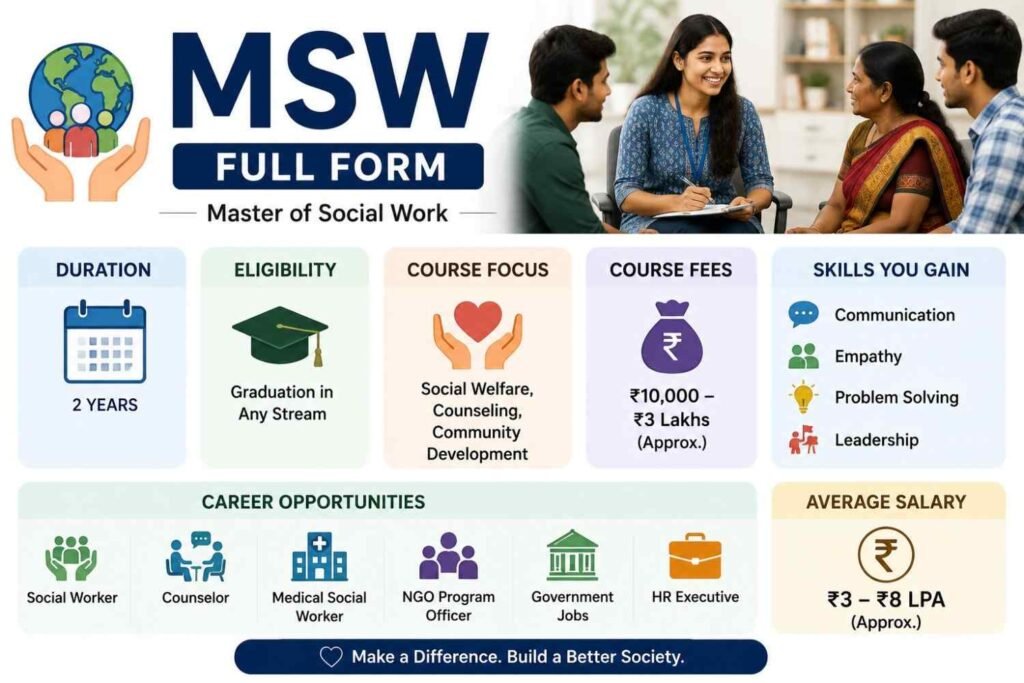
Let’s kick things off with the basics — MSW full form is Master of Social Work.
That’s the complete form of MSW! It is a two-year postgraduate degree programme offered by universities and colleges across India that trains students to become professional social workers who can create meaningful change in communities, organisations, and individuals’ lives.
If you’ve ever felt strongly about issues like poverty, gender inequality, child rights, mental health, or community development — the MSW degree could be the most fulfilling academic path you take.
2. What Is MSW Course? (Explained Simply)
So, what is MSW course exactly?
MSW is a social science course that teaches you how to use available assets to resolve societal issues and try to lessen people’s suffering through social interventions like counselling and funding. It is a PG degree course where you learn about social welfare, social justice, diversity, human behavior, social policy, social ethics, and other social practicalities and challenges.
In simple terms: while engineers build bridges and doctors heal patients, MSW graduates build stronger communities — working directly with vulnerable people, government bodies, NGOs, hospitals, schools, and international organisations to address society’s most pressing problems.
Why is MSW a powerful degree in 2025–26?
- India has over 800 colleges offering the MSW programme — a testament to its growing demand
- Social work professionals are needed across healthcare, education, mental health, child welfare, and corporate CSR departments
- Places like the USA, UK, Canada, and Australia keep bringing in social workers for stuff in healthcare, making policies, and community welfare jobs — giving MSW graduates global career opportunities
- It is one of the most purpose-driven careers you can choose — combining professional stability with the satisfaction of making a real difference
The MSW full form is Master of Social Work. Basically, it’s this two-year program after you graduate, aimed at students who want to dive into working with people, communities, organisations, to make some actual positive changes happen.
3. MSW Course Details – At a Glance
Here’s a quick overview of all the key MSW course details:
| Feature | Details |
|---|---|
| MSW Full Form | Master of Social Work |
| Degree Level | Postgraduate (PG) |
| Duration | 2 Years (4 Semesters) |
| Eligibility | Bachelor’s degree (any stream) with min. 50–60% marks |
| MSW Course Fees | ₹20,000 – ₹3 Lakh (varies by college) |
| Admission Mode | Merit-Based / Entrance Exam |
| Entrance Exams | CUET PG, IPU CET, University-specific exams |
| Popular Specialisations | Medical Social Work, Community Development, HR Management, Child Welfare |
| Average Salary | ₹2.3 LPA – ₹6 LPA |
| Top Recruiters | UNICEF, CRY, WHO, HelpAge India, TISS, National Health Mission |
| Career Roles | Social Worker, Counsellor, NGO Project Coordinator, Child Welfare Officer |
| Further Education | PhD in Social Work, MBA |
4. MSW Eligibility Criteria 2025–26
Before applying for the MSW degree, you need to meet the following eligibility requirements:
Academic Qualification
- A Bachelor’s degree from a recognised university with a minimum of 50–60 per cent marks
- The bachelor’s degree can be in any discipline — Arts, Science, Commerce, Social Work (BSW), Psychology, Sociology, etc.
- Students with a BSW (Bachelor of Social Work) background have an added advantage, but it is not mandatory
Additional Requirements
- Some universities may require applicants to have a background in social sciences or related disciplines
- Certain institutes conduct personal interviews or group discussions as part of the selection process
- Final-year graduation students can apply provisionally, subject to meeting eligibility after results
💡 Good News for 12th Students: While MSW is a postgraduate degree (you can’t join directly after 12th), this is a great time to plan ahead! After completing your graduation in any stream, you’ll be eligible to apply for an MSW programme.
5. MSW Course Duration
The duration of this program is 2 years which is divided into 4 semesters. This course provides knowledge about social work across India and throughout the world. The 4 semesters of this program provide practical knowledge about the different topics of social work like HIV/AIDS, women and child development.
Types of MSW Programmes
Regular (Full-Time) MSW: The standard 2-year, 4-semester programme conducted on campus. This is the most common and recommended format.
Distance / Online MSW: MSW full form in distance education means Master of Social Work. The course allows students to specialise in areas like Healthcare Social Work, Community Development, Family Welfare, and Child Welfare. Distance MSW is ideal for working professionals.
Integrated MSW: Some universities offer 5-year integrated programmes combining BSW + MSW, which students can join directly after 12th.
Fieldwork — The Heart of the MSW Programme
One of the most unique features of the MSW course is its compulsory fieldwork component. Unlike purely theoretical degrees, MSW students spend significant time in the field:
- Community fieldwork will be of 15 hours per week and block placement or internship will be for a duration of 30 days in the 4th semester.
- Students work directly with NGOs, hospitals, community centres, schools, government departments, and rehabilitation centres
- This practical experience is what makes MSW graduates immediately job-ready
6. MSW Course Fees in India
MSW Fees by College Type
The fees for MSW course in India vary by institution. Government Colleges charge ₹20,000 to ₹1,37,000 per year, while Private Universities charge ₹1,50,000 to ₹2,76,000 per year. Scholarships and financial aid are often available for eligible students.
| Type of College | Annual Fees | Total 2-Year Fees |
|---|---|---|
| Government Colleges | ₹20,000 – ₹1,37,000/year | ₹40,000 – ₹2.74 Lakh |
| Private Universities | ₹1,50,000 – ₹2,76,000/year | ₹3 Lakh – ₹5.5 Lakh |
| IGNOU (Distance Mode) | ₹18,000/year | ₹36,000 total |
| Other Distance/Online | ₹15,000 – ₹25,000/year | ₹30,000 – ₹50,000 |
Notable Fee Examples
- IGNOU MSW: The total fee for MSW program is INR 36,000 which has to be paid at INR 18,000 per year. One of the most affordable and trusted options in India.
- Mumbai University MSW: The total fees for MSW is ₹82,025, including total tuition fee of ₹60,000 and other fees of ₹22,025.
- Gujarat University MSW: The total fees for Gujarat University Ahmedabad MSW is ₹60,000 for the complete course duration.
💡 Best Value Tip: IGNOU’s MSW distance programme at just ₹36,000 total is one of the most affordable and widely recognised options. It’s perfect for students who need flexibility or can’t relocate for a regular programme.
7. MSW Subjects & Specialisations
Core MSW Subjects (Semester-wise Overview)
Semester 1:
- Social Work Principles and Perspectives
- Human Growth and Development
- Social Case Work
- Introduction to Indian Society
- Community Fieldwork (Practical)
Semester–2:
- Social Group Work
- Community Organisation
- Social Policy and Administration
- Social Research Methods
- Block Placement (Field Internship)
Semester-3:
- Social Work Administration and Management
- Social Legislation and Labour Welfare
- Study of the Indian Constitution
- Specialisation Subject I
- Concurrent Fieldwork
Semester 4:
- Social Development and Planning
- Specialisation Subject II
- Dissertation / Research Project
- Block Placement (30 days)
Popular MSW Specialisations
The MSW course is offered in specialisations like Clinical Social Work, Community Organisation, Human Resource Management, Social Work Administration and Management, etc.
| Specialisation | Best Suited For |
|---|---|
| Medical & Psychiatric Social Work | Hospitals, mental health clinics, rehabilitation centres |
| Community Development | NGOs, rural development, government schemes |
| Human Resource Management | Corporate sector, employee welfare, organisational development |
| Child Welfare & Development | Child care institutions, CPS, child NGOs |
| Women & Gender Studies | Women empowerment organisations, domestic violence support |
| School Social Work | Educational institutions, student counselling |
| Criminology & Correctional Administration | Prisons, juvenile justice, legal aid |
| Disaster Management | Emergency response, relief organisations |
8. MSW Admission Process & Entrance Exams
Here’s a step-by-step look at how MSW admissions work in India:
Admission Routes
Merit-Based: Most colleges admit students based on their graduation marks. More than 800 colleges are offering MSW courses in India. Among them, most colleges offer admission on a merit-based system.
Entrance Exam-Based: Some top universities require you to clear a national or university-specific entrance exam.
Key MSW Entrance Exams
| Exam | Conducting Body | Level |
|---|---|---|
| CUET PG | NTA (National Testing Agency) | National |
| IPU CET | GGSIPU, Delhi | University |
| TISSNET | TISS Mumbai | University |
| BHU PET | Banaras Hindu University | University |
| JMI Entrance | Jamia Millia Islamia | University |
| University-specific tests | Various colleges | College level |
Step-by-Step Admission Process
Step 1: Students should register for MSW entrance exams to target top colleges in India.
Step-2: MSW registration for the entrance can be done online or offline.
Step 3: Some universities require entrance exam scores, either a national-level entrance exam or university-specific exams. Students need to match the cut-off list and proceed to the further process.
Step-4: Colleges will shortlist students based on their scores achieved in their graduation and entrance exams.
Step 5: Many colleges conduct interviews and group discussions among the students.
Step 6: Colleges send confirmation emails to the selected students.
9. Top Colleges Offering MSW Degree in India
Top MSW colleges include Tata Institute of Social Sciences (TISS) in Mumbai, Delhi School of Social Work at the University of Delhi, Loyola College of Social Sciences in Thiruvananthapuram, and Jamia Millia Islamia’s Department of Social Work in New Delhi.
Here’s a broader list of top-ranked MSW colleges across India:
| College | Location | Type | Approx. Total Fees |
|---|---|---|---|
| TISS (Tata Institute of Social Sciences) | Mumbai | Deemed University | ₹1 – 2 Lakh |
| Delhi School of Social Work, DU | New Delhi | Government | ₹30,000 – ₹50,000 |
| Jamia Millia Islamia | New Delhi | Central University | ₹40,000 – ₹60,000 |
| Loyola College of Social Sciences | Thiruvananthapuram | Private | ₹60,000 – ₹1 Lakh |
| Christ University | Bangalore | Deemed University | ₹1.5 – 2.5 Lakh |
| Madras Christian College | Chennai | Private | ₹60,000 – ₹1 Lakh |
| IGNOU | Pan-India (Distance) | Central University | ₹36,000 total |
| Amity University | Multiple campuses | Private | ₹2 – 3 Lakh |
| Kristu Jayanti College | Bangalore | Private | ₹1 – 1.5 Lakh |
| St. Joseph’s University | Bangalore | Private | ₹1 – 2 Lakh |
🏆 Best Pick: TISS Mumbai is undeniably India’s #1 institution for social work education. Getting into TISS through TISSNET is competitive but worth every effort — its graduates are placed across top NGOs, government bodies, and international organisations worldwide.
10. Career Scope & Jobs After MSW
Here’s the most exciting part — what can you actually do with an MSW degree?
MSW graduates have a great number of career opportunities in various fields such as hospitals, mental health clinics, elected offices, prisons, military, corporations, and numerous public and private agencies. They can become Child Protection Social Workers, Field Investigators, Junior Research Fellows, Programme Managers, and Project Coordinators.
Jobs in the Government Sector
MSW graduates can pursue professions such as PMU State Coordinators, Senior Consultants, Field Executives, Associate Professors (MSW), and PGT Teachers in the government sector. Candidates can also seek job opportunities in Group A and Group B government services by qualifying for national-level entrance exams such as UPSC CSE, SSC CGL, SBI PO and SBI Clerk.
Jobs in the Private Sector / NGOs
There are so many job options in the private sector like Social Worker, Care Manager, School Counsellor, and Fundraiser.
Some of the top MSW recruiters are Dabur India Ltd., CVS Health, Mindful Health Solutions, Goonj NGO, CRY NGO, Accenture, Reliance Industries Ltd., Kotak Life Insurance, Tata Motors, and Just Dial.
Job Roles & Sectors
| Job Role | Sector |
|---|---|
| Social Worker | NGOs, Government, Hospitals |
| School / College Counsellor | Education |
| Medical Social Worker | Hospitals & Healthcare |
| Community Development Officer | Government / Rural Development |
| Mental Health Counsellor | Mental Health Clinics, Rehab Centres |
| Child Welfare Specialist | Child Care Institutions |
| HR Executive (with HR specialisation) | Corporate Sector |
| NGO Project Coordinator | Development Sector |
| Probation Officer | Legal / Criminal Justice |
| Associate / Assistant Professor | Academia |
| Programme Manager | International NGOs (UNICEF, WHO, CARE) |
🌟 Global Scope: Many Indian students go abroad after completing their MSW, often after grabbing some extra licenses or certifications to make it official. Countries like the US, UK, Canada, and Australia actively recruit trained social work professionals.
11. MSW Salary in India
Let’s talk about earnings after the MSW degree:
MSW average salary is Rs 2.3 LPA to 6 LPA.
The average Master of Social Work job salary in India is INR 4.3 LPA in the private sector.
Salary by Job Role
| Job Role | Average Annual Salary |
|---|---|
| Social Worker (Entry Level) | ₹2.2 – 3.5 LPA |
| Community Development Officer | ₹3 – 5 LPA |
| School Counsellor | ₹3 – 6 LPA |
| Medical Social Worker | ₹3.5 – 6 LPA |
| Mental Health Counsellor | ₹3 – 6 LPA |
| NGO Project Coordinator | ₹3 – 7 LPA |
| HR Executive (Corporate) | ₹4 – 8 LPA |
| Professor / Lecturer (MSW) | ₹5 – 10 LPA |
| Programme Manager (Int’l NGO) | ₹6 – 15 LPA |
💡 Salary Growth Tip: The average annual income of a Trained Graduate Teacher (TGT) is INR 5.7 LPA. They can also become Associate Professors, Assistant Professors, and Professors in universities and colleges — making academia one of the highest-paying pathways after MSW.
12. MSW vs MBA – Which Is Better for You?
Many students wonder whether to pursue an MSW degree or go for an MBA. Here’s a clear comparison:
| Feature | MSW | MBA |
|---|---|---|
| Full Form | Master of Social Work | Master of Business Administration |
| Focus | Social welfare, community development, human rights | Business management, finance, marketing |
| Best For | Those passionate about social change | Those focused on corporate career & business |
| Fees | ₹36,000 – ₹5.5 Lakh | ₹3 Lakh – ₹25 Lakh |
| Salary (Average) | ₹2.3 – 6 LPA | ₹5 – 35 LPA |
| Job Sectors | NGOs, hospitals, government, schools | Corporates, banks, consulting firms |
| Duration | 2 Years | 2 Years |
| Job Satisfaction | Very High (purpose-driven work) | High (financially rewarding) |
Verdict: Whether an MBA or MSW course is better depends on the interests or career objectives of a student. If you were to compare the two, MBA has more scope because it has a variety of fields and streams available. However, if you are interested in MSW, you will most likely be able to find a good job. Choose MSW if you’re passionate about social impact; choose MBA if your ambitions lean towards corporate success and higher financial returns.
13. Frequently Asked Questions (FAQs)
Q1. What is MSW full form? MSW full form is Master of Social Work.
It is a 2-year postgraduate degree that trains students to work as professional social workers across NGOs, government bodies, hospitals, schools, and corporate CSR departments.
Q2. What is MSW course?
The MSW course is a postgraduate programme focused on social welfare, human behaviour, social justice, community development, and practical fieldwork. It equips graduates to address social issues like poverty, child abuse, mental health, and gender inequality.
Q3. What are the MSW course fees in India?
Government Colleges charge ₹20,000 to ₹1,37,000 per year, while Private Universities charge ₹1,50,000 to ₹2,76,000 per year. IGNOU’s distance MSW is the most affordable at ₹36,000 total.
Q4. What is the duration of the MSW degree?
The MSW degree is a 2-year (4-semester) programme. Distance and online MSW programmes are also available with the same 2-year duration but more flexibility.
Q5. Can a 12th class student directly join MSW?
No — MSW is a postgraduate degree, so you need to complete your graduation first. However, some universities offer 5-year integrated BSW+MSW programmes that students can join after Class 12.
Q6. What is the eligibility for MSW course?
You need a Bachelor’s degree from any recognised university with a minimum of 50–60% marks. Students from any discipline (Arts, Science, Commerce) are eligible.
Q7. What is the salary after MSW?
Graduates find careers as social workers, counsellors, project officers, and more, earning an average annual salary of INR 3–5 lakh. Senior professionals, academics, and international NGO workers can earn ₹8–15 LPA.
Q8. Which is the best college for MSW in India?
The best colleges for MSW include TISS Mumbai, Delhi School of Social Work (Delhi University), Jamia Millia Islamia, Loyola College, Christ University Bangalore, and Madras Christian College.
Q9. What are the top recruiters for MSW graduates?
MSW top recruiters include UNICEF, CRY, HelpAge India, CARE India, WHO, TISS, and the National Health Mission, along with Goonj, Smile Foundation, Dabur, Reliance CSR, Accenture, and Tata Motors.
Q10. Can I do MSW through distance education?
Yes! IGNOU MSW full form is Master’s of Social Work. It is a post-graduate program with a duration of 2 years. The total course fee is INR 18,600. Many other universities also offer distance and online MSW programmes.
Final Thoughts
And that’s your complete guide to MSW full form, course details, fees, career scope, and everything in between! 🌟
Here’s your quick takeaway:
- MSW full form = Master of Social Work — a 2-year postgraduate degree
- Open to graduates from any stream with 50–60% marks
- MSW course fees range from just ₹36,000 (IGNOU) to ₹5.5 Lakh (top private colleges)
- Fieldwork and internships are compulsory — making MSW graduates truly job-ready
- Career roles include Social Worker, Counsellor, NGO Manager, Medical Social Worker, and more
- Average salary: ₹2.3 – 6 LPA for freshers; much higher for senior roles and academia
- TISS Mumbai is India’s gold standard for MSW education
If you’re someone who genuinely cares about people and wants a career that makes a real difference — the MSW degree is one of the most fulfilling paths you can choose. It combines professional growth with a deeper sense of purpose that very few other degrees can offer.
Best of luck with your future plans! 💚 You’ve got the heart for it — now go build the skills!