BBC Compacta Class 6 Solutions Module 1 – Complete Answers & Detailed Guide
Quick Answer: Looking for the answers of BBC Compacta Class 6 Module 1? You’ve come to the right place! This guide covers the complete BBC Compacta Class 6 solutions Module 1 — including the poem-based Classroom Assignment, Practice Assignment, grammar exercises, vocabulary tasks, and writing activities — explained in a simple, easy-to-understand way.
Table of contents
- BBC Compacta Class 6 Solutions Module 1 – Complete Answers & Detailed Guide
- 1. What is BBC Compacta Class 6?
- 2. What’s in BBC Compacta Class 6 Module 1?
- 3. Classroom Assignment 1 – Poem: “The Squirrels” (Complete Answers)
- 4. Practice Assignment 1 – Poem: “The Monsoon” (Complete Answers)
- 5. Grammar Section – Module 1 Answers
- 6. Vocabulary Section – Module 1 Answers
- 7. Writing Section – Module 1 Guide
- 8. Tips to Use BBC Compacta Class 6 Solutions Effectively
- 9. Frequently Asked Questions (FAQs)
- Final Thoughts
1. What is BBC Compacta Class 6?
Hey there, Class 6 student! 👋 If your school uses the BBC Compacta English book, you already know it’s packed with lots of interesting exercises. But sometimes, the questions can feel a bit tricky, right?
BBC Compacta is published by Brajindra Book Company (BBC) and is one of the most popular English language books used in CBSE and other board schools across India. The book is designed to build your English skills step by step — covering reading, writing, grammar, and vocabulary all in one place.
For Class 6, the book is divided into several modules, and each module contains:
- A Classroom Assignment (based on a poem or passage)
- A Practice Assignment (another poem or prose piece)
- Grammar exercises
- Vocabulary tasks
- Writing activities
In this article, we’re focusing entirely on BBC Compacta Class 6 Solutions Module 1 — giving you clear, detailed answers so you can understand every question properly.
2. What’s in BBC Compacta Class 6 Module 1?
Module 1 is the very first module in the BBC Compacta Class 6 book. Think of it as the “welcome” chapter — it introduces you to the kind of English skills you’ll be developing throughout the year.
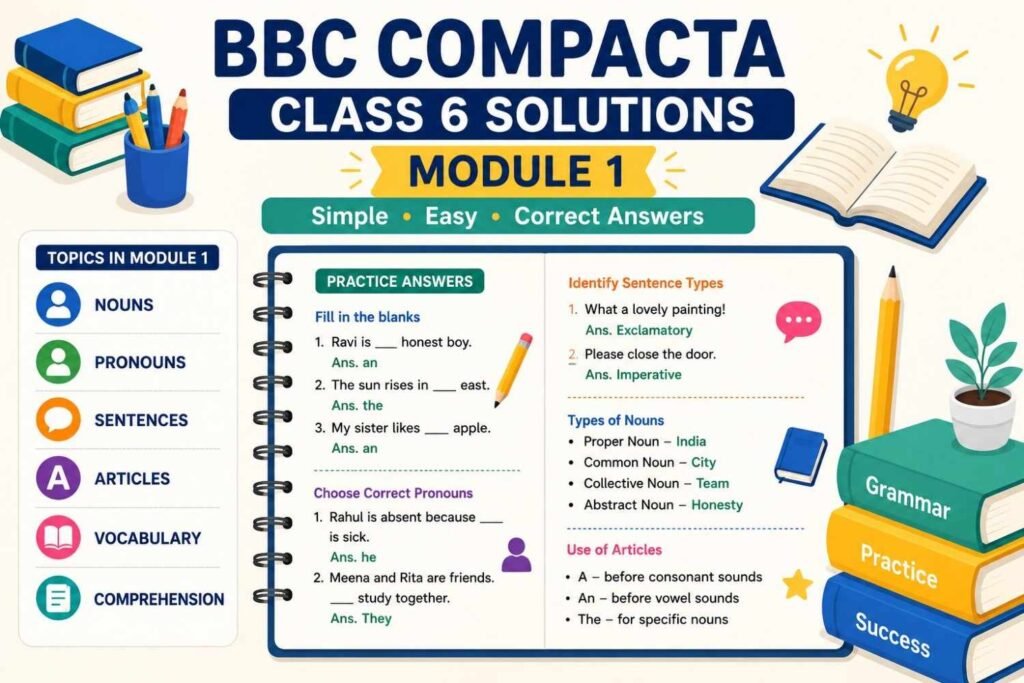
Here’s a quick overview of what Module 1 covers:
| Section | Content |
|---|---|
| Classroom Assignment 1 | Poem: “The Squirrels” – Reading Comprehension |
| Practice Assignment 1 | Poem: “The Monsoon” – Reading Comprehension |
| Grammar | Parts of Speech, Nouns, Pronouns, Sentence basics |
| Vocabulary | Word meanings, Synonyms, Antonyms, Context-based usage |
| Writing | Descriptive writing, Sentences, Short paragraphs |
Now let’s dive into the answers of BBC Compacta Class 6 Module 1, section by section!
3. Classroom Assignment 1 – Poem: “The Squirrels” (Complete Answers)
The Classroom Assignment in Module 1 is based on a lovely short poem about squirrels. Here’s the poem for your reference:
Some little red squirrels Live up in a tree, Out in the woodland gay, They frisk and frolic, And scamper about, On each bright autumn day.
But they are not idle; They’re working away, Busy as they can be, Filling a storehouse, For long winter days, Thrifty and wise, you see.
Now, let’s look at the questions and their answers:
Question 1: Tick (✓) the correct option(s) for each of the following statements.
(a) The poem is about the squirrel’s habit of:
Answer: (ii) storing food
The poem describes squirrels filling a storehouse to prepare for winter. Their main activity highlighted here is storing food.
(b) The word that best describes the “woodland” in the poem is:
Answer: (iv) happy
The poem uses the word “gay” to describe the woodland, which means happy or cheerful. So the woodland in the poem is described as a joyful, lively place.
(c) Which of the following BEST describes the behaviour of the squirrels in the poem? [Tick two correct options]
Answer: (i) fun-loving AND (v) playful
The squirrels “frisk and frolic” and “scamper about,” which shows they are fun-loving and playful, even while being hard at work.
(d) The poem suggests that squirrels are:
Answer: (ii) Options (1) and (3)
The squirrels are shown to be both wise (they plan ahead for winter) and thrifty (they save food instead of wasting it).
Question 2: Find and copy two words or phrases from the poem that describe the way the squirrels move.
Answer: (a) “frisk and frolic” (b) “scamper about”
These two phrases beautifully describe the energetic and playful movements of the squirrels as they run around the woodland.
Question 3: The squirrels carry out the activity of filling a storehouse in the _____________ season.
Answer: autumn
The poem says the squirrels are busy “on each bright autumn day.” They collect and store food during the autumn season to prepare for the cold winter months ahead.
Question 4: List two ways in which squirrels are thrifty and wise.
Answer:
(a) They fill a storehouse for long winter days, which shows their ability to plan ahead and prepare for the future. This is a sign of wisdom — thinking about tomorrow instead of just living for today.
(b) They are described as “busy as they can be,” which means they work hard and don’t waste time. Making the most of resources available during autumn to survive the winter reflects their thriftiness.
Question 5: Two life lessons that human beings can learn from the squirrels in the poem are:
Answer:
(a) Planning for the Future: Squirrels teach us to think ahead. Just like they save food for winter, we should save money, time, and resources for difficult times in the future. Being prepared always helps us face challenges more easily.
(b) Hard Work and Diligence: The squirrels don’t sit around — they’re “busy as they can be.” This teaches us that success comes to those who work consistently and don’t give up, even when there are distractions around.
Question 6: Would you like to save for the future just like the squirrels in the poem do? Give at least two reasons in support of your view.
Sample Answer (Yes):
Yes, I would like to save for the future, just like the squirrels in the poem.
Reason 1 – Financial Security: Saving money gives us a sense of security. Just as squirrels store food to make sure they have enough to eat in winter, I can save money to deal with unexpected expenses, emergencies, or future needs without worrying.
Reason 2 – Achieving Long-Term Goals: Saving helps me work towards big dreams — like buying something I really want, pursuing a hobby, or supporting my education later. By saving a little regularly, I can achieve things that seem impossible right now.
4. Practice Assignment 1 – Poem: “The Monsoon” (Complete Answers)
The Practice Assignment in Module 1 is based on a poem about the monsoon season. This poem paints a vivid picture of the rainy season and how it affects nature and people.
Question 1: Tick (✓) the correct option for each of the following statements.
(a) The sea in the poem is described as full of:
Answer: (ii) white foam
The monsoon winds churn the seawater and fill it with white foam.
(b) The fruit on the trees has been:
Answer: (ii) plucked and scattered by strong winds
The monsoon winds are so strong that they knock down fruit from the trees and scatter it all around.
(c) The poet compares the monsoon winds to:
Answer: (iii) thieves
The poem uses the comparison of thieves to describe the monsoon winds because they sneak in and take away (fell) fruits and disturb the calm of nature.
(d) The poet:
Answer: (iv) wonders how the monsoon rain affects trees, birds, and people
The poet is curious and thoughtful — wondering about where all these creatures go and how they cope when the monsoon arrives.
(e) In the poem, people run to find:
Answer: (ii) shelters
When the heavy rains cause thatched roofs to leak, people are forced to run away from their homes in search of safe, dry shelters.
Question 2: Fill in the blanks with the correct word from the poem.
Answer:
The poem describes the different sounds and movements of the (a) monsoon season and how it affects (b) fish, birds, trees, and (c) people. The poet wonders where these creatures go when (d) monsoon strikes. The monsoon winds (e) churn the seawater and make it full of (f) foam. They fell (g) fruit and scatter (h) it everywhere. The rains cause the (i) thatched roofs of huts to leak, forcing people to (j) run away from their homes in search of safe, dry places.
Question 3: Do you enjoy the rainy season? Give reasons for your answer with reference to the poem.
Sample Answer (No):
No, based on the description in the poem, I would not enjoy this kind of monsoon season.
(i) The poem describes the monsoon as thundering on the water and causing floods, which can be very dangerous and destructive. Such extreme weather makes life difficult and unsafe.
(ii) The poem also mentions trees falling in high winds during the rainy season. Fallen trees can block roads, damage property, and cause accidents — all of which make the rainy season very challenging rather than fun.
Sample Answer (Yes, alternate):
Yes, I do enjoy the rainy season!
(i) The rain brings coolness and freshness after the hot summer. Even though the poem shows the monsoon’s wild side, it also shows the energy and beauty of nature during this season.
(ii) The rains help farmers grow crops and fill rivers and lakes. Without the monsoon, there would be no water for plants, animals, or people — so I think the rainy season is actually very important and beautiful.
5. Grammar Section – Module 1 Answers
Module 1 introduces some basic grammar concepts that are the building blocks of the English language. Here’s a summary of what’s covered and how to approach the answers:
Parts of Speech
Module 1 typically introduces or revises nouns, pronouns, verbs, adjectives, and adverbs. Here’s a quick recap:
| Part of Speech | Definition | Example |
|---|---|---|
| Noun | Name of a person, place, thing, or idea | squirrel, tree, winter |
| Pronoun | Word used instead of a noun | they, it, we |
| Verb | Action or state of being | frisk, fill, live |
| Adjective | Describes a noun | red, thrifty, wise |
| Adverb | Describes a verb | quickly, away, about |
Common Grammar Exercise Types in Module 1
Exercise Type 1: Identify the noun/verb/adjective in a sentence
Example: “The little red squirrels live up in a tree.”
- Nouns: squirrels, tree
- Adjectives: little, red
- Verb: live
Exercise Type 2: Fill in the blanks with the correct form of the verb
Always look at the subject of the sentence. If the subject is singular (he/she/it), add “-s” or “-es” to the verb. If plural (they/we), use the base form.
Example: The squirrel _______ (store/stores) food for winter. Answer: stores (singular subject — one squirrel)
Exercise Type 3: Underline or identify adjectives
Adjectives answer questions like “What kind?”, “How many?”, or “Which one?”
Example: “They are thrifty and wise animals.” Adjectives: thrifty, wise
6. Vocabulary Section – Module 1 Answers
The vocabulary section in Module 1 builds on words from the poems and passages you’ve read. Here are the key vocabulary words from Module 1 with their meanings:
Words from “The Squirrels” Poem
| Word | Meaning |
|---|---|
| Frisk | To move about playfully and energetically |
| Frolic | To play happily; to have fun |
| Scamper | To run quickly with light steps |
| Woodland | A forest or area covered with trees |
| Gay | Happy and cheerful (old-fashioned usage) |
| Idle | Lazy; not working |
| Thrifty | Being careful with money or resources; not wasteful |
| Storehouse | A place where things are kept/stored for future use |
Words from “The Monsoon” Poem
| Word | Meaning |
|---|---|
| Monsoon | A season of heavy rainfall |
| Churn | To stir or mix something vigorously |
| Foam | White bubbles formed on the surface of water |
| Thatched | A type of roof made from dried grass or straw |
| Scatter | To spread or throw things in many directions |
Common Vocabulary Exercise Types
Synonyms (words with similar meaning):
- Thrifty → Careful, economical, frugal
- Idle → Lazy, inactive
- Gay (in this context) → Happy, cheerful, joyful
Antonyms (words with opposite meaning):
- Thrifty ↔ Wasteful
- Idle ↔ Busy, hardworking
- Wise ↔ Foolish
Fill in the blanks with the correct vocabulary word:
Example: The _______ animals played in the forest without a care. Answer: frolicsome / playful
7. Writing Section – Module 1 Guide
The writing tasks in Module 1 are designed to help you express your ideas clearly and correctly. Here’s how to approach the common writing tasks:
Writing Task 1: Describing an Animal
You may be asked to write 4–6 sentences describing an animal of your choice.
Model Answer (Describing a Squirrel):
A squirrel is a small, furry animal with a bushy tail. It has bright, sharp eyes and tiny, nimble feet that help it climb trees quickly. Squirrels are usually reddish-brown or grey in colour. They love to eat nuts, seeds, and fruits. What makes squirrels special is their habit of storing food for the winter — a sign of their wisdom and planning ability. Watching a squirrel scamper about in a park is always a delightful sight!
Writing Task 2: Writing About a Season
You may be asked to write a short paragraph about your favourite season.
Model Answer (The Monsoon/Rainy Season):
The rainy season is my favourite time of the year. After the scorching summer heat, the first drops of rain bring a wonderful sense of relief and joy. The air smells fresh, the plants turn a bright shade of green, and the birds chirp happily. I love jumping in puddles, hearing the patter of rain on the roof, and enjoying a warm cup of tea with my family. The monsoon fills rivers and lakes, helping farmers grow crops. Even though it can sometimes be stormy, the beauty of the rainy season always fills my heart with happiness.
Writing Task 3: A Few Sentences from Your Own Point of View
These questions usually end with “Give your own opinion with reasons.” Here’s how to structure your answer:
- Start with a clear statement: “Yes, I agree…” or “No, I don’t think so…”
- Give Reason 1 with an explanation.
- Give Reason 2 with an explanation.
- End with a brief concluding sentence.
8. Tips to Use BBC Compacta Class 6 Solutions Effectively
Now that you have all the answers of BBC Compacta Class 6 Module 1, here are some smart tips to make the best use of these solutions:
Read First, Then Check: Always try to read the poem or passage on your own and attempt the questions before looking at the answers. This builds your thinking skills!
Understand, Don’t Just Copy: Reading the explanation behind each answer is more important than just copying the answer. Understanding the “why” helps you in exams.
Learn the Vocabulary: Make a small notebook of new words you encounter in Module 1. Write the word, its meaning, and use it in a sentence of your own.
Practice Writing Daily: The writing section improves only with practice. Try writing 4–5 sentences every day about anything you observe around you.
Use Solutions to Cross-Check: After writing your own answers, compare them with the solutions given here. See what you got right and understand where you went wrong.
Don’t Skip the Grammar: Grammar exercises might seem boring, but they form the foundation of everything else. Make sure you understand each rule clearly.
9. Frequently Asked Questions (FAQs)
Q1. What is BBC Compacta Class 6 Module 1 about?
BBC Compacta Class 6 Module 1 is the first module of the BBC Compacta English textbook for Class 6. It includes a Classroom Assignment based on the poem “The Squirrels,” a Practice Assignment based on “The Monsoon,” along with grammar, vocabulary, and writing exercises.
Q2. Where can I find the answers of BBC Compacta Class 6 Module 1?
You’re already in the right place! This article provides complete and detailed answers of BBC Compacta Class 6 Module 1 for all sections — comprehension, grammar, vocabulary, and writing.
Q3. What poem is in BBC Compacta Class 6 Module 1 Classroom Assignment?
The Classroom Assignment 1 is based on the poem about little red squirrels who live in a woodland and work hard to store food for winter. The poem teaches lessons about hard work, planning, and thriftiness.
Q4. What is the answer to Q3 of Classroom Assignment 1 (the blank-filling question)?
The answer is “autumn.” The squirrels fill their storehouse during the autumn season, as mentioned in the poem (“on each bright autumn day”).
Q5. What life lessons does the squirrel poem in Module 1 teach?
The poem teaches two main life lessons: (1) Always plan for the future and save for difficult times, and (2) Be hardworking and diligent — don’t be idle when there’s work to be done.
Q6. Is BBC Compacta Class 6 based on the CBSE syllabus?
Yes, BBC Compacta Class 6 is aligned with the CBSE curriculum and is widely used in CBSE-affiliated schools across India. Its modules cover all the essential English skills required for Class 6.
Q7. What topics are covered in the grammar section of Module 1?
The grammar section of Module 1 typically covers basic parts of speech — nouns, pronouns, verbs, adjectives, and adverbs — along with simple sentence construction exercises.
Q8. How should I write the “opinion-based” answers in BBC Compacta?
Start with a clear “Yes” or “No” statement, then support your view with two specific reasons. Each reason should have a short explanation. End with a brief concluding line.
Final Thoughts
And there you have it — a complete guide to BBC Compacta Class 6 Solutions Module 1! 🎉
Whether you needed the answers to the squirrel poem, help with the monsoon comprehension, or guidance on grammar and vocabulary, we’ve covered it all right here. Remember, these solutions are here to help you understand the concepts better — not just to copy answers. The more you engage with the questions yourself, the more confident you’ll become in English.
Module 1 is just the beginning — and it’s a great one! The lessons from the squirrel poem about hard work and planning ahead are things that will stay with you long after the exam is over. 🐿️
All the best for your studies! You’ve got this! 💪