Top Food Technology Colleges in India 2026: How to Find the Best Institute for Your Future
Think about everything you ate today. That perfectly packaged yoghurt. The ready-to-eat meal you microwaved. The fortified breakfast cereal. The soft drink that stays carbonated even after you open it. Behind every single one of these products is a Food Technologist who figured out how to make it safe, delicious, shelf-stable, and nutritious.
If you’re fascinated by the science of food — how it’s processed, preserved, packaged, and made safe for millions of people — then a Food Technology degree might be the most rewarding career decision you ever make.
And in 2026, the timing couldn’t be better. India is the world’s 6th largest food processor. The food and beverage industry is growing at over 11% annually. Global demand for plant-based foods, functional nutrition, sustainable packaging, and food safety expertise is skyrocketing. The result? Trained Food Technology graduates are in higher demand than at any point in history.
But with hundreds of colleges claiming to offer this programme, how do you find the genuinely good ones? This guide covers everything — what Food Technology is, the Top Food Technology colleges in India, eligibility, fees, subjects, career scope, and how to choose smartly.
Table of contents
- Top Food Technology Colleges in India 2026: How to Find the Best Institute for Your Future
- Quick Snapshot: Food Technology in India 2026
- 1. What Is Food Technology? — The Science That Feeds the World
- 2. Eligibility for Food Technology Courses
- 3. Entrance Exams for Food Technology Colleges in India
- 4. How to Find and Choose the Best Food Technology College: 7 Key Factors
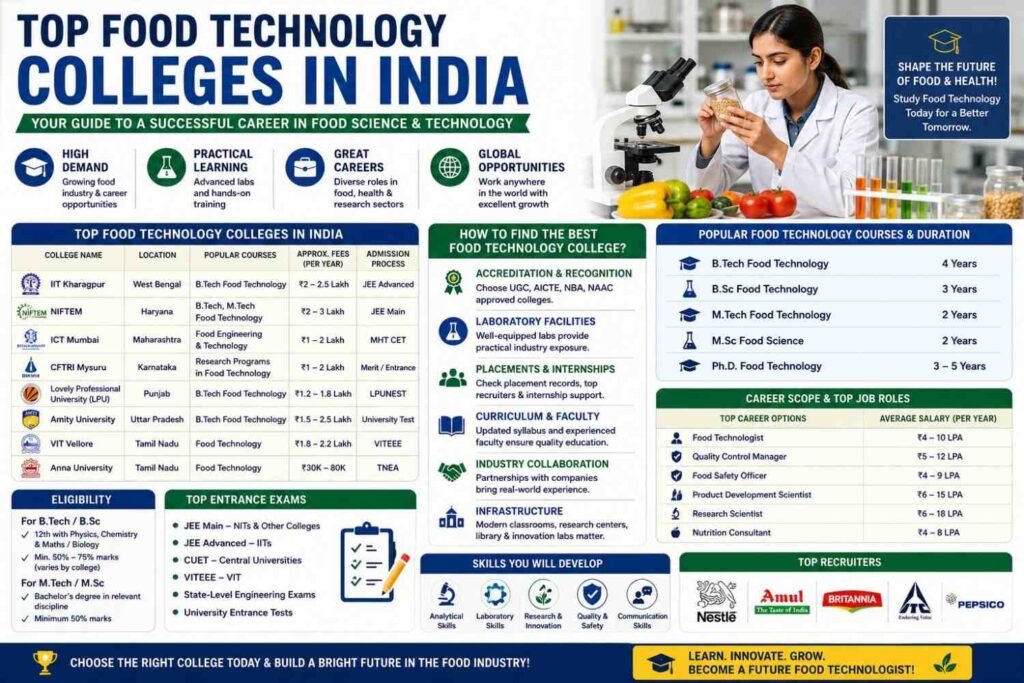
- 5. Top Food Technology Colleges in India 2026
- 6. Top Food Technology Colleges State-Wise
- 7. Food Technology Syllabus: What Will You Study?
- 8. Food Technology Fees: A Realistic Breakdown
- 9. Career Scope After Food Technology
- 10. Government Jobs After Food Technology: A Hidden Career Path
- 11. Higher Education After B.Tech/B.Sc Food Technology
- 12. Frequently Asked Questions
- Quick Decision Guide: Which Food Technology College Is Right for You?
- Final Verdict: Food Technology Is the Future You’re Looking For
Quick Snapshot: Food Technology in India 2026
| Feature | Details |
|---|---|
| Top UG Programme | B.Tech / B.Sc in Food Technology |
| UG Duration | 4 Years (B.Tech) / 3 Years (B.Sc) |
| Top PG Programme | M.Tech / M.Sc in Food Technology |
| PG Duration | 2 Years |
| Regulatory Body | AICTE (B.Tech), UGC (B.Sc), FSSAI (Industry) |
| Key Entrance Exams | JEE Main, CUET, ICAR AIEEA, State CETs, GATE (PG) |
| Eligibility | Class 12 with PCB or PCM (Physics, Chemistry + Maths/Biology) |
| Average Starting Salary | INR 3.5 – 7 LPA |
| Senior Salary | INR 12 – 30+ LPA |
| Top Employers | Nestlé, ITC, Britannia, Amul, Hindustan Unilever, PepsiCo, Cargill |
1. What Is Food Technology? — The Science That Feeds the World
Food Technology: Where Chemistry Meets Cuisine at Scale
Food Technology is the application of food science — chemistry, biology, physics, and engineering — to the production, preservation, packaging, and quality control of food. A food technologist doesn’t just understand what food is — they understand how to make it safe, nutritious, tasty, and available to millions of people.
Food technologists work on:
- Food Processing — Converting raw agricultural produce into safe, shelf-stable products
- Food Preservation — Extending shelf life using techniques like pasteurization, irradiation, freeze-drying, fermentation
- Food Packaging — Designing smart, sustainable packaging that protects food integrity
- Quality Control and Assurance — Ensuring every product batch meets safety and regulatory standards
- Product Development — Creating new food products (plant-based meat, functional foods, nutraceuticals)
- Food Safety and Regulation — Compliance with FSSAI, FDA, CODEX Alimentarius standards
- Sensory Science — Evaluating taste, texture, aroma, and appearance scientifically
- Nutrition and Fortification — Enhancing food with vitamins, minerals, and bioactive compounds
- Sustainable Food Systems — Reducing food waste, developing eco-friendly production methods
Who Should Study Food Technology?
You’re an ideal candidate for B.Tech/B.Sc in Food Technology if you:
- Love Chemistry and Biology at Class 12 level
- Are interested in the science behind the food industry
- Want a career that combines lab science with industry application
- Care about food safety, nutrition, and public health
- Are drawn to research, product development, or quality management
- Want a career with clear global demand — food is universal
Food Technology vs Food Science vs Nutrition
| Programme | Focus | Career |
|---|---|---|
| Food Technology | Processing, preservation, packaging, engineering | Food industry: processing, QC, R&D, safety |
| Food Science | Biological and chemical science of food | Research, academia, food analysis |
| Nutrition and Dietetics | Human nutrition, diet planning, therapeutic nutrition | Dietitian, nutritionist, clinical nutrition |
If you want an industry-facing technical career in food manufacturing, R&D, or quality → Food Technology If you want to work with individuals on health and nutrition → Nutrition and Dietetics
2. Eligibility for Food Technology Courses
B.Tech in Food Technology
- Class 12 with Physics and Chemistry (mandatory)
- Mathematics or Biology as the third subject (PCM or PCB both accepted at most institutions)
- Minimum 50–60% in Class 12 (60% for government colleges; 50% for most private)
- Some colleges prefer PCB since food technology involves significant biology components
B.Sc in Food Technology / Food Science
- Class 12 with PCB (Physics, Chemistry, Biology) preferred
- Minimum 50% in Class 12
- 3-year programme vs 4-year for B.Tech
M.Tech / M.Sc in Food Technology (PG)
- B.Tech/BE in Food Technology, Chemical Engineering, Biotechnology, or relevant engineering
- OR B.Sc in Food Science, Chemistry, Biochemistry, Microbiology (for M.Sc)
- Minimum 55% in graduation
- Admission via GATE (for IITs, NITs) or CUET-PG (for central universities)
3. Entrance Exams for Food Technology Colleges in India
| Exam | Body | For |
|---|---|---|
| JEE Main | NTA | B.Tech Food Technology at most engineering colleges |
| CUET (UG) | NTA | Central universities, many private colleges |
| ICAR AIEEA | ICAR / NTA | Agricultural universities offering Food Technology |
| State CETs | State Governments | State-level Food Technology colleges |
| MHT-CET | Maharashtra | Maharashtra Food Technology colleges |
| KEAM | CEE Kerala | Kerala Food Technology admissions |
| GATE | IITs / NTA | M.Tech at IITs, NITs, central institutes |
| CUET-PG | NTA | M.Sc at central universities |
| University Tests | Individual colleges | Amity, LPU, VIT, Manipal, SRM, etc. |
Key Advice: For government Food Technology colleges and agricultural universities, ICAR AIEEA (for agricultural universities) and state CETs are often more relevant than JEE Main. Research your target colleges specifically.
4. How to Find and Choose the Best Food Technology College: 7 Key Factors
Factor 1: AICTE/UGC Approval and NAAC Accreditation
Verify that the college and programme are AICTE-approved (for B.Tech) or UGC-recognized (for B.Sc). NAAC A or A+ accreditation ensures the institution meets quality benchmarks.
Factor-2: Laboratory Infrastructure
Food Technology is a lab-heavy discipline. Strong programmes need:
- Pilot plant facilities (small-scale industrial food processing equipment)
- Sensory evaluation labs
- Microbiology and food safety testing labs
- Instrumentation: HPLC, GC-MS, spectrophotometers for food analysis
- Packaging technology labs
- Cold chain and preservation testing units
Factor 3: Industry Tie-Ups and Internship Access
The best Food Technology colleges have partnerships with major food companies for internships and placements. Ask: Does Nestlé, ITC, Britannia, Amul, or PepsiCo recruit from this campus?
Factor-4: Faculty with Industry Experience
Look for faculty who have worked in food manufacturing, quality assurance, or food R&D — not just academics. Industry-experienced faculty bring real-world perspective to food processing and quality systems.
Factor 5: NIRF Ranking and Reputation
While NIRF doesn’t have a standalone “Food Technology” category, most Food Technology programmes fall under the Engineering or Agriculture NIRF categories. Use these rankings as quality benchmarks.
Factor 6: Placement Records in Core Food Industry Roles
Not all Food Technology students get placed in core food industry roles — some end up in non-core IT or operations roles. Ask specifically: What percentage of FT graduates are placed in food manufacturing, R&D, or quality roles?
Factor-7: Location Near Food Processing Clusters
Colleges located near India’s food processing hubs have natural internship and placement advantages:
- Maharashtra (Pune, Mumbai): Nestlé India, PepsiCo, Britannia, Cargill, McCain
- Gujarat (Anand, Ahmedabad): Amul (GCMMF), ITC Agri, NDDB, Patanjali
- Delhi NCR: Hindustan Unilever, ITC, Mondelēz, Dabur, Haldiram’s
- Karnataka (Bengaluru): Hindustan Unilever R&D, Cargill, Mother Dairy
- Punjab/Haryana: Nestlé Moga, PepsiCo, Britannia, Bikanervala
5. Top Food Technology Colleges in India 2026
Tier 1: Premier Government and Autonomous Institutions
1. NIFTEM (National Institute of Food Technology Entrepreneurship and Management)
NIFTEM is India’s dedicated national institute for food technology — think of it as the “IIT of Food Technology.”
- Location: Kundli, Haryana (near Delhi-NCR) and Thanjavur, Tamil Nadu (NIFTEM-T)
- Programmes: B.Tech Food Technology and Management, M.Tech, MBA (Food Business Management), PhD
- Fees: INR 1.50 – 2.50 Lakh/year
- Admission: JEE Main + counselling
- Placement: Nestlé, ITC, PepsiCo, Cargill, Marico, HUL — all recruit from NIFTEM
- Why Choose: India’s premier dedicated food technology institution; best industry connections; FSSAI-linked research
2. IIT Kharagpur — Department of Agricultural and Food Engineering
- One of India’s oldest food engineering departments; world-class research facilities
- Programmes: B.Tech + M.Tech + PhD in Agricultural and Food Engineering
- Fees: INR 2.31 Lakh/year
- Admission: JEE Advanced
- Research Focus: Post-harvest technology, food preservation, smart packaging
- Why Choose: IIT brand + food engineering research excellence; excellent for higher studies abroad (MS/PhD)
3. IIT Mumbai — Department of Chemical Engineering (Food Technology specialization)
- Food technology electives and M.Tech specialization available
- Fees: INR 2.24 Lakh/year | Admission: JEE Advanced
- World-class research in food process engineering and biotechnology
4. CFTRI (Central Food Technological Research Institute), Mysuru
- India’s premier food research institution; part of CSIR
- Offers M.Sc and PhD in Food Technology (not B.Tech)
- Admission: CSIR-NET / GATE + Interview
- Fees: Very subsidized | Why Choose: If research and a PhD in Food Science is your goal, CFTRI is the gold standard
5. Jadavpur University, Kolkata — Food Technology and Biochemical Engineering
- One of India’s most respected state universities; strong FT department
- Programmes: B.Tech Food Technology and Biochemical Engineering
- Fees: INR 25,000 – 50,000/year (government; exceptional value)
- Admission: WBJEE + JEE Main
- Strong industry connections in Kolkata’s food processing sector
6. HBTU Kanpur (Harcourt Butler Technical University)
- One of North India’s oldest and most respected government technical institutions
- Programme: B.Tech in Food Technology
- Fees: INR 60,000 – 1.00 Lakh/year
- Admission: JEE Main + State CET
- Good placements with UP and Delhi-NCR food companies
7. Dr. Y.S. Parmar University of Horticulture and Forestry, Himachal Pradesh
- Top agricultural university for food technology in North India (hilly states)
- Excellent for fruit and vegetable processing specialization
- Fees: INR 30,000 – 70,000/year | Admission: ICAR AIEEA / State CET
Tier 2: Top Private Food Technology Colleges in India
8. VIT University, Vellore — School of Bio Sciences and Technology
- NAAC A++ | B.Tech Food Technology with strong South India industry connections
- Fees: INR 2.00 – 2.80 Lakh/year | Admission: VITEEE
- Industry tie-ups with Nestlé, ITC, Marico; excellent lab facilities
- Why Choose: VIT brand + large campus + 800+ industry recruiters
9. SRM Institute of Science and Technology, Chennai
- NAAC A++ | B.Tech Food Technology
- Hospital and food industry connections in Chennai’s growing food processing cluster
- Fees: INR 2.20 – 3.00 Lakh/year | Admission: SRMJEEE
10. Amity University, Noida — Amity Institute of Food Technology
- NAAC A+ | QS World Ranked | B.Sc and B.Tech Food Technology + M.Sc Food Technology
- Fees: INR 2.00 – 3.50 Lakh/year | Admission: CUET / Amity Test
- 800+ recruiting companies; strong research labs; proximity to Delhi-NCR food industry
- Well-regarded programme for students targeting QA, R&D, and regulatory affairs
11. Manipal Academy of Higher Education (MAHE)
- NAAC A++ | B.Tech Food Technology
- Strong international collaborations; good placement record
- Fees: INR 2.50 – 3.20 Lakh/year | Admission: MET
12. Lovely Professional University (LPU), Phagwara
- NAAC A++ | B.Tech and M.Sc Food Technology
- North India’s largest private university; strong scholarship matrix; 700+ recruiters
- Fees: INR 1.50 – 2.50 Lakh/year | Admission: LPUNEST / JEE Main
13. GD Goenka University, Gurugram
- NAAC A+ | QS I-GAUGE Diamond Rated | NIRF Ranked
- B.Sc in Food Technology (affiliated with School of Healthcare and Allied Sciences)
- Fees: INR 1.20 – 2.00 Lakh/year
- Location advantage: Gurugram — proximity to major FMCG, food, and nutrition companies in Delhi-NCR
- 460+ recruiting companies; scholarship opportunities available
14. Chandigarh University
- NAAC A+ | B.Tech Food Technology
- Strong North India placement network; Nestlé Moga, PepsiCo, Britannia recruit from campus
- Fees: INR 1.50 – 2.50 Lakh/year | Admission: JEE Main / CUCET
15. GITAM University, Visakhapatnam / Hyderabad
- NAAC A+ | B.Tech Food Technology with South India food industry access
- Fees: INR 1.80 – 2.80 Lakh/year | Admission: GITAM GAT
6. Top Food Technology Colleges State-Wise
| State | Top Food Technology Colleges |
|---|---|
| Haryana/Delhi-NCR | NIFTEM Kundli, Amity Noida, GD Goenka Gurugram, Chandigarh University |
| West Bengal | Jadavpur University, BCKV (agricultural) |
| Maharashtra | ICT Mumbai, Pune University affiliated colleges, Symbiosis Pune |
| Tamil Nadu | NIFTEM Thanjavur, VIT Vellore, SRM Chennai, Anna University affiliated |
| Karnataka | University of Agricultural Sciences (UAS) Bengaluru, Mysore University |
| Gujarat | Anand Agricultural University (AAU), Gujarat Technological University |
| Uttar Pradesh | HBTU Kanpur, Sam Higginbottom University (Allahabad), Amity Noida |
| Punjab | LPU, PAU Ludhiana, Chandigarh University |
| Andhra Pradesh/Telangana | GITAM, Acharya N G Ranga Agricultural University, SRM Amaravati |
7. Food Technology Syllabus: What Will You Study?
A standard B.Tech Food Technology curriculum covers:
Year–1 — Science Foundation
- Engineering Mathematics
- Engineering Physics and Chemistry
- Introduction to Food Technology
- Biology for Engineers / Biochemistry
- Basic Food Microbiology
- Computer Fundamentals
Year 2 — Core Food Technology
- Food Chemistry (Carbohydrates, Proteins, Fats, Vitamins, Minerals)
- Food Microbiology and Safety
- Unit Operations in Food Processing (heat transfer, mass transfer, fluid flow)
- Cereal Processing Technology
- Dairy Technology
- Post-Harvest Technology
Year–3 — Advanced Processing and Specialization
- Fruit and Vegetable Processing
- Meat, Poultry, and Seafood Technology
- Beverage Technology (Juices, Carbonated Drinks, Fermented Beverages)
- Food Packaging Technology
- Bakery and Confectionery Technology
- Food Quality Management (HACCP, ISO 22000, FSSAI Regulations)
- Food Engineering (Dryers, Evaporators, Freezing Systems)
Year 4 — Industry Application and Projects
- Novel Food Processing (High Pressure Processing, Microwave, Ultrasound)
- Nutraceuticals and Functional Foods
- Food Laws and Regulations (FSSAI, FDA, CODEX)
- Product Development and Sensory Evaluation
- Industrial Training Report
- Major Project / Dissertation
8. Food Technology Fees: A Realistic Breakdown
Government / Central Institutions
| Institution Type | Annual Fee |
|---|---|
| NIFTEM | INR 1.50 – 2.50 Lakh |
| IITs | INR 2.00 – 2.40 Lakh |
| State Government Colleges | INR 20,000 – 80,000 |
| Agricultural Universities (ICAR) | INR 30,000 – 1.00 Lakh |
Private Colleges
| College Tier | Annual Fee |
|---|---|
| Top Private (VIT, Manipal, Amity) | INR 2.00 – 3.50 Lakh |
| Mid-Tier (LPU, GD Goenka, Chandigarh University) | INR 1.50 – 2.50 Lakh |
| Entry-Level Private | INR 60,000 – 1.50 Lakh |
Scholarships Available
- ICAR / NTA Scholarships for students qualifying ICAR AIEEA
- GATE-Based: MHRD scholarship of INR 12,400/month for M.Tech Food Technology students
- JEE-Based Merit Scholarships: Most private colleges offer 25–100% tuition fee waivers for high JEE percentile scores
- DST INSPIRE: For top 1% in Class 12 PCB/PCM; INR 80,000/year renewable scholarship
9. Career Scope After Food Technology
Job Roles After B.Tech/B.Sc/M.Sc Food Technology
| Job Role | Description | Avg. Salary (3–5 yrs) |
|---|---|---|
| Food Technologist | Product development, quality testing | INR 5 – 12 LPA |
| Quality Control/Assurance Manager | FSSAI, ISO, HACCP compliance | INR 6 – 15 LPA |
| R&D Scientist | Developing new food products | INR 7 – 18 LPA |
| Food Safety Auditor | Third-party safety certification audits | INR 6 – 14 LPA |
| Process Engineer | Optimizing food manufacturing processes | INR 6 – 14 LPA |
| Regulatory Affairs Specialist | FSSAI/FDA compliance, labeling | INR 6 – 15 LPA |
| Sensory Scientist | Evaluating taste, texture, aroma | INR 5 – 12 LPA |
| Supply Chain Manager | Procurement and distribution of food | INR 7 – 18 LPA |
| Nutritional Scientist | Food fortification, functional foods | INR 5 – 12 LPA |
| Food Entrepreneur | Building own food brand or product | Variable; high ceiling |
Top Employers for Food Technology Graduates
- FMCG Giants: Nestlé India, Hindustan Unilever, ITC Limited, PepsiCo, Coca-Cola India, Mondelēz, Britannia, Marico, Dabur
- Dairy and Cooperatives: Amul (GCMMF), Mother Dairy, Parag Milk Foods, Vadilal, Heritage Foods
- Global Food Companies (India Offices): Cargill, ADM, Olam International, Bunge, McCain Foods, Bel Group
- Startups and Emerging Brands: OYO Foods, Country Delight, Epigamia, WickedGud, Blue Tribe (plant-based), Nourish.You, The Whole Truth
- Government Jobs: FSSAI (Food Safety and Standards Authority of India), ICAR, CSIR labs (CFTRI, NDRI), Export Inspection Council, DRDO (food for armed forces)
- International Opportunities: Food technology is a globally transferable skill. Indian food technologists are hired in the USA, UK, UAE, Singapore, Australia, and the EU at premium packages for roles in food safety, R&D, and quality assurance.
10. Government Jobs After Food Technology: A Hidden Career Path
Many students don’t realize that food technology opens excellent government job pathways:
- Food Safety Officer (FSSAI) — Enforcing India’s food safety regulations
- Assistant Director of Food Safety — State and central government roles
- Technical Officer / Scientist at CFTRI, CSIR, ICAR — Research and development
- Quality Controller at NDDB / Amul / NAFED — Cooperative sector
- Food Analyst at State Food Laboratories — Testing and certification
- Defence Food Research Laboratory (DFRL), DRDO — Food R&D for armed forces
- Export Inspection Council Technical Officer — Ensuring exported food meets international standards
Exam to clear: UPSC/SSC for central government; State PSC for state food safety officer roles. M.Tech/M.Sc in Food Technology significantly improves your eligibility and scoring in these exams.
11. Higher Education After B.Tech/B.Sc Food Technology
M.Tech / M.Sc Food Technology — Top Colleges
| College | Programme | Annual Fee | Admission |
|---|---|---|---|
| NIFTEM Kundli / Thanjavur | M.Tech Food Technology | INR 1.50 – 2.50 Lakh | JEE Main / GATE |
| IIT Kharagpur | M.Tech Agricultural and Food Engineering | INR 30,000 – 60,000 | GATE |
| CFTRI Mysuru | M.Sc Food Technology | Very Low | GATE + Interview |
| HBTU Kanpur | M.Tech Food Technology | INR 60,000 – 1.00 Lakh | GATE |
| Jadavpur University | M.Tech Food Technology | INR 20,000 – 50,000 | GATE |
| Amity University | M.Sc Food Technology | INR 2.00 – 3.00 Lakh | CUET-PG |
| LPU | M.Sc Food Technology | INR 1.50 – 2.50 Lakh | GATE / University Test |
MS Abroad After Food Technology
Food Technology graduates are highly sought-after for MS programmes abroad:
- USA: Purdue University, Cornell University, UC Davis, Penn State — all have world-class food science programmes
- Germany: TU Munich, University of Hohenheim — free/low tuition; excellent food research
- Netherlands: Wageningen University — globally ranked #1 for Life Sciences and Food
- Canada: University of Guelph — Canada’s leading food science university
12. Frequently Asked Questions
Q: Which is the best Food Technology college in India?
A: NIFTEM (Kundli, Haryana) is India’s dedicated national institute for food technology — the best choice for a focused food technology career. IIT Kharagpur is the best for engineering+research integration. For private colleges, VIT Vellore, Amity Noida, and LPU are highly regarded.
Q: Is Food Technology a good career in 2026?
A: Yes, absolutely. India’s food processing sector is one of the government’s priority industries under Make in India. The FSSAI is increasingly enforcing food safety standards, creating demand for qualified food technologists. Global food companies also hire extensively from Indian food technology programmes.
Q: Can PCB students do B.Tech Food Technology?
A: Most Food Technology programmes accept both PCM and PCB students, since the field straddles biology and engineering. NIFTEM and most state government colleges accept PCB/PCM. Confirm with individual colleges, as some B.Tech programmes require Maths.
Q: What is the salary after Food Technology in India?
A: Entry-level food technologists earn INR 3.5 – 6 LPA. With 5 years of experience in FMCG or food R&D, salaries reach INR 10 – 18 LPA. Senior roles (R&D Director, QA Head) can reach INR 25 – 40 LPA.
Q: What entrance exam is needed for Food Technology?
A: JEE Main for engineering colleges, CUET for central universities, and ICAR AIEEA for agricultural universities. For M.Tech, GATE is the primary exam. Many private colleges also accept university-level tests.
Q: What is NIFTEM?
A: NIFTEM stands for National Institute of Food Technology Entrepreneurship and Management. It is India’s premier national institute for food technology education and research, established under the Ministry of Food Processing Industries. It has campuses in Kundli (Haryana) and Thanjavur (Tamil Nadu).
Quick Decision Guide: Which Food Technology College Is Right for You?
| If you… | Choose… |
|---|---|
| Want India’s best dedicated FT institute | NIFTEM Kundli or Thanjavur (via JEE Main) |
| Can crack JEE Advanced | IIT Kharagpur (Agricultural and Food Engineering) |
| Want top private with strong industry | VIT Vellore, Amity University Noida |
| Are in North India, want quality private | GD Goenka Gurugram, Chandigarh University, LPU |
| Want government job pathway + research | CFTRI Mysuru (M.Sc/PhD), ICAR agricultural universities |
| Are a graduate targeting M.Tech FT | NIFTEM M.Tech, IIT Kharagpur (via GATE), HBTU Kanpur |
| Want MS abroad after B.Tech | Focus on any NIRF top 40 college + strong CGPA + research project |
Final Verdict: Food Technology Is the Future You’re Looking For
India needs more Food Technology professionals — urgently. The country wastes over 16% of its food every year for lack of proper processing and preservation infrastructure. The government’s ₹10,000 crore Production Linked Incentive (PLI) scheme for food processing is creating thousands of new plants, labs, and quality management roles.
And globally, the food industry is being reinvented — plant-based proteins, precision fermentation, AI-driven quality control, sustainable packaging — all of this needs trained food technologists who understand both the science and the industry.
Whether you’re a Class 12 student choosing your first degree or a graduate looking to specialize in food science, a Food Technology course from the right college gives you a career that is:
- Recession-proof (food is essential, always)
- Globally transferable (every country needs food safety experts)
- Financially rewarding at senior levels
- Socially meaningful (you’re literally helping feed and protect people)
Find the right college, build your lab skills, chase that internship at a top food company, and watch the industry come to you.
The world is hungry for food technologists. Go feed it. 🌾