How to Choose the Top BAMS College in India (2026 Complete Guide)
So you’ve decided to pursue BAMS — Bachelor of Ayurvedic Medicine and Surgery. Great choice! Ayurveda is one of the world’s oldest healing systems, and a BAMS degree opens doors to a rewarding career in medicine, wellness, research, and even entrepreneurship. But with hundreds of ayurvedic medical colleges spread across India, how do you pick the right one?
Don’t worry — we’ve got you covered. This guide walks you through everything you need to know: from NEET scores and BAMS cut-offs to fees structures, top government and private colleges, and state-wise options. Whether you’re a Class 12 student just starting your research or a graduate looking to understand the landscape, this is the only guide you’ll need.
Table of contents
- How to Choose the Top BAMS College in India (2026 Complete Guide)
- 1. What is BAMS? A Quick Overview
- 2. Why Choosing the Right BAMS College Matters
- 3. Key Factors to Consider When Choosing a BAMS College
- 4. NEET Score for BAMS Government College: What You Need to Know
- 5. BAMS Cut Off for Government Colleges (State-wise)
- 6. Top Government BAMS Colleges in India (Best Ayurvedic Colleges)
- 7. Best Private BAMS Colleges in India
- 8. BAMS Government College Fees vs BAMS Private College Fees
- 9. Semi-Government BAMS College Fees
- 10. Low Fees BAMS Colleges in India
- 11. Best BAMS Colleges by State
- 12. BAMS Colleges in Bihar
- 13. BAMS Government College in UP (Uttar Pradesh)
- 14. BAMS Colleges in Andhra Pradesh (AP)
- 15. BAMS Colleges in Tamil Nadu
- 16. How to Apply for BAMS: Step-by-Step Process
- 17. Frequently Asked Questions (FAQs)
- Final Thoughts: How to Make Your Decision
1. What is BAMS? A Quick Overview
BAMS stands for Bachelor of Ayurvedic Medicine and Surgery. It is a 5.5-year undergraduate medical degree (including a 1-year mandatory internship) that trains students in the ancient Indian system of Ayurvedic medicine, along with modern medical sciences.
After completing BAMS, graduates can:
- Practice as an Ayurvedic doctor (with state registration)
- Work in government hospitals and health centers
- Pursue MD (Ayurveda) for specialization
- Start their own clinic or wellness center
- Work in the pharmaceutical, cosmetics, and nutraceutical industries
- Pursue research and academics
The course is regulated by the National Commission for Indian System of Medicine (NCISM), which was formerly known as the Central Council of Indian Medicine (CCIM).
2. Why Choosing the Right BAMS College Matters
Here’s a truth that many students overlook: the college you study in can significantly shape your career. A good ayurvedic medical college will offer:
- Quality clinical training with real patient exposure
- Experienced faculty with research credentials
- Well-equipped hospital and herbal gardens
- Strong placement and alumni networks
- Affordable or subsidized fees
A poor choice, on the other hand, can mean inadequate clinical exposure, unapproved degrees, and wasted years. So, let’s make sure you choose wisely!
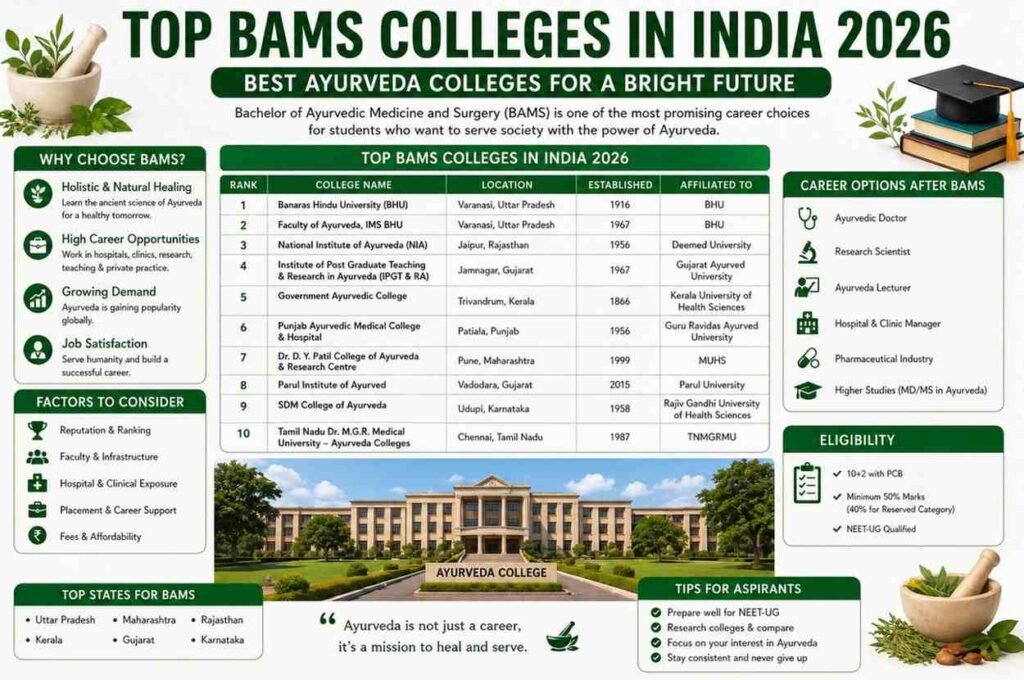
3. Key Factors to Consider When Choosing a BAMS College
Before you start shortlisting colleges, ask yourself these questions:
✅ Is the College Recognized by NCISM?
This is non-negotiable. The college must be recognized by the National Commission for Indian System of Medicine (NCISM) and affiliated to a recognized university. Unrecognized colleges can leave you with a degree that’s not valid for practice.
✅ What is the Hospital Strength?
BAMS is a clinical course. You need real patient exposure. Check whether the college has an attached hospital with at least 60 beds (as mandated by NCISM) — ideally more.
✅ What are the Infrastructure and Teaching Facilities Like?
Look for a well-stocked library, herbal garden (a must for Ayurveda), laboratories, and modern classrooms.
✅ What is the Faculty-to-Student Ratio?
Smaller batch sizes and more faculty mean better learning. Check if the professors are experienced practitioners and researchers.
✅ What are the Fees and Scholarship Options?
Compare BAMS fees in government vs private colleges. Government college fees are significantly lower. Also check if the college offers scholarships, installment options, or hostel facilities.
✅ What is the College’s Track Record?
Look for pass percentages in BAMS final exams, MD Ayurveda selections, and the success of alumni in practice and research.
✅ What is the Location?
Proximity to your home state can reduce living costs. Also, different states have different NEET counselling quotas, so understanding state-wise admission policies matters.
4. NEET Score for BAMS Government College: What You Need to Know
Admission to all BAMS colleges in India — government or private — is done through the NEET UG (National Eligibility cum Entrance Test) score. There is no separate entrance exam for BAMS.
Here’s how it works:
- 15% All India Quota (AIQ): Counselled by the Ayush Admissions Central Counselling Committee (AACCC) at the national level.
- 85% State Quota: Managed by respective state counselling authorities.
NEET Score for BAMS Government College (General Expectation)
| Category | Expected NEET Score Range |
|---|---|
| General (Open) | 450–550+ |
| OBC | 400–460 |
| SC/ST | 300–380 |
| EWS | 420–470 |
Note: These are approximate ranges and vary significantly by state, year, and the number of seats available. Always check the official counselling authority’s data for the most accurate cut-offs.
For government colleges in competitive states like Maharashtra, UP, or Tamil Nadu, the NEET score requirement can be higher. Smaller states or newer colleges may have lower cut-offs.
5. BAMS Cut Off for Government Colleges (State-wise)
The BAMS cut-off is the minimum NEET percentile/rank required to secure admission in a government college under either AIQ or state quota. Cut-offs change every year based on difficulty level, the number of applicants, and available seats.
Here are approximate BAMS cut-off ranges for government colleges in some key states:
| State | General Category (Approx. NEET Score) | Remarks |
|---|---|---|
| Uttar Pradesh | 420–500 | High competition; many government seats |
| Maharashtra | 450–550 | Very competitive; fewer government colleges |
| Rajasthan | 400–480 | Moderate competition |
| Bihar | 380–460 | State-level counselling |
| Kerala | 480–560 | Highly competitive |
| Madhya Pradesh | 390–470 | Moderate |
| Gujarat | 420–510 | Moderate to high |
| Andhra Pradesh | 430–510 | Moderate competition |
| Tamil Nadu | 450–530 | High competition; few government seats |
| Karnataka | 440–530 | Moderate to high |
Pro Tip: The BAMS cut-off for government colleges is always higher than for private colleges. If your NEET score falls below the government cut-off, look for reputable low-fees BAMS colleges or aided private colleges.
6. Top Government BAMS Colleges in India (Best Ayurvedic Colleges)
Government BAMS colleges are preferred by most students because they offer quality education at very low fees. Here are some of the best ayurvedic colleges (government) in India:
1. Banaras Hindu University (BHU) – Faculty of Ayurveda, Varanasi
One of the oldest and most prestigious institutions for Ayurveda in India. Affiliated to BHU, a central university. Exceptional faculty, large Ayurvedic hospital, and strong research culture.
2. Rajiv Gandhi University of Health Sciences – Government Ayurvedic Medical College, Bengaluru
A top ayurvedic college in Karnataka with strong clinical training and state-of-the-art infrastructure.
3. Gujarat Ayurved University (GAU), Jamnagar
One of the premier Ayurvedic universities in the country. Offers BAMS, MD, and PhD programs. Known for research and traditional learning methods.
4. Government Ayurvedic College, Patna, Bihar
The leading government BAMS institution in Bihar with decades of history and affordable education.
5. Dr. Sarvepalli Radhakrishnan Rajasthan Ayurved University, Jodhpur
A dedicated Ayurvedic university in Rajasthan offering BAMS through its constituent and affiliated colleges.
6. Government Ayurvedic Medical College, Nagpur, Maharashtra
A well-established government college with good hospital facilities and experienced faculty.
7. National Institute of Ayurveda (NIA), Jaipur
A government-funded autonomous institute under the Ministry of AYUSH, offering excellent education and research opportunities.
8. Kerala University of Health Sciences (KUHS) Affiliated Government Colleges
Kerala is known for its rich Ayurvedic heritage. Government colleges in Kerala like the Government Ayurveda College, Thiruvananthapuram, offer outstanding training.
9. Institute of Medical Sciences, BHU (IMS-BHU), Varanasi
Combines Ayurveda with modern medical exposure. Highly sought after by NEET toppers aspiring for BAMS.
10. Government Ayurvedic College, Lucknow (UP)
One of the prominent BAMS government colleges in UP, offering subsidized education under state quota.
7. Best Private BAMS Colleges in India
If you just missed the BAMS cut-off for government colleges, don’t be disheartened. India has several excellent best private BAMS colleges that offer quality education. The key is to choose an NCISM-recognized, well-established institution.
Top Private BAMS Colleges in India:
| College Name | Location |
|---|---|
| DY Patil College of Ayurved & Research Centre | Pune, Maharashtra |
| Smt. Chandaben Mohanbhai Patel Homeopathic Medical College (Ayurvedic Section) | Mumbai |
| KLE Shri B.M. Kankanwadi Ayurveda Mahavidyalaya | Belagavi, Karnataka |
| JSS Ayurveda Medical College | Mysuru, Karnataka |
| Sri Dharmasthala Manjunatheshwara (SDM) College of Ayurveda | Udupi, Karnataka |
| Amrita School of Ayurveda | Kollam, Kerala |
| Vaidyaratnam Ayurveda College | Thrissur, Kerala |
| Shree Dhanvantari Ayurvedic College | Surat, Gujarat |
| Patanjali Ayurved College | Haridwar, Uttarakhand |
| Shree Saptashrungi Ayurved Mahavidyalaya | Nashik, Maharashtra |
| Rishikul Ayurvedic College | Haridwar, Uttarakhand |
When evaluating best private BAMS colleges in India, prioritize:
- NCISM recognition and university affiliation
- Hospital with 60+ beds
- Qualified faculty with PG and PhD degrees
- Transparent fee structure
- Positive alumni reviews
8. BAMS Government College Fees vs BAMS Private College Fees
One of the biggest deciding factors for most students is fees. Here’s a clear comparison:
BAMS Government College Fees
Government college fees are highly subsidized because the state or central government funds the institution. Here’s what you can expect:
| Fee Component | Approximate Range |
|---|---|
| Annual Tuition Fee | ₹10,000 – ₹50,000 |
| Hostel Charges (if applicable) | ₹15,000 – ₹40,000/year |
| Exam/Registration Fee | ₹2,000 – ₹10,000/year |
| Total (5.5 years) | ₹1 lakh – ₹3 lakh |
BAMS Fees in Private College
Private college fees vary widely depending on the state, institution reputation, and management quota vs merit quota:
| Fee Component | Approximate Range |
|---|---|
| Annual Tuition Fee | ₹80,000 – ₹2,50,000 |
| Development Fee | ₹20,000 – ₹50,000/year |
| Hostel + Mess | ₹50,000 – ₹1,20,000/year |
| Total (5.5 years, NRI/Management) | ₹10 lakh – ₹30 lakh+ |
| Total (5.5 years, State Merit Quota) | ₹5 lakh – ₹12 lakh |
💡 Key Insight: BAMS private college fees under the state merit quota (through NEET counselling) are regulated and capped by the respective state governments’ fee regulatory authority. Always check the state-regulated fee before panicking about the college’s brochure fees!
9. Semi-Government BAMS College Fees
You may not have heard much about semi-government BAMS colleges — these are aided or grant-in-aid institutions that receive partial government funding. They sit between fully government and fully private colleges in terms of fees and facilities.
What to Expect at Semi-Government BAMS Colleges:
| Aspect | Semi-Government College |
|---|---|
| Annual Tuition Fee | ₹30,000 – ₹90,000 |
| Infrastructure | Moderate to Good |
| Faculty Quality | Generally Regulated |
| Admission Process | Through State NEET Counselling |
| Total Cost (5.5 years) | ₹2 lakh – ₹6 lakh |
Semi-government BAMS colleges can be a sweet spot — regulated fees with reasonable infrastructure. Many state-aided Ayurvedic institutions fall in this category.
10. Low Fees BAMS Colleges in India
Looking for affordable options? Here’s a roundup of low fees BAMS colleges that are recognized and reputable:
Tips to Find Low-Fee BAMS Options:
- Prioritize government colleges — the cheapest and often the best.
- Look for state-aided or semi-government colleges — fees are regulated.
- Apply through NEET state counselling — merit seat fees are capped by the government.
- Explore scholarships — SC/ST/OBC/EWS students often get full or partial fee waivers.
- Check NRI seats carefully — these are premium seats and not fee-regulated.
Low-Fee BAMS Colleges to Consider:
| College | State | Approx. Annual Fee |
|---|---|---|
| Government Ayurvedic College, Patna | Bihar | ₹15,000 – ₹25,000 |
| Government Ayurvedic Medical College, Lucknow | UP | ₹20,000 – ₹35,000 |
| Gujarat Ayurved University, Jamnagar | Gujarat | ₹25,000 – ₹40,000 |
| Government Ayurveda College, Thiruvananthapuram | Kerala | ₹20,000 – ₹30,000 |
| National Institute of Ayurveda, Jaipur | Rajasthan | ₹25,000 – ₹45,000 |
| Government Ayurvedic College, Nagpur | Maharashtra | ₹15,000 – ₹30,000 |
11. Best BAMS Colleges by State
India’s BAMS landscape varies enormously by state. Here’s a quick breakdown of the best options in key states:
12. BAMS Colleges in Bihar
Bihar has a significant number of students appearing for NEET each year, and BAMS is increasingly popular. Here’s what you need to know:
Government BAMS College in Bihar:
- Government Ayurvedic College, Patna — The flagship government institution for Ayurveda in Bihar. Low fees, state-funded, and the most sought-after option.
Private BAMS Colleges in Bihar:
Bihar has several private BAMS colleges affiliated to Aryabhatta Knowledge University (AKU) and Nalanda Open University:
- Shri Krishna Ayurvedic Medical College, Darbhanga
- Madhav Ayurvedic Medical College, Patna
- Jai Prakash Institute of Ayurvedic Sciences, Chapra
BAMS fees in private college in Bihar typically range from ₹60,000 to ₹1,50,000 per year. Government seats are highly competitive — NEET scores of 380–450+ are generally required for the general category.
Admission Process in Bihar:
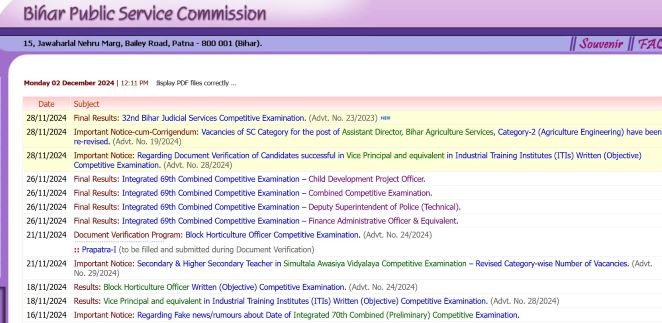
- Bihar Combined Entrance Competitive Examination Board (BCECEB) manages state counselling for BAMS.
- 85% seats are filled through state quota; 15% through AIQ via AACCC.
13. BAMS Government College in UP (Uttar Pradesh)
Uttar Pradesh is one of the largest states in India and has a well-developed Ayurveda education infrastructure.
Key BAMS Government Colleges in UP:
| College | Location |
|---|---|
| Government Ayurvedic College, Lucknow | Lucknow |
| Rajeev Gandhi Government PG Ayurvedic College, Paprola (Campus in UP) | Various |
| Rajkiya Ayurvedic Medical College, Varanasi | Varanasi |
The UP BAMS cut-off for government colleges (general category) typically hovers around 420–500 in NEET. Admission is managed through the UPDNMSC (Uttar Pradesh Dr. Shakuntala Misra National Rehabilitation University) and relevant state counselling bodies.
BAMS Government College Fees in UP: Government college fees in UP are very affordable — typically ranging between ₹10,000 to ₹35,000 per year.
Private BAMS Colleges in UP: UP also has numerous private BAMS colleges. Popular ones include:
- Shri Dhanwantari Ayurvedic Medical College, Mathura
- Rishikul Govt. PG Ayurvedic College, Haridwar (Uttarakhand, near UP)
- Om Ayurvedic Medical College, Lucknow
BAMS private college fees in UP range from ₹80,000 to ₹2,00,000 annually.
14. BAMS Colleges in Andhra Pradesh (AP)
Andhra Pradesh has a growing number of BAMS institutions. Key points for students looking at BAMS colleges in AP:
- Regulating Authority: Dr. NTR University of Health Sciences (NTRUHS) affiliates BAMS colleges in AP.
- State Counselling: Managed by NTRUHS or state MBBS/BAMS counselling committee.
Notable BAMS Colleges in Andhra Pradesh:
| College | Location | Type |
|---|---|---|
| Government Ayurvedic College, Vijayawada | Vijayawada | Government |
| Sri Krishna Ayurvedic Medical College | Guntur | Private |
| Srisaila Ayurvedic Medical College | Kurnool | Private |
| Shri Panchakosh Ayurved Mahavidyalaya | Visakhapatnam | Private |
BAMS fees in private college in AP typically range from ₹70,000 to ₹1,80,000 per year. Government college seats are limited, making the BAMS cut-off in AP competitive.
15. BAMS Colleges in Tamil Nadu
Tamil Nadu has a strong tradition in Siddha medicine, but BAMS (Ayurveda) institutions are also growing. Here’s what to know:
- Regulatory Body: The Tamil Nadu Dr. MGR Medical University (TNMGRMU) affiliates BAMS colleges.
- Counselling: Tamil Nadu Medical Admissions (TNMA) committee manages state quota counselling.
Notable BAMS Colleges in Tamil Nadu:
| College | Location | Type |
|---|---|---|
| Government Ayurveda College, Chennai | Chennai | Government |
| Santhigiri Ayurveda Medical College | Kanyakumari | Private |
| Sri Sai Ram Ayurveda Medical College | Chennai | Private |
| Harikrishna Ayurvedic Medical College | Coimbatore | Private |
BAMS colleges in Tamil Nadu are limited compared to Siddha colleges (since Siddha is the traditional medicine of the state). Government seats are few, and competition is high — expect NEET scores of 450–530 for government seats.
16. How to Apply for BAMS: Step-by-Step Process
Here’s a simple step-by-step walkthrough of the admission process:
Step 1: Appear in NEET UG
- Eligibility: Class 12 with Physics, Chemistry, Biology/Biotechnology
- Minimum marks: 50% aggregate in PCB (40% for SC/ST/OBC)
- Register at neet.nta.nic.in
Step-2: Check Your Score vs Cut-Off
- Compare your NEET score with the expected BAMS cut-off for your target state and category.
- Decide between government vs private, home state vs other state.
Step 3: Register for Counselling
- AIQ (15%): Register at aaccc.gov.in (Ayush Admissions Central Counselling Committee)
- State Quota (85%): Register with your state’s Ayush/Medical counselling authority
Step-4: Fill College Preferences
- List colleges in order of preference — government first, then private
- Keep NCISM recognition and infrastructure in mind
Step 5: Document Verification and Seat Allotment
- Upload and verify documents: NEET scorecard, Class 10 & 12 marksheets, category certificate, domicile certificate, etc.
- Attend seat allotment rounds; accept your seat and pay fees within the deadline.
Step-6: Reporting to College
- Report to the allotted college with original documents
- Complete medical fitness check and admission formalities
17. Frequently Asked Questions (FAQs)
Q1. What NEET score is required for BAMS in a government college?
Generally, a NEET score of 380–550 (depending on state and category) is needed for government BAMS colleges. High-competition states like Kerala and Maharashtra require higher scores (480–560+).
Q2. What is the total BAMS fees in private college for 5.5 years?
BAMS fees in private college (state merit quota) typically total ₹5 lakh – ₹12 lakh over 5.5 years. Management/NRI quota can be ₹15 lakh – ₹30 lakh or more.
Q3. Is BAMS a good career option?
Absolutely! BAMS graduates have excellent career opportunities in private practice, government health departments, Ayurvedic pharma companies, wellness centers, research institutions, and abroad (with additional qualifications).
Q4. Can I do BAMS without NEET?
No. Since 2020, NEET is mandatory for admission to all BAMS colleges in India, including private colleges.
Q5. What is the difference between BAMS and MBBS?
MBBS trains doctors in modern (allopathic) medicine. BAMS trains doctors in Ayurvedic medicine. Both are 5.5-year programs including internship. BAMS graduates can prescribe Ayurvedic medicines and in some states, limited modern medicines (as per state bridge course policy).
Q6. Are there BAMS government colleges in Bihar?
Yes! Government Ayurvedic College, Patna is the primary government BAMS institution in Bihar. There are also several private BAMS colleges in Bihar.
Q7. What is the BAMS cut-off for government colleges?
The BAMS cut-off varies by state and category. For general category, expect 400–550 NEET marks for government college seats across different states. Check the official counselling website for your state’s latest cut-off.
Q8. What are semi-government BAMS college fees?
Semi-government (aided) BAMS college fees typically range from ₹30,000 – ₹90,000 per year, making them a cost-effective alternative to fully private colleges.
Q9. Which is the best ayurvedic college in India?
Some of the top ayurvedic colleges in India include BHU (Faculty of Ayurveda), Gujarat Ayurved University Jamnagar, National Institute of Ayurveda Jaipur, SDM College of Ayurveda Karnataka, and Government Ayurveda College Thiruvananthapuram.
Q10. Are there low fees BAMS colleges in India?
Yes! Government BAMS colleges across India offer very low fees — often ₹10,000 – ₹50,000 per year. Semi-government and aided colleges are also affordable at ₹30,000 – ₹90,000 per year.
Final Thoughts: How to Make Your Decision
Choosing among the top BAMS colleges in India can feel overwhelming, but if you break it down into clear priorities, it becomes manageable:
- First, know your NEET score and which government colleges you’re eligible for.
- If eligible for government seats, always prefer them for the low fees and quality training.
- If opting for private BAMS colleges, stick to NCISM-recognized institutions with strong hospital infrastructure.
- Consider your home state for lower fees and state quota advantages.
- Never pay capitation fees — they are illegal, and any college demanding capitation money is a red flag.
- Visit the college (if possible) before confirming admission — check the hospital, faculty, and library.
Ayurveda is a 5,000-year-old science, and studying it from the right institution can truly make the difference between a fulfilling career and a frustrating one. Take your time, do your research, and choose wisely. All the best! 🌿
Disclaimer: Fees, NEET cut-offs, and college information change every year. Always verify current information from official NCISM, AACCC, and state counselling authority websites before making any admissions decision.