
Top 10 Engineering Colleges in India 2026: Rankings, Fees, Placements & How to Choose the Right One
Table of contents
- Top 10 Engineering Colleges in India 2026: Rankings, Fees, Placements & How to Choose the Right One
- Why Engineering Is Still One of India’s Best Career Choices
- How Are Engineering Colleges Ranked in India?
- Top 10 Engineering Colleges in India 2025
- Fees Comparison at Top Engineering Colleges
- Fees Comparison at Top Private Engineering Colleges
- Entrance Exams You Must Know
- Eligibility Criteria
- Government vs Private Engineering Colleges: The Real Difference
- Career Scope and Salary After Engineering
- How to Choose the Right Engineering College in India
- Frequently Asked Questions (FAQs)
- Conclusion
Why Engineering Is Still One of India’s Best Career Choices
Every year, over 12 lakh students appear for JEE Main — and for good reason. Engineering remains one of the most versatile, well-paying, and future-proof careers you can build in India. From artificial intelligence and robotics to civil infrastructure and clean energy, engineers are at the heart of every industry that shapes our world.
But here’s the thing — not all engineering colleges are created equal. The difference between graduating from a top-ranked IIT and an average private college can mean a starting salary gap of ₹10–25 LPA or more. That’s why choosing the right college is one of the most important decisions of your life.
This guide gives you everything you need: NIRF 2025 rankings, real placement data, fee structures, entrance exam requirements, and a practical framework to help you pick the best engineering college for your goals and budget.
Let’s dive in.
How Are Engineering Colleges Ranked in India?
Before looking at the rankings, it helps to understand what they’re based on. The NIRF (National Institutional Ranking Framework), released annually by India’s Ministry of Education, is the most credible and widely used ranking system for engineering colleges in India.
NIRF evaluates engineering colleges on five key parameters:
- Teaching, Learning & Resources (TLR) — Faculty strength, salaries, infrastructure quality, and research facilities
- Research & Professional Practices (RPC) — Research papers published, patents filed, and professional impact
- Graduation Outcomes (GO) — Placement rates, higher education pursuits, and PhD output
- Outreach & Inclusivity (OI) — Diversity in student enrollment, regional and gender inclusion
- Perception (PR) — Reputation among employers, academics, and peers
The final NIRF score combines all five parameters into a composite score used to rank institutions. Other rankings to watch include India Today, QS World University Rankings, and IIRF.
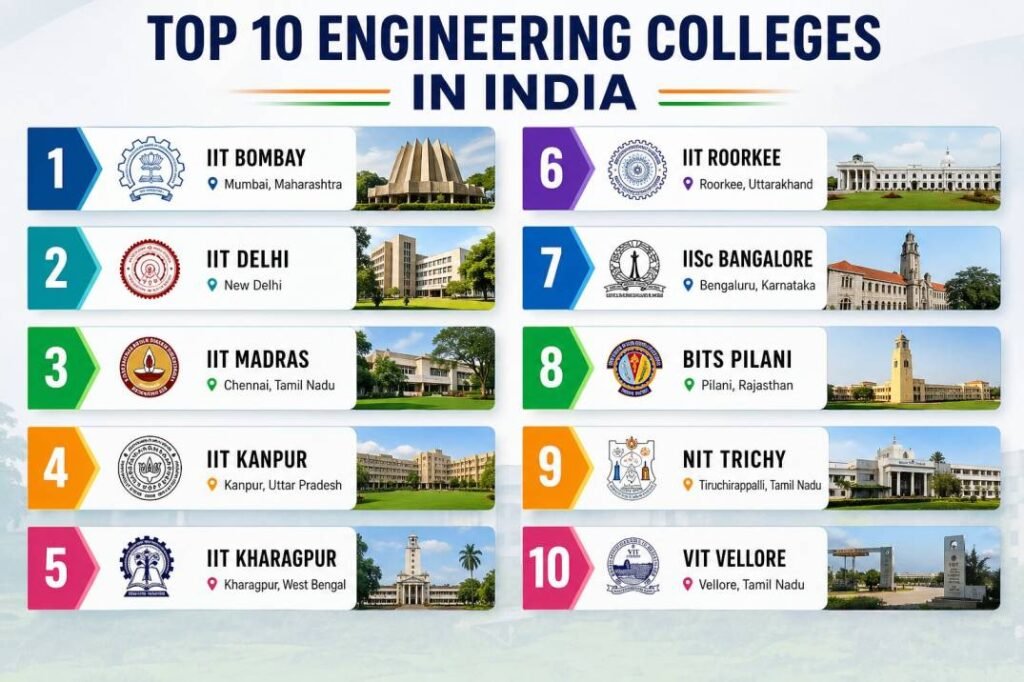
Top 10 Engineering Colleges in India 2025
🥇 1. IIT Madras — Chennai, Tamil Nadu
NIRF 2025 Rank: #1 in Engineering (7th consecutive year) Type: Government (Institution of National Importance) Established: 1959
IIT Madras is the undisputed king of engineering education in India. IIT Madras has secured the top position in the NIRF Engineering rankings for the 10th consecutive year, a record that speaks for itself. Located in Chennai, it is known for cutting-edge research, world-class faculty, and a powerful alumni network that spans Google, ISRO, NASA, and Fortune 500 companies.
Key Courses: B.Tech, M.Tech, MBA, M.Sc, PhD across Computer Science, Electrical, Mechanical, Civil, Chemical, Aerospace, and more.
Fees: ₹75,000–₹1 lakh per semester (approximately ₹6–9 lakh for the full B.Tech programme). SC/ST students pay minimal fees.
Placements 2025: In the first phase of IIT Madras placements 2025, 1,091 candidates secured offers with an average package of ₹22 LPA and a median of ₹19.6 LPA. Top recruiters included J.P. Morgan Chase, Texas Instruments, Adobe, Amazon, and EY India. The highest package offered at IIT Madras in 2025 is ₹4.3 crore per annum — an all-time record — made by Jane Street to a Computer Science student for its Hong Kong operations.
Admission: JEE Advanced (for B.Tech); GATE (for M.Tech); IITJAM (for M.Sc)
Best for: Students who want India’s #1 engineering brand with unmatched research depth and global placement outcomes.
🥈 2. IIT Delhi — New Delhi
NIRF 2025 Rank: #2 in Engineering Type: Government (Institution of National Importance) Established: 1961
IIT Delhi is ranked 2nd in the Engineering Category by NIRF 2024 and holds the 150th position in the QS World University Rankings 2025. It maintains international collaborations with premier institutions such as MIT, Stanford, ETH Zurich, and NTU Singapore.
Key Courses: B.Tech in Computer Science, Electrical, Mechanical, Civil, Chemical Engineering, and more.
Fees: IIT Delhi B.Tech Computer Science and Engineering fees in 2025 is ₹8.63 lakhs for the entire course duration, including a total tuition fee of ₹8 lakhs. For SC/ST category students, the total fees is ₹62,550.
Placements 2025: IIT Delhi’s placement season witnessed participation from over 370 companies, including 14 Public Sector Undertakings. The highest domestic package recorded at IIT Delhi stands at ₹2.05 crore. Top recruiters include Google, Microsoft, Goldman Sachs, OLA, Oracle, PayU, American Express, Barclays, and BCG.
Admission: JEE Advanced (B.Tech); GATE (M.Tech)
Best for: Students aiming for top-tier tech and finance careers in India’s capital with access to premium internship opportunities.
🥉 3. IIT Bombay — Mumbai, Maharashtra
NIRF 2025 Rank: #3 in Engineering Type: Government (Institution of National Importance) Established: 1958
IIT Bombay is India’s most internationally recognized IIT and consistently ranks among the top 150 universities globally. Located in Mumbai — India’s financial and tech capital — it gives students unmatched access to startups, investment firms, and multinational companies.
Key Courses: B.Tech in Computer Science, Electrical Engineering, Mechanical, Civil, Aerospace, and dual-degree programmes.
Fees: Approximately ₹2.20 lakh per year (₹8.8 lakh for full B.Tech); SC/ST students pay minimal fees.
Placements 2025: IIT Bombay reported an average package of approximately ₹36.9 LPA, with sectors like technology, finance, and consulting dominating recruitment. The highest IIT placement package in 2024–25 reached ₹3.67 crore at IIT Bombay. Top recruiters include Procter & Gamble, Sony Japan, Texas Instruments, Qualcomm, Morgan Stanley, Google, and Tata Group.
Admission: JEE Advanced (B.Tech); UCEED (B.Des); GATE (M.Tech); CEED (M.Des)
Best for: Students who want India’s most globally recognized IIT brand, with unparalleled access to finance, consulting, and tech internships in Mumbai.
4. IIT Kanpur — Kanpur, Uttar Pradesh
NIRF 2025 Rank: #4 in Engineering Type: Government (Institution of National Importance) Established: 1959
IIT Kanpur is one of the original five IITs and is renowned for its exceptional Computer Science programme, which routinely produces some of the highest-paid engineering graduates in India. It is also known for its strong research culture, with several Nobel Prize winners having studied or taught there.
Key Courses: B.Tech in Computer Science, Electrical, Mechanical, Civil, Aerospace, Chemical, and Biological Sciences.
Fees: Approximately ₹2 lakh per year (₹8 lakh for full B.Tech)
Placements 2025: IIT Kanpur placements 2025 Phase 1 concluded with 579 offers. The highest and average package offered in IIT Kanpur placements 2024 were ₹1.9 crore and ₹26.27 LPA respectively. The BTech CSE average CTC in 2024 was ₹52.8 LPA — the highest median CTC across all branches. Top recruiters include Goldman Sachs, Microsoft, Google, Graviton, Uber, and Tiger Analytics.
Admission: JEE Advanced (B.Tech); GATE (M.Tech)
Best for: Students passionate about Computer Science and mathematics-heavy engineering who want India’s strongest CS brand outside of IIT Bombay and Delhi.
5. IIT Kharagpur — Kharagpur, West Bengal
NIRF 2025 Rank: #5 in Engineering Type: Government (Institution of National Importance) Established: 1951 (India’s first IIT)
IIT Kharagpur is India’s oldest and largest IIT, spread over a 2,100-acre campus. It is the only IIT to offer a Law programme and has one of the broadest course offerings of any engineering institution in India. It’s particularly known for its core engineering strengths in Mechanical, Civil, and Metallurgy.
Fees: Approximately ₹1.5–2 lakh per year
Placements 2025: IIT Kharagpur recorded a domestic highest package of ₹1 crore, with top recruiters including Apple, Texas Instruments, Goldman Sachs, Uber, and Schlumberger. Over 750 job offers were made on the very first day of the 2024–25 placement season.
Admission: JEE Advanced (B.Tech); GATE (M.Tech); JAM (M.Sc)
Best for: Students who want the prestige of India’s oldest IIT with its massive campus, diverse course offerings, and strong core engineering legacy.
6. IIT Roorkee — Roorkee, Uttarakhand
NIRF 2025 Rank: #6 in Engineering Type: Government (Institution of National Importance) Established: 1847 (Asia’s oldest technical institute)
IIT Roorkee is Asia’s oldest technical institution, originally established in 1847 as the Thomason College of Civil Engineering. It is particularly known for its strength in Civil Engineering, Architecture, and Earth Sciences — disciplines that are essential in India’s rapidly growing infrastructure sector.
Fees: Approximately ₹2 lakh per year
Placements: Top recruiters include Google, Microsoft, Uber India, Goldman Sachs, and D.E. Shaw. Average packages range from ₹15–20 LPA.
Admission: JEE Advanced (B.Tech); GATE (M.Tech)
Best for: Students interested in Civil, Structural, or Environmental Engineering, or any branch at one of India’s most historically significant campuses.
7. IIT Guwahati — Guwahati, Assam
NIRF 2025 Rank: #7 in Engineering Type: Government (Institution of National Importance) Established: 1994
IIT Guwahati may be a younger IIT, but it has one of the most impressive recent placement records in the entire IIT system. IIT Guwahati Design students reported an average package of ₹21.94 LPA with highest packages up to ₹52 LPA, with some international offers reaching ₹57.7 LPA. For core engineering branches, placement records are equally strong. The campus is also known for its stunning natural setting beside the Brahmaputra river.
Fees: Approximately ₹2 lakh per year
Admission: JEE Advanced (B.Tech); GATE (M.Tech)
Best for: Students who want a top-5 IIT experience with an exceptional placement track record, a beautiful campus, and slightly lower JEE Advanced cutoffs compared to older IITs.
8. IIT BHU (Banaras Hindu University) — Varanasi, Uttar Pradesh
NIRF 2025 Rank: #8 in Engineering Type: Government (Institution of National Importance) Established: 1919 (one of India’s oldest technical institutions)
IIT BHU, located within the sprawling Banaras Hindu University campus, is known for its strong heritage, diverse course offerings, and a growing placement record. It offers engineering programmes in areas like Mining, Metallurgy, and Ceramics that aren’t available at most other IITs.
Fees: Approximately ₹1.5–2 lakh per year
Placements: Average packages range from ₹15–22 LPA. Top recruiters include Microsoft, Amazon, Infosys, Deloitte, and Goldman Sachs.
Admission: JEE Advanced (B.Tech); GATE (M.Tech)
Best for: Students who want an IIT tag with access to unique niche branches not offered elsewhere, in one of India’s most culturally rich cities.
9. NIT Trichy (National Institute of Technology, Tiruchirappalli) — Tamil Nadu
NIRF 2025 Rank: #9 in Engineering (Top NIT in India) Type: Government (National Institute of Technology) Established: 1964
NIT Trichy is consistently ranked as the Number 1 NIT in India and stands among the top technical institutions globally. It secured the 9th position in the Engineering category by NIRF in 2025. This makes it the only NIT in the top 10, and it’s a powerhouse. NIT Trichy is the dream destination for JEE Main students who narrowly miss the JEE Advanced cutoff.
Fees: The total B.Tech fees at NIT Trichy range from ₹1,15,000 to ₹1,20,000 — making it one of the most affordable top-tier engineering colleges in India.
Placements: As per the NIRF report, in 2024, 1,554 students were placed across all UG and PG programmes at NIT Trichy. Top recruiters include Google, Microsoft, Amazon, Apple, Meta, Infosys, Wipro, and TCS. The CSE branch consistently sees the highest packages.
Admission: JEE Main + JoSAA Counselling. The JEE Main cutoff for B.Tech CSE in 2025 for the General category ranged from 559 to 4,463 across different JoSAA rounds.
Best for: JEE Main students who want a top-ranked, affordable government engineering college with excellent placements — especially in Computer Science and Electrical Engineering.
10. BITS Pilani — Pilani, Rajasthan
NIRF 2025 Rank: #16–21 in Engineering (Top private engineering college in India) Type: Private Deemed University Established: 1964
BITS Pilani earns its spot in every serious list of India’s top 10 engineering colleges as the unmatched leader among private engineering institutions. Its unique Practice School programme — where students spend an entire semester at a company — is one of the best industry exposure models in India. While IITs charge around ₹8 lakh and NITs about ₹6 lakh with similar placement packages, BITS Pilani charges ₹18–20 lakh — a higher fee, but one that comes with exceptional ROI.
Fees: B.Tech fees at BITS Pilani range from ₹22 lakh to ₹25 lakh for the full 4-year programme.
Placements: The highest and average packages at BITS Pilani are ₹21–22 LPA and ₹14–15 LPA respectively. Top recruiters include Google, Microsoft, Amazon, Goldman Sachs, BCG, Flipkart, and leading global tech firms.
Admission: BITSAT (Birla Institute of Science and Technology Aptitude Test). The BITS Pilani cutoff in the BITSAT exam is expected to range from 238 to 327 marks.
Best for: Students who didn’t make it to an IIT but want a premier private engineering education with strong placements, flexible academics, and the famous BITS culture.
Fees Comparison at Top Engineering Colleges
| College | Type | Total B.Tech Fees (Approx.) | SC/ST Fees |
|---|---|---|---|
| IIT Madras | Government | ₹6–9 lakh | Nearly free |
| IIT Delhi | Government | ₹8.63 lakh | ₹62,550 |
| IIT Bombay | Government | ₹8–9 lakh | Nearly free |
| IIT Kanpur | Government | ₹8 lakh | Nearly free |
| IIT Kharagpur | Government | ₹6–8 lakh | Nearly free |
| IIT Roorkee | Government | ₹8 lakh | Nearly free |
| IIT Guwahati | Government | ₹8 lakh | Nearly free |
| IIT BHU | Government | ₹6–8 lakh | Nearly free |
| NIT Trichy | Government | ₹1.15–1.2 lakh/year | Reduced |
| BITS Pilani | Private | ₹22–25 lakh | No concession |
Scholarship Note: All IITs and NITs offer need-cum-merit scholarships, SC/ST fee waivers (full tuition exemption), and OBC concessions. Students with family income below ₹1 lakh per year qualify for full tuition waivers at IITs. Always check the official institute website for the latest scholarship details.
Fees Comparison at Top Private Engineering Colleges
| College | Total B.Tech Fees (Approx.) | Admission Exam |
|---|---|---|
| BITS Pilani | ₹25.29 lakh | BITSAT |
| VIT Vellore | ₹12–18 lakh | VITEEE |
| SRM Chennai | ₹11–24 lakh | SRMJEEE / JEE Main |
| Thapar Institute | ₹20–22 lakh | JEE Main |
| MIT Manipal | ₹14–18 lakh | MET / JEE Main |
| IIIT Hyderabad | ₹17–19 lakh | UGEE / JEE Main |
| KIIT Bhubaneswar | ₹15–18 lakh | KIITEE |
| Amrita Vishwa | ₹10–13 lakh | AEEE / JEE Main |
| Chandigarh University | ₹8–12 lakh | CU-CET / JEE Main |
| LPU | ₹8–12 lakh | LPUNEST / JEE Main |
Entrance Exams You Must Know
Getting into India’s top engineering colleges requires cracking the right entrance exam:
JEE Main Conducted by NTA (National Testing Agency), twice a year (January and April sessions). Required for: NITs, IIITs, and Government Funded Technical Institutes (GFTIs). Also a prerequisite for appearing in JEE Advanced. Syllabus: Physics, Chemistry, Mathematics (Class 11 and 12 level).
JEE Advanced Conducted by IITs on a rotational basis. Required for: All 23 IITs across India. Eligibility: Must be in top 2.5 lakh ranks in JEE Main. Highly competitive — considered one of the world’s toughest undergraduate entrance exams.
BITSAT Conducted by BITS Pilani for admission to its campuses in Pilani, Goa, and Hyderabad. Online exam with a unique feature: candidates scoring very high can attempt bonus questions.
VITEEE Conducted by VIT University for its campuses in Vellore, Chennai, and Bhopal. One of the most widely taken private engineering entrance exams in India.
State Engineering Entrance Exams MHT CET (Maharashtra), KCET (Karnataka), WBJEE (West Bengal), AP EAMCET (Andhra Pradesh) — for state-level government and private engineering colleges.
Eligibility Criteria
For Class 12 Students (B.Tech Programmes):
- Must have passed Class 12 (or be appearing) from a recognized board
- Compulsory subjects: Physics, Chemistry, Mathematics (PCM)
- Minimum aggregate: 75% marks in Class 12 (65% for SC/ST/PwD)
- For IITs: Must qualify JEE Main and then JEE Advanced
- For NITs: Must qualify JEE Main and participate in JoSAA counselling
- Age limit: Maximum 25 years for general category (30 years for SC/ST/PwD) for JEE Advanced
For Graduates (M.Tech Programmes):
- B.Tech or B.E. degree in a relevant discipline
- Valid GATE score (required for IITs and NITs; also qualifies for PSU jobs)
- Minimum 55–60% aggregate in graduation (varies by institute)
Government vs Private Engineering Colleges: The Real Difference
One of the most common questions students ask is: “Should I go to a government NIT or a private college like BITS/VIT?” Here’s a clear breakdown:
| Factor | IITs | NITs | Private (BITS/VIT) |
|---|---|---|---|
| Total Fees | ₹6–9 lakh | ₹4–8 lakh | ₹12–25 lakh |
| Brand Value | Highest globally | Very high nationally | Strong (BITS), good (VIT) |
| Placement Avg | ₹17–36 LPA | ₹8–15 LPA | ₹14–22 LPA (BITS) |
| Admission | JEE Advanced (very tough) | JEE Main (tough) | BITSAT/VITEEE (moderate) |
| Scholarships | Excellent | Good | Limited |
| Campus Life | Focused, research-heavy | Balanced | Vibrant, activity-rich |
| Return on Investment | Highest | Very High | High (BITS), Moderate (others) |
The verdict: If you can crack JEE Advanced, IITs offer the best ROI in India — world-class education for under ₹9 lakh. If you narrowly miss IITs, top NITs like NIT Trichy offer similar placement outcomes at a fraction of the cost. BITS Pilani is the best private engineering college, but the higher fees need to be weighed against placements.
Career Scope and Salary After Engineering
Engineering graduates from India’s top colleges are among the most employable people in the world. Here’s what the career landscape looks like:
- Technology & Software Engineering Software Engineer, Full Stack Developer, AI/ML Engineer, Data Scientist, Cloud Architect — at companies like Google, Microsoft, Amazon, Meta, Flipkart, and thousands of startups. Starting salary range: ₹12–50 LPA from IITs; ₹6–15 LPA from good NITs.
- Core Engineering Mechanical, Electrical, Civil, and Chemical engineers work in manufacturing, energy, infrastructure, and aerospace. PSU (Public Sector Undertaking) jobs through GATE offer ₹8–15 LPA with excellent job security.
- Finance & Consulting Many IIT graduates pivot to investment banking, management consulting, and quant trading. Goldman Sachs, JPMorgan, McKinsey, and BCG are among the top non-tech recruiters at IITs.
- Entrepreneurship IITs and NITs have produced a remarkable number of successful startup founders — from the founders of Flipkart (IIT Delhi) to Zomato (IIT Delhi) to Ola (IIT Bombay). The entrepreneurial ecosystem at these institutions is unmatched.
- Higher Education (MS/MBA/PhD) A large percentage of IIT graduates pursue MS or PhD abroad — at MIT, Stanford, Carnegie Mellon, and other top global universities. An IIT degree is one of the most respected credentials at international graduate school admissions offices.
- The average starting salary for IIT graduates typically ranges between ₹17 LPA to ₹26.27 LPA across top IIT campuses, with the highest packages reaching ₹3.67 crore at IIT Bombay.
How to Choose the Right Engineering College in India
Step 1: Know your JEE rank and be realistic. Your JEE Main or JEE Advanced rank largely determines which colleges are accessible to you. Use the official JoSAA college predictor and previous year’s opening and closing ranks to shortlist realistic options.
Step 2: Choose your branch before your college. This is one of the most underrated pieces of advice. A Computer Science graduate from NIT Trichy will often out-earn a Metallurgy graduate from an older IIT. Pick the branch you’re genuinely interested in and good at — don’t just chase the brand name.
Step 3: Look at placement data critically. Don’t just look at the “highest package” headline — it’s usually an outlier. Focus on the median package (the middle value), the placement percentage, and which companies regularly recruit. These numbers are far more representative of your likely outcome.
Step 4: Consider location and industry access. IIT Bombay students have Mumbai’s finance and startup ecosystem at their doorstep. IIT Delhi students benefit from proximity to India’s government, policy, and consulting sectors. Location matters for internships, networking, and your first job.
Step 5: Factor in the true cost. Can you easily pay ₹18–20 lakh like at BITS Pilani, or would you prefer the lower fees of IITs (around ₹8 lakh) or NITs (about ₹6 lakh) with similar placement packages? Don’t forget to add hostel, food, travel, and other living costs on top of tuition.
Step 6: Research research opportunities. If you’re interested in pursuing an MS or PhD abroad, the quality of research projects, faculty publications, and international collaborations matters enormously. IIT Madras, IIT Bombay, and IIT Delhi are consistently the strongest on this front.
Step 7: Visit campuses or attend open days. Shortlisting on paper is one thing — actually walking around a campus, speaking to students, and attending a college fair gives you a feel that no ranking can capture.
Step 8: Talk to seniors and alumni on LinkedIn. Current students and recent graduates from your target colleges will give you the most honest, ground-level feedback about faculty, hostel life, course quality, and placement reality. LinkedIn is your best research tool here.
Frequently Asked Questions (FAQs)
Q1. Which is the No. 1 engineering college in India in 2025?
Indian Institute of Technology Madras (IIT Madras) has been ranked as the best engineering college in India according to NIRF 2025. IIT Madras has secured the top position for the seventh consecutive year. Other top performers include IIT Delhi (#2), IIT Bombay (#3), IIT Kanpur (#4), and IIT Kharagpur (#5).
Q3. What is the average salary after graduating from an IIT?
Average packages at top IITs range from ₹17 LPA (IIT Madras) to ₹26.27 LPA (IIT Kanpur) across all branches. The salary packages at top IITs normally vary from ₹20 lakh to more than ₹1 crore per annum for the top performers.
Q4. Is BITS Pilani better than NITs?
BITS Pilani has a stronger brand globally and excellent placements, but its fees (₹22–25 lakh total) are significantly higher than NITs (₹4–8 lakh total). For Computer Science specifically, top NITs like NIT Trichy offer comparable placement outcomes at a fraction of the cost. BITS wins on flexibility, campus culture, and Practice School exposure.
Q5. Can a student from Commerce or Arts pursue engineering in India?
No. Engineering requires Physics, Chemistry, and Mathematics (PCM) in Class 12 as mandatory subjects. Students from Commerce or Arts streams are not eligible to appear for JEE Main or Advanced.
Q6. What is the scope of engineering in India in 2025?
Engineering remains one of the most in-demand career fields in India. The rise of AI, data science, EVs, green energy, smart cities, and digital infrastructure has created massive demand for skilled engineers. IIT and NIT graduates are among the most sought-after candidates globally, with career opportunities spanning technology, finance, consulting, manufacturing, and entrepreneurship.
Conclusion
India’s engineering education landscape is dominated by world-class institutions that produce graduates recruited by the best companies in the world. The top 10 engineering colleges in India in 2025 — led by IIT Madras, IIT Delhi, IIT Bombay, and IIT Kanpur — offer extraordinary career outcomes, but competition is fierce.
Here’s your quick recap:
- Best Government Engineering College: IIT Madras — #1 for 7 consecutive years in NIRF 2025
- Best in New Delhi: IIT Delhi — #2 in NIRF, global tie-ups with MIT and Stanford
- Best for Finance & Tech Careers: IIT Bombay — Highest placement package of ₹3.67 crore in 2024–25
- Best NIT: NIT Trichy — Only NIT in the top 10, affordable fees at ₹1.15 lakh/year
- Best Private Engineering College: BITS Pilani — India’s top private institute with the famous Practice School model
Start your JEE preparation early, build your fundamentals in Physics, Chemistry, and Mathematics, and use this guide to make a smart, well-researched college decision. The right engineering college won’t just give you a degree — it’ll launch your entire career.